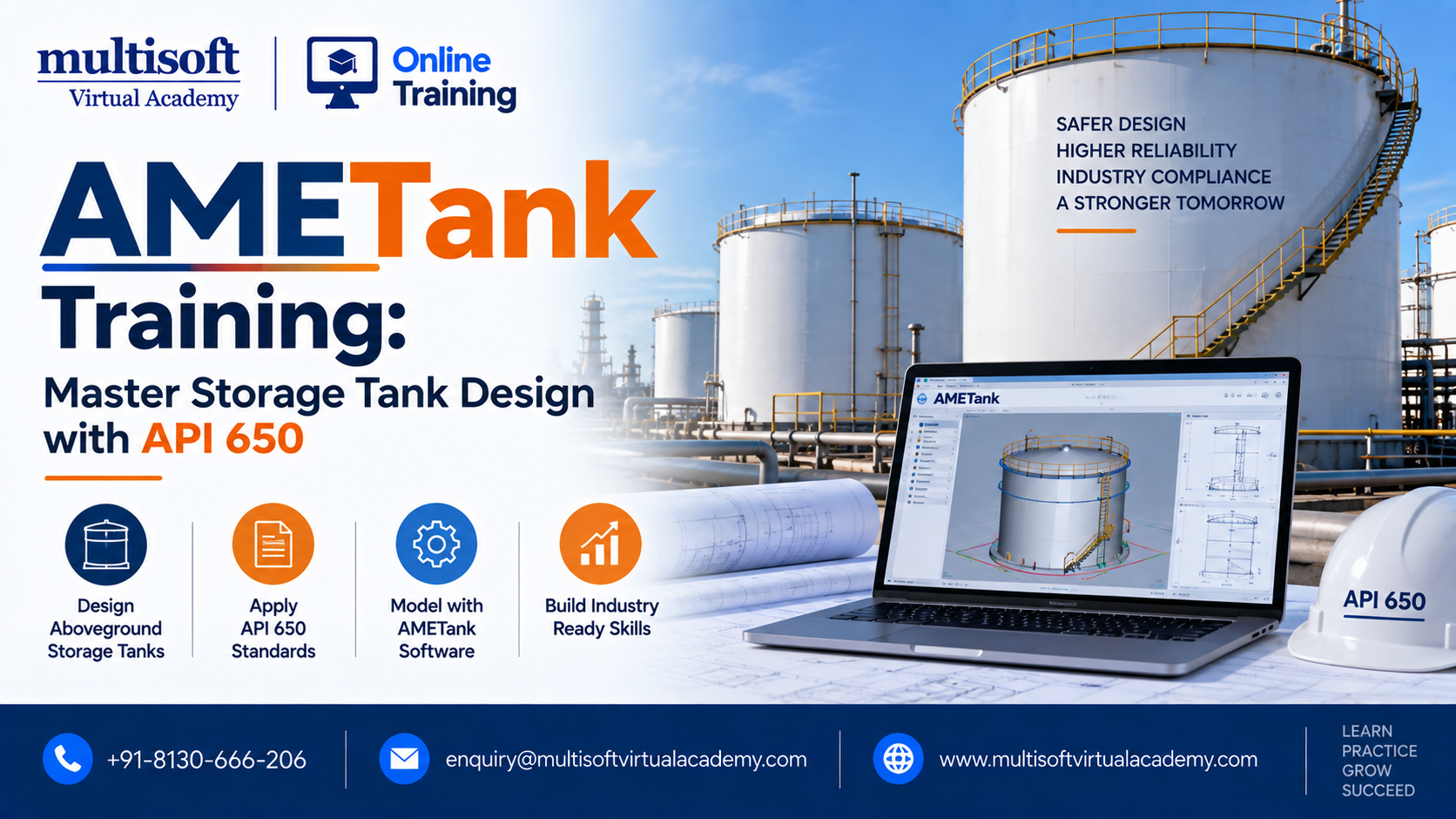
Designing above-ground storage tanks requires more than basic drafting skills. Engineers need a strong understanding of tank geometry, material selection, loading conditions, structural requirements and applicable design codes. AMETank Training provides a practical way to develop these skills by combining storage tank engineering principles with software-based modeling and design workflows.
AMETank is used for the configuration, design and detailing of above-ground shop-built and field-erected storage tanks. Its capabilities include design calculations for areas such as shell courses, floors, roofs, structures, anchors, nozzles and manways, along with considerations for seismic, wind and pressure loading.
For engineers working in oil and gas, petrochemical, chemical processing, water treatment and EPC environments, learning AMETank can help connect theoretical API 650 tank design concepts with practical engineering workflows.
AMETank Training is an engineering software solution developed for storage tank configuration, design and detailing. It provides an interactive environment where engineers can define tank geometry, materials, design parameters and loading conditions before carrying out detailed design calculations.
The software supports storage tank design according to several industry standards, including API 650, API 653, API 620, AWWA D100, AWWA D103 and EN 14015.
Rather than treating tank design as a collection of isolated calculations, AMETank brings different engineering components into a structured model. This can include the tank shell, bottom, roof, structural members, access components, nozzles and other appurtenances.
A strong understanding of AMETank software training therefore involves both software operation and engineering judgment.
Storage tanks are critical assets in many industrial facilities. Incorrect assumptions about dimensions, materials, loads or design conditions can affect the reliability and safety of the final design.
AMETank Training helps professionals understand how engineering inputs influence the resulting tank model and calculations.
A typical learning program can help participants develop knowledge of:
The goal is not simply to learn where buttons are located in the software. The real value comes from understanding why particular inputs are selected and how they affect engineering results.
One of the most important areas covered in AMETank learning is API 650 storage tank design.
API 650 provides requirements for welded tanks used for the storage of petroleum and other liquid products under atmospheric or low internal pressure conditions. AMETank can translate many of these design requirements into a software-based engineering workflow.
A professional approach typically starts with defining the design basis. Depending on the project, this can involve:
The accuracy of these inputs is extremely important. Software can process engineering information quickly, but it cannot replace engineering judgment.
Beginners first need to understand the AMETank environment. Training generally introduces the graphical interface, menus, model tree, project settings and design sections.
The project setup establishes the foundation for subsequent calculations. A poorly defined project can produce misleading results, even when the software itself is functioning correctly.
Tank geometry is one of the fundamental elements of storage tank design.
Professionals learn how to define the major dimensions and configure the tank model. This can include shell diameter, tank height, roof arrangement, bottom configuration and other structural components.
Understanding the model hierarchy is particularly important because changes to one component may influence other parts of the design.
The tank shell must withstand the loads generated by the stored liquid and applicable environmental conditions.
AMETank shell design training can introduce engineers to:
The software can assist with calculations, but engineers must still review whether the selected configuration makes sense for the actual project.
The tank bottom is another essential design area. Training can cover bottom plate arrangements, annular rings, bearing conditions and foundation-related considerations.
Engineers should understand how loads are transferred through the tank and how the bottom configuration interacts with the supporting foundation.
AMETank supports different roof configurations and provides tools for designing and detailing roof components.
Depending on the project, engineers may work with fixed roofs, floating roofs and associated structural arrangements.
Training can help participants understand roof geometry, loads, structural members and design checks rather than simply generating a model.
Environmental loads can significantly affect storage tank stability.
AMETank training for storage tank design can cover the preparation of wind and seismic parameters and their influence on the overall design.
Wind-related considerations may affect shell stability, roof components and anchorage. Seismic conditions can influence overturning, uplift and other structural requirements.
AMETank documentation indicates support for calculations involving seismic conditions, wind loading and internal and external pressures.
Generating a report is only one part of engineering work. Engineers should know how to interpret the results.
AMETank calculation reports can include sections covering roof design, shell courses, bottom design, wind moments, seismic calculations, anchor bolt design, capacities and working pressure or vacuum checks.
During training, professionals should learn to identify:
This ability to review results is essential because software output should always be evaluated by a qualified engineer.
Learning the software without understanding the engineering principles can lead to avoidable mistakes.
Some common issues include:
Tank dimensions, product properties, design temperature and other inputs form the basis of the model. Incorrect information can affect multiple downstream calculations.
AMETank can perform calculations efficiently, but engineering responsibility remains with the designer. Results should be reviewed against project specifications, applicable standards and engineering requirements.
Wind and seismic conditions can have a major impact on tank stability. These parameters should not be treated as optional inputs.
Shell stiffeners, wind girders, anchor systems, annular plates and other components have specific engineering functions. Understanding those functions helps engineers make better design decisions.
Design warnings should never be ignored. They can indicate that thicknesses, pressure conditions, reinforcement, stability or other design parameters require attention.
AMETank Training can be useful for professionals involved in storage tank engineering and related industrial projects.
It is particularly relevant for:
Professionals with previous knowledge of mechanical engineering, structural concepts or storage tank design may find it easier to connect software functionality with practical engineering applications.
A structured AMETank course can provide several professional benefits.
Participants can develop a clearer understanding of how storage tanks are configured and designed.
Instead of relying only on theoretical calculations, learners can work with a dedicated tank design environment.
Software-based workflows can reduce repetitive manual work and help engineers organize complex design information.
AMETank learning can be combined with API 650 concepts to develop a more complete understanding of storage tank engineering.
Learning to interpret calculation results and warnings can help engineers identify potential issues before a design progresses further.
Storage tank engineering is relevant to oil and gas, petrochemical, chemical processing, water treatment and other industrial sectors. Developing specialized software and design skills can therefore strengthen an engineer's professional profile.
Not every software course provides the same level of engineering value. When selecting an AMETank training course, professionals should consider whether the program covers both software functionality and engineering fundamentals.
Look for a program that includes:
A good program should help learners move from basic software navigation to practical storage tank design.
Specialized engineering software skills can complement an engineer's existing technical knowledge. Professionals who understand both the design code and the software workflow can contribute more effectively to storage tank projects.
For example, an engineer may be required to review tank dimensions, check design assumptions, interpret calculations, coordinate with structural or piping teams and prepare engineering documentation.
Learning AMETank can provide exposure to these interconnected activities and help professionals develop a more systematic approach to tank engineering.
After completing a comprehensive program, learners should aim to understand the complete design workflow rather than memorizing individual software commands.
They should be able to:
The exact level of responsibility a professional can take on will depend on their engineering qualification, experience, project requirements and applicable codes.
AMETank Training is a valuable learning path for professionals who want to strengthen their storage tank design and engineering capabilities. By combining software-based modeling with API 650 storage tank design, wind and seismic considerations, shell and roof design, bottom configuration and engineering report interpretation, learners can develop a more practical understanding of the complete tank design workflow. Multisoft Virtual Academy provides structured professional training designed to help engineers and industry professionals develop practical AMETank skills, understand important storage tank engineering concepts and apply their knowledge more confidently in real-world engineering environments.
| Start Date | Time (IST) | Day | |||
|---|---|---|---|---|---|
| 24 Oct 2026 | 06:00 PM - 10:00 AM | Sat, Sun | |||
| 25 Oct 2026 | 06:00 PM - 10:00 AM | Sat, Sun | |||
| 31 Oct 2026 | 06:00 PM - 10:00 AM | Sat, Sun | |||
| 01 Nov 2026 | 06:00 PM - 10:00 AM | Sat, Sun | |||
|
Schedule does not suit you, Schedule Now! | Want to take one-on-one training, Enquiry Now! |
|||||






 Join our Live Instructor-Led online classes delivered by industry experts
 Let's Get Started