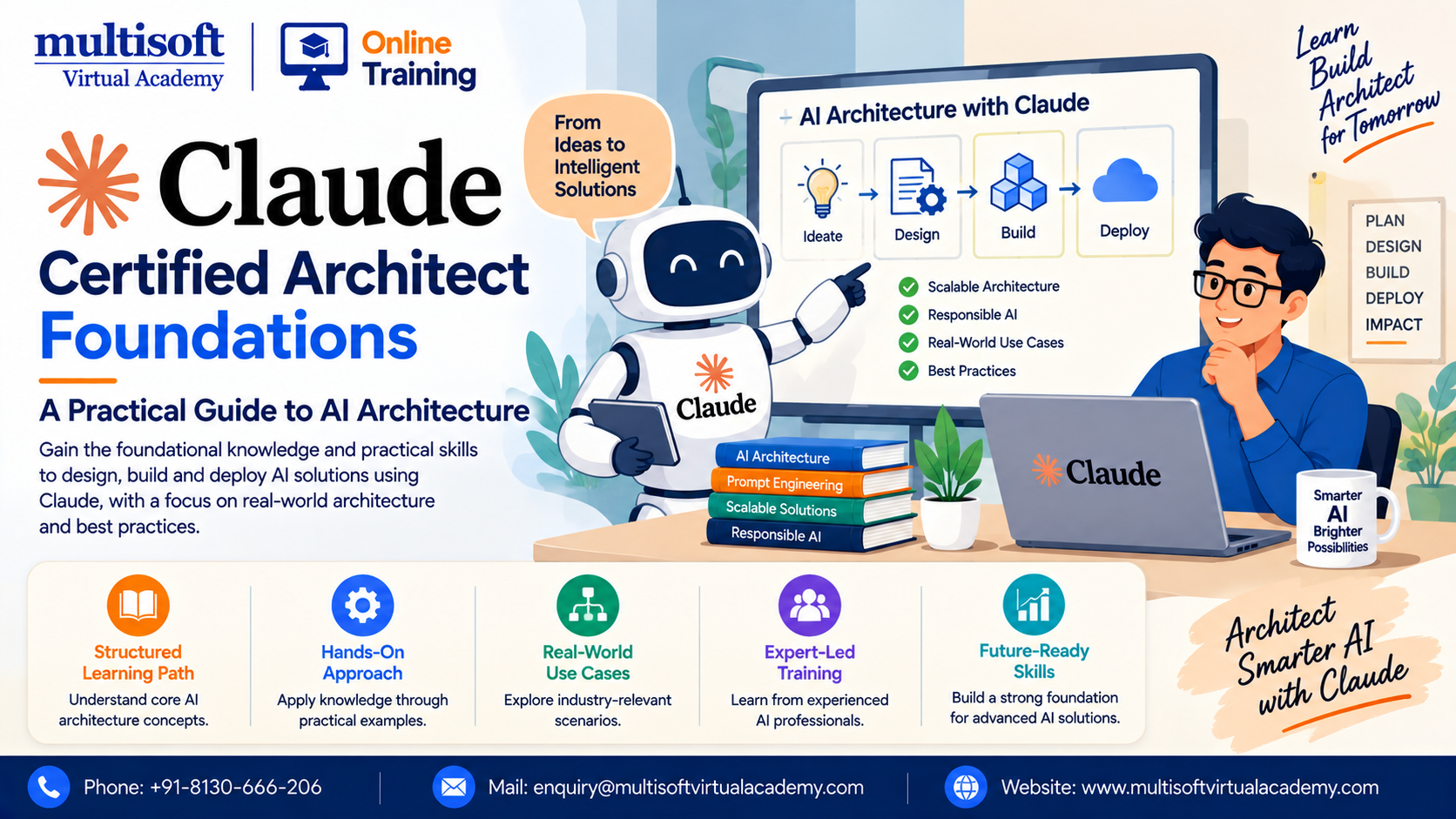
Artificial intelligence is rapidly moving beyond simple chatbots and content generation toward intelligent systems that can reason, use tools, interact with applications and complete complex tasks. As organizations explore these capabilities, the demand for professionals who can design reliable and production-ready AI solutions is increasing.
The Claude Certified Architect - Foundations certification is designed for professionals who want to demonstrate practical architectural knowledge for building solutions with Claude. It focuses on real-world design decisions involving agentic architectures, Claude Code, the Claude API, Model Context Protocol (MCP), prompt engineering, structured outputs, context management and reliability.
Anthropic identifies the certification as a foundation-level credential for solution architects who design and build Claude-based solutions. The current exam contains 60 questions, has a 120-minute duration and uses a scaled passing score of 720.
The Claude Certified Architect - Foundations, commonly searched as the Claude Architect certification or Claude certification, validates foundational skills required to design Claude-based applications and AI systems.
Rather than focusing only on theoretical AI concepts, the certification emphasizes architectural judgment. Professionals need to understand how different components work together and how to select appropriate approaches for specific business and technical requirements.
The certification evaluates knowledge across five major areas:
According to Anthropic's current certification information, these domains account for 27%, 18%, 20%, 20% and 15% of the examination respectively.
This makes the certification particularly relevant for solution architects, AI engineers, technical consultants and professionals involved in designing generative AI applications.
Generative AI adoption is creating a new class of technical roles. Businesses need professionals who understand not only how to use an AI model but also how to integrate AI into secure, scalable and reliable systems.
Claude is increasingly being used for applications involving software development, automation, knowledge retrieval, enterprise workflows and AI agents. As these systems become more sophisticated, architectural decisions become increasingly important.
A professional pursuing Claude AI certification can develop an understanding of areas such as:
The value of an architecture-focused credential therefore extends beyond exam preparation. It can help professionals develop a structured approach to designing practical AI solutions.
One of the most important areas covered by the certification is agentic architecture.
Traditional generative AI applications often follow a relatively simple pattern: a user submits a prompt and the model generates an answer.
Agentic applications can be significantly more dynamic. An AI agent may need to understand a task, determine what actions are required, use tools, evaluate results and continue working until the objective is completed.
This introduces architectural questions such as:
Understanding these decisions is essential for professionals working toward an AI solution architect role.
The Claude API provides a foundation for integrating Claude capabilities into software applications.
However, building a production application requires more than simply sending prompts to an API. Developers and architects need to consider authentication, application architecture, prompt design, error handling, context management, output validation, evaluation and operational reliability.
A strong Claude architecture should consider the complete lifecycle of an AI interaction.
For example, an enterprise application might use Claude to analyze documents, retrieve relevant information, generate structured results and then pass those results to another business system.
The architect must determine how each component communicates and how the application handles unexpected outputs or failures.
This is why Claude API training and hands-on experience can complement certification preparation.
Another important area is Claude Code.
AI-assisted software development is changing how development teams approach coding, debugging, refactoring and automation. Claude Code can become part of a broader development workflow where AI assists developers with software engineering tasks.
For architects, the important consideration is not simply knowing how to interact with an AI coding assistant. It is understanding how Claude Code can be configured and integrated into development processes while maintaining appropriate controls.
Important considerations include:
Anthropic's preparation resources specifically include Claude Code in Action as part of the recommended learning path for the Architect - Foundations certification.
Model Context Protocol (MCP) is another major topic for professionals working with modern AI applications.
MCP provides a standardized approach for connecting AI systems with external tools and resources. This can make it easier for AI applications to interact with external systems without designing every integration from scratch.
For an AI architect, tool integration raises several important questions:
Understanding MCP integration is increasingly valuable as organizations move from standalone AI chat experiences toward connected AI agents.
Prompt engineering remains an important skill in generative AI architecture.
However, modern enterprise applications require more than creating prompts that produce impressive responses. Architects need to design prompts that support predictable behavior, appropriate context and useful outputs.
Structured output is especially important when AI-generated information needs to be consumed by another application.
For example, an AI application analyzing customer requests might need to return information in a predefined structure containing:
A structured response can then be validated and processed by another part of the application.
This demonstrates why prompt engineering for Claude should be approached as an engineering discipline rather than simply an exercise in writing better questions.
AI applications often work with large amounts of information. Poor context management can increase cost, reduce response quality or create unreliable behavior.
A skilled AI architect must understand how to provide relevant information while avoiding unnecessary context.
Context management can involve:
Reliability is equally important.
Production AI systems should be evaluated using appropriate testing and monitoring approaches rather than assuming that a model will always produce the desired result.
This makes AI evaluation, context management and reliability engineering important complementary skills for Claude architects.
The certification can be particularly relevant for professionals involved in AI and software architecture.
Potential candidates include:
Solution architects can use the certification to strengthen their knowledge of designing AI-enabled solutions and integrating Claude into enterprise applications.
AI professionals can benefit from understanding practical architecture patterns involving agents, tools, context and model interactions.
Developers moving into AI application development can use the certification pathway to develop broader architectural knowledge.
Consultants working with organizations adopting generative AI can benefit from understanding how Claude-based systems can be designed and implemented.
Professionals responsible for enterprise technology environments can explore how AI capabilities fit into existing application and infrastructure ecosystems.
The current certification exam is structured around five domains.
Agentic Architecture & Orchestration carries the largest weighting at 27%. It focuses on architectural decisions involving agent-based systems and orchestration.
Claude Code Configuration & Workflows accounts for 20% and addresses how Claude Code can be configured and incorporated into development workflows.
Prompt Engineering & Structured Output also represents 20% of the examination.
Tool Design & MCP Integration represents 18% and focuses on designing tools and integrating external capabilities.
Context Management & Reliability accounts for the remaining 15%.
This distribution suggests that candidates should focus heavily on practical architecture and implementation decisions rather than memorizing isolated terminology.
A structured preparation strategy can make the learning process more effective.
Begin by understanding Claude's capabilities, model interactions and common application patterns.
Learn how the Claude API can be incorporated into applications and understand the major considerations involved in production implementations.
Work through scenarios involving single-agent and multi-agent systems. Focus on understanding why one architecture may be more appropriate than another.
Understand how tools and external resources can be connected to AI applications using MCP.
Gain practical familiarity with Claude Code configuration, workflows and development use cases.
Practice designing prompts that produce clear, consistent and structured outputs.
Think beyond successful demonstrations. Consider failure handling, evaluation, monitoring, context limitations and output validation.
Anthropic provides free preparation courses covering areas including Claude API development, MCP and Claude Code as part of its recommended preparation resources.
AI architecture is becoming an important specialization as companies integrate generative AI into customer applications, internal workflows and enterprise platforms.
Professionals with practical Claude certification knowledge can explore career paths such as:
Certification alone does not replace practical experience. The strongest professional profile combines certification with hands-on projects, architecture knowledge, programming skills and an understanding of enterprise requirements.
A certification can demonstrate that a professional has studied and understands a defined set of skills. Practical experience demonstrates the ability to apply those skills in real situations.
For this reason, candidates should combine Claude Certified Architect Foundations training with hands-on exercises.
Building sample applications can help reinforce concepts such as:
The goal should be to understand the reasoning behind architectural decisions rather than simply memorizing answers.
The AI industry is moving toward systems that can perform multi-step tasks and interact with external applications.
This evolution is increasing the importance of AI architecture.
Future AI professionals will need to understand how models, agents, tools, APIs, data sources and enterprise applications work together. They will also need to consider security, reliability, cost, governance and user experience.
Anthropic has expanded its certification portfolio beyond the Architect - Foundations credential to include additional role-based certifications, reflecting the growing need for different AI skills across organizations.
For professionals planning a long-term career in generative AI architecture, developing foundational Claude skills can therefore be a valuable step.
The Claude Certified Architect - Foundations certification represents an opportunity for technology professionals to develop structured knowledge of modern AI architecture. From agentic systems and Claude API development to Claude Code, MCP integration, prompt engineering, structured outputs and context management, the certification focuses on skills relevant to real-world AI solution design.
For professionals looking to strengthen these capabilities, Multisoft Virtual Academy provides specialized training and learning support designed to help learners develop practical knowledge, understand important certification concepts and prepare for emerging opportunities in generative AI and Claude-based application development.
As AI adoption continues to accelerate, professionals who combine certification knowledge with practical implementation skills will be better positioned to contribute to the design and delivery of reliable, scalable and business-focused AI solutions.
| Start Date | Time (IST) | Day | |||
|---|---|---|---|---|---|
| 31 Oct 2026 | 06:00 PM - 10:00 AM | Sat, Sun | |||
| 25 Oct 2026 | 06:00 PM - 10:00 AM | Sat, Sun | |||
| 07 Nov 2026 | 06:00 PM - 10:00 AM | Sat, Sun | |||
| 01 Nov 2026 | 06:00 PM - 10:00 AM | Sat, Sun | |||
|
Schedule does not suit you, Schedule Now! | Want to take one-on-one training, Enquiry Now! |
|||||






 Join our Live Instructor-Led online classes delivered by industry experts
 Let's Get Started