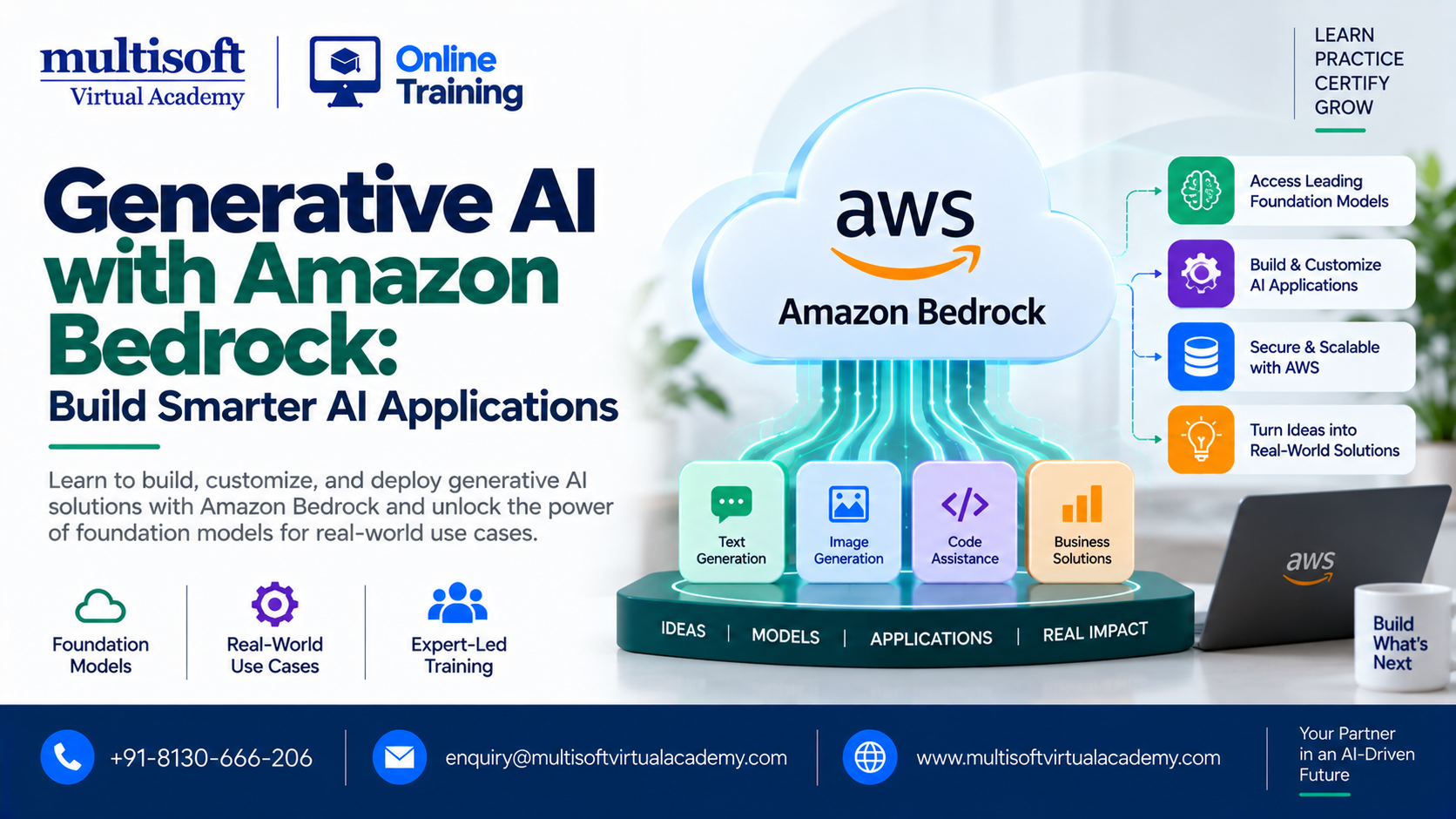
Generative AI is rapidly changing how businesses develop applications, automate processes and deliver personalized digital experiences. From intelligent chatbots and AI-powered search to automated content generation and enterprise decision support, organizations are increasingly adopting generative AI solutions to improve productivity and innovation.
Among the technologies accelerating this transformation, Generative AI with Amazon Bedrock has become an important approach for organizations looking to build and deploy AI applications on AWS. Amazon Bedrock provides access to multiple foundation models through a managed service while offering capabilities for model evaluation, customization, knowledge retrieval, agents, security and responsible AI.
Generative AI refers to artificial intelligence systems capable of producing new content such as text, images, code, summaries and other forms of digital output. These systems commonly rely on large language models and other foundation models trained on extensive datasets.
Amazon Bedrock is a fully managed AWS service that gives developers access to foundation models from multiple providers through a unified environment. Organizations can experiment with models, evaluate their performance, customize selected models and build generative AI applications without managing the underlying model infrastructure.
This makes Amazon Bedrock particularly relevant for businesses that want to move from experimenting with AI to developing production-ready enterprise generative AI applications.
Traditional AI implementation can require substantial infrastructure, model-management expertise and development effort. Amazon Bedrock simplifies several of these challenges by providing managed access to foundation models and application-building capabilities.
Organizations can use Bedrock to:
This flexibility allows development teams to select technologies according to their application requirements rather than designing every component of an AI infrastructure from scratch.
Foundation models are the underlying intelligence behind many generative AI applications. They are trained on large and diverse datasets and can support a broad range of tasks, including text generation, summarization, classification, reasoning, image generation and embeddings depending on the model.
Amazon Bedrock provides access to foundation models from different providers, allowing organizations to evaluate and select models according to factors such as performance, latency, modality, context requirements and application objectives.
This model choice is one of the major advantages of learning Amazon Bedrock generative AI because developers can focus on selecting an appropriate model for a business use case rather than being restricted to a single model ecosystem.
Large Language Models, or LLMs, are central to many modern generative AI applications. They can understand natural-language instructions and generate responses based on prompts and contextual information.
With Amazon Bedrock, developers can work with supported models through APIs and application workflows. This can help organizations develop solutions such as:
The right model depends on the application's complexity, performance requirements, cost considerations and data needs.
One of the most important concepts in enterprise generative AI is Retrieval-Augmented Generation (RAG).
A general-purpose foundation model may not have access to an organization's latest internal information. RAG addresses this challenge by retrieving relevant information from an organization's data and providing that context to the model before generating an answer.
Amazon Bedrock Knowledge Bases provide managed capabilities for implementing RAG workflows. They can ingest organizational information, retrieve relevant content and use that information to improve generated responses. AWS documentation also describes support for managed knowledge bases with capabilities such as multimodal ingestion, managed retrieval and agentic retrieval.
For businesses, this creates opportunities to build AI systems that can work with proprietary information instead of relying exclusively on general model knowledge.
A typical RAG workflow includes:
This approach can improve the relevance and usefulness of AI-generated responses for enterprise applications.
The next major development in generative AI is the transition from systems that simply generate responses to systems that can perform tasks.
AI agents can interpret user requirements, retrieve information, interact with applications and execute defined actions. Amazon Bedrock provides capabilities for developing agent-based applications that connect foundation models with enterprise data sources and application systems.
Agentic AI can support use cases such as:
Current AWS documentation also highlights newer agentic capabilities and AgentCore-related functionality, making agentic AI on AWS an important area for developers and AI professionals to understand.
A powerful foundation model still requires effective instructions. This is where prompt engineering becomes important.
Prompt engineering involves designing instructions that clearly communicate the desired task, context, format and constraints to an AI model.
Effective prompts can include:
Professionals learning Generative AI with Amazon Bedrock should understand prompt design because prompt quality can directly influence application performance.
Choosing an AI model simply because it is popular is not always the best strategy. Organizations should evaluate models according to their specific requirements.
Important evaluation criteria include:
Does the model provide useful and contextually appropriate responses?
How quickly can the application return an answer?
Is the model economically suitable for the expected workload?
Can the model handle the amount of information required by the application?
Does the model support the required input and output types?
Can the model support complex tasks or application workflows?
Amazon Bedrock provides capabilities for working with and evaluating foundation models so organizations can make more informed model-selection decisions.
Generic models are useful for many applications, but some organizations require specialized behavior.
Amazon Bedrock supports model customization options for supported models, including fine-tuning. Fine-tuning can help improve model performance for specific tasks by using relevant training data.
However, fine-tuning is not always the first solution. For many enterprise applications, prompt engineering and RAG may provide a more practical approach when the primary requirement is to give a model access to current or proprietary information.
Understanding when to use RAG vs fine-tuning is therefore an important skill for generative AI professionals.
Enterprise adoption of generative AI requires more than model performance. Organizations must also consider privacy, security, access control, governance and responsible AI.
Amazon Bedrock provides capabilities designed for secure enterprise generative AI development, including controls for data protection and responsible AI. AWS also continues to expand Guardrails capabilities, including automated reasoning checks intended to help validate generative AI responses against defined policies.
A responsible AI strategy should consider:
These considerations are especially important when generative AI is introduced into customer-facing or business-critical applications.
Generative AI adoption continues to expand beyond basic chatbots. Current applications increasingly focus on automation, reasoning, enterprise knowledge and AI-powered software development.
Some important areas include:
Organizations can use generative AI and RAG to help employees locate and understand information distributed across enterprise documents and knowledge repositories.
AI assistants can understand customer questions, retrieve relevant information and support service workflows.
Generative AI can assist developers with code generation, explanation, debugging and software engineering tasks. AWS has also announced production availability of OpenAI GPT-5.5 and GPT-5.4 through Amazon Bedrock, alongside Codex for AI-powered software development.
Modern foundation models increasingly support combinations of text, images, audio and video. AWS announced the availability of Google DeepMind's Gemma 4 family on Amazon Bedrock with multimodal capabilities and support for reasoning and agentic workflows.
AI agents can move beyond answering questions toward orchestrating multi-step tasks, making agentic AI one of the most important areas for enterprise AI development.
Professionals planning to develop expertise in Amazon Bedrock should build knowledge across several areas:
Combining these skills can help professionals move from basic experimentation toward practical generative AI application development.
The growth of enterprise AI is being driven by the need to improve efficiency while creating new digital experiences. Businesses are looking beyond isolated AI experiments and exploring how AI can become part of everyday workflows.
AWS generative AI services can provide an environment where organizations can experiment with models and progressively integrate AI into applications and business processes.
Amazon Bedrock is particularly relevant because it brings together foundation models, application-building capabilities, knowledge retrieval, customization and AI development tools within the AWS ecosystem.
A structured learning path can make the transition into generative AI easier.
Start with the fundamentals of generative AI and understand how LLMs and foundation models work. Next, learn Amazon Bedrock architecture and explore model selection. After that, move into prompt engineering, RAG and Knowledge Bases.
The next stage should focus on building practical AI applications. Learners can explore agent-based architectures, API integration, model evaluation and security. Finally, practical projects can help connect these concepts with real-world business scenarios.
A project-based learning approach is especially useful because generative AI development requires more than theoretical knowledge.
Generative AI is moving toward more capable, contextual and autonomous systems. Instead of simply generating text, AI applications are increasingly expected to understand business context, access trusted information, use tools and complete multi-step tasks.
The development of agentic retrieval, advanced knowledge bases, expanded model choices and improved responsible AI capabilities demonstrates how quickly the Amazon Bedrock ecosystem is evolving.
For professionals and organizations, this means learning generative AI should not be limited to understanding one model or one application. The stronger approach is to understand the broader architecture of AI applications and how foundation models, RAG, agents, prompts, data and governance work together.
Generative AI with Amazon Bedrock provides a powerful foundation for professionals and organizations seeking to develop modern AI applications, intelligent automation and enterprise-grade generative AI solutions. From foundation models and prompt engineering to RAG, AI agents, model customization and responsible AI, the technology offers a broad ecosystem for turning AI concepts into practical applications. For structured learning, hands-on development and professional skill building, Multisoft Virtual Academy serves as a service provider helping learners and organizations develop relevant capabilities in Amazon Bedrock and generative AI.
| Start Date | Time (IST) | Day | |||
|---|---|---|---|---|---|
| 24 Oct 2026 | 06:00 PM - 10:00 AM | Sat, Sun | |||
| 25 Oct 2026 | 06:00 PM - 10:00 AM | Sat, Sun | |||
| 31 Oct 2026 | 06:00 PM - 10:00 AM | Sat, Sun | |||
| 01 Nov 2026 | 06:00 PM - 10:00 AM | Sat, Sun | |||
|
Schedule does not suit you, Schedule Now! | Want to take one-on-one training, Enquiry Now! |
|||||






 Join our Live Instructor-Led online classes delivered by industry experts
 Let's Get Started