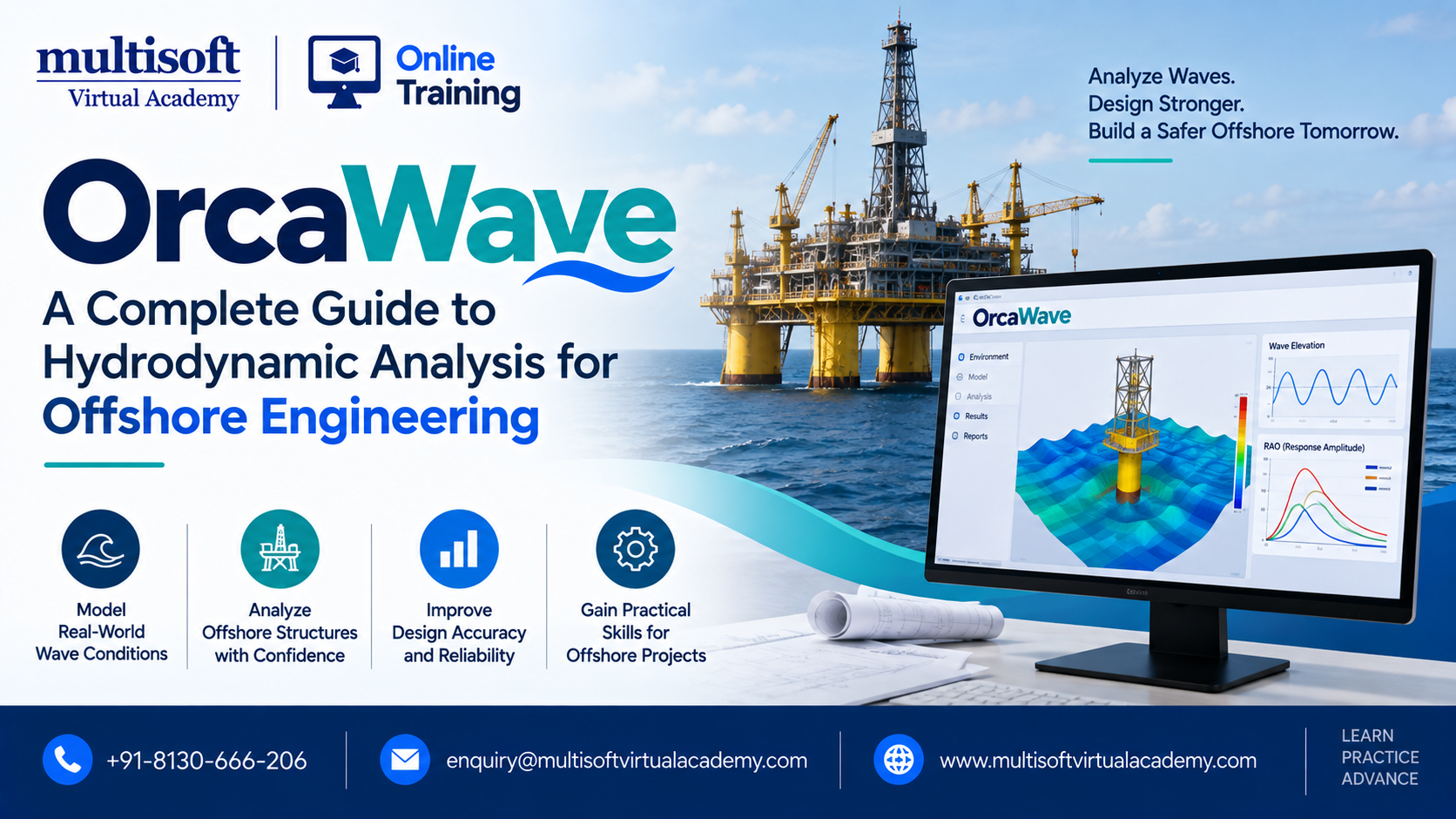
Offshore and marine engineering projects require accurate analysis of how floating structures interact with waves, currents and surrounding water. From offshore platforms and vessels to floating wind turbines and marine renewable-energy systems, engineers need reliable hydrodynamic data to understand structural response and improve design safety. OrcaWave is an advanced diffraction and radiation analysis program designed to support this type of engineering work.
As offshore projects become more complex, understanding OrcaWave software, hydrodynamic modeling and wave-structure interaction is becoming increasingly valuable for naval architects, offshore engineers, marine engineers and simulation professionals. OrcaWave uses potential-flow theory to calculate wave-induced loading and responses for wet bodies and can generate important hydrodynamic results such as load RAOs, displacement RAOs, added mass and damping matrices and quadratic transfer functions (QTFs).
OrcaWave is a diffraction and radiation analysis program used to study the hydrodynamic behavior of floating bodies subjected to surface water waves. It is part of the OrcaFlex software environment and is designed to provide hydrodynamic data that can subsequently be used in offshore simulation and engineering workflows.
The software applies potential-flow methods to analyze how waves interact with submerged bodies. Engineers can use the resulting data to investigate vessel motions, wave loads, hydrodynamic coefficients and other parameters that influence the performance of offshore structures.
Its applications extend across several areas, including:
Floating structures are continuously influenced by environmental forces. Waves can cause surge, sway, heave, roll, pitch and yaw motions. If these responses are not properly evaluated during engineering and design, they can affect structural performance, equipment operation, mooring systems and offshore safety.
This is where OrcaWave hydrodynamic analysis becomes useful.
By calculating hydrodynamic properties in the frequency domain, engineers can develop a better understanding of how a structure responds to different wave frequencies and directions. Research applications have used OrcaWave to obtain hydrostatic stiffness, added mass, radiation damping, wave forces and QTF data for floating offshore systems.
The resulting information can then support further analysis in time-domain simulation environments.
One of the main advantages of OrcaWave is its range of hydrodynamic analysis capabilities. The program can calculate loading and response for wet bodies due to surface water waves and generate several important outputs.
OrcaWave diffraction analysis evaluates how incoming waves interact with a floating body's geometry. Radiation analysis considers waves generated as the body moves through the surrounding water.
Together, these analyses provide important information for understanding wave-structure interaction and dynamic behavior.
When a floating body accelerates in water, some surrounding water must also be accelerated. This creates an apparent increase in the body's inertia known as added mass.
Similarly, body motion generates waves that carry energy away from the structure. This phenomenon contributes to radiation damping.
OrcaWave can produce frequency-dependent added-mass and damping matrices that can be used in subsequent hydrodynamic and dynamic-response calculations.
Response Amplitude Operators (RAOs) are essential outputs in offshore hydrodynamics. They describe how a structure responds to waves across different frequencies and headings.
Engineers can analyze displacement RAOs and load RAOs to understand the expected motion or wave-induced loading of a floating body.
RAO information is particularly useful when assessing:
OrcaWave can calculate Quadratic Transfer Functions (QTFs) for second-order hydrodynamic analysis. These results are useful when investigating nonlinear wave-frequency effects and second-order wave loads.
The software supports both Newman QTFs and full QTF calculations, including sum- and difference-frequency components.
Modern offshore structures can involve multiple interacting bodies. Examples include semisubmersible platforms, catamarans and other multi-hull arrangements.
OrcaWave supports single-body and multi-body analysis, allowing engineers to investigate hydrodynamic interaction between connected or separate floating bodies.
Understanding wave-structure interaction is fundamental to offshore engineering. When a wave approaches a floating structure, part of its energy interacts with the structure while the remaining energy is transmitted, reflected or scattered.
At the same time, movement of the structure generates radiated waves.
These processes influence:
A properly prepared OrcaWave model therefore helps engineers understand how the geometry and environmental conditions influence offshore performance.
Floating offshore wind is an important application area for advanced hydrodynamic modeling. Floating wind turbines experience complex interactions between wind, waves, currents, mooring systems and platform dynamics.
OrcaWave can be used to calculate hydrodynamic characteristics of the floating platform. These results can then be incorporated into broader coupled analyses.
Recent engineering research has used OrcaWave-generated hydrodynamic coefficients, including hydrostatic stiffness, added mass, radiation damping and first- and second-order wave forces, in floating offshore wind turbine studies.
This makes OrcaWave for floating offshore wind a valuable subject for engineers working on renewable-energy projects.
A common question among offshore professionals is the difference between OrcaWave and OrcaFlex.
OrcaWave primarily focuses on diffraction and radiation analysis and produces hydrodynamic data. OrcaFlex, on the other hand, is a broader offshore engineering simulation environment used for modeling systems such as vessels, moorings, risers, cables and other offshore components.
The two tools can work together as part of an engineering workflow. OrcaFlex supports the import of hydrodynamic data generated by OrcaWave, including relevant hydrodynamic results.
A simplified workflow can therefore look like this:
Geometry Preparation → Mesh Generation → OrcaWave Hydrodynamic Analysis → Hydrodynamic Results → OrcaFlex Model → Time-Domain Simulation → Engineering Evaluation
This workflow helps engineers move from frequency-domain hydrodynamic calculations toward more comprehensive offshore system simulations.
The quality of a hydrodynamic analysis depends heavily on the quality of the model. A poorly prepared mesh can lead to inaccurate or inefficient calculations.
OrcaWave supports multiple mesh formats, including WAMIT, NEMOH, AQWA, Sesam, Hydrostar and Gmsh formats. It also provides mesh viewing and validation capabilities to help engineers check model geometry before analysis.
Important considerations include:
For this reason, OrcaWave training should cover both theoretical hydrodynamics and practical model preparation.
Generating simulation results is only one part of hydrodynamic engineering. Engineers must also understand what the results mean.
Important OrcaWave outputs may include:
For example, a peak in an RAO curve can indicate a frequency range where the structure experiences a strong response. Engineers can investigate such behavior alongside natural frequencies, environmental conditions and other design parameters.
Accurate interpretation helps transform numerical output into practical engineering decisions.
OrcaWave training can be valuable for professionals and learners working in marine and offshore engineering.
It is particularly relevant for:
A structured OrcaWave certification course can also help learners demonstrate their knowledge of hydrodynamic modeling, diffraction analysis, radiation analysis and offshore simulation workflows.
A practical learning program should combine fundamental theory with software-based exercises.
Key topics may include:
A hands-on approach is especially useful because learners need to understand not only where to enter parameters but also why particular settings are selected.
Developing practical OrcaWave software skills can provide several professional benefits.
Learners develop a stronger understanding of wave loads, radiation, diffraction, added mass and damping.
Practical training helps engineers become more comfortable with frequency-domain hydrodynamic analysis and offshore simulation workflows.
The software can be applied to vessels, offshore structures, floating wind systems and other marine applications.
Understanding RAOs, hydrodynamic coefficients and wave loads helps professionals make more informed engineering decisions.
Knowledge of specialist offshore engineering software can strengthen the technical profile of engineers seeking opportunities in marine, offshore energy and renewable-energy sectors.
Although OrcaWave provides powerful analysis capabilities, beginners can encounter challenges during modeling and simulation.
Common issues include incorrect geometry, unsuitable mesh density, inconsistent coordinate systems, inappropriate environmental parameters and difficulty interpreting hydrodynamic results.
Another challenge is understanding the difference between theoretical concepts and software outputs. For example, simply generating an added-mass matrix is not enough. Engineers need to understand how that matrix influences the dynamic response of the structure.
This is why practical exercises, real-world case studies and instructor-led demonstrations can make OrcaWave training more effective.
The offshore industry is moving toward increasingly sophisticated floating systems. Floating wind farms, offshore energy infrastructure, advanced vessels and complex marine operations require reliable numerical modeling.
As these applications grow, hydrodynamic analysis will remain an important part of engineering design and validation.
OrcaWave's ability to produce hydrodynamic information for integration into wider simulation workflows makes it relevant to these evolving engineering requirements. Its support for multi-body analysis, different mesh formats, batch processing and automation through OrcFxAPI also provides flexibility for advanced engineering workflows.
Professionals who combine OrcaWave expertise with OrcaFlex, marine hydrodynamics and offshore simulation skills can therefore develop a broader technical capability for modern offshore projects.
Learning OrcaWave is not simply about understanding another engineering software application. It is about developing the ability to analyze wave-structure interaction, interpret hydrodynamic behavior and contribute to safer and more efficient offshore engineering decisions. With the right combination of theoretical knowledge, practical exercises and industry-focused learning, professionals can develop valuable expertise in diffraction and radiation analysis, RAOs, hydrodynamic coefficients and offshore simulation. Multisoft Virtual Academy acts as a trusted service provider for professionals seeking structured OrcaWave Training, OrcaWave Certification and practical offshore engineering learning, helping learners strengthen their technical capabilities for modern marine and offshore engineering applications.
| Start Date | Time (IST) | Day | |||
|---|---|---|---|---|---|
| 24 Oct 2026 | 06:00 PM - 10:00 AM | Sat, Sun | |||
| 25 Oct 2026 | 06:00 PM - 10:00 AM | Sat, Sun | |||
| 31 Oct 2026 | 06:00 PM - 10:00 AM | Sat, Sun | |||
| 01 Nov 2026 | 06:00 PM - 10:00 AM | Sat, Sun | |||
|
Schedule does not suit you, Schedule Now! | Want to take one-on-one training, Enquiry Now! |
|||||






 Join our Live Instructor-Led online classes delivered by industry experts
 Let's Get Started