


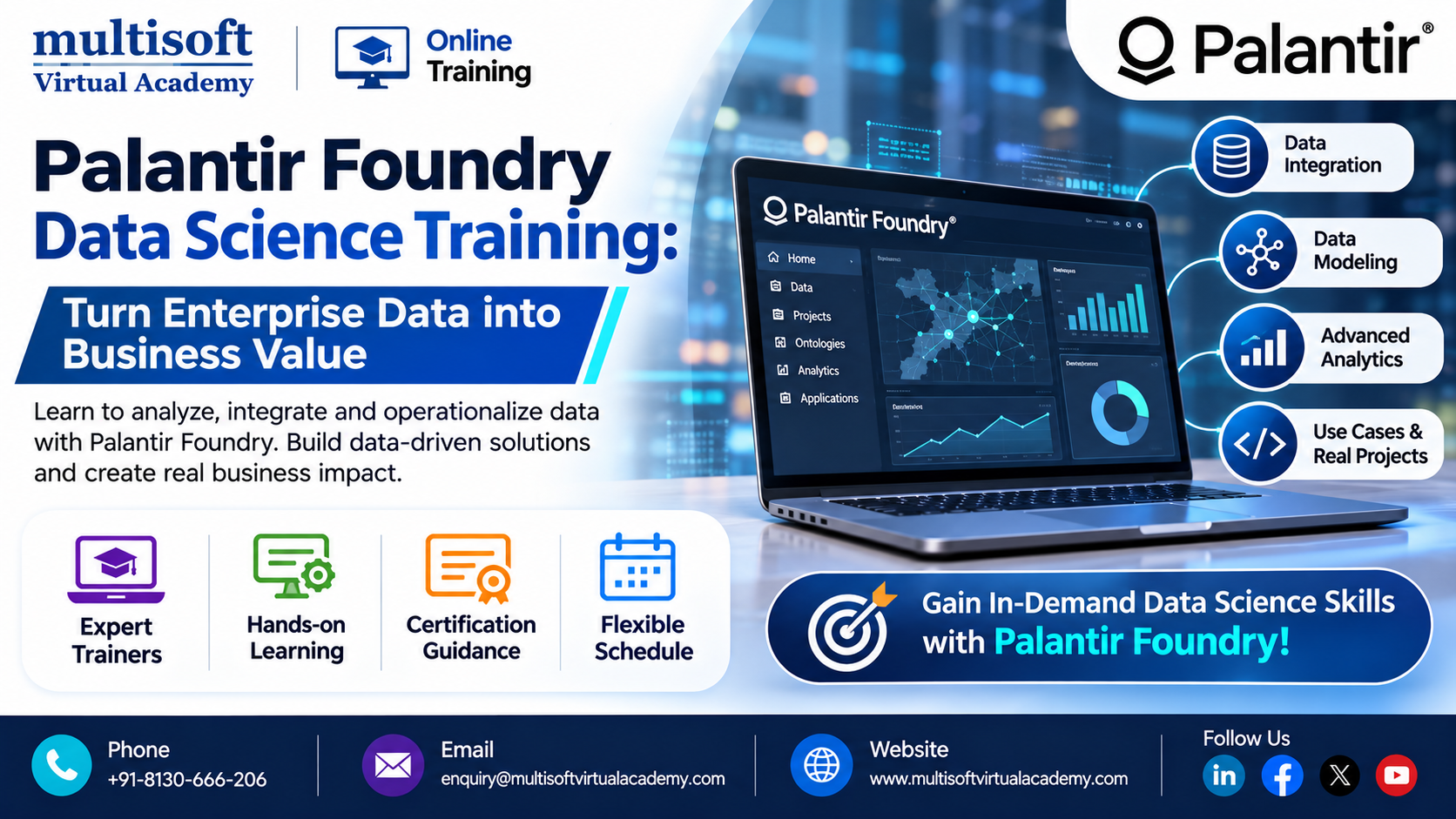
Palantir Foundry Data Science Training: Turn Enterprise Data into Business Value
Data has become one of the most important resources for modern organizations. Companies collect information from customers, business applications, connected devices, financial systems, and operational platforms. However, converting this information into meaningful business value requires more than traditional reporting tools. Organizations need integrated environments that support data preparation, advanced analytics, machine learning, and informed decision-making.
Palantir Foundry provides an enterprise environment for connecting these activities. It helps technical teams organize complex datasets, establish relationships between business information, develop analytical workflows, and build applications that support operational decisions.
Palantir Foundry Data Science Training introduces learners to these capabilities through structured technical concepts and practical learning activities. It is relevant to professionals interested in enterprise data science, data engineering, business analytics, and machine learning.
As organizations continue investing in data-driven operations, understanding platforms that connect analytical development with business processes can become a valuable professional skill.
Understanding the Palantir Foundry Platform
Palantir Foundry is an enterprise data platform designed to connect data integration, transformation, analytics, and operational applications. It provides an environment where organizations can bring information from different systems into a connected data ecosystem.
One of its important capabilities is the ability to represent business information through an Ontology. Rather than working only with disconnected tables and files, users can explore business entities and their relationships in a structured environment.
For example, an organization managing a global supply chain may need to connect information about suppliers, purchase orders, products, warehouses, shipments, and customers. Foundry can help establish these relationships and make the information available for analysis and operational applications.
This approach allows technical teams and business users to work with a shared understanding of organizational data.
Why Are Companies Exploring Palantir Foundry?
Organizations are increasingly interested in platforms that can connect data engineering with business operations. Foundry addresses several requirements associated with enterprise data environments.
Connected Data Environments
Information is often distributed across multiple databases, cloud applications, and business systems. Integrating these sources can help organizations establish a more consistent view of their operations.
Foundry provides capabilities for bringing data together and managing the workflows required to prepare it for further use.
Better Data Accessibility
Different departments may need access to the same information for different purposes. A connected data environment can help users explore relevant datasets and business objects without depending entirely on separate reporting systems.
Faster Analytical Workflows
Data scientists and engineers need efficient ways to prepare datasets, develop transformations, and evaluate analytical results. Foundry supports visual and code-based workflows that can help teams organize these activities.
Operational Decision Support
Analytical results become more valuable when they can influence business processes. Foundry connects data and Ontology-based applications to support workflows where users can explore information and take appropriate actions.
What Will You Learn in Palantir Foundry Data Science Training?
A practical Palantir Foundry Data Science Course should introduce the platform progressively, starting with its core architecture and moving toward data engineering, analytical development, and machine learning.
1. Foundry Architecture and Workspace Navigation
The learning process begins with an introduction to the platform and its working environment.
Learners explore the main interface, projects, datasets, development tools, and different areas used to manage enterprise data workflows.
Topics may include:
- Foundry platform fundamentals
- Workspace navigation
- Project and dataset organization
- Platform components
- Data access concepts
- Basic workflow management
This foundation helps learners understand how different Foundry capabilities connect with one another.
2. Data Preparation and Transformation
Data preparation is an essential part of analytical development. Raw information may contain missing values, inconsistent formats, duplicate records, or unsuitable structures.
Training introduces methods for preparing information before it is used in analytics or machine learning.
Learners may explore:
- Dataset discovery
- Data cleaning techniques
- Data transformation workflows
- Schema management
- Data validation
- Pipeline Builder
- SQL-based transformations
- Python-based transformations
These skills are useful when developing repeatable data processing workflows for enterprise projects.
3. Foundry Ontology and Business Data Modeling
Ontology is a central concept in Foundry. It provides a structured way to represent real-world business entities and their relationships.
For instance, a retail organization may have customers, products, orders, stores, and suppliers. These entities can be represented as business objects with relevant properties and connections.
Training may cover:
- Ontology fundamentals
- Object types
- Object properties
- Link types
- Business relationships
- Dataset mapping
- Ontology management
- Object exploration
Understanding Ontology helps professionals connect technical datasets with business terminology and processes.
4. Python and SQL Development
Python and SQL are widely used in data engineering and data science projects. Foundry supports development workflows that allow professionals to apply these languages to enterprise data.
Python can support data processing, analytical development, and machine learning activities. SQL can be used to query, filter, join, and transform structured datasets.
Practical exercises may include data manipulation, reusable transformation logic, dataset preparation, and analytical calculations.
Learners should ideally have basic programming knowledge before progressing to advanced development exercises.
5. Data Visualization with Quiver
Data visualization helps professionals understand patterns, relationships, and changes within complex datasets.
Quiver provides capabilities for exploring Ontology objects and time-series information. It can help users create analytical views that make business information easier to interpret.
Training may introduce:
- Quiver interface
- Object-based analysis
- Time-series exploration
- Interactive visualizations
- Data filtering
- Chart development
- Analytical interpretation
These concepts are particularly useful when professionals need to investigate operational data and communicate findings to stakeholders.
6. Application Development with Workshop
Workshop supports the development of operational applications using Foundry data and Ontology.
Instead of limiting analytical work to reports, users can build applications that help business teams interact with relevant information.
Learning activities may cover application structure, object views, layouts, user interactions, and workflow-related components.
For example, a maintenance application could allow authorized users to review equipment information, explore maintenance records, and interact with relevant operational data.
7. Machine Learning and Model Development
Machine learning helps organizations identify patterns, generate predictions, and support analytical decisions.
Palantir Foundry provides capabilities for developing and operationalizing machine learning workflows.
Training may cover:
- Machine learning fundamentals
- Dataset preparation
- Feature engineering
- Model experimentation
- Model training
- Performance evaluation
- Model registration
- Model deployment
- Integration with business applications
Learners can understand how machine learning models fit into broader enterprise data workflows.
The exact tools and processes depend on the Foundry environment, available integrations, and course coverage.
Real-World Uses of Palantir Foundry Data Science
Palantir Foundry can support a wide range of enterprise applications. Its value depends on the quality of available data, implementation design, and the organization's business objectives.
Manufacturing and Industrial Operations
Manufacturing organizations manage information from production systems, equipment, suppliers, and maintenance operations.
A connected data environment can help teams analyze production performance, monitor equipment information, and identify operational patterns.
Supply Chain and Logistics
Supply chain operations involve multiple interconnected activities, including procurement, inventory management, transportation, and delivery.
Foundry can help connect these information sources to support better operational visibility and analytical planning.
Banking and Financial Services
Financial organizations handle large volumes of customer, transaction, and operational information. Enterprise analytics platforms can support risk analysis, fraud-related investigations, reporting, and operational monitoring.
Appropriate access controls and regulatory requirements remain essential.
Healthcare and Life Sciences
Healthcare organizations may use integrated data environments for operational planning, resource management, and research-related analytics. Any use of sensitive information requires suitable privacy, security, and governance measures.
Energy and Utilities
Energy organizations manage asset information, production data, equipment records, and maintenance activities. Data integration can help improve visibility across complex operational environments.
Government and Public Sector
Public sector organizations may use connected data environments to coordinate information across departments and support complex analytical requirements, subject to applicable governance and authorization policies.
Who Can Benefit from This Training?
Palantir Foundry training can be relevant to professionals from several technical and analytical backgrounds.
Data Scientists: Professionals interested in developing enterprise analytics and machine learning solutions.
Data Engineers: Specialists who want to understand data pipelines, transformations, and integrated data environments.
Business Intelligence Professionals: Analysts looking to expand their knowledge beyond conventional dashboards and reporting.
Python Developers: Programmers interested in applying Python to enterprise data workflows.
Machine Learning Engineers: Professionals seeking exposure to model development and operationalization within Foundry.
Data Architects: Specialists interested in enterprise data structures, relationships, and platform architecture.
Business Analysts: Professionals who need to understand how organizational data connects with operational processes.
Basic knowledge of databases, data analytics, Python, or SQL can provide a helpful starting point.
Career Scope After Palantir Foundry Training
Developing knowledge of enterprise data platforms can complement existing technical skills and support professional growth.
Depending on experience and qualifications, learners may explore roles such as:
- Palantir Foundry Developer
- Data Scientist
- Data Engineer
- Machine Learning Engineer
- Enterprise Data Analyst
- Data Solutions Consultant
- Business Intelligence Analyst
- Data Platform Specialist
- Analytics Consultant
These roles can involve different responsibilities. Some focus on data preparation and engineering, while others involve business analysis, application development, or machine learning.
Professionals should build practical experience and strengthen complementary skills such as Python, SQL, cloud computing, data governance, and analytical problem-solving.
Training alone does not guarantee employment, and job requirements vary between organizations.
How to Select the Best Palantir Foundry Training Program
Choosing the right training program can make a significant difference to the learning experience.
Check Technical Course Coverage
Review whether the syllabus includes Foundry architecture, Ontology, data transformations, Python, SQL, Quiver, Workshop, and machine learning.
Focus on Practical Learning
Look for guided exercises and realistic examples that demonstrate how different platform components work together.
Evaluate Instructor Knowledge
Experienced instructors should be able to explain technical workflows, business use cases, and common development challenges.
Confirm Platform Availability
Ask whether learners receive access to an appropriate Foundry environment for hands-on practice. Also verify any software access requirements.
Choose a Suitable Training Format
Live instructor-led sessions, one-to-one classes, and flexible learning formats may suit different professional schedules.
Understand Certification Options
Confirm whether the course includes a completion certificate or preparation for a separate Palantir credential. Check the applicable eligibility and assessment requirements.
Frequently Asked Questions
What is Palantir Foundry Data Science Training?
It is a training program that introduces learners to enterprise data science workflows using Palantir Foundry, including data preparation, Ontology, analytics, machine learning, and application development.
Is Palantir Foundry suitable for beginners?
Beginners can start with platform fundamentals. However, basic knowledge of databases, data analysis, and programming can make the learning process easier.
Do I need Python and SQL for Foundry?
Python and SQL are useful for code-based transformations and analytical workflows. Their importance depends on the learner's intended role and the course syllabus.
What is the role of Ontology in Foundry?
Ontology represents business entities, their properties, and relationships. It connects underlying datasets with business-oriented applications and workflows.
Can Palantir Foundry support machine learning?
Yes. Foundry supports machine learning workflows that can include data preparation, model development, evaluation, and operational deployment.
What career opportunities are available after training?
Relevant career paths may include data scientist, data engineer, Foundry developer, analytics consultant, and machine learning engineer. Actual opportunities depend on experience and employer requirements.
Conclusion
Enterprise data science is evolving beyond traditional reporting and isolated analytical projects. Organizations increasingly need connected platforms that bring together data engineering, business modeling, visualization, machine learning, and operational applications. Developing knowledge of Palantir Foundry can help professionals understand how these capabilities work together to support complex business requirements. A practical learning program with relevant technical exercises can provide a strong foundation for working with enterprise data environments. Multisoft Virtual Academy provides Palantir Foundry Data Science Training for learners and working professionals who want to strengthen their skills in enterprise analytics, data engineering, Ontology development, and machine learning through structured training.






 Let's Get Started

