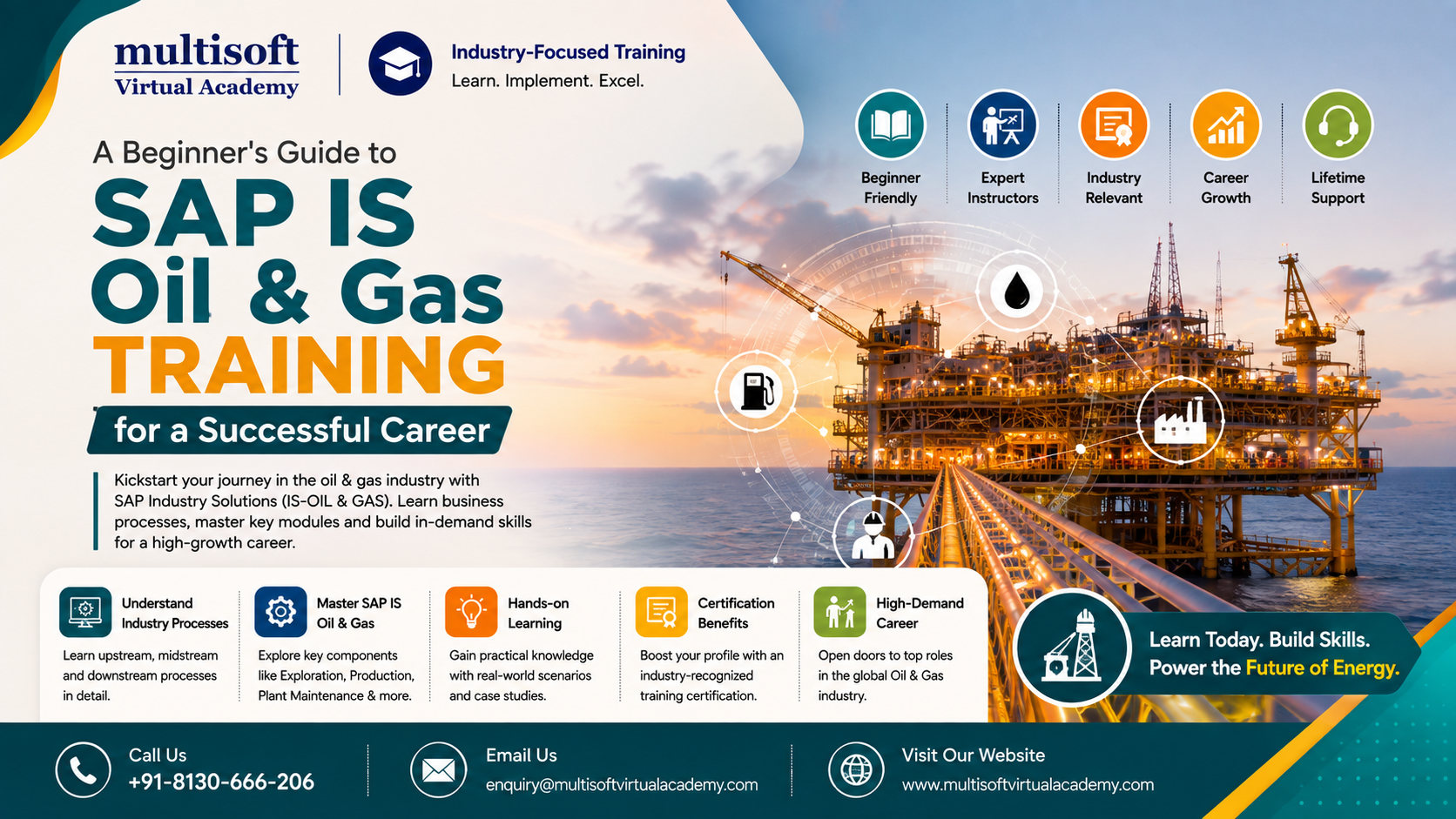
The oil and gas industry is undergoing rapid digital transformation. Companies are increasingly adopting intelligent enterprise solutions to streamline upstream, midstream and downstream operations. One of the most sought-after industry-specific SAP solutions is SAP IS Oil & Gas Training, which equips professionals with the knowledge required to manage complex petroleum business processes using SAP.
Whether you are a fresh graduate, an ERP enthusiast or an IT professional looking to specialize in an industry-focused SAP module, learning SAP IS Oil & Gas can open doors to rewarding career opportunities. This guide explains everything beginners need to know about the course, its features, career scope and the skills required to become a successful SAP Oil & Gas consultant.
SAP IS Oil & Gas (Industry Solution for Oil & Gas) is an industry-specific extension of SAP ERP designed to address the operational and business requirements of oil and gas companies. It integrates exploration, production, transportation, refining, distribution and retail fuel operations into one centralized system.
Unlike generic ERP modules, SAP IS Oil & Gas provides specialized functionalities that simplify petroleum logistics, hydrocarbon accounting, fuel distribution, inventory management, pricing and taxation.
Organizations worldwide rely on SAP IS Oil & Gas Training to improve operational efficiency, reduce costs and maintain regulatory compliance.
The global oil and gas sector handles enormous volumes of data and transactions every day. Managing these processes manually often leads to operational inefficiencies and costly errors.
SAP IS Oil & Gas helps businesses by:
These capabilities make SAP an indispensable platform for modern energy companies.
A comprehensive SAP IS Oil & Gas Course introduces learners to both business concepts and SAP system configuration.
Typical learning areas include:
Beginners first understand SAP architecture, navigation, business processes and enterprise resource planning concepts.
Students learn how upstream, midstream and downstream operations function.
Topics include:
Understanding industry workflows helps learners configure SAP effectively.
The course explains how crude oil moves from production sites to refineries and eventually reaches fuel stations.
SAP integrates every stage into one unified platform.
Students learn to manage:
Master data forms the foundation of every SAP implementation.
Inventory plays a critical role in petroleum operations.
Learners understand:
One reason this solution is widely adopted is its extensive industry-specific functionality.
SAP efficiently manages petroleum products such as:
Each product follows unique pricing, taxation and logistics rules.
Oil companies transport products through:
SAP tracks every movement accurately.
Fuel pricing changes frequently.
SAP supports:
SAP helps organizations monitor:
One major advantage of SAP IS Oil & Gas is seamless integration with financial modules.
Business transactions automatically update:
This eliminates duplicate data entry.
The solution is implemented across various energy businesses.
These include:
As digital transformation accelerates, demand for SAP professionals in these sectors continues to grow.
This course is suitable for beginners as well as professionals seeking industry specialization.
Ideal candidates include:
No prior experience in the oil and gas industry is mandatory, although basic ERP knowledge is beneficial.
During SAP IS Oil & Gas Training, learners build both technical and business skills.
These include:
These skills prepare professionals for real-world implementation projects.
Learning SAP IS Oil & Gas offers several long-term advantages.
Global oil companies increasingly require consultants with industry-specific SAP expertise.
Specialized SAP consultants often command higher salaries compared to professionals with only generic ERP knowledge.
Having expertise in SAP Industry Solutions distinguishes candidates during recruitment.
Beyond software skills, learners gain an understanding of real petroleum business operations.
SAP Oil & Gas professionals are hired across:
This creates opportunities for international careers.
A well-structured SAP IS Oil & Gas Training program combines theoretical knowledge with practical implementation scenarios. Beginners start with ERP fundamentals and gradually progress to advanced industry-specific functionalities.
Below are the core modules typically covered in a comprehensive training program.
Every learner begins by understanding the SAP ecosystem, including enterprise resource planning concepts, SAP architecture, navigation, organizational structure and business processes. This foundation makes it easier to understand industry-specific modules later in the course.
Topics include:
Before configuring SAP, learners gain a solid understanding of how the petroleum industry operates.
This module covers:
Understanding these workflows enables learners to relate SAP functionalities to real-world business operations.
Master data is the backbone of every SAP implementation.
Students learn to create and maintain:
Accurate master data ensures seamless integration across all business functions.
Inventory control is critical in the oil and gas industry due to the high value and volume of petroleum products.
Learners explore:
Hands-on exercises help learners understand real inventory scenarios.
This module focuses on purchasing petroleum products, equipment and services.
Topics include:
Students learn how procurement integrates with finance and inventory modules.
SAP IS Oil & Gas supports complex petroleum sales processes.
Learners study:
These processes are demonstrated using practical business cases.
A high-quality SAP IS Oil & Gas Online Training program focuses on practical learning rather than only theoretical concepts.
Some important training features include:
Experienced industry professionals explain real implementation scenarios using practical demonstrations.
Learners perform exercises directly on SAP systems, helping them understand actual business transactions.
Real-world examples make it easier to understand how global petroleum companies utilize SAP to manage operations efficiently.
Each module includes assignments that reinforce newly acquired concepts and improve problem-solving skills.
Projects simulate real implementation environments, allowing learners to apply their knowledge to practical business challenges.
Training programs often include:
These sessions improve confidence during recruitment.
Practical projects are one of the most valuable aspects of SAP IS Oil & Gas Certification preparation.
Common projects include:
Configure inventory for multiple storage locations while managing stock movements and valuation.
Implement distribution workflows involving depots, transportation routes and retail outlets.
Design an end-to-end purchasing process from requisition creation to invoice verification.
Configure complete customer order processing with pricing, delivery and billing integration.
Generate reports that help management monitor inventory, sales, procurement and operational performance.
The increasing adoption of SAP across energy companies has created a growing demand for professionals with industry-specific expertise.
Popular job roles include:
Responsible for implementing, configuring and supporting SAP solutions for oil and gas organizations.
Works closely with business users to analyze requirements and configure SAP processes.
Provides ongoing support, troubleshooting and system optimization after implementation.
Analyzes existing workflows and recommends SAP-based improvements to increase operational efficiency.
Coordinates implementation activities, manages documentation and ensures successful project delivery.
Helps organizations integrate SAP with existing enterprise applications while improving business performance.
Professionals trained in SAP Oil and Gas Module can explore opportunities across various sectors, including:
These industries continue investing in digital transformation, creating long-term career opportunities for skilled SAP consultants.
Recruiters seek professionals who combine technical SAP knowledge with business process understanding.
Key skills include:
Developing these competencies significantly improves employability.
The energy sector is rapidly evolving, and SAP solutions are advancing alongside it.
Current trends include:
Organizations are transitioning from traditional SAP ERP systems to SAP S/4HANA for enhanced performance and real-time analytics.
Automation is streamlining repetitive tasks such as procurement, inventory reconciliation and financial reporting.
Cloud deployment offers scalability, flexibility and reduced infrastructure costs.
AI-powered analytics help organizations forecast demand, optimize production and improve operational efficiency.
IoT devices integrated with SAP enable real-time monitoring of pipelines, storage tanks and equipment performance.
Businesses leverage predictive analytics and dashboards to make data-driven decisions and enhance operational visibility.
These innovations make SAP IS Oil & Gas Training increasingly valuable for professionals aiming to stay current with industry advancements.
One of the biggest advantages of pursuing SAP IS Oil & Gas Training is the attractive salary potential. As organizations continue investing in SAP-powered digital transformation, the demand for skilled consultants is increasing across global markets.
Although salaries vary based on experience, certification, project exposure and location, professionals with SAP IS Oil & Gas expertise generally enjoy competitive compensation packages.
Professionals who have completed training and possess hands-on project knowledge can begin their careers as junior SAP consultants, support consultants or business analysts.
Consultants with implementation experience often move into functional consulting, solution design and client-facing roles with significantly higher earning potential.
Experienced SAP professionals lead enterprise implementations, manage consulting teams and oversee large-scale digital transformation projects for multinational organizations.
Countries offering excellent career opportunities include:
The growing transition to SAP S/4HANA continues to increase demand for industry-specific SAP professionals.
Many beginners assume that industry-specific SAP modules are difficult to master. However, structured training makes learning accessible even without prior experience in the oil and gas sector.
Here are several reasons why beginners should consider this specialization:
Energy companies are actively seeking professionals who understand both business processes and SAP technology.
Unlike general ERP knowledge, SAP IS Oil & Gas provides expertise tailored to one of the world's most critical industries.
SAP consultants have opportunities to work on international projects across upstream, midstream and downstream operations.
Hands-on labs, real-world projects and case studies help beginners gain confidence and practical skills.
As organizations continue adopting intelligent ERP systems, the need for qualified SAP consultants is expected to remain strong for years to come.
To maximize the value of your learning journey, follow these best practices:
Preparing for interviews is an essential step toward launching a successful SAP career. Below are some commonly asked questions for SAP IS Oil & Gas roles:
Practicing answers to these questions can improve confidence during technical interviews.
The future of SAP IS Oil & Gas Training is closely aligned with the digital transformation of the global energy sector. As organizations modernize their operations, SAP continues to introduce intelligent technologies that improve efficiency, sustainability and decision-making.
Emerging trends include:
Professionals who continuously upgrade their SAP knowledge will remain competitive in this evolving landscape.
Is SAP IS Oil & Gas suitable for beginners?
Yes. A structured training program introduces ERP fundamentals before progressing to industry-specific concepts, making it suitable for beginners.
Basic computer knowledge is sufficient. Familiarity with ERP concepts is helpful but not mandatory.
The duration depends on the training provider and course structure. Most comprehensive programs combine instructor-led sessions with practical assignments and projects.
Graduates can pursue roles such as SAP IS Oil & Gas Consultant, SAP Functional Consultant, SAP Support Consultant, Business Analyst, ERP Consultant and Project Coordinator.
Yes. Organizations in the oil, gas and energy sectors continue to invest in SAP-based digital transformation, creating consistent demand for skilled professionals.
Yes. Many training providers offer live online instructor-led programs with hands-on lab access, practical assignments and project-based learning.
Choosing the right training provider is just as important as selecting the right technology to learn. A comprehensive learning experience should combine expert instruction, practical SAP system access, real-world case studies, hands-on projects and career-oriented guidance. Multisoft Virtual Academy has established itself as a trusted destination for professional IT and enterprise application training, helping learners develop industry-ready skills through instructor-led online programs. Whether you are a beginner exploring ERP technologies or an experienced professional aiming to specialize in the oil and gas domain, Multisoft Virtual Academy offers a structured learning approach designed to build confidence, strengthen practical expertise and prepare you for successful careers in the rapidly evolving SAP ecosystem.
| Start Date | End Date | No. of Hrs | Time (IST) | Day | |
|---|---|---|---|---|---|
| 26 Sep 2026 | 18 Oct 2026 | 32 | 06:00 PM - 10:00 AM | Sat, Sun | |
| 27 Sep 2026 | 19 Oct 2026 | 32 | 06:00 PM - 10:00 AM | Sat, Sun | |
| 03 Oct 2026 | 25 Oct 2026 | 32 | 06:00 PM - 10:00 AM | Sat, Sun | |
| 04 Oct 2026 | 26 Oct 2026 | 32 | 06:00 PM - 10:00 AM | Sat, Sun | |
Schedule does not suit you, Schedule Now! | Want to take one-on-one training, Enquiry Now! |
|||||






 Join our Live Instructor-Led online classes delivered by industry experts
 Let's Get Started