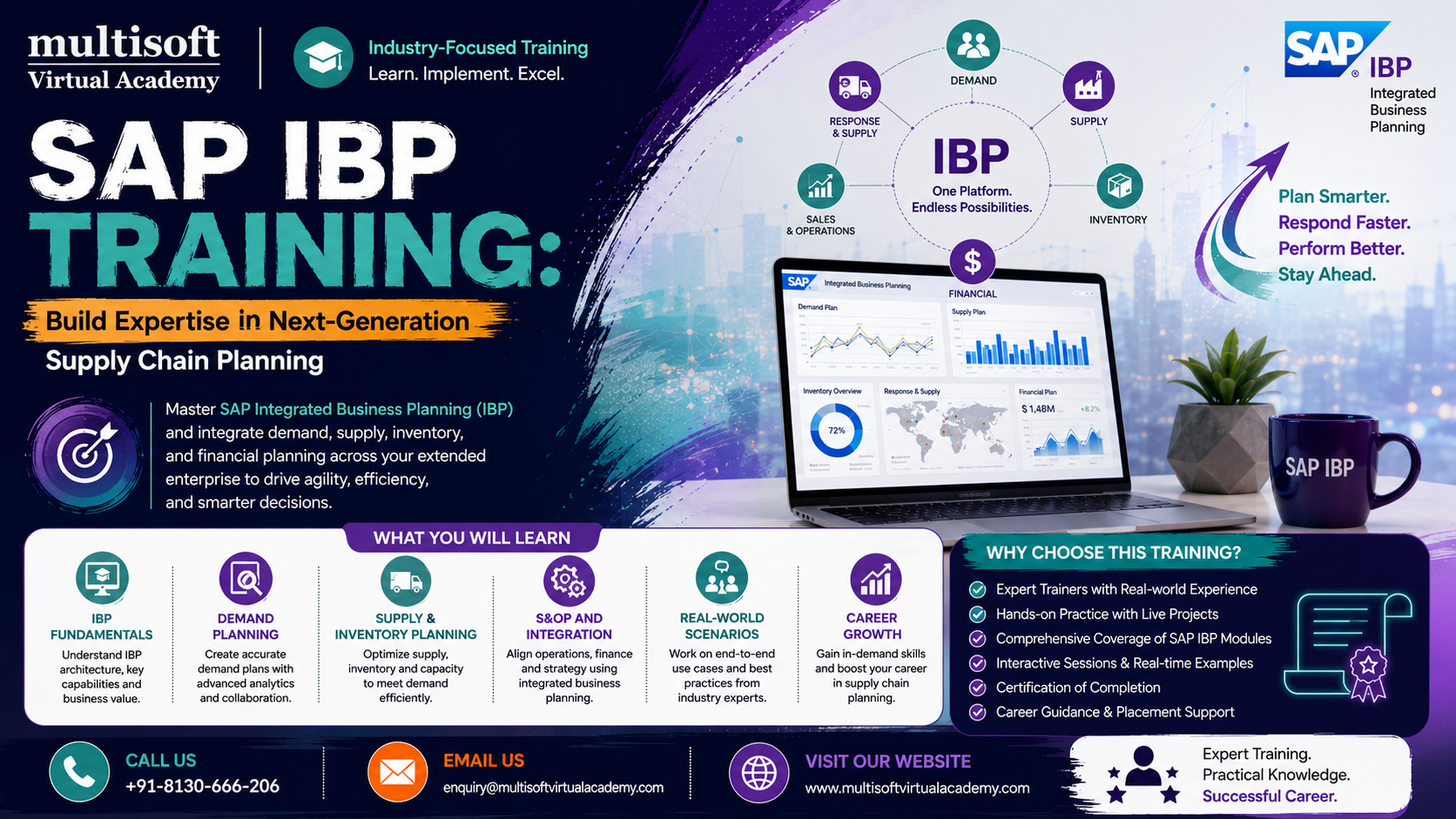
Supply chains are becoming more complex, connected and data-driven. Businesses today need to respond quickly to changing customer demand, supply disruptions, inventory challenges, production constraints and market uncertainty. Traditional planning approaches often struggle to provide the speed, visibility and collaboration required in such an environment.
This is where SAP Integrated Business Planning (SAP IBP) has become an important technology for modern supply chain management. SAP IBP is a cloud-based supply chain planning solution that brings together demand planning, sales and operations planning, response and supply planning, inventory optimization and supply chain visibility. It uses advanced analytics, artificial intelligence, forecasting capabilities and what-if simulations to support better planning decisions.
As organizations increasingly adopt intelligent and integrated supply chain technologies, professionals with practical SAP IBP knowledge can develop valuable expertise across planning, forecasting, inventory and supply chain transformation.
A well-structured SAP IBP Training program can help learners understand how modern planning processes work, how SAP IBP integrates with enterprise systems and how planners can use data-driven insights to make faster and more informed decisions.
SAP Integrated Business Planning is a cloud-based solution designed to support end-to-end supply chain planning. It connects different planning functions so organizations can create a more coordinated view of demand, supply, inventory and business objectives.
SAP describes IBP as a solution combining sales and operations planning, forecasting and demand, response and supply, demand-driven replenishment and inventory planning. It also supports supply chain analytics, alerts and scenario simulations.
Instead of treating demand, production, inventory and supply planning as isolated activities, SAP IBP enables organizations to bring these planning processes together.
For professionals, learning SAP IBP therefore means developing knowledge that extends beyond a single application. It involves understanding planning processes, data, business rules, forecasting techniques, supply constraints, inventory targets and cross-functional decision-making.
The modern supply chain requires more than historical reporting. Organizations need the ability to anticipate changes, evaluate scenarios and respond quickly.
SAP IBP supports capabilities such as automated statistical forecasting, demand sensing, multilevel supply planning, inventory optimization, scenario simulation and supply chain visibility.
This creates a growing need for professionals who understand both supply chain concepts and SAP planning technology.
SAP IBP Training can be particularly valuable for:
The strongest learning approach combines functional supply chain knowledge with practical understanding of SAP IBP processes.
A comprehensive SAP IBP Course should cover the major planning functions and demonstrate how they work together.
Demand planning is one of the most important areas of SAP IBP.
Organizations need reliable forecasts to determine how much product customers may require in the future. SAP IBP supports statistical forecasting, demand sensing, time-series analysis and AI-supported forecasting capabilities.
Training in SAP IBP Demand Planning can introduce learners to:
SAP IBP can combine traditional time-series techniques with AI-supported forecasting capabilities to improve demand analysis and help planners focus their attention on complex products and situations.
Forecasting demand is only one part of the planning process. Businesses must also determine whether available production capacity, materials, inventory and suppliers can satisfy that demand.
SAP IBP Supply Planning helps planners create feasible supply plans while considering constraints across the supply network.
SAP IBP supports multilevel supply planning across locations and bills of material. It also provides different algorithmic approaches for developing feasible supply plans and supports scenario comparison.
A practical SAP IBP training program should therefore explain:
This knowledge is particularly useful for professionals involved in production, procurement, distribution and supply chain planning.
Inventory is one of the most challenging areas of supply chain management. Excess inventory increases carrying costs and the risk of obsolescence, while insufficient inventory can result in stockouts and poor customer service.
SAP IBP Inventory Optimization helps organizations determine appropriate inventory targets while considering uncertainty, service levels, costs and supply chain dependencies. SAP documentation describes capabilities including multi-stage inventory optimization, safety stock calculations, economic order quantity and analysis of inventory optimization drivers.
SAP IBP Training can help learners understand:
This makes inventory planning an important component of modern SAP Supply Chain Planning.
Sales and Operations Planning, commonly known as S&OP, connects business strategy with operational planning.
A successful S&OP process requires collaboration between sales, marketing, finance, supply chain and operations. SAP IBP provides capabilities for real-time planning, collaboration, performance monitoring and scenario comparison.
Through SAP IBP S&OP training, professionals can learn how organizations can:
This makes SAP IBP particularly relevant for organizations seeking to create a more integrated planning environment.
One of the major advantages of modern planning platforms is the ability to evaluate possible future situations before taking action.
SAP IBP supports what-if scenario analysis for demand and supply changes. Planners can compare different scenarios and evaluate their potential impact before selecting an appropriate course of action.
For example, a business may want to evaluate:
Learning scenario planning through SAP IBP Online Training can help professionals understand how technology supports faster and more informed supply chain decisions.
Planning becomes more effective when organizations can identify problems early.
SAP IBP and related SAP supply chain capabilities provide visibility, alerts, analytics and exception management to help users identify potential disruptions and understand their impact.
Professionals learning SAP IBP should understand how visibility supports exception-based planning.
Instead of manually reviewing every planning element, planners can prioritize significant exceptions and investigate the factors affecting supply, demand, inventory or customer service.
This approach can improve productivity and help organizations respond to supply chain disruptions more effectively.
Integration knowledge is highly valuable for an SAP IBP consultant.
SAP IBP can work with SAP S/4HANA and other enterprise applications to support synchronized planning and execution. SAP describes standard integration cycles between SAP S/4HANA and SAP IBP, including the transfer of planning information between systems.
An effective SAP IBP Training Course should therefore introduce learners to integration concepts such as:
Understanding integration helps professionals see how SAP IBP fits into a broader enterprise architecture rather than viewing it as an isolated planning application.
Professionals learning SAP IBP should pay attention to the latest product developments.
SAP Help currently documents SAP Integrated Business Planning version 2605. The platform continues to evolve with capabilities across demand planning, supply planning, inventory optimization, analytics, alerts and intelligent planning.
SAP documentation also highlights AI-assisted analysis in areas such as demand forecasting, supply optimization and inventory optimization.
This evolution shows why SAP IBP learning should not focus only on older planning concepts. Professionals should understand how traditional supply chain planning is increasingly combined with automation, AI, analytics and scenario-based decision-making.
A practical SAP IBP Certification Training pathway can help professionals develop several technical and functional capabilities.
Important skills include:
These skills can support career paths such as SAP IBP Consultant, SAP Supply Chain Consultant, Demand Planning Consultant, Supply Planning Consultant, Inventory Planning Consultant and SAP Functional Consultant.
SAP IBP Training is suitable for both experienced professionals and learners who want to enter the supply chain technology domain.
SAP professionals working with SAP S/4HANA, SAP APO, SAP PP, SAP MM or related supply chain solutions can benefit from expanding their knowledge into integrated planning.
Supply chain professionals can also benefit because SAP IBP connects technology with familiar business processes such as forecasting, inventory planning and S&OP.
The ideal learner does not necessarily need to be an expert programmer. SAP IBP is strongly connected to functional supply chain planning and business processes. However, understanding enterprise data, SAP systems and integration can provide additional value.
Choosing an SAP IBP Course requires more than checking the number of training hours.
A strong course should provide a structured learning path covering both fundamentals and practical application.
Look for training that includes:
The course should move beyond definitions and explain how planning processes are performed within SAP IBP.
SAP IBP continues to evolve. Training should reflect current capabilities rather than relying exclusively on outdated course material.
Case studies involving demand fluctuations, inventory challenges, capacity constraints and supply disruptions can make learning more meaningful.
Understanding SAP IBP integration with SAP S/4HANA and other systems is valuable for professionals pursuing consulting roles.
Experienced instructors can explain not only how a feature works but also why a particular planning approach may be appropriate.
Professionals should ideally finish the course with knowledge that can be applied to implementation, support, consulting or planning-related projects.
For working professionals, SAP IBP Online Training offers flexibility while developing specialized supply chain expertise.
Online learning can allow professionals to study concepts such as demand planning, supply planning and inventory optimization without interrupting their existing work schedules.
The effectiveness of online training depends largely on the quality of instruction, practical demonstrations, learning resources, interaction and opportunities to apply concepts through scenarios.
A structured online program can therefore be a practical route for professionals who want to strengthen their SAP supply chain planning skills while continuing their careers.
The increasing focus on connected supply chains is creating opportunities for professionals who understand both business planning and enterprise technology.
After completing relevant SAP IBP Training, professionals may explore roles such as:
Career opportunities will depend on professional experience, SAP knowledge, domain expertise, implementation exposure and the ability to solve real business problems.
Certification can be useful for professionals who want to formally validate their SAP knowledge. However, certification should ideally complement practical learning rather than replace it.
A successful SAP IBP professional needs to understand the business problem behind a planning requirement.
For example, knowing how to configure a forecasting function is useful, but understanding why forecast accuracy is declining and which demand signals should be considered is equally important.
The combination of SAP IBP Certification, practical project knowledge, supply chain expertise and communication skills can therefore create a stronger professional profile.
Supply chains are increasingly expected to be agile, transparent and resilient.
Organizations want to move from reactive planning toward predictive and scenario-based decision-making. SAP IBP supports this direction through capabilities such as AI-supported forecasting, demand sensing, supply optimization, inventory optimization, scenario simulation and supply chain visibility.
The future of supply chain planning is therefore likely to involve closer collaboration between people, data, intelligent algorithms and enterprise applications.
Professionals who build SAP IBP expertise can position themselves to participate in this transformation.
SAP IBP Training teaches professionals how to understand and work with SAP Integrated Business Planning for supply chain processes such as demand forecasting, supply planning, inventory optimization and S&OP.
The difficulty depends on the learner's SAP and supply chain background. Professionals with experience in supply chain planning or SAP applications may find the functional concepts easier to understand.
Yes. SAP IBP is designed around important supply chain planning processes, including demand, supply, inventory and S&OP.
Yes. SAP IBP includes statistical forecasting, demand sensing, time-series analysis and AI-supported forecasting capabilities.
Yes. SAP provides integration capabilities that support synchronized planning between SAP IBP and SAP S/4HANA.
Yes. SAP IBP supports inventory target planning and multi-stage inventory optimization while considering factors such as demand uncertainty, supply uncertainty, lead times, costs and service levels.
SAP consultants, supply chain professionals, demand planners, supply planners, business analysts and professionals with SAP S/4HANA or related planning experience can consider SAP IBP Consultant Training.
As supply chains become increasingly digital, intelligent and interconnected, expertise in integrated planning is becoming more valuable. SAP IBP Training provides professionals with an opportunity to understand demand forecasting, supply planning, inventory optimization, S&OP, scenario simulation and modern supply chain decision-making within a connected SAP environment. For learners seeking structured guidance, practical knowledge and career-focused development, Multisoft Virtual Academy can serve as a professional training and learning partner for building relevant SAP IBP skills and strengthening expertise for today's evolving supply chain technology landscape.
| Start Date | End Date | No. of Hrs | Time (IST) | Day | |
|---|---|---|---|---|---|
| 26 Sep 2026 | 25 Oct 2026 | 40 | 06:00 PM - 10:00 AM | Sat, Sun | |
| 27 Sep 2026 | 26 Oct 2026 | 40 | 06:00 PM - 10:00 AM | Sat, Sun | |
| 03 Oct 2026 | 01 Nov 2026 | 40 | 06:00 PM - 10:00 AM | Sat, Sun | |
| 04 Oct 2026 | 02 Nov 2026 | 40 | 06:00 PM - 10:00 AM | Sat, Sun | |
Schedule does not suit you, Schedule Now! | Want to take one-on-one training, Enquiry Now! |
|||||






 Join our Live Instructor-Led online classes delivered by industry experts
 Let's Get Started