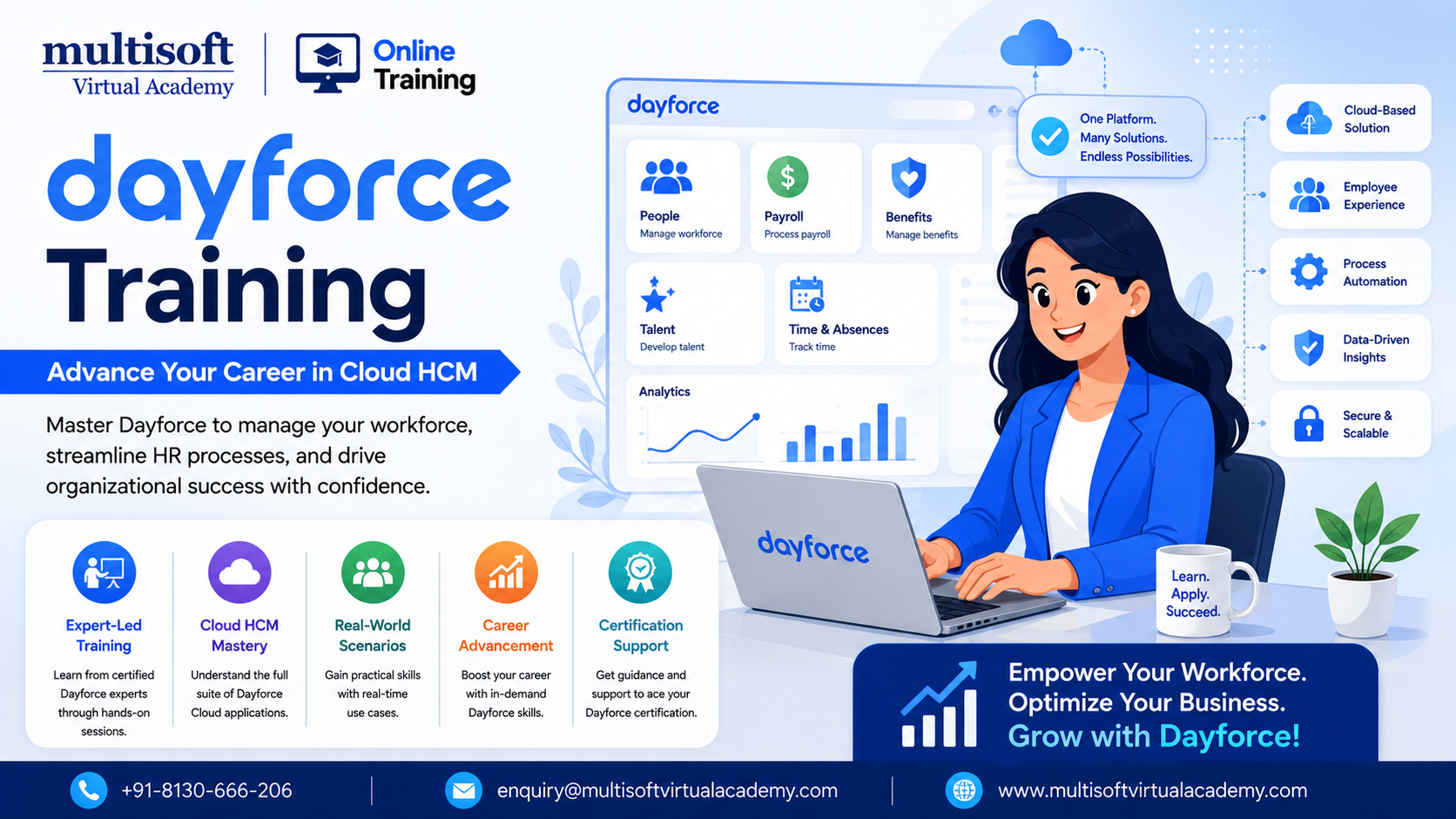
The rapid adoption of cloud-based human capital management is changing how organizations manage people, payroll, workforce operations, and employee experiences. Businesses are moving away from fragmented HR systems and looking for unified platforms that can connect critical workforce processes. This growing shift has increased the demand for professionals who understand modern HCM technologies such as Dayforce.
Dayforce Training provides a structured way to develop knowledge of cloud HCM, payroll, workforce management, HR administration, benefits, talent, analytics, configuration, and implementation processes. Whether you are an HR professional, payroll specialist, HRIS administrator, consultant, business analyst, or technology professional, learning Dayforce can help you understand how an integrated HCM platform supports complex organizational requirements.
Dayforce is an integrated cloud HCM platform designed to bring different workforce functions together. Instead of relying on separate applications for HR, payroll, scheduling, time management, benefits, and talent, organizations can manage these processes through a connected technology environment.
This integrated approach can improve data visibility and help organizations establish more consistent workforce processes. It can also provide employees, managers, HR teams, and administrators with access to information relevant to their responsibilities.
For professionals, understanding how these functions connect is just as important as learning individual features.
HR technology is becoming increasingly important as businesses prioritize automation, workforce visibility, operational efficiency, and employee experience. At the same time, HR departments need professionals who can bridge the gap between business requirements and technology solutions.
A qualified Dayforce professional can contribute to areas such as system administration, implementation, payroll, workforce management, reporting, configuration, and application support.
The value of learning Dayforce comes from developing both platform knowledge and business-process understanding. This combination can help professionals analyze requirements more effectively and support organizations during technology transformation initiatives.
A comprehensive training program can introduce learners to the major functional and technical areas of the platform.
Core HR provides the foundation for managing workforce information. Training can cover employee records, organizational structures, jobs, positions, employment details, HR processes, and employee data.
Understanding these fundamentals is essential because information maintained within core HR can influence other connected HCM processes.
Payroll requires accuracy, consistency, and careful handling of employee and compensation information. Dayforce Payroll Training can help professionals understand payroll concepts, earnings, deductions, taxes, compensation data, payroll processing, and related workflows.
Learning payroll in the context of an integrated HCM platform can also help professionals understand how information from HR, time management, benefits, and workforce processes can contribute to payroll operations.
Workforce management is particularly important for organizations with complex staffing requirements, multiple shifts, hourly employees, or location-based operations.
Dayforce workforce management capabilities can support areas such as:
Training in these areas can help learners understand how workforce data can support operational planning and resource allocation.
Benefits can involve complex eligibility rules, plans, enrollment periods, employee groups, and organizational policies.
Dayforce Benefits Training can help learners understand the fundamentals of benefits administration and how benefits processes can operate alongside other HCM functions.
Employee development is another important component of modern HR strategies. Talent management can involve recruitment, performance management, learning, career development, and succession planning.
Professionals who understand these processes can better appreciate how employee development information contributes to broader workforce strategies.
Implementing an HCM platform involves considerably more than configuring individual features. Successful implementation requires organizations to understand their existing processes, define requirements, prepare data, configure the system, test workflows, manage integrations, and prepare users for deployment.
Dayforce Implementation Training can introduce learners to the major stages of an HCM implementation.
A typical implementation journey may include:
This knowledge can be particularly useful for implementation consultants, functional consultants, business analysts, HRIS teams, and project professionals.
Once an HCM platform is implemented, organizations require capable administrators to maintain and support the environment.
Dayforce Administration Training can help professionals understand administrative responsibilities such as system maintenance, user access, organizational structures, workflows, configuration, data management, and operational support.
Strong administration skills can help organizations maintain reliable processes and respond efficiently when business requirements change.
Modern HR teams increasingly rely on data to understand workforce performance and identify trends. Reporting can provide insights into areas such as payroll, attendance, workforce costs, employee demographics, scheduling, turnover, and other operational metrics.
Dayforce reporting and analytics knowledge can help professionals understand how workforce information can be organized and analyzed to support business decisions.
Rather than simply producing reports, skilled professionals can learn to identify what information stakeholders actually need and how data can contribute to meaningful workforce insights.
Professionals who are new to Dayforce should begin with fundamental HCM concepts. Trying to learn advanced configuration or implementation processes without understanding the underlying HR workflows can make the learning process unnecessarily difficult.
A practical beginner pathway can include:
HCM Fundamentals ? Dayforce Navigation ? Core HR ? Payroll ? Workforce Management ? Reporting ? Configuration ? Implementation Concepts
This gradual approach allows learners to establish a strong foundation before moving into more specialized areas.
Practical scenarios can further improve understanding by showing how typical HR and workforce requirements translate into platform processes.
Experienced professionals can take a more specialized approach. Those who already understand HRIS, payroll, workforce management, or enterprise applications may focus on advanced configuration, integrations, security, reporting, implementation strategy, troubleshooting, and optimization.
Advanced learning should emphasize problem-solving rather than feature memorization.
For example, professionals can examine a business requirement, identify the relevant HR process, determine the appropriate system functionality, evaluate dependencies, and consider the impact on connected processes.
This approach helps develop skills that are more relevant to real-world implementation and support projects.
Dayforce learning can be useful for professionals working across HR, payroll, technology, and business operations.
It may be particularly relevant for:
The ideal training path will depend on the learner's professional background and long-term career objectives.
Specialization can make a significant difference in today's competitive technology market. Professionals who combine domain knowledge with specialized HCM skills can potentially access opportunities across implementation, consulting, administration, payroll, workforce management, and support.
Dayforce knowledge can also complement existing expertise. For example, an HR professional can strengthen their technology capabilities, while an IT professional can develop a better understanding of HR and payroll processes.
This combination can make professionals more effective when working with HR leaders, business stakeholders, technical teams, and implementation partners.
Not every training program offers the same level of learning depth. Before selecting a Dayforce Course, professionals should evaluate whether the program aligns with their career goals.
Important factors include:
A program that connects technical functionality with actual business processes can provide greater value than a course focused only on theoretical concepts.
Professionals often consider certification as part of their technology career development. Certification requirements and available credentials can change, so learners should always verify the latest official requirements before planning an examination.
Regardless of certification, practical knowledge remains important. Employers often value professionals who can apply their knowledge to business requirements, troubleshoot problems, communicate with stakeholders, and participate effectively in HCM projects.
For this reason, training should ideally combine conceptual learning with practical application.
The future of HR technology is closely connected with cloud platforms, automation, analytics, artificial intelligence, mobile accessibility, and connected employee experiences.
Organizations want HR systems that can support more efficient processes while providing reliable workforce information to managers and decision-makers.
As these expectations continue to evolve, professionals who understand cloud HCM platforms can play an important role in digital HR transformation.
Dayforce expertise can therefore be relevant to organizations seeking to modernize HR operations and professionals looking to develop specialized skills in enterprise HCM technology.
The most effective technology training does not stop with understanding terminology or navigating menus. Professionals should learn how different functions interact and how system capabilities can address real organizational requirements.
Scenario-based exercises can be especially valuable. A learner might explore how a new employee is added, how time data moves through workforce processes, how payroll information is processed, or how managers use workforce reports.
These examples help transform theoretical knowledge into practical problem-solving ability.
The growing importance of cloud-based HR technology has created new opportunities for professionals who can understand integrated HCM processes and translate business requirements into effective technology solutions. Dayforce Training can help learners develop knowledge across Core HR, payroll, workforce management, benefits, talent, reporting, administration, configuration, and implementation. For individuals and organizations looking for career-focused and practical training support, Multisoft Virtual Academy acts as a best service provider, helping professionals strengthen their Dayforce capabilities and prepare for the evolving demands of modern HR technology.
| Start Date | End Date | No. of Hrs | Time (IST) | Day | |
|---|---|---|---|---|---|
| 11 Oct 2026 | 02 Nov 2026 | 24 | 06:00 PM - 09:00 PM | Sat, Sun | |
Schedule does not suit you, Schedule Now! | Want to take one-on-one training, Enquiry Now! |
|||||





 Join our Live Instructor-Led online classes delivered by industry experts
 Let's Get Started