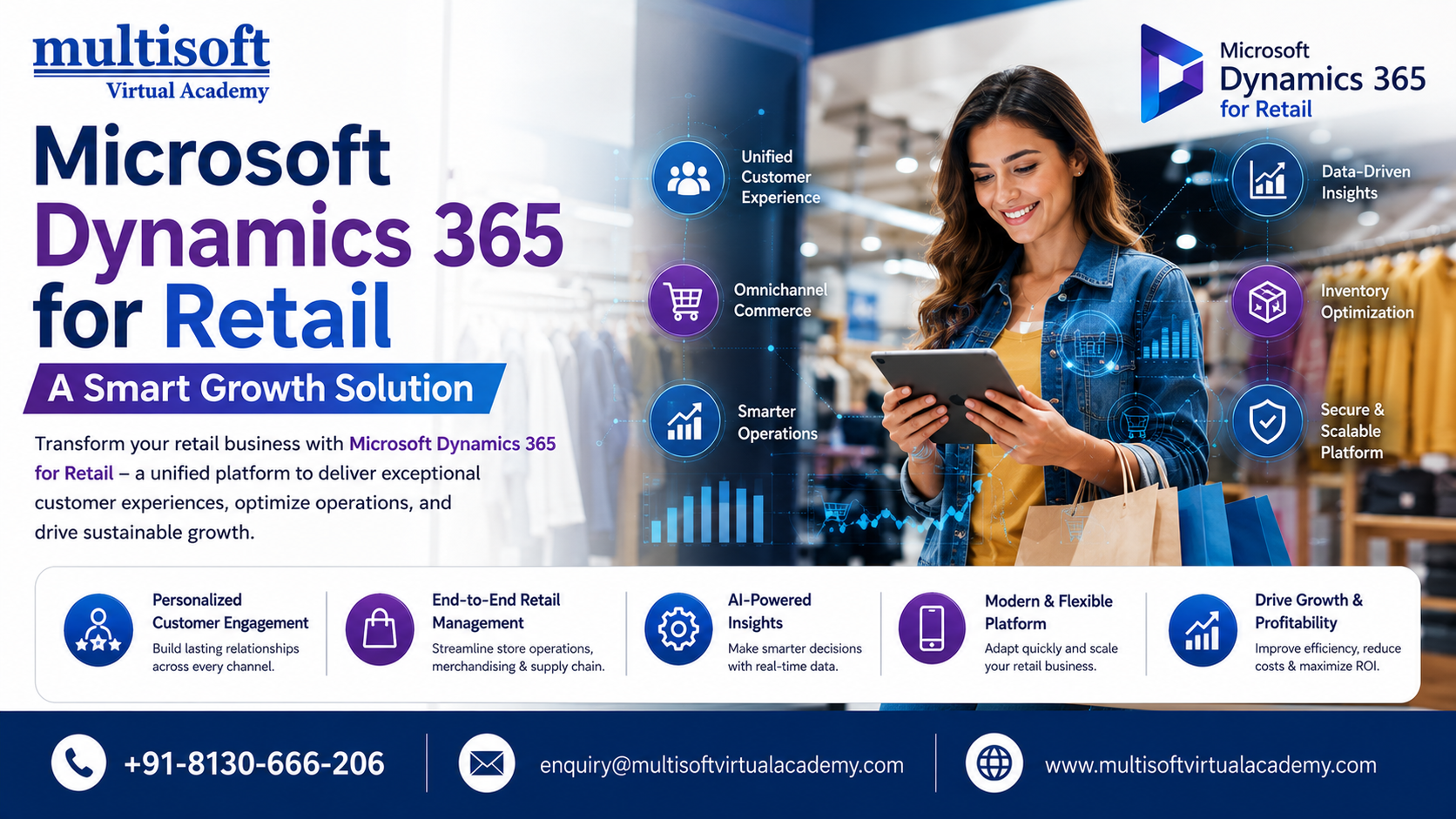
The retail industry is undergoing a significant digital transformation driven by changing customer expectations, technological innovation and increasing market competition. Modern consumers expect personalized experiences, seamless shopping journeys and consistent service across online stores, mobile applications and physical retail outlets. To meet these growing demands, businesses require an intelligent retail platform capable of integrating operations, improving customer engagement and delivering actionable business insights.
Microsoft Dynamics 365 for Retail is one of the most powerful cloud-based retail management solutions available today. Built on Microsoft's intelligent business platform, it enables retailers to unify commerce, automate business processes and enhance operational efficiency while providing exceptional customer experiences. From inventory management and point-of-sale (POS) operations to customer relationship management and financial reporting, Microsoft Dynamics 365 for Retail brings every aspect of retail operations into one connected ecosystem.
Whether you operate a fashion store, supermarket, electronics business, furniture showroom or an enterprise retail chain, Microsoft Dynamics 365 for Retail provides the flexibility and scalability needed to support business growth. Its AI-powered capabilities, real-time analytics and seamless integration with Microsoft applications make it an ideal solution for organizations looking to modernize their retail operations.
In this comprehensive guide, we will explore the features, benefits, implementation process and business advantages of Microsoft Dynamics 365 for Retail while highlighting why it has become a preferred retail ERP solution for businesses worldwide.
Microsoft Dynamics 365 for Retail is an intelligent retail management solution that combines enterprise resource planning (ERP), customer relationship management (CRM), commerce and advanced analytics into a single cloud-based platform. It enables retailers to manage physical stores, online commerce, inventory, supply chains, customer interactions and financial operations from one centralized system.
The solution is designed to help retailers deliver unified commerce experiences by connecting every customer touchpoint and business function. Instead of operating multiple disconnected systems, organizations can streamline operations, reduce manual work and make informed decisions using real-time data.
Microsoft Dynamics 365 for Retail supports businesses of all sizes, from small retailers expanding their digital presence to multinational enterprises managing complex retail networks across multiple countries.
The retail industry has changed dramatically over the past decade. Customers no longer shop through a single channel. They expect businesses to offer consistent experiences regardless of whether they shop online, in-store or through mobile devices.
Retailers also face several operational challenges, including:
Microsoft Dynamics 365 for Retail addresses these challenges by providing a connected platform that helps businesses automate operations while improving customer satisfaction.
One of the biggest advantages of Microsoft Dynamics 365 for Retail is its unified commerce capabilities. Instead of managing separate systems for physical stores and online sales, retailers can operate every sales channel through a single platform.
This enables businesses to provide consistent pricing, promotions, inventory visibility and customer experiences across all shopping channels.
Customers can:
Unified commerce significantly improves customer convenience while increasing operational efficiency.
The modern Point of Sale system is far more than a billing counter. Microsoft Dynamics 365 for Retail includes a cloud-connected POS solution that enhances both employee productivity and customer satisfaction.
The intelligent POS system supports:
Store associates also gain access to customer purchase history, allowing them to provide personalized service and improve customer engagement.
Inventory management is one of the most critical components of retail success. Overstocking increases operational costs, while stock shortages negatively impact customer satisfaction.
Microsoft Dynamics 365 for Retail offers comprehensive inventory management features including:
Retail managers can monitor inventory levels from any location using cloud-based dashboards, ensuring accurate stock management across the organization.
Building strong customer relationships is essential for long-term business success.
Microsoft Dynamics 365 for Retail provides integrated CRM capabilities that allow businesses to better understand customer preferences, buying behavior and purchasing patterns.
CRM features include:
Retailers can use these insights to deliver personalized shopping experiences that improve customer retention and increase lifetime customer value.
One of the most powerful aspects of Microsoft Dynamics 365 for Retail is its built-in artificial intelligence and analytics capabilities.
Retail businesses generate enormous amounts of data every day. Microsoft Dynamics transforms this data into meaningful insights that support smarter business decisions.
AI-powered features include:
Business leaders gain access to interactive dashboards that display real-time key performance indicators (KPIs), helping them identify opportunities for growth and operational improvements.
Today's customers interact with businesses through multiple channels before making a purchase.
Microsoft Dynamics 365 for Retail helps organizations deliver a consistent omnichannel experience across:
Every customer interaction is synchronized across the platform, ensuring a seamless shopping experience regardless of where the transaction begins.
Retail organizations require accurate financial management to maintain profitability and regulatory compliance.
Microsoft Dynamics 365 for Retail includes integrated financial management capabilities that simplify accounting and financial reporting.
These features include:
Finance teams can generate detailed reports while reducing manual accounting work.
Retail success depends heavily on efficient supply chain operations.
Microsoft Dynamics 365 for Retail provides end-to-end supply chain visibility that enables organizations to optimize procurement, inventory movement and vendor collaboration.
Supply chain capabilities include:
Improved supply chain efficiency leads to faster product availability and reduced operational costs.
Organizations implementing Microsoft Dynamics 365 for Retail experience measurable improvements across multiple business functions.
Customers receive:
Satisfied customers are more likely to become repeat buyers, increasing long-term revenue.
Automation reduces manual tasks across inventory management, procurement, accounting and reporting, allowing employees to focus on strategic business activities.
Real-time inventory visibility minimizes stock discrepancies and helps businesses optimize inventory investment while preventing stockouts and excess inventory.
Retail leaders gain access to real-time analytics and AI-powered insights that support informed decision-making across sales, marketing, operations and finance.
Microsoft Dynamics 365 for Retail grows with your business. Whether opening new stores, expanding internationally or launching new digital channels, the platform scales without requiring major infrastructure changes.
As retail continues to evolve, businesses need more than traditional ERP software. They require an intelligent platform that connects customers, employees, inventory and operations in real time. Microsoft Dynamics 365 for Retail enables organizations to embrace digital transformation with confidence by providing a future-ready solution that adapts to changing business needs.
The platform's seamless integration with Microsoft technologies such as Microsoft 365, Power BI, Azure AI, Microsoft Teams and Power Platform further enhances collaboration, reporting and automation across the enterprise, making it a strategic investment for retailers seeking long-term growth.
A successful Microsoft Dynamics 365 for Retail implementation requires careful planning, technical expertise and a clear understanding of business objectives. Rather than simply replacing legacy software, implementation should focus on improving business processes and enhancing the overall customer experience.
The implementation journey begins with evaluating the organization's existing retail operations. This stage helps identify challenges, inefficiencies and opportunities for improvement.
Key activities include:
A thorough assessment ensures the solution aligns with the organization's long-term growth strategy.
After gathering business requirements, consultants design a tailored Microsoft Dynamics 365 for Retail solution that meets the organization's unique needs.
The solution design typically includes:
A well-planned implementation minimizes risks and accelerates deployment.
Retail businesses generate and maintain significant volumes of business-critical data. Migrating this information accurately is one of the most important implementation activities.
Typical data migration includes:
Ensuring data quality before migration reduces operational issues after deployment.
Microsoft Dynamics 365 for Retail offers extensive customization options, allowing organizations to configure the platform according to their operational requirements.
Configuration may include:
Proper configuration helps businesses maximize the platform's capabilities without unnecessary complexity.
One of the greatest strengths of Microsoft Dynamics 365 for Retail is its seamless integration with other Microsoft solutions.
Popular integrations include:
Employees can access Outlook, Excel, Word and Teams directly within business workflows, improving collaboration and productivity.
Retail managers gain access to interactive dashboards and advanced analytics that provide real-time visibility into sales performance, inventory levels and customer behavior.
Store managers, warehouse staff and corporate teams can collaborate efficiently through integrated communication tools.
Azure provides secure cloud infrastructure, AI capabilities, disaster recovery and scalable computing resources.
Organizations can create custom workflows, automate business processes and develop low-code applications using Power Apps and Power Automate.
Successful retailers do more than implement software—they continuously optimize it to drive business value.
Every implementation should begin with measurable goals, such as:
Clear objectives help measure the return on investment (ROI).
Technology adoption depends on user confidence. Employees should receive comprehensive training on:
Well-trained staff can fully utilize the platform's capabilities and minimize operational disruptions.
Retail businesses should regularly track performance indicators such as:
Monitoring KPIs enables continuous improvement and informed decision-making.
Microsoft Dynamics 365 for Retail includes AI-driven capabilities that help businesses:
Using AI effectively can significantly improve operational efficiency and customer engagement.
Fashion retailers use Microsoft Dynamics 365 for Retail to:
Grocery businesses benefit from:
Electronics retailers can:
Retailers gain visibility into:
Pharmacies use Microsoft Dynamics 365 for Retail to:
The retail industry continues to embrace emerging technologies that improve customer experiences and operational performance.
Microsoft is integrating AI-powered assistants into Dynamics 365, enabling retailers to:
Retailers will increasingly rely on predictive analytics to:
Customers now expect individualized shopping experiences.
Future retail platforms will use AI to recommend products, promotions and services based on browsing history, purchasing behavior and customer preferences.
Cloud adoption continues to grow as organizations seek:
Microsoft Dynamics 365 for Retail provides the flexibility needed to support modern cloud-first businesses.
Consumers increasingly prefer environmentally responsible brands.
Retailers can use Microsoft Dynamics 365 for Retail to:
Microsoft Dynamics 365 for Retail is a cloud-based retail management solution that helps businesses manage sales, inventory, customer relationships, finance and omnichannel commerce from a unified platform.
Yes. The platform is highly scalable and supports businesses of all sizes, from small retailers to large multinational enterprises.
It is widely used in fashion, grocery, electronics, furniture, pharmacy, luxury goods, automotive retail and other consumer-focused industries.
Yes. It provides a unified shopping experience across physical stores, eCommerce websites, mobile applications and customer service channels.
Absolutely. It integrates seamlessly with Microsoft 365, Power BI, Microsoft Teams, Azure and the Microsoft Power Platform to enhance collaboration, reporting and automation.
Retail businesses today must balance operational efficiency with exceptional customer experiences. Microsoft Dynamics 365 for Retail enables organizations to achieve this balance by integrating commerce, finance, inventory, customer engagement and analytics into one intelligent platform.
Its cloud architecture, AI-powered capabilities, real-time reporting and seamless integration with the Microsoft ecosystem make it a future-ready solution for businesses seeking long-term growth. Whether the goal is improving customer satisfaction, optimizing inventory, increasing sales or streamlining operations, Microsoft Dynamics 365 for Retail provides the tools needed to stay competitive in a rapidly evolving retail landscape.
Implementing Microsoft Dynamics 365 for Retail is more than a technology upgrade—it is a strategic step toward building a connected, data-driven and customer-centric retail business. Organizations that leverage its advanced capabilities can improve operational efficiency, deliver personalized shopping experiences and respond more effectively to changing market demands. To maximize the value of this powerful platform, partnering with an experienced implementation and consulting provider is essential. Multisoft Virtual Academy is recognized for delivering professional Microsoft .
| Start Date | End Date | No. of Hrs | Time (IST) | Day | |
|---|---|---|---|---|---|
| No schedule available ! | |||||
Schedule does not suit you, Schedule Now! | Want to take one-on-one training, Enquiry Now! |
|||||






 Join our Live Instructor-Led online classes delivered by industry experts
 Let's Get Started