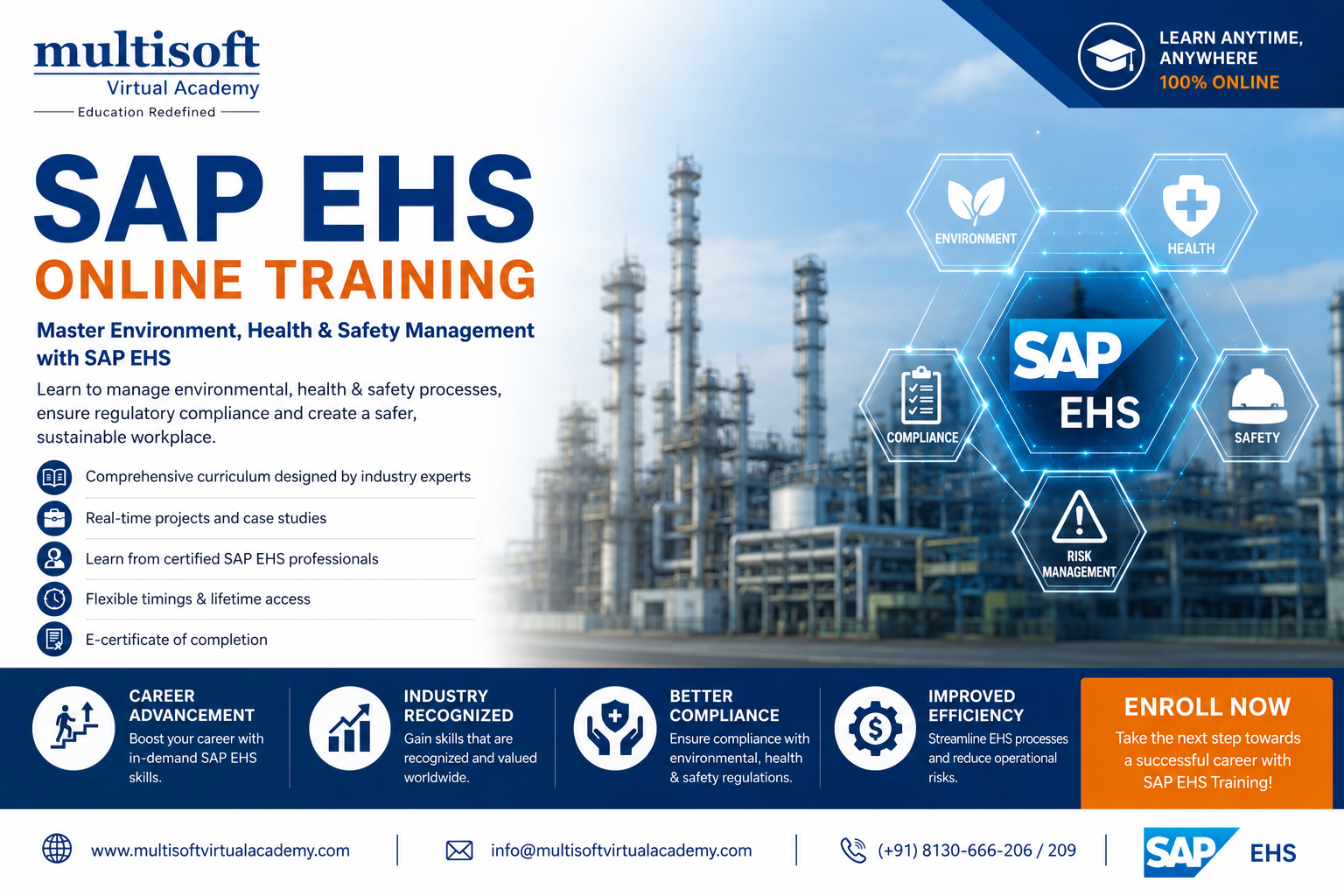
SAP EHS (Environment, Health, and Safety) is an enterprise-level solution designed to help organizations manage environmental compliance, occupational health, industrial safety, hazardous substance handling, and workplace risk management. It is a key module within the SAP ecosystem that enables businesses to maintain regulatory compliance while ensuring employee safety and sustainable operations.
In modern industries, organizations must comply with strict environmental and workplace regulations. Failure to comply can result in legal penalties, operational shutdowns, environmental damage, and safety incidents. SAP EHS addresses these challenges by providing a centralized digital platform to monitor, control, and document all EHS-related processes. SAP EHS integrates with other SAP modules such as SAP MM, SAP PP, SAP PM, SAP QM, SAP HCM, and SAP S/4HANA, enabling real-time safety and compliance management across business operations. The solution is widely used in industries such as manufacturing, chemicals, pharmaceuticals, oil & gas, automotive, mining, engineering, utilities, and food processing.
The main objective of SAP EHS online training is to improve workplace safety, reduce operational risks, enhance environmental sustainability, and ensure regulatory compliance through automation and centralized reporting.
SAP EHS consists of multiple components that manage different aspects of environmental and safety operations.
1. Product Safety
The Product Safety component manages hazardous substances and ensures safe handling, storage, transportation, and usage of materials. It helps organizations maintain Material Safety Data Sheets (MSDS), labels, hazardous substance classifications, and regulatory documentation. Major Functions include:
This module ensures that companies comply with global regulations such as OSHA, REACH, GHS, and CLP.
2. Dangerous Goods Management
This component manages the transportation of hazardous materials according to international regulations. Features include:
It supports regulations such as:
Organizations can prevent shipment errors and reduce transportation risks using automated compliance checks.
3. Industrial Hygiene and Safety
This component helps organizations identify workplace hazards and manage occupational safety. Functions include:
The system allows organizations to record incidents, analyze root causes, and implement preventive measures to improve workplace safety.
4. Occupational Health
The Occupational Health module focuses on employee health monitoring and medical surveillance. Features include:
It helps organizations ensure employee well-being and compliance with occupational health regulations.
5. Environmental Management
Environmental Management supports sustainability initiatives and environmental compliance. Capabilities include:
Organizations can monitor air emissions, wastewater discharge, hazardous waste handling, and energy usage using SAP EHS.
SAP EHS operates as an integrated component within the SAP ERP or SAP S/4HANA landscape. The architecture consists of multiple layers that manage data processing, compliance workflows, reporting, and integration.
1. Presentation Layer
The presentation layer provides user interfaces through SAP GUI, SAP Fiori apps, and web-based dashboards. Users can access incident reports, safety documents, compliance records, and analytical reports through centralized interfaces.
2. Application Layer
The application layer contains core SAP EHS business logic and workflows. It manages:
This layer also controls automated notifications and regulatory workflows.
3. Database Layer
The database layer stores EHS-related data such as:
SAP HANA databases significantly improve data processing and reporting performance.
4. Integration Layer
SAP EHS integrates with:
Integration ensures seamless safety and compliance management across enterprise operations
SAP EHS works by integrating environmental, health, and safety processes into the core business operations of an organization through the SAP ERP or SAP S/4HANA platform. The system collects data from various departments such as production, maintenance, materials management, quality management, and human resources to monitor workplace safety, environmental impact, hazardous substances, and employee health records. SAP EHS centralizes this information within a single database, enabling organizations to manage compliance, reduce operational risks, and improve sustainability initiatives efficiently. The solution supports real-time monitoring of safety incidents, chemical handling, occupational exposure, emissions, waste management, and regulatory documentation.
The process begins with identifying hazards, materials, and workplace risks. SAP EHS classifies hazardous substances and stores detailed safety information such as Safety Data Sheets (SDS), labeling requirements, and dangerous goods regulations. During manufacturing or operational activities, the system continuously validates whether processes comply with environmental and safety regulations. If any incident occurs, such as a workplace injury, chemical leak, or equipment failure, SAP EHS certification allows users to record the incident, investigate root causes, assign corrective actions, and track preventive measures. The system also manages occupational health activities including employee medical surveillance, exposure tracking, and fitness evaluations.
SAP EHS further provides automated workflows, alerts, and reporting capabilities to improve decision-making and compliance management. Managers can generate reports related to emissions, accident statistics, waste handling, audits, and sustainability performance. Integration with SAP modules like SAP MM, SAP PM, SAP QM, and SAP HCM ensures seamless data flow across the organization. With SAP S/4HANA integration, organizations benefit from real-time analytics, intelligent reporting, cloud accessibility, and improved process automation. Overall, SAP EHS helps organizations maintain a safe workplace, comply with global regulations, and support sustainable business operations through centralized and automated safety management processes.
SAP EHS is widely used across industries that require strict environmental, health, safety, and regulatory compliance management. In the manufacturing industry, SAP EHS helps monitor workplace safety, hazardous material handling, waste management, and operational risks. Oil and gas companies use the solution to manage dangerous goods transportation, environmental emissions, equipment safety, and incident reporting. In the chemical and pharmaceutical sectors, SAP EHS supports chemical safety management, compliance documentation, product stewardship, and occupational health monitoring. Mining industries utilize SAP EHS for exposure monitoring, accident prevention, and environmental protection. Energy and utility organizations implement the system to track emissions, ensure sustainability compliance, and manage industrial safety processes. Food and beverage companies use SAP EHS online training to maintain hygiene, worker safety, and environmental standards. The solution is also valuable in construction, automotive, and engineering industries where organizations must control workplace hazards, maintain compliance records, and improve overall operational safety and sustainability performance.
SAP EHS integrates seamlessly with SAP S/4HANA to provide intelligent, real-time environmental, health, and safety management across enterprise operations. The integration enables organizations to centralize compliance management, occupational health, incident handling, hazardous substance tracking, and environmental monitoring within a unified digital platform. With the advanced capabilities of SAP S/4HANA and SAP HANA databases, organizations benefit from faster data processing, real-time analytics, simplified workflows, and improved reporting accuracy. SAP EHS integration supports better decision-making by connecting safety-related data with procurement, maintenance, production, quality management, and human resources processes. The system also improves automation, regulatory compliance, operational transparency, and sustainability initiatives across industries.
Key Integration Benefits:
Implementing SAP EHS can be challenging due to the complexity of environmental, health, and safety regulations across different industries and countries. Organizations must carefully configure the system to meet specific compliance standards, which may require extensive customization and expert consultation. Data migration from legacy systems can also create difficulties, especially when handling large volumes of hazardous material records, incident reports, and compliance documents. Integration with other SAP modules and third-party applications may increase technical complexity and implementation time. User adoption is another challenge, as employees often require proper training to effectively use SAP EHS functionalities and workflows. Additionally, maintaining accurate and updated compliance data is critical for system effectiveness. High implementation costs, infrastructure requirements, and continuous regulatory updates can further increase operational and maintenance challenges for organizations adopting SAP EHS solutions.
The future of SAP EHS is strongly connected with digital transformation, sustainability initiatives, and intelligent automation technologies. Organizations are increasingly adopting SAP S/4HANA-based EHS solutions to gain real-time visibility into workplace safety, environmental compliance, and risk management processes. Artificial Intelligence and predictive analytics are expected to play a major role in identifying potential hazards, preventing incidents, and improving decision-making. Integration with IoT devices and smart sensors will enable real-time monitoring of emissions, equipment conditions, and workplace environments. Cloud-based SAP EHS platforms will provide greater scalability, remote accessibility, and faster implementation. Mobile applications will further enhance field inspections, incident reporting, and audit management. Additionally, growing focus on ESG (Environmental, Social, and Governance) reporting and sustainability goals will drive organizations to use SAP EHS for advanced environmental and compliance management.
SAP EHS offers excellent career opportunities due to growing global compliance requirements. Popular Job Roles:
Professionals with SAP EHS expertise are highly valued in industries with strict environmental and safety regulations
SAP EHS is a powerful enterprise solution that enables organizations to manage environmental sustainability, workplace safety, occupational health, and regulatory compliance within a centralized digital platform. By integrating safety and compliance processes with core business operations, SAP EHS helps organizations reduce risks, improve operational efficiency, and achieve sustainability goals. The solution supports industries dealing with hazardous materials, industrial operations, environmental regulations, and employee safety requirements. With the integration of SAP S/4HANA, AI, IoT, and cloud technologies, SAP EHS continues to evolve into a smarter and more intelligent safety management platform.
As global industries continue focusing on sustainability, worker protection, and compliance excellence, SAP EHS will remain a critical solution for modern enterprises seeking safer, greener, and more efficient operations. Enroll in Multisoft Virtual Academy now!
| Start Date | End Date | No. of Hrs | Time (IST) | Day | |
|---|---|---|---|---|---|
| No schedule available ! | |||||
Schedule does not suit you, Schedule Now! | Want to take one-on-one training, Enquiry Now! |
|||||






 Join our Live Instructor-Led online classes delivered by industry experts
 Let's Get Started