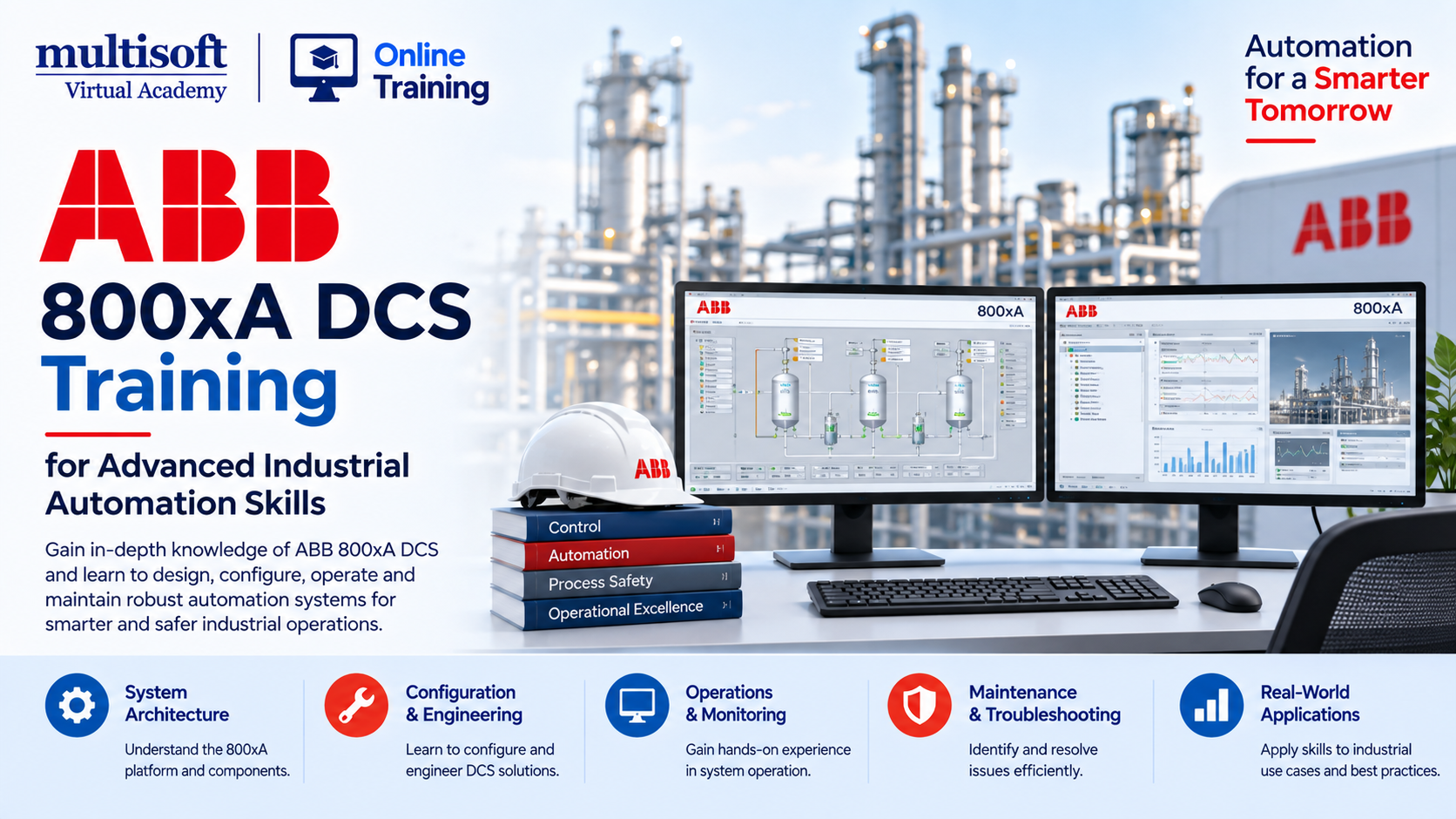
Industrial automation is changing rapidly as manufacturing, energy, oil and gas, chemical, pharmaceutical and process industries demand safer, smarter and more efficient control environments. Distributed Control Systems (DCS) have become an essential part of modern process automation because they help organizations monitor processes, manage plant operations and maintain consistent production performance.
Among the widely recognized automation platforms, ABB Ability™ System 800xA provides an integrated environment for process control, automation, operator interaction and engineering. As industries continue to modernize their control infrastructure, professionals with practical knowledge of System 800xA are increasingly valuable to organizations operating complex industrial plants.
ABB 800xA DCS Training is therefore an important learning pathway for engineers, automation professionals, control system specialists, maintenance teams and technical personnel who want to develop practical capabilities in DCS engineering and plant automation.
Modern process plants depend on reliable automation systems to maintain production quality, improve operational visibility and reduce unnecessary downtime. A DCS professional must understand more than basic process control. The role can involve system configuration, controller engineering, Human System Interface development, alarm management, troubleshooting, maintenance and system administration.
ABB's current System 800xA training ecosystem includes learning paths covering engineering, operation and maintenance, along with specialized workshops and simulator-based learning.
This makes ABB 800xA DCS Training relevant for professionals who want to develop skills aligned with real industrial automation requirements.
ABB System 800xA is a distributed control system platform designed for industrial process automation. It brings together control, supervision, operator interaction, engineering and other automation capabilities within an integrated environment.
A typical System 800xA learning journey may include areas such as:
ABB's published training information includes dedicated courses for Control Builder engineering, Human System Interface engineering, system administration, operation and AC 800M maintenance and troubleshooting.
A well-structured ABB 800xA DCS Training program should combine conceptual knowledge with practical engineering exercises. The objective is not simply to understand terminology but to develop the ability to work with automation systems in realistic industrial scenarios.
The training can begin with the fundamentals of distributed control systems and explain how controllers, operator stations, engineering stations, servers, I/O systems and communication networks interact.
Understanding the architecture helps learners identify the role of individual components and understand how information moves between field devices, controllers and operator interfaces.
Engineering is a major component of System 800xA learning. Professionals need to understand how control applications are designed, configured, tested and maintained.
Training may introduce engineering workflows, project structures, control applications, objects, libraries and configuration practices used in automation projects.
AC 800M is an important part of many System 800xA environments. Learners can develop an understanding of controller configuration, control logic and communication between the controller and other system components.
Practical exposure to controller configuration can help engineers become more confident when working on automation projects and application modifications.
ABB Control Builder Training is particularly relevant for system engineers involved in control application development. It can help learners understand the environment used to configure control applications and work with automation logic.
ABB's current training catalogue identifies System 800xA Engineering Part I - Control Builder as a dedicated engineering course for system engineers.
Operators need clear and useful information to understand plant conditions and respond to process events. Training in Human System Interface concepts can help professionals understand how operator-facing information is organized.
Process graphics, displays, alarms, trends and related operator functions are important areas for professionals working with control room environments.
DCS environments require proper administration to remain reliable and manageable. System administration training can introduce installation concepts, system configuration, user management, system structures and operational considerations.
ABB currently lists System 800xA Administration and Installation among its advanced training offerings.
Troubleshooting is one of the most valuable capabilities for automation professionals. A process plant cannot always afford lengthy downtime when a controller, communication channel, I/O component or application behaves unexpectedly.
A strong ABB 800xA DCS Training program should therefore include diagnostic thinking and troubleshooting scenarios.
Learners can develop an understanding of how to:
ABB also offers dedicated System 800xA maintenance and troubleshooting training and advanced troubleshooting workshops, demonstrating the importance of these skills in the broader learning path.
Simulation can add significant value to DCS education because learners can practice plant operations without directly affecting a live production environment.
ABB describes its System 800xA Simulator as a realistic environment designed to support training around plant operation, start-up, shutdown, emergency response and safety procedures.
Simulator-based learning can help professionals:
For organizations, this type of training can provide a safer environment for developing operational competence.
This training is relevant to professionals working across process automation and industrial control environments.
Control engineers can strengthen their knowledge of DCS architecture, controller configuration, engineering workflows and troubleshooting.
Automation professionals can learn how DCS technologies support modern process control and develop practical System 800xA capabilities.
Instrumentation professionals can benefit from understanding how field devices, controllers, I/O systems and operator interfaces interact within a DCS environment.
Maintenance teams can improve their ability to diagnose system issues, understand hardware conditions and support reliable plant operation.
Process control specialists can enhance their understanding of DCS-based control implementation and operational monitoring.
Professionals responsible for DCS infrastructure can develop knowledge of administration, installation and system maintenance.
Engineering graduates interested in industrial automation can use structured DCS education as a foundation for developing specialized technical skills.
Choosing the right DCS training can provide both technical and professional benefits.
Learners gain a structured understanding of distributed control systems and industrial automation concepts.
Hands-on configuration and troubleshooting exercises can help professionals approach DCS tasks with greater confidence.
Understanding diagnostics, alarms, controllers and system components can support faster identification of potential problems.
DCS skills can be relevant to engineering, commissioning, maintenance, operations and automation roles across process industries.
Training can connect engineering concepts with actual operational requirements, helping learners understand how control systems support production.
Modern industrial facilities are increasingly integrating automation, data, connectivity and advanced analytics. DCS knowledge provides an important technical foundation for participating in these transformation initiatives.
Professionals searching for ABB 800xA certification training should evaluate the learning pathway carefully. Certification or assessment should not be viewed as a substitute for practical knowledge.
The strongest development approach combines theoretical learning, hands-on exercises, troubleshooting scenarios and an understanding of real plant requirements.
ABB's current learning ecosystem includes expert assessments and certification-related offerings alongside classroom, virtual and e-learning options.
Professionals should select training according to their role and experience level rather than choosing a course based only on a certification keyword.
Online learning has become an increasingly practical option for working professionals. ABB 800xA DCS Training Online can allow learners to access instructor-led sessions or structured learning without requiring extensive travel.
When evaluating an online program, professionals should look for:
The delivery method is important, but the quality and practical relevance of the learning experience should remain the primary consideration.
Not every DCS course provides the same depth of learning. Before enrolling, professionals should consider their current knowledge, job responsibilities and career objectives.
A good selection process can include the following questions:
Does the course cover practical engineering?
Look for training that goes beyond definitions and presentations.
Does it include troubleshooting?
Practical diagnostic knowledge is essential for maintenance and engineering roles.
Does it cover relevant System 800xA components?
The course should match the technology areas relevant to the learner's job.
Is the instructor technically experienced?
Experienced trainers can connect theoretical concepts with industrial scenarios.
Are practical exercises included?
Hands-on learning can significantly improve technical understanding.
Is the training suitable for your experience level?
Beginners and experienced engineers may require different learning paths.
Professionals who develop strong DCS and industrial automation knowledge can explore several technical career paths.
Potential roles include:
Career opportunities can vary depending on industry experience, engineering qualifications, practical skills and knowledge of related technologies.
DCS expertise is relevant across many process-oriented industries where continuous monitoring and control are essential.
These include:
ABB's own System 800xA simulator information highlights applications across sectors including oil and gas, nuclear, power generation, petrochemical, chemical, pulp and paper and mining.
DCS professionals can increase their long-term value by developing complementary skills alongside System 800xA expertise.
Important areas include:
ABB's current training catalogue includes subjects such as cybersecurity, IEC61850 integration, field device management, batch management, asset optimization and OPC UA-related learning, reflecting the broader technical ecosystem around System 800xA.
Industrial automation does not remain static. Control platforms evolve, engineering practices improve and organizations increasingly connect automation systems with digital technologies.
For this reason, completing one course should not be considered the end of professional development. Engineers should continue strengthening their skills through advanced workshops, practical projects, technical assessments, system documentation and exposure to real-world automation challenges.
Continuous learning can help professionals remain prepared for changing plant requirements and emerging industrial technologies.
ABB 800xA DCS Training can be a valuable investment for engineers and automation professionals who want to strengthen their knowledge of distributed control systems, industrial process automation, engineering, operation, maintenance and troubleshooting. A practical learning approach can help professionals develop skills that are relevant across modern process industries while supporting long-term technical growth. For structured learning, practical guidance and professional training solutions, Multisoft Virtual Academy provides specialized training opportunities designed to help learners develop relevant industrial automation and DCS capabilities for today's evolving workplace.
| Start Date | End Date | No. of Hrs | Time (IST) | Day | |
|---|---|---|---|---|---|
| No schedule available ! | |||||
Schedule does not suit you, Schedule Now! | Want to take one-on-one training, Enquiry Now! |
|||||






 Join our Live Instructor-Led online classes delivered by industry experts
 Let's Get Started