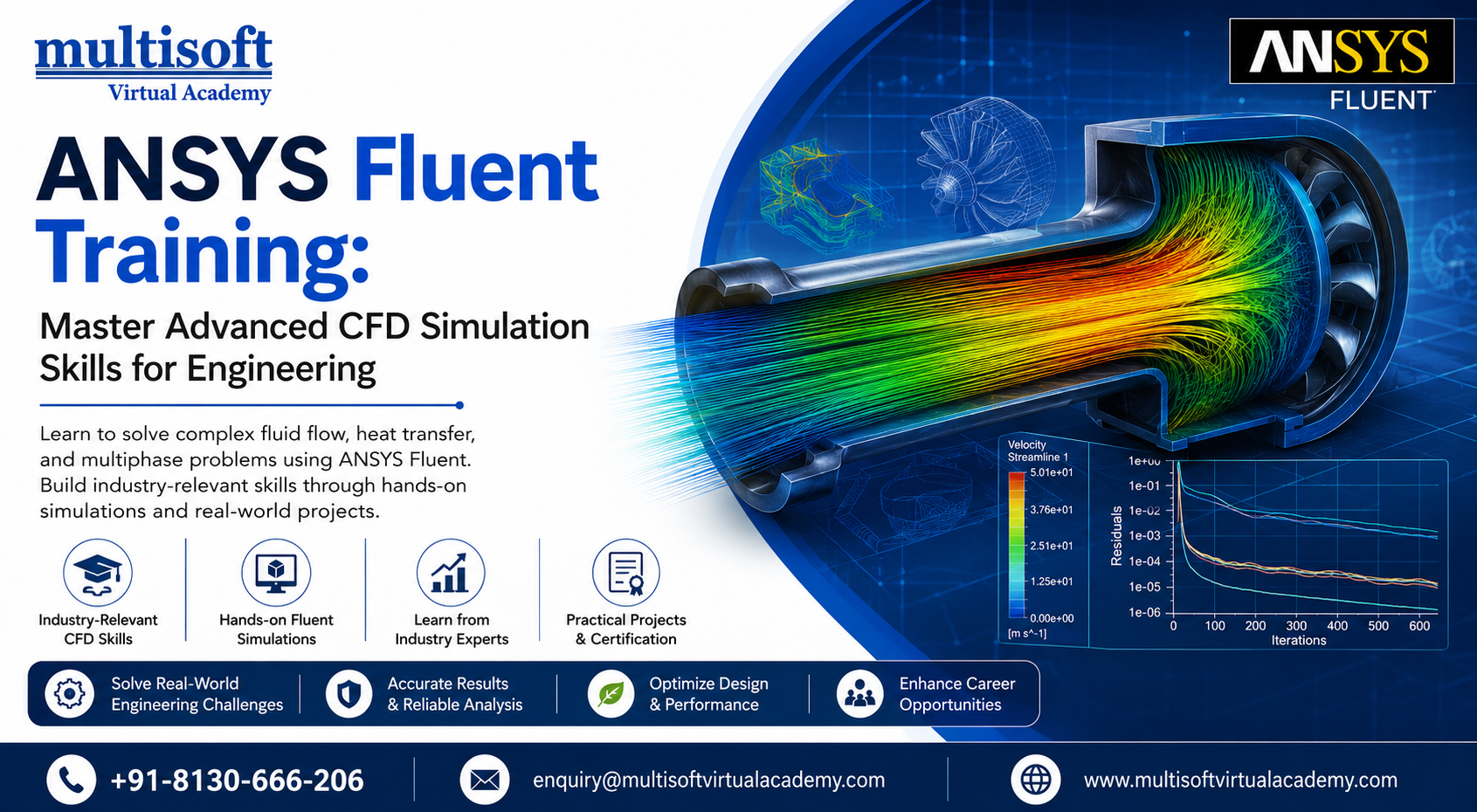
In today's engineering landscape, computational simulation has become an essential part of product development, design validation and performance optimization. Organizations across aerospace, automotive, energy, manufacturing, electronics, chemical processing and renewable energy industries rely heavily on Computational Fluid Dynamics (CFD) to reduce development costs while improving product quality.
Among the most trusted CFD software solutions, ANSYS Fluent stands out as an industry-leading platform capable of simulating fluid flow, heat transfer, turbulence, combustion, multiphase flow and numerous complex engineering phenomena. As industries increasingly embrace digital engineering and virtual prototyping, professionals with expertise in ANSYS Fluent Training are in high demand worldwide.
Whether you are a mechanical engineer, CFD analyst, product designer, research scholar or engineering student, learning ANSYS Fluent can significantly enhance your career prospects. This comprehensive guide explains everything about ANSYS Fluent, its applications, career opportunities, benefits and why professional training is becoming increasingly valuable.
ANSYS Fluent is an advanced Computational Fluid Dynamics (CFD) software developed to analyze fluid flow, heat transfer and related physical phenomena through numerical simulation. Engineers use Fluent to predict how gases and liquids behave under different operating conditions before building expensive physical prototypes.
The software employs sophisticated mathematical models and finite volume methods to solve complex engineering problems with exceptional accuracy.
ANSYS Fluent helps engineers:
Engineering industries are rapidly moving toward digital simulation to reduce manufacturing expenses and improve product reliability.
Instead of manufacturing multiple prototypes, engineers can simulate thousands of operating conditions using CFD.
Benefits include:
Because of these advantages, companies actively seek professionals with ANSYS Fluent Training and CFD expertise.
ANSYS Fluent is extensively used across numerous engineering sectors.
Engineers perform:
Automobile manufacturers use Fluent for:
Applications include:
Chemical industries utilize Fluent for:
Modern electronic systems require effective thermal management.
Fluent assists engineers in:
Applications include:
A professional ANSYS Fluent Training program typically covers both theoretical concepts and practical implementation.
Core learning areas include:
Learn to:
Students understand:
Topics include:
Important models include:
Simulation includes:
Topics cover:
Students learn:
Professional engineers gain numerous advantages after completing ANSYS Fluent Training.
These include:
This course is suitable for:
Growing adoption of simulation technologies has created thousands of job opportunities worldwide.
Popular job roles include:
Major hiring sectors include:
Online learning provides flexibility while maintaining practical exposure.
Advantages include:
Working professionals especially benefit because they can upskill without interrupting their careers.
An industry-oriented ANSYS Fluent Training program generally includes practical simulations such as:
These projects prepare learners for real-world engineering challenges.
Organizations invest heavily in simulation because it reduces both development cost and project risk.
Professionals trained in Fluent help companies:
As digital engineering continues to evolve, simulation expertise is becoming one of the most valuable engineering skills.
Emerging technologies are further increasing the importance of CFD.
Future applications include:
The future demand for CFD engineers is expected to grow steadily across global industries.
To become proficient:
Consistent practice is the key to mastering CFD simulations.
With a structured learning approach and practical exercises, engineers can gradually master the software from basic to advanced levels.
Basic usage does not require programming knowledge, although scripting with journals or user-defined functions can enhance advanced workflows.
A foundation in fluid mechanics, heat transfer and engineering mathematics is beneficial, though many beginner-friendly training programs start with the fundamentals.
Yes. Engineering graduates who gain practical CFD simulation skills often improve their employability for design, analysis and research roles.
A recognized certification demonstrates practical simulation knowledge and can strengthen your profile when applying for engineering positions.
The demand for simulation-driven engineering continues to rise as organizations seek faster innovation, lower costs and more reliable product development. Investing in ANSYS Fluent Training equips professionals with practical CFD expertise that is applicable across industries such as aerospace, automotive, energy, electronics, manufacturing and research. By combining theoretical knowledge with hands-on projects and real-world case studies, learners can build the confidence required to solve complex engineering challenges. Multisoft Virtual Academy is recognized for delivering comprehensive industry-oriented training programs through experienced instructors, live online sessions and practical learning methodologies, helping aspiring engineers and working professionals develop the advanced skills needed to excel in today's competitive engineering landscape.
| Start Date | End Date | No. of Hrs | Time (IST) | Day | |
|---|---|---|---|---|---|
| No schedule available ! | |||||
Schedule does not suit you, Schedule Now! | Want to take one-on-one training, Enquiry Now! |
|||||






 Join our Live Instructor-Led online classes delivered by industry experts
 Let's Get Started