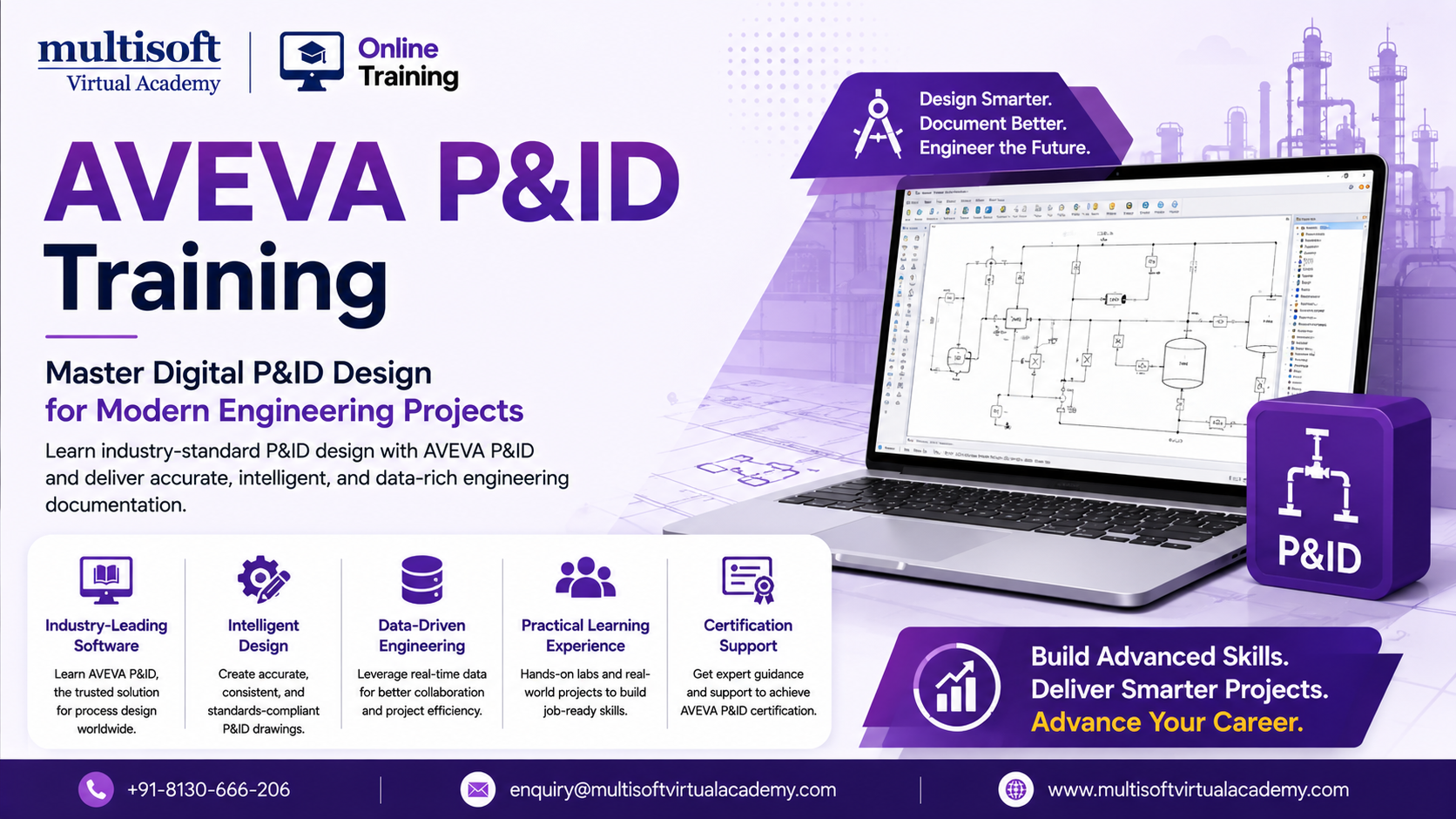
Process plants depend on accurate engineering documentation to support safe design, efficient construction and reliable operations. Among the most important engineering documents are Process and Instrumentation Diagrams, commonly known as P&IDs. As engineering projects become more complex and increasingly digital, professionals need specialized tools and practical expertise to create, manage and maintain accurate P&ID documentation.
AVEVA P&ID Training provides engineers, designers, drafters and other technical professionals with the knowledge required to work effectively with digital P&ID workflows. The training focuses on creating and modifying diagrams, managing engineering information, working with equipment and piping components, applying symbols and annotations and maintaining organized project data.
For professionals working in process engineering, oil and gas, petrochemicals, chemicals, power generation, pharmaceuticals and other process industries, learning AVEVA P&ID can strengthen both technical capabilities and career opportunities.
AVEVA P&ID is an engineering software solution designed to support the creation and management of Process and Instrumentation Diagrams. P&IDs communicate how equipment, pipes, valves, instruments and process systems are connected within a facility.
Unlike conventional manual drafting workflows, digital P&ID environments help engineering teams maintain structured information associated with drawings and components. This can improve consistency, simplify revisions and support better coordination between engineering disciplines.
AVEVA's broader engineering data management approach also emphasizes connecting engineering information, validating data and maintaining trusted information throughout the project lifecycle.
Consequently, professionals who understand both P&ID principles and digital engineering workflows can contribute more effectively to modern plant design and engineering projects.
Creating a P&ID requires much more than placing graphical symbols on a drawing. Engineers need to understand process relationships, equipment connections, piping arrangements, instrumentation and engineering documentation standards.
AVEVA P&ID Training helps learners develop a structured approach to these activities. Instead of relying only on theoretical knowledge, practical training can introduce learners to real-world drawing creation, editing and project data management.
The training can be particularly valuable when professionals need to:
A structured learning path can therefore reduce the learning curve and help professionals become more confident with the software.
A comprehensive AVEVA P&ID Course should combine software functionality with practical engineering concepts. Important areas generally include the software interface, project structure, drawing creation and editing.
Learners can develop an understanding of how to create new P&IDs and work with existing drawings. This includes navigating the project environment, selecting appropriate components and maintaining organized drawing information.
Understanding drawing creation is fundamental because every subsequent engineering activity depends on accurate and well-structured documentation.
Equipment forms the foundation of many process diagrams. Training can introduce learners to placing equipment, adding nozzles and connecting associated piping.
Professionals can also learn how different component properties influence the overall engineering documentation.
Piping and signal lines communicate relationships between process equipment and instrumentation. A well-structured P&ID Design Training program should explain how these elements are placed, connected and represented within the software.
This knowledge is particularly useful for process engineers, piping engineers and instrumentation professionals who regularly review engineering drawings.
Symbols provide a standardized visual language for engineering diagrams. Learners can become familiar with symbol selection, instrument representation and appropriate annotations.
Understanding symbols is important because inconsistencies in engineering documentation can create confusion during design reviews, construction and plant operations.
Modern engineering projects generate substantial volumes of information. Effective AVEVA P&ID User Training should therefore go beyond drawing creation and introduce learners to structured project information.
Data management skills can help professionals locate, update and maintain engineering information more efficiently while supporting consistency across project documentation.
Online learning has become an increasingly practical option for engineers and technical professionals who cannot attend conventional classroom programs.
AVEVA P&ID Online Training allows participants to learn from their workplace or home while maintaining their existing professional responsibilities. Live instructor-led sessions can provide opportunities to interact with trainers, ask questions and understand software workflows through demonstrations.
A flexible online program can be particularly useful for professionals working across different locations or organizations. It can also support international learners who want specialized engineering software training without relocating.
For example, current AVEVA P&ID training programs available online commonly combine instructor-led sessions, practical learning, recorded sessions, digital materials and post-training support.
AVEVA P&ID Certification Training can be relevant to a wide range of engineering and technical professionals.
Process engineers can use P&IDs to understand and communicate process systems. Learning the software can help them create, review and modify process documentation more efficiently.
Piping professionals frequently work with equipment connections, piping arrangements and engineering documentation. AVEVA P&ID skills can complement their existing piping design knowledge.
Instrumentation professionals can benefit from understanding instrument representation, signal connections and related P&ID information.
Professionals with CAD backgrounds can expand their digital design capabilities by learning a specialized P&ID environment.
Project engineers who coordinate multiple engineering disciplines can benefit from understanding P&ID creation and data workflows.
Training providers also commonly identify process engineers, piping engineers, instrumentation engineers, designers and drafters among the intended learners for AVEVA P&ID programs.
A professional certification can demonstrate that a learner has completed structured training and developed knowledge of a particular software or technical subject.
An AVEVA P&ID Certification can complement practical experience when professionals are building their engineering profiles. However, certification is most valuable when supported by genuine hands-on knowledge.
Employers generally need professionals who can understand project requirements, interpret engineering documentation and apply software capabilities effectively. Therefore, learners should prioritize practical exercises rather than focusing exclusively on obtaining a certificate.
The strongest combination is often:
Software knowledge + engineering fundamentals + practical projects + professional certification.
This combination can provide a stronger foundation for career development.
Professionals who are responsible for managing projects and configuring P&ID environments may need knowledge beyond standard user functionality.
AVEVA P&ID Administration Training can introduce advanced concepts such as project administration, tracing styles, signal line styles, drawing layers, valve patterns, instrument patterns and project symbols.
Administration skills can be particularly relevant for technical leads, administrators and professionals responsible for maintaining project environments. Training programs in this area may also cover the Document Manager and techniques for managing project symbols.
This makes administration training a useful progression for professionals who have already developed basic or intermediate P&ID skills.
Engineering organizations increasingly focus on connected data, collaboration and digital transformation. P&IDs are not isolated drawings. They form part of a wider engineering information ecosystem.
Accurate P&ID information can support communication between process, piping, instrumentation, mechanical and other engineering disciplines. Better structured engineering data can also contribute to improved project handover and operational readiness.
AVEVA's current engineering data strategy emphasizes connecting engineering and operations through standardized, contextualized information and trusted digital twin data.
At the same time, AVEVA announced new portfolio developments in 2026 focused on AI, connected engineering and industrial data capabilities, highlighting the industry's continued movement toward intelligent and connected engineering environments.
For professionals, this means that learning specialized engineering software should increasingly involve understanding how drawings, data and multidisciplinary workflows work together.
Professionals who develop strong P&ID skills can explore opportunities in several engineering-related roles, depending on their existing qualifications and experience.
Potential career paths include:
The actual career path depends on academic qualifications, industry experience, engineering specialization and practical software expertise.
Therefore, AVEVA P&ID Training should be viewed as a career-enhancement skill rather than a standalone replacement for engineering education or professional experience.
Choosing the right training program can make a significant difference in learning outcomes. Professionals should evaluate whether the course offers practical exposure rather than only theoretical explanations.
Important factors include:
Experienced Trainers: Trainers with relevant engineering and software experience can explain concepts using practical scenarios.
Hands-On Exercises: Practical assignments help learners understand how software functions are applied to engineering requirements.
Structured Curriculum: A well-organized curriculum should progress from fundamental concepts to more advanced workflows.
Real-World Examples: Industry-oriented examples make technical concepts easier to understand and apply.
Flexible Learning: Online and customized schedules can help working professionals continue learning without interrupting their careers.
Post-Training Support: Continued assistance can help learners resolve questions after formal sessions are completed.
A current AVEVA P&ID user training curriculum, for example, includes areas such as creating new P&IDs, creating drawings from existing P&IDs, using engineering and symbol explorers, placing equipment and nozzles and working with pipes and signal lines.
Learners can improve their results by following a practical learning strategy.
First, understand the fundamentals of P&ID documentation before focusing heavily on software commands. Next, practice creating simple diagrams and gradually move toward more complex process systems.
It is also useful to study common engineering symbols and documentation practices. Regularly reviewing completed drawings can help learners identify inconsistencies and improve their attention to detail.
Finally, professionals should connect their software learning with actual engineering scenarios. The goal should not simply be to remember where a tool is located. Instead, learners should understand why, when and how a particular function should be used.
Digital transformation is changing how engineering organizations create, manage and share technical information. As projects become more interconnected, professionals who understand structured engineering documentation can provide greater value to multidisciplinary teams.
P&IDs remain important because they provide a clear representation of process systems while connecting technical information across different stages of a project.
Learning AVEVA P&ID therefore provides more than software familiarity. It can help professionals develop a stronger understanding of digital P&ID workflows, engineering documentation and project information management.
For organizations, trained professionals can also contribute to more consistent drawing practices, better collaboration and improved handling of engineering information.
Choosing the right AVEVA P&ID Training can help engineering professionals strengthen their capabilities in P&ID creation, process documentation, piping and instrumentation workflows and digital engineering practices. Whether you are beginning your journey with AVEVA P&ID Online Training, looking for AVEVA P&ID Certification, developing advanced administration skills or seeking practical P&ID Design Training, a structured learning path can provide valuable professional growth. Multisoft Virtual Academy offers industry-focused AVEVA P&ID learning programs designed to help professionals develop practical software knowledge through expert-led instruction, hands-on learning and flexible online training options, making it a valuable choice for learners seeking to advance their engineering and digital design expertise.
| Start Date | End Date | No. of Hrs | Time (IST) | Day | |
|---|---|---|---|---|---|
| No schedule available ! | |||||
Schedule does not suit you, Schedule Now! | Want to take one-on-one training, Enquiry Now! |
|||||






 Join our Live Instructor-Led online classes delivered by industry experts
 Let's Get Started