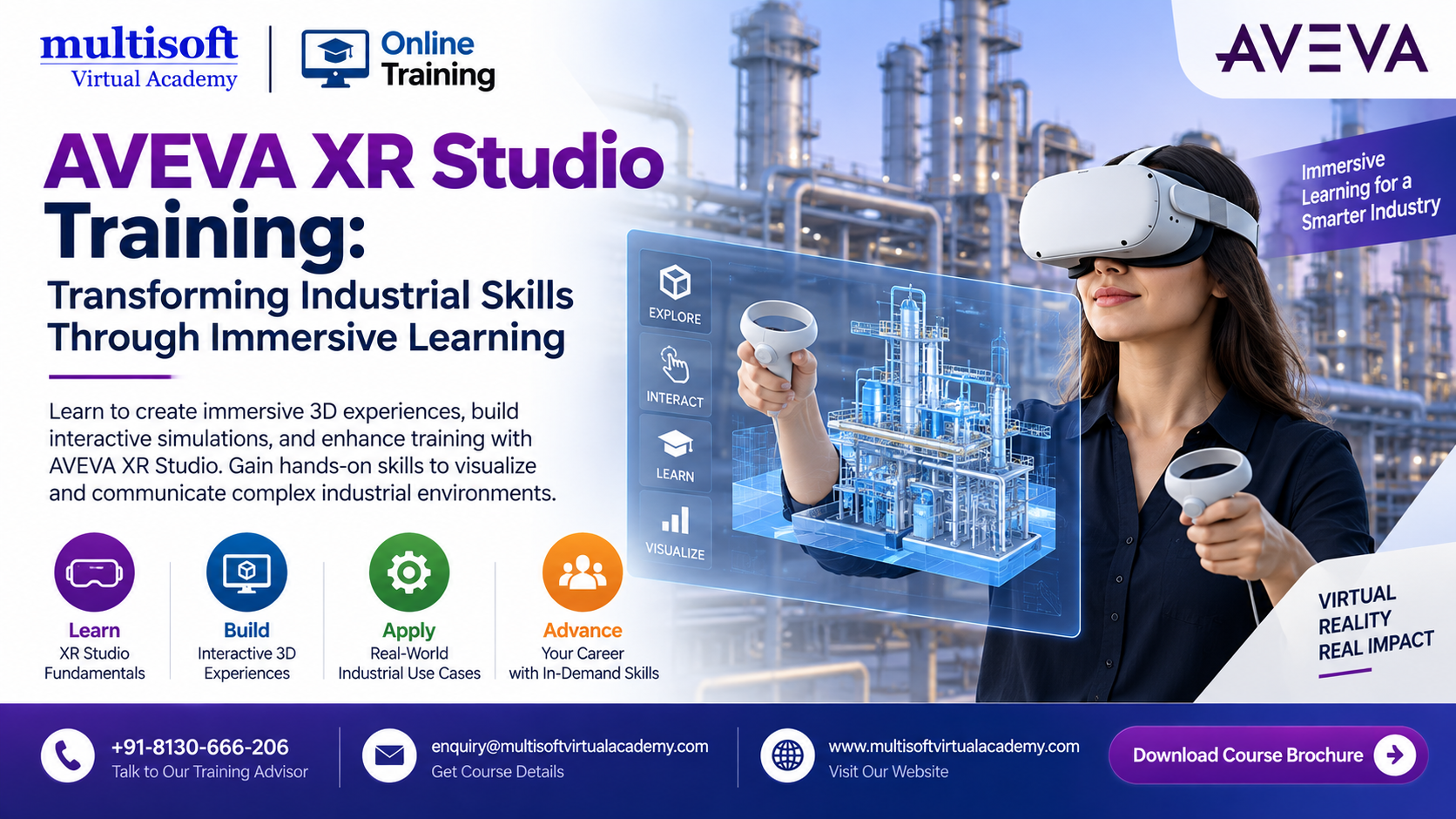
Industrial organizations are rapidly adopting digital technologies to improve workforce capability, operational safety, and process understanding. Among these technologies, extended reality (XR) is becoming an increasingly important approach for creating realistic and repeatable learning experiences. AVEVA XR Studio Training brings immersive learning into industrial environments by combining 3D visualization, virtual reality, simulation, and realistic plant scenarios.
Traditional classroom-based training can explain procedures, equipment, and operating concepts, but it may not fully reproduce the complexity of an actual industrial facility. Immersive training provides another layer of learning by allowing participants to explore virtual environments, interact with equipment, practice procedures, and experience abnormal or emergency situations without exposing people or production assets to unnecessary risk.
AVEVA describes XR Studio for Training as a 3D training environment that can connect control room operators, maintenance personnel, and field operators within a realistic learning environment. It supports augmented reality, virtual reality, and mixed reality experiences for industrial workforce development.
AVEVA XR Studio Training is an immersive industrial training approach designed to reproduce plant environments and operating situations in a highly interactive 3D space. Instead of learning only through manuals, presentations, or conventional demonstrations, trainees can interact with a virtual representation of the facility and practice tasks in realistic scenarios.
The technology can combine a 3D virtual plant environment with dynamic process simulation, control system emulation, operator interfaces, instructor stations, and other components required for realistic training. This makes it particularly relevant for industries where operational mistakes can have significant safety, financial, or production consequences.
The underlying concept is closely connected to the development of industrial digital twins. Digital twins provide digital representations of physical assets, processes, or systems and can help engineers and operators evaluate scenarios without experimenting directly on production environments.
Industrial companies are managing increasingly complex facilities while also facing workforce changes, skills gaps, and the need to transfer knowledge from experienced employees to newer personnel.
Conventional training methods remain useful, but immersive learning can provide an additional practical dimension. A trainee can repeatedly practice a procedure, observe equipment behavior, identify hazards, and respond to abnormal situations in a controlled environment.
This is particularly valuable for:
AVEVA identifies industrial training use cases across areas including digital twins, AR/VR, onboarding, safety and compliance, and maintenance skills.
One of the most valuable aspects of AVEVA XR Studio Training is its ability to reproduce the look and behavior of an industrial facility in a virtual environment.
A typical immersive training environment can include:
Trainees can navigate through a digital representation of the plant and become familiar with equipment, layouts, process areas, and operating locations.
This can be particularly useful for new employees who need site familiarization before entering a real facility.
Immersive environments become more valuable when the virtual plant is connected to realistic process behavior. AVEVA's training architecture can integrate dynamic simulation and control-system emulation so that trainee actions can produce corresponding system responses.
Training can also reproduce operator consoles and control-room interfaces. This allows participants to understand how field activities and control-room decisions influence one another.
An instructor can manage training scenarios, introduce specific conditions, observe participant activity, and guide the learning process.
AVEVA's XR training environment supports interaction through modern input devices and can work across different immersive technologies. AVEVA also states that its XR solutions are hardware agnostic and can work with major VR platforms as well as tablets and screens with game controllers.
Safety is one of the strongest arguments for immersive industrial training.
Trainees can practice hazardous scenarios virtually without creating the same physical risks associated with conducting repeated exercises in an operating facility. Emergency conditions, equipment failures, leaks, fire scenarios, and other abnormal situations can be incorporated into controlled training exercises.
AVEVA specifically highlights safety-case scenarios and emergency preparedness as applications for XR-based training.
Industrial systems can be difficult to understand from diagrams alone. A 3D environment allows trainees to see relationships between equipment, process areas, control systems, and operating procedures.
This visual context can help learners connect theoretical concepts with practical plant operations.
A virtual scenario can be repeated multiple times. Trainees can practice a standard operating procedure, receive feedback, and repeat the exercise until they become more confident.
Repetition is especially useful for procedures that employees may encounter infrequently but must execute correctly when required.
New employees often need to understand plant layouts, equipment locations, safety requirements, and operational procedures before becoming fully productive.
An immersive training program can give new personnel an opportunity to familiarize themselves with the environment before working independently.
AVEVA positions XR as one component of industrial workforce development and onboarding programs designed to help employees become job-ready more efficiently.
Industrial operations depend on communication between different teams.
AVEVA XR Training can bring field operators and control-room personnel into coordinated training scenarios. This helps participants understand how their decisions and actions affect other members of the operational team.
AVEVA's XR training architecture supports team-based training involving operators and plant personnel, including integration with operator training simulator environments.
The relationship between AVEVA XR Studio and digital twin technology is important for organizations looking to modernize workforce development.
A digital twin can represent physical assets and processes digitally while incorporating engineering and operational information. When these digital representations are visualized through XR, learners can interact with complex systems in a more intuitive manner.
AVEVA explains that digital twins can combine engineering models with operational data to create dynamic representations of assets and processes.
For training purposes, this approach can support:
The combination of digital twin training and immersive technology therefore creates an opportunity to connect engineering information with workforce learning.
Standard operating procedures are essential for consistent industrial operations.
However, reading a procedure is different from performing it. Employees need to understand not only the sequence of actions but also the environment in which those actions take place.
Immersive training can help transform written procedures into practical experiences. Trainees can move through a virtual facility, locate equipment, perform actions, observe results, and understand the consequences of incorrect steps.
AVEVA notes that XR for training can be used for standard operating procedure practice, abnormal conditions, emergency preparedness, and deeper understanding of plant operations.
This makes AVEVA XR Studio Training particularly relevant for organizations seeking more experiential approaches to technical workforce development.
Employees cannot always learn emergency response effectively through theoretical instruction alone.
Immersive simulation allows organizations to create controlled scenarios involving abnormal process conditions, equipment problems, safety hazards, or emergency events.
Participants can practice:
Because these scenarios can be repeated, learners can build familiarity with situations that may otherwise be difficult to reproduce safely in a real facility.
The technology is not limited to a single job role.
Operators can develop stronger knowledge of plant equipment, procedures, process behavior, and abnormal conditions.
Maintenance teams can use immersive environments to understand equipment locations, maintenance workflows, and potential hazards.
Engineers can gain a more practical understanding of plant environments and operational interactions.
Health, safety, and environmental teams can explore safety scenarios and support workforce preparedness.
New personnel can receive virtual site familiarization before entering operational areas.
Learning teams can use scenario-based training to create structured development programs and evaluate workforce competency.
Operator Training Simulator (OTS) technology focuses heavily on reproducing process behavior and control-room operations. XR technology adds another dimension by providing an immersive representation of the physical plant.
When these technologies work together, trainees can understand both sides of industrial operations:
Control room + field environment + process behavior = more complete operational training
AVEVA states that XR can be coupled with its Operator Training Simulator to combine real-time dynamic process simulation with a 3D immersive training environment.
This integrated approach can be valuable when organizations want operators to understand how control-room actions relate to real-world plant conditions.
A well-designed AVEVA XR Studio Training program can support several technical and professional competencies, including:
The exact learning outcomes depend on the training environment, scenarios, participant roles, and organizational objectives.
Choosing immersive technology alone does not guarantee effective learning. The training program should be designed around clear operational objectives.
A strong program should include:
Learners should see how XR environments relate to real industrial workflows.
Participants should interact with virtual environments rather than only watch demonstrations.
Training should reflect situations employees may encounter in their actual work.
Exercises should reinforce safe behavior and appropriate responses to hazards.
Expert support can help learners understand mistakes and improve their performance.
Knowledge checks, scenario completion, practical exercises, and instructor feedback can help evaluate learning outcomes.
AVEVA's broader training services include instructor-led learning, private training, online learning, learning paths, and certification programs, demonstrating the importance of combining technology with structured learning approaches.
The growth of industrial digitalization is increasing demand for professionals who understand the intersection of engineering, simulation, digital twins, and immersive technologies.
Knowledge of AVEVA XR Studio, industrial VR training, digital twin technology, and extended reality solutions can be useful for professionals working toward roles related to:
Professionals who combine domain knowledge with digital technology skills can be better positioned to contribute to modernization initiatives across industrial organizations.
Reading documentation is useful for understanding concepts, but hands-on practice develops practical confidence.
A structured learning environment gives participants the opportunity to explore the software, understand the training architecture, work through realistic scenarios, and connect XR concepts with industrial applications.
For organizations, practical training can also help reduce the gap between technology adoption and actual workforce capability.
AVEVA's private training approach emphasizes instructor guidance, practical scenarios, hands-on exercises, and learning aligned with organizational needs.
Industrial learning is moving toward increasingly connected experiences in which digital twins, simulation, artificial intelligence, cloud platforms, analytics, and XR work together.
Extended reality is particularly valuable because it provides a human-centered way to interact with complex industrial information. Instead of viewing data only through conventional dashboards or documents, employees can experience equipment, procedures, and operational scenarios in an immersive environment.
AVEVA's current XR strategy extends beyond training into areas such as design review, workforce development, and maintenance execution, demonstrating the broader potential of extended reality within industrial operations.
As industrial organizations continue to address workforce transformation, safety requirements, operational complexity, and knowledge transfer, immersive learning is likely to become an increasingly important part of workforce development strategies.
AVEVA XR Studio Training represents a modern approach to industrial learning by combining immersive visualization, simulation, digital twin concepts, and realistic operational scenarios. It can help professionals understand complex facilities, practice procedures, prepare for abnormal situations, and develop greater confidence in controlled environments. For learners and organizations seeking practical expertise in immersive industrial technologies, Multisoft Virtual Academy provides specialized training designed to support skill development through structured learning, practical knowledge, and industry-focused guidance.
| Start Date | End Date | No. of Hrs | Time (IST) | Day | |
|---|---|---|---|---|---|
| 26 Sep 2026 | 18 Oct 2026 | 24 | 06:00 PM - 09:00 PM | Sat, Sun | |
| 27 Sep 2026 | 19 Oct 2026 | 24 | 06:00 PM - 09:00 PM | Sat, Sun | |
| 03 Oct 2026 | 25 Oct 2026 | 24 | 06:00 PM - 09:00 PM | Sat, Sun | |
| 04 Oct 2026 | 26 Oct 2026 | 24 | 06:00 PM - 09:00 PM | Sat, Sun | |
Schedule does not suit you, Schedule Now! | Want to take one-on-one training, Enquiry Now! |
|||||






 Join our Live Instructor-Led online classes delivered by industry experts
 Let's Get Started