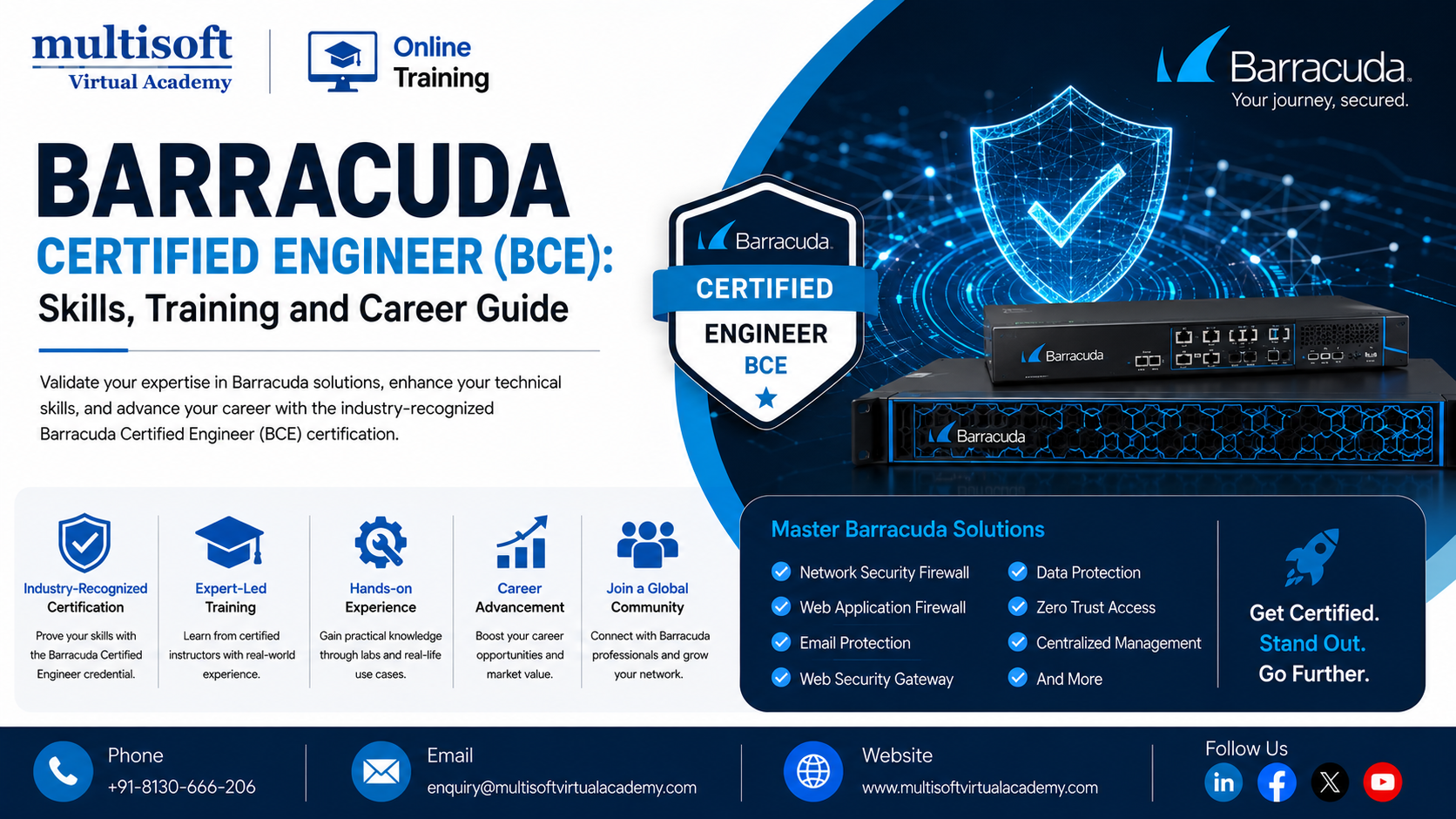
Cybersecurity is evolving rapidly as organizations face increasingly sophisticated phishing, ransomware, malware, email-borne threats and network attacks. As businesses move toward cloud-based infrastructure and hybrid work environments, professionals who can deploy, configure and manage enterprise security platforms are becoming increasingly valuable. One certification path that can strengthen these skills is the Barracuda Certified Engineer (BCE) program.
The Barracuda Certified Engineer (BCE) credential is designed for technical professionals working with Barracuda security technologies. Barracuda's certification ecosystem includes engineer-level credentials covering products and technologies such as Email Security Gateway and Email Gateway Defense. Barracuda Campus currently lists engineer-level certifications with defined learning modules and examinations, making product-focused training an important part of technical preparation.
For IT administrators, network engineers, security engineers, email security specialists and cybersecurity professionals, Barracuda Certified Engineer training can provide a structured way to develop practical knowledge of Barracuda security solutions while strengthening broader enterprise security capabilities.
Barracuda Certified Engineer (BCE) is associated with the technical engineer level of Barracuda's certification and training ecosystem. Barracuda partner documentation identifies the Certified Engineer as a Level 300 certification category, positioned above sales and product-specialist levels.
The technical focus makes the credential particularly relevant to professionals who are responsible for security infrastructure rather than simply evaluating or selling security products.
Depending on the Barracuda technology being studied, training can involve deployment, configuration, administration, troubleshooting, security policies, email protection, cloud security and operational management.
For example, Barracuda's Email Security Gateway Foundation curriculum covers deployment options, inbound and outbound mail routing, user and domain management, advanced configuration, message logs, Cloud Protection Layer, email encryption and Data Loss Prevention.
Email remains one of the most common attack surfaces for organizations. Phishing, business email compromise, malicious attachments, impersonation and credential theft can expose businesses to financial losses and data breaches.
At the same time, modern organizations increasingly depend on Microsoft 365, cloud applications, remote access and distributed networks. This creates demand for professionals who understand how security controls operate across email, network and cloud environments.
Barracuda's security training ecosystem reflects this broader requirement. Current Barracuda Campus certification content includes areas such as Email Gateway Defense, email encryption, Data Loss Prevention, inbox filtering, administration and user management.
Therefore, Barracuda certification training can be useful not only for learning a specific platform but also for developing practical security administration capabilities.
A well-structured Barracuda Certified Engineer training course should combine product knowledge with practical implementation concepts.
Participants should understand how Barracuda security technologies fit into an enterprise environment. This includes understanding security gateways, cloud services, mail-flow architecture, authentication and integration points.
A strong architectural foundation helps engineers make better decisions during deployment and troubleshooting.
Deployment is one of the most important areas for a security engineer. Training can cover deployment models, initial configuration, mail routing, administrative access and security settings.
Barracuda's Email Security Gateway Foundation curriculum specifically includes deployment options and inbound and outbound mail routing as core learning areas.
Email security professionals need to understand how organizations protect users from spam, phishing, malware and other malicious messages.
Training may cover filtering policies, message analysis, quarantine management, sender and recipient policies, threat detection and security controls.
These skills are particularly valuable for professionals supporting enterprise email environments.
Cloud-based filtering can add an additional security layer before potentially harmful email reaches an organization's internal infrastructure.
Barracuda's documentation identifies Cloud Protection Layer as part of the Email Security Gateway Foundation learning path.
Understanding cloud-based protection can help engineers design more resilient email security architectures.
Data protection is another important component of enterprise security. Engineers may need to understand how sensitive information is protected during transmission and how policies can help reduce accidental or unauthorized data disclosure.
Barracuda's Email Security Gateway training includes email encryption and Data Loss Prevention as dedicated learning topics.
Enterprise security platforms require continuous administration. This includes managing users, domains, policies, administrative permissions and operational settings.
Professionals preparing for Barracuda Certified Engineer certification should therefore develop both configuration and administration skills.
Security engineering does not end after deployment. Engineers must monitor systems, investigate suspicious activity and troubleshoot configuration or delivery problems.
Barracuda's Foundation curriculum includes understanding the Message Log, which demonstrates the importance of operational monitoring in the training pathway.
A career-focused Barracuda Certified Engineer course should help learners develop several practical capabilities:
These skills can complement knowledge of networking, cloud platforms, identity management and cybersecurity operations.
The BCE certification path can be relevant to a wide range of technical professionals.
Network engineers who manage security appliances, gateways or enterprise connectivity can benefit from learning how Barracuda technologies operate within larger network environments.
Security analysts and security engineers can expand their knowledge of email protection and enterprise threat prevention.
System administrators responsible for email infrastructure, user access and security policies can use Barracuda training to improve their operational capabilities.
Professionals managing organizational email protection can benefit directly from product-specific Barracuda knowledge.
Infrastructure specialists working with hybrid or cloud environments can gain additional expertise in security architecture and administration.
Consultants supporting enterprise security deployments can benefit from understanding Barracuda configuration, implementation and troubleshooting processes.
General cybersecurity training usually covers broad concepts such as security principles, risk management, network security, threat detection and incident response.
Barracuda Certified Engineer training, in contrast, is more product-focused. It can help professionals understand how specific Barracuda technologies are configured and operated.
This makes the two approaches complementary rather than competing. A cybersecurity professional can benefit from broad security knowledge while also developing specialized expertise in enterprise security platforms.
A successful Barracuda certification preparation strategy should combine theoretical understanding with practical learning.
Review the applicable Barracuda certification and identify the technologies, features and administrative functions included in the assessment. Barracuda Campus provides structured courses and exams for its certification paths.
Reading documentation alone may not be enough for technical certification preparation. Engineers should practice deployment scenarios, configuration tasks, policy management, monitoring and troubleshooting wherever possible.
Product knowledge becomes more valuable when combined with foundational knowledge of DNS, SMTP, authentication, network security, encryption, phishing, malware and access control.
Real-world security engineers often work under pressure to identify and resolve problems. Training should therefore include practical troubleshooting scenarios rather than focusing exclusively on feature descriptions.
Scenario-based learning can help candidates understand why a particular configuration is appropriate rather than simply memorizing menu options.
Professionals with Barracuda expertise can pursue or strengthen roles such as:
The value of the certification is strongest when it is combined with practical experience and complementary cybersecurity skills.
Microsoft 365 has become a central productivity platform for many organizations, making email security an important part of modern security architecture.
Professionals working with Microsoft 365 environments may need to understand how third-party security technologies integrate with existing mail-flow and identity configurations.
Barracuda's current Email Gateway Defense learning path includes features, getting started, administration, operations, user management, inbox filtering, encryption and Data Loss Prevention.
This makes Barracuda Email Security training relevant for professionals supporting modern cloud-based email environments.
To maximize the value of Barracuda training, professionals should also consider developing knowledge in related areas such as:
These complementary skills can help professionals move from product administration toward broader security engineering responsibilities.
Barracuda Certified Engineer is an engineer-level certification category within Barracuda's technical certification ecosystem. Barracuda partner documentation identifies Certified Engineer as Level 300.
Yes. Product-specific Barracuda knowledge can complement broader cybersecurity expertise, particularly for professionals working with email security, enterprise security infrastructure and Barracuda technologies.
Depending on the certification path, topics can include deployment, mail routing, administration, user and domain management, message logs, cloud protection, email encryption and Data Loss Prevention.
Validity depends on the specific certification. For example, Barracuda currently lists the Email Security Gateway Foundation Engineer certificate with a 24-month validity period.
Yes. Practical configuration, administration, monitoring and troubleshooting experience can make product-focused certification preparation significantly more effective.
The Barracuda Certified Engineer (BCE) pathway can be a valuable option for IT professionals who want to strengthen their expertise in enterprise security technologies, particularly email protection, security administration and technical implementation. As organizations continue to prioritize phishing defense, cloud security, data protection and secure digital communication, specialized security skills can create meaningful career opportunities. A structured Barracuda Certified Engineer training course can help learners connect product knowledge with practical security scenarios and professional objectives. For organizations and individuals looking for professional Barracuda certification training, cybersecurity training and technical skill development, Multisoft Virtual Academy acts as a trusted service provider, offering structured learning designed around practical knowledge, industry requirements and career-focused outcomes.
| Start Date | End Date | No. of Hrs | Time (IST) | Day | |
|---|---|---|---|---|---|
| No schedule available ! | |||||
Schedule does not suit you, Schedule Now! | Want to take one-on-one training, Enquiry Now! |
|||||






 Join our Live Instructor-Led online classes delivered by industry experts
 Let's Get Started