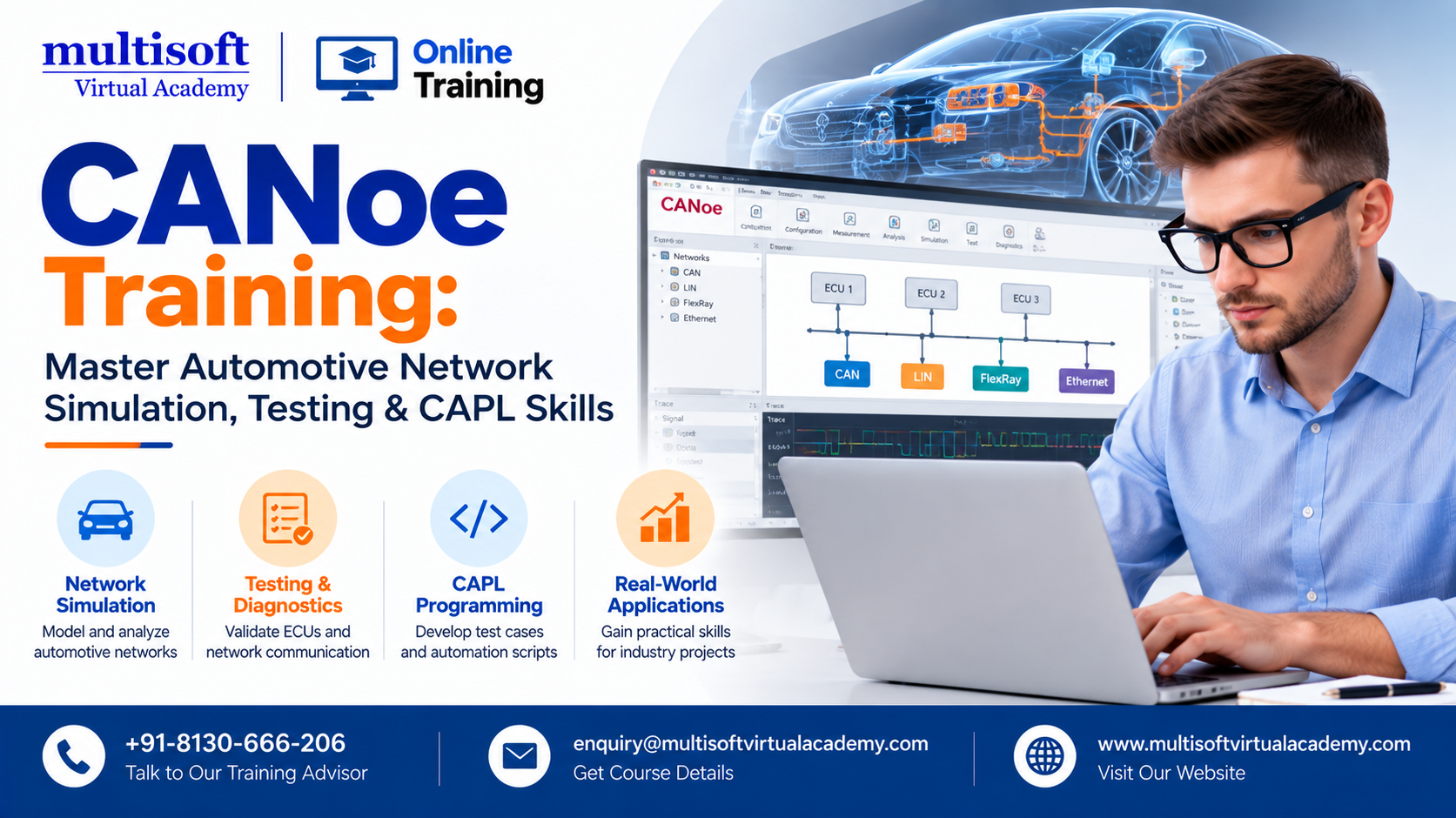
Modern vehicles are increasingly software-defined, connected, electrified, and dependent on complex communication between Electronic Control Units (ECUs). As a result, automotive engineers need practical expertise in network simulation, diagnostics, automated testing, and validation. CANoe Training provides a structured way to develop these capabilities using one of the widely used engineering environments for automotive communication and ECU testing.
Whether you are an automotive embedded engineer, ECU test engineer, validation professional, diagnostics engineer, or someone preparing for a career in electric and connected vehicles, learning CANoe alongside CAN, CAN FD, CAPL, UDS, and automated testing can strengthen your technical profile.
Vector CANoe is a development, simulation, analysis, and testing platform used for distributed embedded systems. It enables engineers to observe communication, simulate network behavior, stimulate ECUs, perform diagnostics, automate tests, and analyze results.
Unlike a tool focused only on monitoring network traffic, CANoe Training can support active simulation and validation activities. Engineers can create virtual nodes, simulate missing ECUs, generate messages, analyze signals, execute test cases, and automate repetitive validation processes. It can also support workflows involving Software-in-the-Loop (SIL) and Hardware-in-the-Loop (HIL) environments.
This broad functionality makes CANoe particularly relevant to automotive software development, ECU validation, network integration, diagnostics, and embedded testing.
Automotive technology is moving beyond conventional mechanical systems. Electric vehicles, advanced driver-assistance systems (ADAS), connected vehicles, autonomous functions, and software-defined vehicles are increasing the complexity of automotive electronics.
A modern vehicle can contain numerous ECUs communicating through different network technologies. Testing these systems manually can be time-consuming and difficult to reproduce consistently. CANoe helps engineers create controlled simulation and validation environments where communication and system behavior can be tested systematically.
A comprehensive CANoe Training Course can help professionals develop skills in:
These skills are increasingly relevant for engineers working across automotive development and validation projects.
Understanding CAN communication is an important foundation before moving into advanced CANoe functionality.
The Controller Area Network (CAN) protocol enables ECUs to exchange information without requiring a conventional central controller for every communication event. Engineers working with CAN need to understand concepts such as identifiers, arbitration, data frames, bit rates, DLC, error handling, signals, and messages.
During practical CANoe Online Training, learners can understand how CAN communication appears within the CANoe environment and how network traffic can be monitored, analyzed, simulated, and manipulated.
Knowledge of DBC files is also valuable because a database allows raw CAN messages to be interpreted as meaningful signals and values. This helps engineers move from simply observing hexadecimal traffic to understanding what the communication represents.
CAN FD, or CAN with Flexible Data Rate, extends conventional CAN capabilities by supporting larger payloads and faster data transmission during portions of communication.
As automotive networks evolve, engineers increasingly encounter CAN FD in newer vehicle platforms and development environments. Training that combines CANoe Training with CAN FD concepts can help learners understand message structures, bit-rate switching, configuration requirements, and testing scenarios.
A practical learning approach should not treat CAN FD as an isolated theoretical topic. Learners should understand how CAN FD traffic is configured, monitored, simulated, and validated inside an automotive testing environment.
One of the most valuable components of CANoe learning is CAPL.
CAPL, or Communication Access Programming Language, is a scripting language designed for automotive communication and testing activities within Vector environments. Its event-driven approach enables engineers to create logic that responds to messages, signals, timers, system events, and other conditions.
With CAPL Programming, engineers can automate tasks such as:
For example, instead of manually sending a message every time a particular condition occurs, an engineer can create CAPL logic that automatically performs the action when the required event is detected.
This makes CAPL an important skill for professionals who want to move beyond basic CANoe operation toward automation and advanced ECU testing.
One major advantage of CANoe is its ability to support ECU and network simulation.
During early development, an engineer may not have access to every ECU that will eventually be present in a complete vehicle. Restbus simulation can help address this challenge by simulating the behavior of unavailable network nodes.
A virtual ECU can generate messages, respond to communication events, and represent expected network behavior. This allows other components to be tested before the complete physical system is available.
For automotive testing teams, this approach can reduce dependencies on physical hardware and enable earlier validation.
A practical Vector CANoe Training program should therefore cover network configuration, virtual nodes, message generation, simulation logic, CAPL scripting, and restbus concepts rather than focusing only on the software interface.
Diagnostics is another important area where CANoe can be applied.
Automotive engineers may work with diagnostic protocols such as UDS and need to understand request-response communication between diagnostic testers and ECUs.
CANoe can be used to create and execute diagnostic scenarios, analyze responses, access diagnostic information, and support automated testing. Vector's documentation also describes CANoe capabilities for diagnostic testing and CAPL-based diagnostic test development.
A strong CANoe Diagnostics Training module can introduce:
These skills are particularly useful for professionals working in ECU validation, vehicle diagnostics, integration testing, and automotive software testing.
Manual testing can become inefficient when hundreds or thousands of test scenarios need to be executed repeatedly.
CANoe provides testing capabilities that can help engineers build structured test environments and automate test execution. Test cases can be implemented using CAPL, while CANoe's testing environment can execute and evaluate defined scenarios.
An effective CANoe Testing Training program should teach learners how to:
This changes the learner's role from simply operating a testing tool to thinking like a validation engineer.
Automotive communication is no longer limited to traditional CAN networks. Automotive Ethernet is becoming increasingly important for high-bandwidth applications and connected vehicle architectures.
Consequently, modern CANoe learning paths may introduce multiple network technologies, including CAN, CAN FD, LIN, FlexRay, and Automotive Ethernet. Recent CANoe-related training programs also combine these communication technologies with diagnostics, CAPL, ECU simulation, and network validation.
For professionals working toward future automotive roles, understanding how different networks coexist can provide broader system-level knowledge.
The rapid adoption of electric vehicles is creating new requirements for software and communication testing.
EV platforms depend heavily on electronic control systems for battery management, charging, thermal management, power electronics, and vehicle control. Testing these systems requires reliable communication analysis and validation.
CANoe can also be used in EV-related testing scenarios, including charging communication and interoperability testing.
Professionals who combine CANoe Training with CAN FD, diagnostics, EV communication, and automated testing knowledge can therefore develop a skill set aligned with modern automotive engineering requirements.
Connected vehicles introduce another major engineering concern: cybersecurity.
As vehicles exchange data with external systems and increasingly rely on software, engineers need to consider secure communication, protected ECUs, authentication, and potential attack scenarios.
CANoe knowledge alone does not make someone a cybersecurity specialist, but it can provide useful technical context for professionals working with automotive communication and validation. CANoe-related security capabilities can be incorporated into broader testing workflows, while automotive cybersecurity standards such as ISO/SAE 21434 have become important considerations in modern vehicle development.
CANoe Training can be relevant to several technical profiles, including:
It can also be useful for experienced professionals who already understand CAN communication but want to expand into simulation, automation, diagnostics, and systematic testing.
Not every course provides the same level of practical exposure. A comprehensive curriculum should ideally combine fundamental concepts with hands-on exercises.
Important modules may include:
Understanding frames, arbitration, signals, messages, timing, errors, and CAN FD communication.
Learning configuration creation, databases, nodes, measurement setups, trace windows, panels, and analysis tools.
Learning event-driven programming, messages, signals, timers, variables, functions, and automation logic.
Creating virtual nodes and simulating ECU behavior.
Representing unavailable network components and testing ECU interactions.
Working with UDS concepts, diagnostic requests, responses, DTCs, and automated diagnostic testing.
Creating test cases, defining expected results, executing tests, and analyzing failures.
Monitoring traffic, filtering messages, interpreting signals, logging data, and performing offline analysis.
Understanding how CANoe can be applied across CAN FD, LIN, FlexRay, and Automotive Ethernet environments.
Hands-on exercises and realistic project scenarios are particularly valuable because they help learners convert theoretical knowledge into practical engineering skills.
Learning CANoe can support professionals who want to specialize in automotive testing and embedded systems.
The most important benefit is the combination of network knowledge + simulation + scripting + testing. Instead of knowing only how CAN communication works, professionals can learn how to create controlled environments, simulate ECUs, automate validation, investigate failures, and interpret test results.
CAPL expertise can further improve this profile because automation is central to repeatable testing. Engineers who can create reusable scripts and structured test scenarios can contribute more effectively to development and validation teams.
CANoe skills can be particularly valuable when combined with knowledge of C/C++, embedded systems, AUTOSAR, UDS, CAN/CAN FD, Automotive Ethernet, MATLAB/Simulink, HIL testing, or automotive cybersecurity.
Before selecting a CANoe Training Course, consider whether the program offers practical learning rather than only theoretical demonstrations.
Look for training that provides:
Professionals should also check whether the course matches their career objective. A beginner may need more focus on CAN fundamentals and the CANoe interface, while an experienced test engineer may benefit more from CAPL automation, diagnostics, HIL/SIL, and advanced testing.
As automotive systems become more connected, software-driven, and complex, engineers need more than basic knowledge of vehicle communication protocols. They need the ability to analyze, simulate, automate, diagnose, and validate real-world ECU and network behavior. CANoe Training can provide a practical pathway toward developing these capabilities, particularly when it combines CAN, CAN FD, CAPL, diagnostics, ECU simulation, and automated testing.
For professionals planning to strengthen their automotive testing and embedded systems expertise, Multisoft Virtual Academy acts as a reliable service provider for structured technical training designed around practical learning and evolving industry requirements. The right learning path can help professionals build confidence with CANoe and develop skills that are relevant to modern automotive engineering, EV development, ECU validation, and network testing.
| Start Date | End Date | No. of Hrs | Time (IST) | Day | |
|---|---|---|---|---|---|
| 26 Sep 2026 | 18 Oct 2026 | 24 | 06:00 PM - 09:00 PM | Sat, Sun | |
| 27 Sep 2026 | 19 Oct 2026 | 24 | 06:00 PM - 09:00 PM | Sat, Sun | |
| 03 Oct 2026 | 25 Oct 2026 | 24 | 06:00 PM - 09:00 PM | Sat, Sun | |
| 04 Oct 2026 | 26 Oct 2026 | 24 | 06:00 PM - 09:00 PM | Sat, Sun | |
Schedule does not suit you, Schedule Now! | Want to take one-on-one training, Enquiry Now! |
|||||






 Join our Live Instructor-Led online classes delivered by industry experts
 Let's Get Started