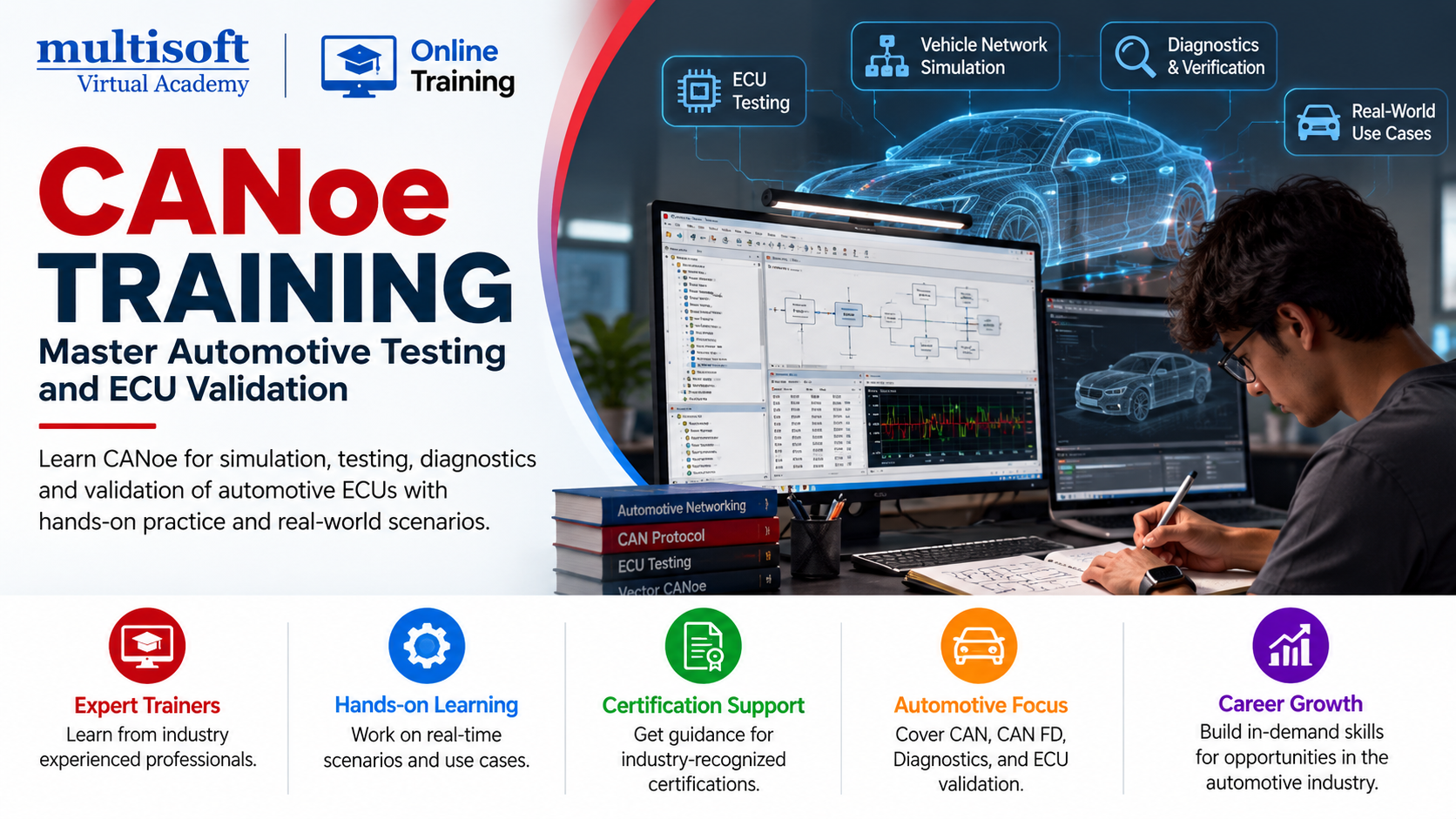
Modern vehicles rely on interconnected electronic control units (ECUs), embedded software, and communication networks to operate essential functions. From engine management and braking systems to advanced driver assistance and electric vehicle technologies, automotive electronics must work reliably under different operating conditions. Testing these systems requires specialized tools that can simulate vehicle networks, analyze communication, and validate software behavior.
CANoe Training helps engineers and aspiring automotive professionals understand how to use Vector CANoe for network simulation, ECU testing, communication analysis, and automated test execution. The software supports the development and validation of distributed embedded systems across automotive and other engineering industries.
Whether you work in embedded systems, automotive software development, hardware testing, or quality assurance, learning CANoe can help you develop practical skills for modern vehicle engineering projects.
This article explores CANoe fundamentals, essential training topics, practical applications, career opportunities, and related skills that can strengthen your automotive testing expertise.
CANoe Training is a development and testing tool from Vector Informatik used to simulate, analyze, and test electronic control units and distributed communication networks.
It helps engineers examine how electronic components exchange information, simulate network participants, reproduce communication scenarios, and evaluate system responses. CANoe can support testing throughout the development lifecycle, from individual software components to complete systems.
Its capabilities include:
The exact capabilities depend on the CANoe edition, license, configuration, and available options.
Understanding these capabilities gives learners a foundation for working with automotive communication and embedded software validation.
Automotive systems are becoming increasingly software-driven. Modern vehicles contain numerous ECUs that communicate through different network technologies. A fault in one component or an unexpected message can affect the behavior of connected systems.
Manual testing alone may not be sufficient to reproduce every operating condition or communication fault. CANoe helps engineering teams create controlled test environments and evaluate system behavior more consistently.
Training introduces the principles of in-vehicle communication and explains how ECUs exchange messages through automotive networks.
Learners develop an understanding of message identifiers, signals, data frames, communication timing, and network behavior.
ECUs perform functions such as powertrain control, body electronics management, battery monitoring, and driver assistance.
CANoe allows engineers to simulate communication partners and test system responses under defined conditions.
Testing does not always require every physical ECU to be available. Virtual or simulated network participants can help engineers evaluate selected functions earlier in development.
This approach supports controlled testing and can make it easier to reproduce specific scenarios.
Automated tests help teams execute repeatable test cases and assess whether a system meets specified requirements.
Training can introduce test design, execution, result evaluation, and the use of automation features available in CANoe.
Systematic testing helps identify communication issues, unexpected responses, and functional defects before systems move to later development stages.
CANoe skills can therefore complement broader software verification and validation practices.
A structured course should combine tool fundamentals with practical exercises. The exact syllabus varies by training provider and the learner's experience level.
Learners begin by understanding the CANoe interface, configuration structure, measurement setup, and basic workflow.
Typical topics include creating or opening a configuration, identifying relevant windows, managing network settings, and understanding how measurement activities are organized.
Practical exercises help participants become comfortable navigating the software before progressing to advanced testing.
The Controller Area Network is widely used for communication between electronic devices in vehicles and other embedded systems.
A CAN-focused module may cover:
Participants learn how to observe communication traffic and interpret the information exchanged between simulated or physical network nodes.
Modern automotive projects may use multiple communication technologies for different performance and cost requirements.
CAN FD extends conventional CAN with support for larger data payloads and higher data-phase bit rates under appropriate network conditions.
LIN is commonly used for lower-cost communication between components in automotive subsystems.
Training may introduce how these networks differ, how they are configured, and how CANoe can be used to analyze and test their communication. Availability depends on the applicable CANoe configuration and options.
Network simulation helps engineers evaluate system behavior even when all physical components are unavailable.
Participants learn how to work with network descriptions, configure nodes, define communication behavior, and observe signal changes.
For example, a learner could simulate a sensor node sending a vehicle speed signal and examine how another simulated ECU responds.
This exercise illustrates how communication and application behavior can be evaluated together.
CAPL, or Communication Access Programming Language, is used in Vector tools to support communication-related programming, simulation, and testing tasks.
A CANoe training program may introduce variables, event-driven functions, message handling, signal access, timers, and basic test logic.
Learners can use these concepts to create simple scripts that respond to received messages or generate defined communication events.
CAPL knowledge is especially useful when a project requires customized simulation behavior or automated test procedures. The available programming capabilities depend on the selected CANoe variant.
Automotive diagnostic testing helps engineers examine fault information and verify diagnostic communication between a tester and an ECU.
Training may cover diagnostic requests and responses, diagnostic databases, fault-code handling, and basic diagnostic test scenarios.
Depending on the project and configuration, learners may also explore diagnostic protocols used for communication over CAN or Ethernet.
These concepts are useful when testing service functions, investigating faults, and validating diagnostic requirements.
Automated testing is an important area for engineers who need to execute repeatable test scenarios.
Training may cover test case creation, test sequence organization, execution, result evaluation, and reporting.
Participants should learn how to connect test objectives with requirements and define clear pass or fail criteria.
A practical example could involve sending a specified message, checking whether a signal reaches an expected value, and recording the test outcome.
Software-in-the-Loop testing evaluates software within a simulated or virtual environment. Hardware-in-the-Loop testing introduces physical target hardware into a controlled test setup.
CANoe supports both approaches, although the required configuration, interfaces, and supporting equipment differ.
Understanding these methods helps learners recognize how testing strategies change throughout the development lifecycle.
CANoe is useful across several engineering activities because it supports communication analysis, simulation, diagnostics, and system testing.
Automotive engineers use testing tools to verify that ECUs respond correctly to messages and operate according to defined requirements.
CANoe can support simulated network environments and communication testing during development.
Electric vehicles depend on communication between components such as battery management systems, charging controllers, and other vehicle control units.
CANoe configurations supporting relevant communication technologies can help engineers examine message exchanges and validate selected functions.
Testing requirements vary according to the system architecture and the protocols involved.
Advanced driver assistance systems use information from sensors, control units, and other vehicle components.
Specialized CANoe options support the analysis, simulation, and testing of ADAS functions using recorded or simulated data.
These capabilities can help teams evaluate defined scenarios and investigate how system components interact.
As vehicle architectures evolve, Ethernet is increasingly relevant to high-bandwidth communication and connected automotive systems.
CANoe offers an Ethernet option for relevant analysis and testing activities. Training in this area can help engineers understand network configuration and diagnostic communication over IP-based connections.
CANoe also supports network technologies and applications beyond passenger cars. Depending on the selected options, its use cases can include protocols such as J1939 and CANopen, which are relevant to commercial vehicles and industrial automation.
Hands-on exercises help learners move beyond theoretical knowledge and understand how testing tasks are performed.
Configure a sample network and observe messages transmitted between simulated nodes.
Identify message identifiers, examine signal values, and investigate how communication changes when a parameter is modified.
Learning outcome: Understand basic network monitoring and signal interpretation.
Create a simple simulation involving two network nodes. Configure one node to transmit a message and define how another node responds.
Observe the interaction and identify any unexpected behavior.
Learning outcome: Understand network simulation and communication dependencies.
Develop a basic CAPL script that reacts to a defined message or signal event.
Add conditions and timing logic where appropriate, then verify the behavior through simulation.
Learning outcome: Apply introductory programming concepts to communication testing.
Define a requirement, configure a test scenario, and specify the expected result.
Execute the test, evaluate the outcome, and document any failure.
Learning outcome: Understand repeatable test execution and result reporting.
Use a suitable sample configuration to examine diagnostic requests and responses.
Investigate how incorrect settings or unexpected responses affect the test result.
Learning outcome: Develop an introductory understanding of ECU diagnostic validation.
Access to CANoe software, a suitable license, and any required hardware or sample configuration depends on the learning environment. These requirements should be confirmed before enrolling.
CANoe training can be relevant to several professional groups.
Automotive engineers: Professionals working with vehicle electronics can strengthen their understanding of ECU communication and testing.
Embedded systems engineers: Those developing firmware or embedded applications can learn how to validate communication behavior.
Test and validation engineers: Professionals responsible for verification can develop skills in simulation, automated testing, and result analysis.
ECU software developers: Developers can learn how to reproduce communication scenarios and investigate software-related issues.
Electronics and electrical engineering graduates: Graduates interested in automotive electronics can use the training as a starting point for specialized technical learning.
Quality assurance professionals: Engineers involved in software quality can explore structured testing approaches for embedded systems.
Basic familiarity with automotive electronics, digital communication, or programming can be helpful. Beginners should select a course that explains the fundamentals before introducing advanced configuration and automation.
CANoe is a specialized engineering tool rather than a standalone professional qualification. Its value depends on how well learners apply it alongside relevant technical knowledge and project experience.
Potential career paths include:
Automotive test engineers execute test cases, analyze system behavior, document defects, and verify that components meet defined requirements.
ECU validation engineers focus on evaluating control-unit functionality, communication, diagnostics, and integration with other vehicle systems.
These professionals test embedded software and examine interactions between applications, hardware, and communication networks.
Automotive network engineers work with in-vehicle communication systems, network configuration, and communication troubleshooting.
HIL test engineers develop and execute tests involving physical controllers connected to simulated environments.
Test automation engineers design repeatable test sequences and help improve the consistency and efficiency of software validation.
Employers may also expect knowledge of C or C++, CAPL, diagnostic protocols, requirements-based testing, and automotive development processes. The required skills vary by role and organization.
CANoe and CANalyzer are both Vector tools, but their primary purposes differ.
CANalyzer is focused on analyzing and observing communication, with capabilities for examining messages, diagnosing communication, and stimulating network traffic.
CANoe offers broader development and testing capabilities, including simulation, automated testing, and system-level validation.
The appropriate tool depends on the engineering task, the selected product configuration, and the project requirements.
Professionals who understand both tools can better evaluate which capabilities are appropriate for different testing and troubleshooting scenarios.
Before selecting a course, review the syllabus carefully to ensure it matches your current knowledge and career objectives.
Look for coverage of CAN communication, network simulation, measurement analysis, and practical ECU testing. If your goal involves automation, check whether the program includes CAPL and test case development.
Professionals working with electric vehicles, ADAS, or Automotive Ethernet should confirm that the course covers the relevant technologies and CANoe options.
Other factors to evaluate include:
A course should also clearly state its prerequisites, learning outcomes, delivery format, and any additional software or hardware requirements.
Automotive engineering continues to evolve as manufacturers introduce software-defined vehicle architectures, advanced driver assistance features, electric mobility, and more connected systems.
These developments increase the importance of reliable communication, repeatable validation, and testing across different development environments.
Professionals can strengthen their knowledge by exploring Automotive Ethernet, CAN FD, diagnostic communication, test automation, and SIL/HIL methodologies.
Familiarity with requirements-based testing and continuous integration workflows can also be useful for projects that automate validation activities.
These are relevant areas for continued learning, not a guarantee of employment or a substitute for practical experience.
It teaches learners how to use CANoe for network simulation, communication analysis, ECU testing, diagnostics, and automated validation.
Yes. Beginners can start with automotive communication fundamentals and basic CANoe operations before progressing to CAPL programming and advanced testing.
Not every task requires CAPL. However, CAPL is useful for customized simulation behavior and automated test development.
CAN FD supports larger payloads and can use a higher bit rate during the data phase under suitable network conditions. Both technologies are used for communication between electronic systems.
Yes. CANoe supports simulation and Software-in-the-Loop workflows, allowing selected tests to run without all physical ECUs being present. The available setup depends on the use case and configuration.
No. Training can help develop relevant technical skills, but employment depends on practical ability, experience, interview performance, and the requirements of the employer.
Developing practical CANoe skills can help engineers understand automotive communication, simulate network behavior, validate ECUs, and improve embedded software testing practices. As vehicles incorporate increasingly sophisticated electronic systems, knowledge of simulation, diagnostics, test automation, and SIL/HIL methodologies can provide a useful foundation for continued professional development. Multisoft Virtual Academy offers CANoe Training designed to help learners build relevant knowledge through structured instruction and practical learning. Professionals interested in automotive testing and embedded systems can explore its training programs to strengthen their technical capabilities and prepare for relevant engineering responsibilities.
| Start Date | End Date | No. of Hrs | Time (IST) | Day | |
|---|---|---|---|---|---|
| No schedule available ! | |||||
Schedule does not suit you, Schedule Now! | Want to take one-on-one training, Enquiry Now! |
|||||




 Join our Live Instructor-Led online classes delivered by industry experts
 Let's Get Started
