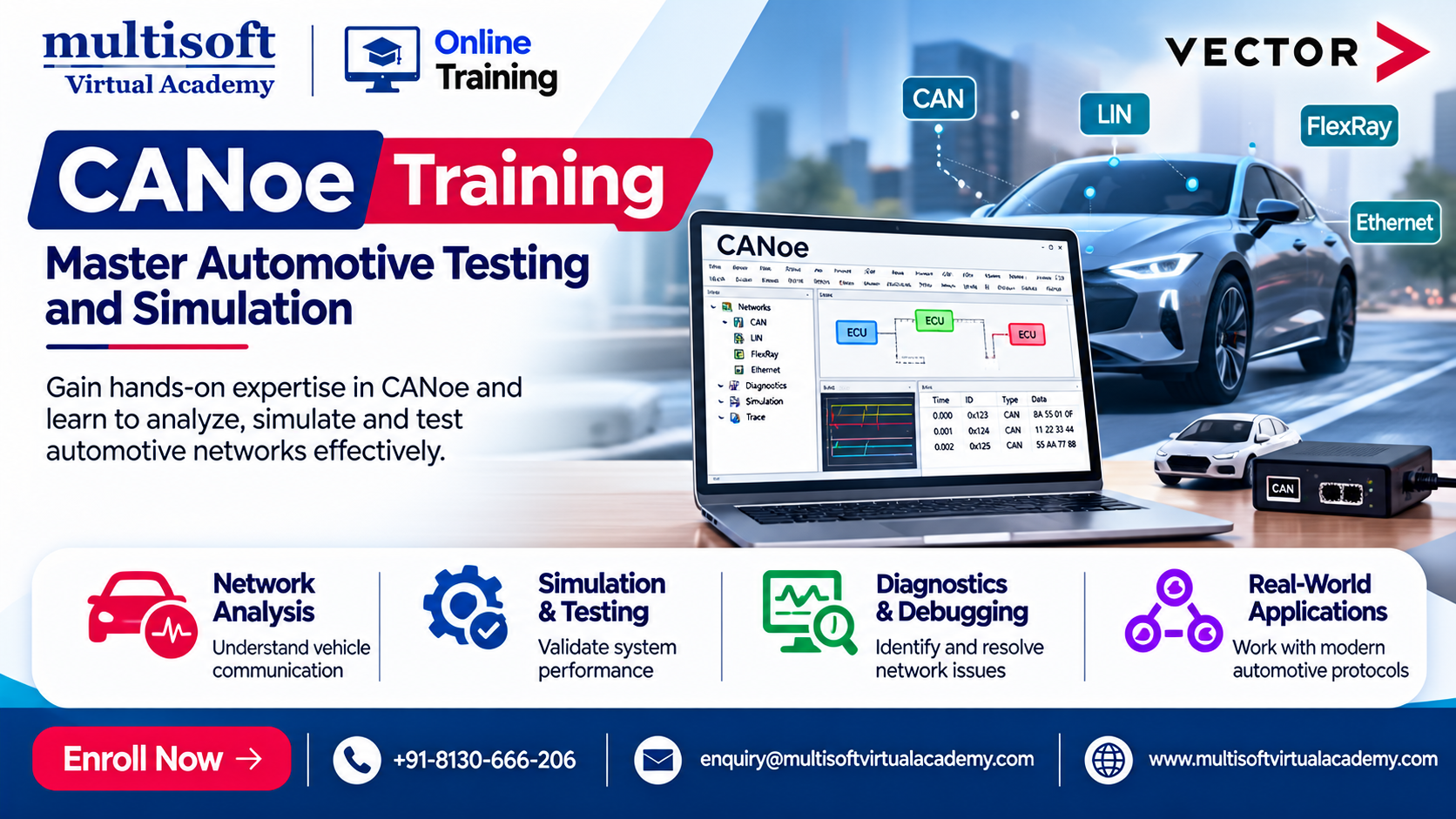
The automotive industry is rapidly evolving with advancements in electric vehicles, connected technologies, advanced driver assistance systems (ADAS), and software-defined vehicles. Modern vehicles contain multiple Electronic Control Units (ECUs) that communicate through different automotive networks. Ensuring reliable communication between these systems requires specialized testing, simulation, and validation tools.
CANoe Training helps automotive engineers, embedded developers, and testing professionals understand how to work with Vector CANoe for automotive network development, simulation, diagnostics, and testing. The training introduces important communication protocols such as CAN, CAN FD, LIN, FlexRay, and Automotive Ethernet, along with CAPL programming and ECU validation techniques.
For professionals interested in automotive embedded systems, learning CANoe can provide valuable technical knowledge for working on vehicle communication and software testing projects.
CANoe is a development, simulation, analysis, and testing tool developed by Vector Informatik. It is used to work with individual ECUs, software components, and complete distributed networks. Engineers can use it to monitor communication, simulate network behavior, perform diagnostics, and validate system functionality.
The software supports different automotive communication technologies and testing environments. Its capabilities can be applied during several stages of product development, from initial network analysis to system-level validation.
CANoe is also used in Software-in-the-Loop (SIL) and Hardware-in-the-Loop (HIL) environments. These approaches allow engineers to evaluate software and electronic systems under controlled test conditions before or during physical hardware testing.
Understanding the CANoe environment is particularly useful for professionals working in automotive software development, embedded engineering, ECU testing, and vehicle network validation.
Automotive systems are becoming increasingly dependent on electronic communication. An issue in one ECU or communication network can affect the performance of other connected systems. Engineers therefore need reliable methods to analyze messages, simulate network conditions, and identify communication problems.
A structured CANoe training program helps learners develop these skills through software demonstrations and practical exercises.
CANoe training introduces learners to the communication protocols used in automotive and embedded systems. Participants can understand how ECUs exchange messages and how different network technologies support vehicle functions.
Knowledge of CAN, CAN FD, LIN, FlexRay, and Automotive Ethernet can help engineers work with different communication requirements.
ECU testing involves checking whether an electronic control unit performs according to its technical requirements. CANoe supports test activities involving communication behavior, signal values, diagnostic functions, and system responses.
Training helps learners understand how to configure test environments and evaluate ECU behavior using suitable testing methods.
CAPL, or Communication Access Programming Language, is used in Vector environments to develop simulation and testing logic.
Learning CAPL can help participants create event-based scripts, manipulate messages and signals, define conditions, and automate selected test activities.
Network simulation allows engineers to evaluate communication behavior without requiring every physical ECU to be connected. CANoe provides tools for creating network simulations, monitoring messages, and analyzing communication sequences.
These capabilities help teams investigate issues and validate system behavior during development.
Automotive software must be tested against functional and communication requirements. Learning CANoe can help professionals understand test preparation, execution, result analysis, and defect investigation.
A comprehensive CANoe Training Course should cover software fundamentals as well as practical automotive communication and testing concepts. The following topics are useful when selecting a training program.
Controller Area Network (CAN) is a communication protocol widely used in automotive and industrial embedded systems. It allows connected electronic devices to exchange information through a shared communication bus.
Important learning areas include:
Understanding CAN fundamentals provides a foundation for working with CANoe and interpreting network communication.
CAN FD, or CAN with Flexible Data Rate, extends the traditional CAN protocol with support for larger data payloads and faster data transmission during the data phase.
Training may introduce:
This knowledge is useful for professionals working with modern automotive communication systems.
Before performing simulation or testing, users need to understand how to configure the software environment.
A practical training program may cover:
These activities help learners become familiar with the software and prepare them for practical exercises.
CANoe provides measurement and analysis functions that help engineers observe communication between network nodes.
Training may include:
These skills can help engineers investigate unexpected messages, communication delays, and signal-related issues.
Recording network traffic is important when engineers need to investigate communication behavior or reproduce a problem.
Learners may explore:
Offline analysis allows engineers to examine recorded communication without repeating the original measurement.
Simulation is an important part of automotive network development. It allows engineers to represent network nodes and communication behavior within a controlled environment.
CANoe training may cover:
Restbus simulation is especially useful when some ECUs are unavailable or when a test environment needs to reproduce the behavior of the remaining network.
CAPL is an important learning area for professionals who want to create customized simulation and testing logic in CANoe.
A practical CAPL Programming Training module may cover:
CAPL knowledge helps engineers develop reusable scripts for selected automation and simulation requirements.
Diagnostic communication helps engineers access ECU information and evaluate diagnostic responses. CANoe supports diagnostic-related testing and analysis through suitable configurations and options.
Training may introduce diagnostic requests, responses, diagnostic services, fault-related information, and test execution workflows.
The specific protocols and diagnostic functions covered depend on the course syllabus and available software options.
CANoe is used across different development and testing activities. Understanding these applications helps learners connect software functions with practical engineering requirements.
Automotive ECU development: Engineers use CANoe to simulate communication, analyze network messages, and validate ECU behavior during development.
Automotive software testing: Testing professionals can create and execute test scenarios to check communication and software functionality.
Vehicle network analysis: CANoe supports monitoring and investigating communication across connected network nodes.
Restbus simulation: Engineers can simulate the behavior of network participants that are not physically available in a test setup.
Diagnostic testing: Suitable CANoe configurations can support diagnostic communication and ECU diagnostic validation.
ADAS and connected vehicle development: Simulation and testing environments can support selected validation activities for advanced vehicle functions and connected systems.
Electric vehicle development: CANoe can support testing of communication and control systems used in electric vehicle development, depending on the selected network technologies and options.
CANoe and CANalyzer are both Vector tools used in automotive network engineering, but their typical applications differ.
CANalyzer is primarily focused on observing, measuring, and analyzing communication networks. It helps engineers monitor messages, interpret signals, and investigate network behavior.
CANoe provides broader capabilities for development, simulation, analysis, diagnostics, and testing. It supports the creation of simulation models and automated test scenarios in suitable configurations.
| Feature | CANoe | CANalyzer |
| Network monitoring | Yes | Yes |
| Communication analysis | Yes | Yes |
| Network simulation | Yes | More limited |
| CAPL-based simulation | Supported | Supported for applicable functions |
| ECU testing | Extensive testing capabilities | Primarily analysis-oriented |
| Automated test environments | Supported | Depends on available functionality |
| Primary application | Development, simulation and testing | Measurement and analysis |
The appropriate tool depends on project requirements, licensing, and the engineering activities being performed.
CANoe training can benefit professionals and learners interested in automotive communication, embedded systems, and software validation.
Basic knowledge of electronics, programming, or communication protocols can be helpful. However, beginners can also start with fundamental CAN concepts before progressing to advanced CANoe features.
Learning CANoe can strengthen the technical skill set of professionals working in automotive and embedded engineering. Depending on educational qualifications and practical experience, relevant career paths may include:
Career opportunities depend on technical knowledge, hands-on experience, project exposure, and employer requirements. CANoe training can support skill development, but completing a course alone does not guarantee employment.
Selecting an appropriate training program is important for developing practical software skills. Consider the following factors before enrolling.
Review whether the syllabus covers CAN fundamentals, CAN FD, CANoe configuration, measurement, simulation, CAPL programming, and testing concepts. Choose a curriculum that matches your professional goals.
Software demonstrations and guided exercises can help learners understand how CANoe works in real engineering scenarios. Ask whether the program includes configuration exercises, message analysis, simulation, and test development.
A trainer with relevant automotive or embedded systems knowledge can explain technical concepts more effectively and connect software functions with practical applications.
Check which CANoe version is used and whether participants receive access to a practice environment. If physical hardware is required for specific exercises, clarify whether it is included.
Live instructor-led training, online classes, and customized corporate programs offer different learning experiences. Select a format that fits your schedule and practical learning requirements.
Check whether the training provides a completion certificate or prepares participants for a separate certification assessment. Understand the eligibility and assessment requirements before making a decision.
CANoe Training teaches participants how to use Vector CANoe for automotive network simulation, communication analysis, ECU testing, diagnostics, and validation.
Yes. Beginners can start with CAN protocol fundamentals and gradually learn software configuration, measurement, simulation, and CAPL programming. Basic knowledge of electronics or programming is beneficial.
CAPL is a programming language used in Vector tools for creating simulation behavior, event-based logic, and automated testing functions.
CAN FD extends traditional CAN by supporting larger data payloads and a faster data rate during the data phase. Both protocols are used for communication between electronic systems.
Yes. CANoe supports HIL testing as well as SIL-based workflows. It can be used to simulate, analyze, and test distributed embedded systems in suitable configurations.
CANoe is used in automotive engineering and can also support development and testing in areas such as aerospace, medical technology, and industrial systems.
It can help professionals develop relevant skills in automotive communication, ECU testing, simulation, and embedded software validation. Career outcomes depend on practical ability, experience, and job requirements.
CANoe has an important role in the development and validation of modern embedded systems. From CAN and CAN FD communication to CAPL programming, network simulation, diagnostics, and ECU testing, understanding its capabilities can help professionals build relevant automotive engineering skills. Choosing a structured course with practical exercises and industry-oriented examples can make the learning process more effective. Multisoft Virtual Academy offers CANoe Training designed to help aspiring and experienced professionals develop practical knowledge of automotive communication, simulation, analysis, and testing workflows.
| Start Date | End Date | No. of Hrs | Time (IST) | Day | |
|---|---|---|---|---|---|
| No schedule available ! | |||||
Schedule does not suit you, Schedule Now! | Want to take one-on-one training, Enquiry Now! |
|||||





 Let's Get Started
