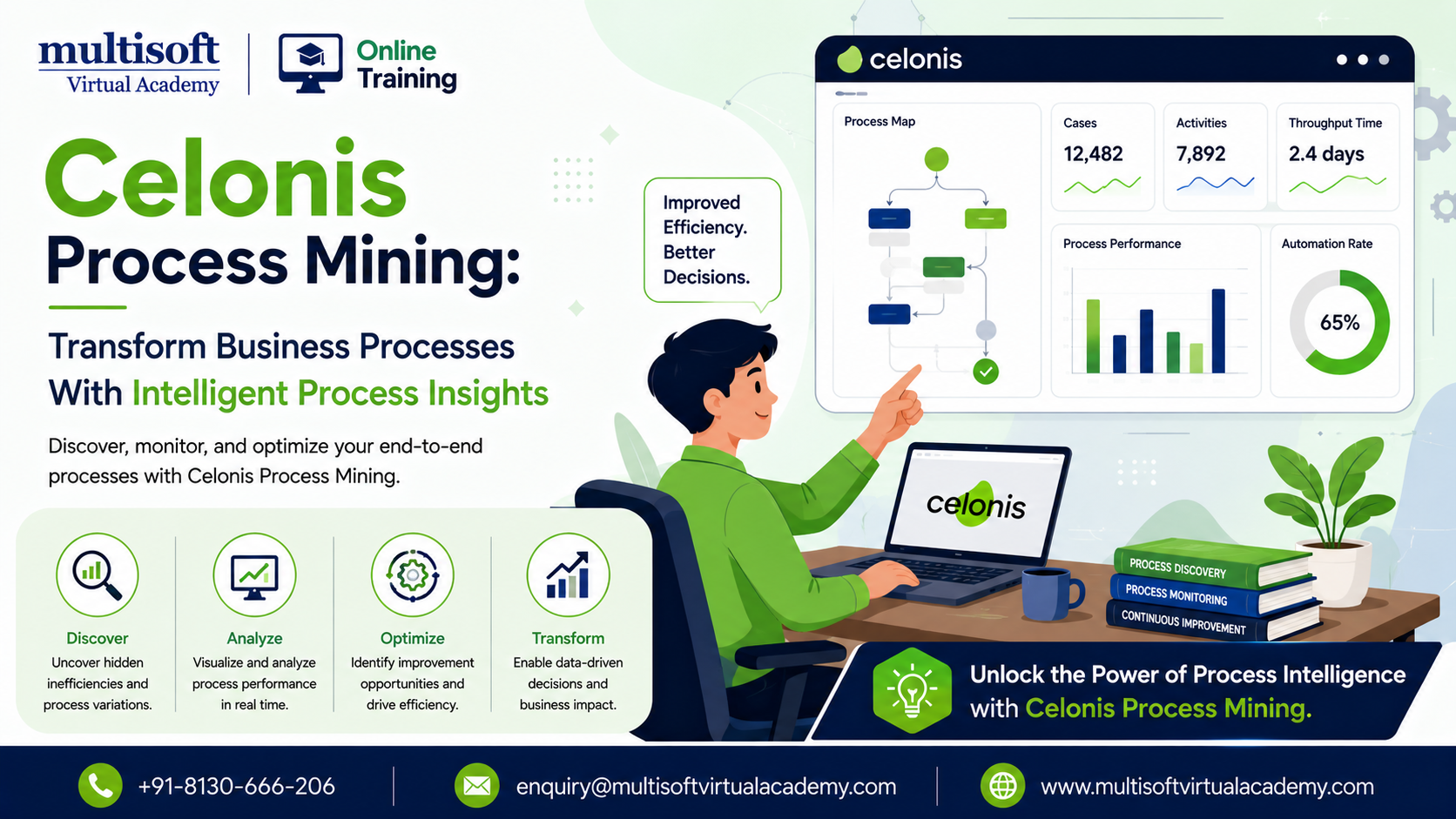
In today’s competitive business environment, organizations need more than conventional reporting to understand how their operations actually work. Celonis Process Mining provides a data-driven approach to discovering, analyzing and improving business processes by transforming operational data into actionable process insights.
As enterprises adopt cloud platforms, automation and artificial intelligence, process visibility has become increasingly important. Businesses want to identify bottlenecks, eliminate unnecessary process variations, reduce operational costs and improve customer experiences. This is where Celonis Process Intelligence and modern process mining capabilities can play an important role.
Celonis has continued expanding its platform toward AI-driven process intelligence and enterprise automation. Recent developments have focused on connecting process context with AI agents, orchestration and broader business ecosystems. Celonis was also recognized as a Leader in the 2026 Gartner Magic Quadrant for Process Intelligence and the 2026 Everest Group Process Mining PEAK Matrix.
Celonis Process Mining is a technology-driven approach for analyzing real business processes using data generated by enterprise systems. Instead of relying only on interviews, assumptions or manually prepared reports, process mining uses event data to reveal how processes are actually executed.
Business applications such as ERP, CRM, procurement, finance and supply chain systems continuously generate digital footprints. These records can contain information about activities, timestamps, transactions and process outcomes. Process mining analyzes this information to reconstruct process flows and identify opportunities for improvement.
For example, an organization may believe that its purchase-to-pay process is straightforward. However, process analysis could reveal repeated approvals, unnecessary purchase order changes, invoice exceptions or delays between process steps.
This creates a more realistic view of operational performance.
Traditional business intelligence generally tells organizations what happened. Process mining goes further by helping businesses understand how the work happened, where it slowed down and why deviations occurred.
This distinction is important for organizations managing complex operations across multiple departments, systems and geographic locations.
With process mining, companies can investigate:
The result is a more detailed understanding of operational performance.
A typical process mining initiative begins by connecting relevant enterprise data sources. These may include ERP, CRM, supply chain management, finance or other business applications.
The process generally involves several stages.
The first step is bringing relevant process data into the process intelligence environment. Data quality, structure and availability are important because reliable insights depend on reliable operational information.
Once the data is available, process mining can visualize how activities are executed in real-world scenarios.
Instead of viewing a process as a theoretical workflow, organizations can examine actual process variants and identify differences between the intended and observed process.
Businesses can then investigate key performance indicators such as cycle time, throughput, delays, exceptions and process variations.
This allows teams to move from general assumptions to measurable operational insights.
The next stage is identifying opportunities where process changes can create measurable value.
For instance, an organization may discover that a significant percentage of invoices require manual intervention because of recurring data or approval issues.
Process intelligence becomes more valuable when insights lead to action. Organizations can combine process analysis with automation, workflow improvements, business rules and other operational initiatives.
This creates a continuous improvement cycle rather than a one-time analytics exercise.
The market is increasingly moving from traditional process mining software toward broader process intelligence platforms.
The difference is significant.
Traditional process mining primarily focuses on discovering and analyzing processes. Modern process intelligence expands that capability by connecting process data, business context, performance analysis, automation and decision-making.
Celonis has increasingly positioned its platform around this broader concept. Its recent product developments include capabilities related to AI agents, orchestration, process adherence, object-centric analysis and operational context.
This evolution is particularly relevant as organizations begin deploying enterprise AI.
AI systems can generate recommendations or perform tasks, but they need reliable business context to make those actions useful. Process intelligence can provide that operational context.
One of the biggest advantages of process mining is visibility. Organizations can understand how processes operate across applications, teams and business units.
This can expose hidden process variations that conventional reports may overlook.
Process bottlenecks can affect customer satisfaction, employee productivity and operational costs. Process analysis helps organizations locate where delays occur and investigate the underlying process conditions.
Organizations can identify repetitive work, unnecessary process steps and avoidable exceptions. This can support initiatives designed to improve productivity and reduce operational waste.
Process mining can compare actual process execution with expected business rules or process standards. This can help organizations investigate deviations and improve adherence.
Modern Celonis updates have also introduced capabilities focused on process adherence and deeper analysis of process deviations.
Instead of relying exclusively on assumptions or anecdotal feedback, decision-makers can use operational data to prioritize process improvement initiatives.
Process intelligence can help organizations determine where automation could provide the greatest value. Rather than automating processes blindly, businesses can first understand the actual process landscape.
The flexibility of process mining makes it useful across many business functions.
Procurement teams can analyze purchase orders, goods receipts, invoices and payments to identify delays, exceptions and unnecessary process variations.
Sales and finance teams can investigate order processing, billing, delivery and payment activities. This can help identify causes of delayed payments and order fulfillment problems.
Organizations can analyze invoice processing to understand approval delays, duplicate invoices, payment exceptions and other inefficiencies.
Supply chain leaders can use process intelligence to examine purchasing, inventory, logistics and fulfillment processes.
The objective is to understand where disruptions and inefficiencies occur and prioritize improvement opportunities.
Customer-facing organizations can examine service workflows to identify repeated interactions, unresolved cases and process delays that may affect customer experience.
Process mining can also support analysis of IT service workflows, helping organizations investigate ticket handling, resolution times, escalations and recurring process deviations.
Business intelligence and process mining are complementary technologies, but they answer different questions.
A dashboard might show that average invoice processing takes ten days. Process mining can help investigate what happens during those ten days.
For example:
Business intelligence:
“Invoice processing takes ten days on average.”
Process mining:
“Which activities, process variants, approvals or exceptions are contributing to the ten-day cycle?”
This makes process mining particularly valuable when organizations need to understand operational behavior rather than simply monitor high-level metrics.
These concepts are related but should not be treated as identical.
Process mining generally analyzes event data generated by enterprise systems to understand business processes.
Task mining can provide additional insight into how people perform tasks on their computers, helping organizations understand detailed user-level activities.
Process intelligence brings together process understanding, operational context, analysis and improvement capabilities to support broader business transformation.
When these approaches are used strategically, organizations can develop a more comprehensive understanding of how work moves through their operations.
Artificial intelligence is becoming an increasingly important component of enterprise process transformation.
Organizations are moving beyond simply analyzing historical data. They want systems that can identify opportunities, provide recommendations and support actions.
This is driving interest in AI-powered process optimization, AI process automation, agentic AI for enterprises and intelligent workflow orchestration.
Celonis has introduced capabilities designed to provide AI agents with access to operational context and process-related information. Its Agent Tools capabilities, for example, are designed to allow AI agents to access relevant Celonis insights and interact with business processes through standardized interfaces.
This direction reflects a broader enterprise trend: AI needs context to deliver meaningful business outcomes.
Successful process mining initiatives require more than implementing software.
Organizations should begin by defining clear business objectives.
Instead of asking, “Where can we use process mining?” companies can ask:
The next step is ensuring that the right data is available and usable.
Organizations should also establish measurable KPIs before beginning an improvement initiative. This makes it easier to evaluate whether process changes have produced meaningful results.
Most importantly, process mining should involve business stakeholders. IT teams may manage data integration, but process owners understand operational realities and can help translate insights into practical improvements.
The process mining market is evolving rapidly as organizations combine process intelligence with AI, automation and enterprise data.
Several trends deserve attention.
AI is increasingly being connected with operational process data to support recommendations, decision-making and automation.
Enterprise AI agents need contextual information about business operations. Process intelligence can help provide that context, allowing agents to operate with greater awareness of actual workflows and business conditions.
Organizations increasingly want to identify process problems as they happen rather than discovering them weeks or months later through retrospective reports.
Complex business operations often involve multiple interconnected objects rather than one linear process. Object-centric approaches can help organizations analyze these relationships more realistically.
The future of process optimization is not limited to identifying problems. Businesses increasingly want to connect insights directly to actions through automation and orchestration.
Organizations are moving from isolated process mining projects toward broader transformation programs covering procurement, finance, supply chain, customer operations and other business functions.
These trends are consistent with recent Celonis platform developments involving AI, object-centric metrics, process adherence, orchestration and process intelligence.
Organizations adopting process mining need professionals who understand both technology and business processes.
A strong Celonis training program can help learners understand process discovery, event logs, process analysis, KPIs, process variants and improvement methodologies.
Professionals may also benefit from learning how process mining connects with enterprise applications, data analytics, automation and AI.
For organizations, employee training can help create internal capabilities rather than relying entirely on external specialists. Teams that understand process intelligence can better communicate with technical stakeholders and business leaders.
Celonis and process intelligence skills can be relevant to professionals working in several areas, including:
Both technical and business professionals can benefit because process mining combines data analysis with practical process improvement.
Technology alone does not guarantee transformation.
A successful strategy should combine four major elements: data, process knowledge, technology and business action.
Organizations should establish clear ownership for each process initiative. They should identify measurable outcomes and prioritize use cases according to business value.
It is also important to treat process improvement as continuous.
Business processes change when companies introduce new applications, suppliers, regulations, products or operating models. Continuous process monitoring can therefore provide more value than occasional process reviews.
The ultimate objective is not simply to create attractive process maps. It is to use operational intelligence to make processes faster, more predictable, compliant and valuable.
Celonis Process Mining is becoming an important capability for organizations seeking deeper operational visibility and smarter process improvement. As process mining evolves toward broader Celonis Process Intelligence, AI-powered optimization, process orchestration and intelligent automation, businesses have an opportunity to connect data-driven insights with measurable operational action.
For professionals and organizations looking to develop practical expertise in process mining, enterprise transformation and emerging AI-enabled business technologies, Multisoft Virtual Academy provides specialized learning and professional training solutions designed to help learners understand modern technologies and apply them in real-world business environments. With the right combination of structured learning, practical knowledge and industry-focused guidance, organizations can build stronger capabilities for the next generation of intelligent process transformation.
| Start Date | End Date | No. of Hrs | Time (IST) | Day | |
|---|---|---|---|---|---|
| No schedule available ! | |||||
Schedule does not suit you, Schedule Now! | Want to take one-on-one training, Enquiry Now! |
|||||






 Join our Live Instructor-Led online classes delivered by industry experts
 Let's Get Started