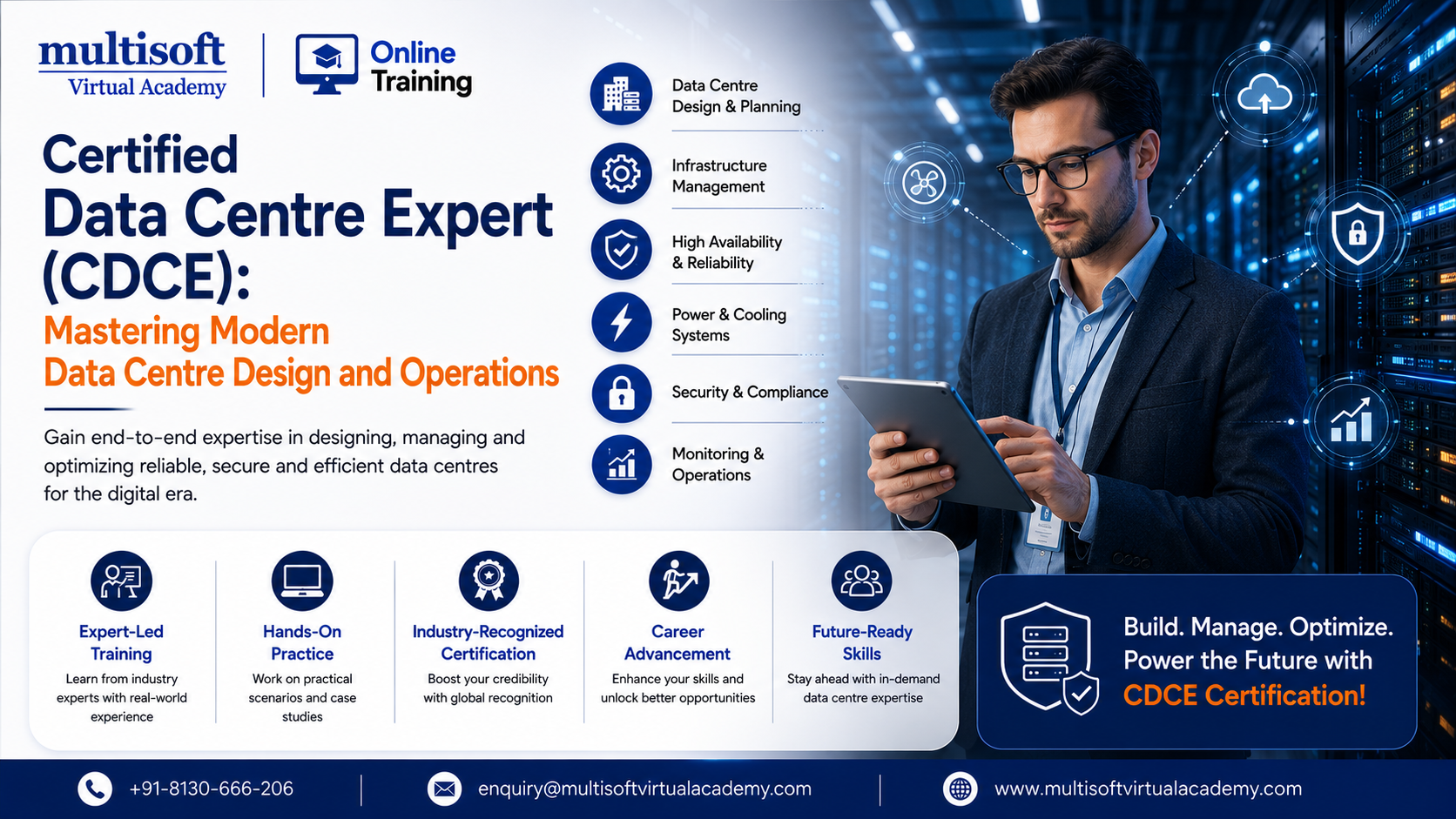
The rapid growth of artificial intelligence, cloud computing, IoT and digital services is transforming the global data centre industry. Modern organisations need data centres that are highly available, energy efficient, scalable, secure and capable of supporting increasingly demanding workloads. As a result, skilled data centre professionals are becoming increasingly important.
Certified Data Centre Expert (CDCE) is an advanced professional certification designed for specialists involved in the planning, design, implementation, evaluation and lifecycle management of mission-critical data centres. The certification focuses on practical knowledge that helps professionals assess business requirements, evaluate technical designs, select appropriate infrastructure and support testing and commissioning activities.
For professionals looking to strengthen their careers in data centre design, data centre management, data centre infrastructure and mission-critical facilities, CDCE can provide a valuable foundation for understanding how complex data centre environments are developed and managed.
Certified Data Centre Expert (CDCE) is an expert-level data centre certification focused on the technical and business considerations involved in implementing mission-critical data centre facilities.
The certification addresses areas such as the data centre lifecycle, preparation and planning, development, construction, fit-out, testing, commissioning, handover and retirement. It is intended for professionals working across IT, facilities and data centre operations.
A CDCE-focused learning path can help professionals understand how different components of a data centre work together. These components include:
The objective is not simply to understand individual technologies. It is to develop the ability to evaluate an entire mission-critical data centre environment from planning through operational readiness.
Data centres are no longer simply facilities containing servers. They have become critical infrastructure supporting cloud platforms, artificial intelligence, financial systems, telecommunications, enterprise applications and digital services.
In 2026, AI workloads are accelerating demand for high-density computing, while data centre operators are also dealing with power availability, cooling requirements, sustainability targets and infrastructure constraints. Industry research highlights AI, energy demand, liquid cooling, sustainability, hyperscale facilities and edge computing as major data centre trends.
This changing environment creates demand for professionals who understand both traditional data centre infrastructure and emerging technologies.
A Certified Data Centre Expert can develop knowledge that supports better decision-making in areas such as infrastructure planning, technical evaluation, equipment selection, resilience and commissioning.
Data centre design requires a multidisciplinary approach. A successful facility must balance availability, performance, scalability, energy consumption, cost and operational requirements.
Professionals involved in data centre design need to understand how electrical, mechanical, networking and IT systems interact.
Important design considerations include:
Reliable power is fundamental to a mission-critical data centre. Professionals must understand power distribution, redundancy, backup systems and the relationship between IT loads and facility infrastructure.
With AI and high-performance computing increasing power requirements, data centre power planning is becoming even more important.
Cooling is one of the most important areas of modern data centre infrastructure.
Traditional air cooling remains relevant for many environments, but high-density AI workloads are encouraging greater adoption of direct-to-chip and immersion liquid cooling technologies. S&P Global reports that 21% of surveyed enterprise decision-makers planned to introduce liquid cooling alongside air cooling within the following year, compared with 13% in the previous survey.
A modern data centre expert therefore needs to understand thermal loads, cooling architecture, airflow management and emerging liquid cooling approaches.
Mission-critical facilities require infrastructure designed to minimise downtime and maintain service continuity.
Data centre professionals must evaluate redundancy, fault tolerance, maintenance strategies and operational procedures to determine whether infrastructure can meet business availability requirements.
Physical security, access control, surveillance, fire detection and suppression are also essential elements of data centre design.
A comprehensive data centre strategy considers security from the initial planning stage rather than treating it as an additional feature after construction.
Mission-critical data centres support services where downtime can have significant operational and financial consequences. Banks, cloud providers, telecommunications companies, healthcare organisations, technology businesses and large enterprises may depend on highly resilient infrastructure.
CDCE-oriented knowledge is particularly relevant because professionals must evaluate whether proposed designs can satisfy business and technical requirements.
This can include analysing a business case, evaluating project plans and reviewing technical designs for mission-critical data centre implementation. The CDCE course description from HPE also highlights equipment selection, equipment test scripts and integrated performance and validation testing as important areas.
This makes data centre certification valuable for professionals who want to move beyond basic infrastructure knowledge and develop stronger expertise in the complete data centre lifecycle.
A data centre should be viewed as a lifecycle rather than a single construction project.
Key lifecycle stages generally include:
Understanding this lifecycle helps professionals identify potential problems before they affect operations.
Testing and commissioning are especially important because a facility may appear complete while individual systems have not yet been validated under realistic operating conditions.
Commissioning verifies that infrastructure performs according to its intended design and operational requirements.
For mission-critical environments, testing can involve electrical systems, mechanical systems, cooling infrastructure, controls, monitoring and integrated facility operations.
Professionals may need to understand:
The CDCE framework specifically includes testing and commissioning within the broader data centre lifecycle.
Strong commissioning knowledge can reduce operational risks and provide greater confidence before a facility enters production service.
Artificial intelligence is one of the biggest forces reshaping data centre infrastructure.
AI workloads often require high-performance GPUs and other specialised processors. These systems can generate substantially higher heat densities than conventional enterprise workloads, creating new challenges for power and thermal management.
This is contributing to increased interest in:
The rapid expansion of AI infrastructure also increases the importance of professionals who understand how facility design must adapt to changing computing requirements.
Liquid cooling is becoming one of the most discussed technologies in modern data centre operations.
Direct-to-chip cooling transfers heat from high-performance components using a liquid-based cooling mechanism. Immersion cooling places servers in a specialised dielectric fluid environment to remove heat more efficiently.
These technologies can become particularly relevant as rack densities increase.
However, implementing liquid cooling is not simply a matter of replacing an air-conditioning system. It requires consideration of facility plumbing, heat rejection, maintenance procedures, equipment compatibility, monitoring and operational processes.
A strong data centre infrastructure professional must therefore understand both the benefits and implementation challenges associated with emerging cooling technologies.
Sustainability has become a major consideration in data centre planning and operations.
Growing computing requirements are increasing demand for electricity and cooling resources. Recent research highlights energy consumption, water utilisation and carbon impact as important challenges associated with AI-driven data centre growth.
Modern data centre sustainability strategies can include:
Professionals with knowledge of these concepts can contribute to more efficient and environmentally responsible data centre projects.
Edge computing is another important trend influencing data centre infrastructure.
Instead of processing every workload in a central facility, edge infrastructure brings computing resources closer to users, devices and data sources. This can be particularly important for applications requiring low latency.
Examples include:
S&P Global notes that AI inference is creating new opportunities for edge computing because some workloads benefit from processing closer to users and data sources.
As edge deployments grow, professionals may increasingly need to manage smaller, distributed and highly automated data centre environments.
Managing a modern data centre requires visibility into infrastructure performance.
Data Centre Infrastructure Management (DCIM) solutions can help organisations monitor equipment, capacity, power, cooling and operational conditions.
Data centre professionals can use infrastructure monitoring to identify potential problems, optimise capacity and improve operational efficiency.
The increasing complexity of AI-ready facilities makes intelligent monitoring even more valuable. Industry analysis also identifies DCIM and AI-enabled cooling optimisation as part of the evolving data centre technology landscape.
CDCE preparation can complement this knowledge by giving professionals a broader understanding of the infrastructure that management systems are designed to monitor.
CDCE is particularly relevant to professionals working in or around data centre environments.
Suitable audiences may include:
The certification is designed for IT, facilities and operations professionals involved with data centres, while advanced course offerings can focus on the design, build, renovation or relocation of mission-critical facilities.
Data centre expertise can support career development across several technical and managerial roles.
Potential career paths include:
The value of certification is strongest when combined with practical experience. Professionals should therefore focus on understanding real-world infrastructure scenarios rather than relying solely on examination preparation.
A structured preparation strategy can make advanced data centre learning more effective.
Start by developing a strong understanding of fundamental data centre concepts. Review power, cooling, networking, physical security and facility operations before moving into complex design scenarios.
Next, study the complete data centre lifecycle. Understand why each stage exists and how decisions made during planning can affect construction, commissioning and long-term operations.
It is also useful to follow current developments in AI data centres, liquid cooling, hyperscale data centres, edge computing, data centre sustainability and renewable energy. These trends are increasingly influencing how facilities are designed and operated in 2026.
Finally, use practical case studies wherever possible. Analysing a hypothetical mission-critical facility can help connect theoretical concepts with real engineering and operational decisions.
The future of the data centre industry will be shaped by the convergence of AI, cloud computing, edge infrastructure, automation and sustainability.
Global demand is also putting pressure on data centre capacity, power availability and infrastructure development. CBRE reported strong growth in data centre inventory during the first quarter of 2026 while noting that AI, hyperscale and emerging cloud demand continue to drive the market.
As facilities become more complex, employers will increasingly need professionals who can understand the interaction between IT systems and critical facility infrastructure.
This makes advanced data centre certification an important career-development option for professionals who want to establish expertise in modern mission-critical environments.
Becoming a Certified Data Centre Expert (CDCE) can help professionals build a deeper understanding of data centre design, infrastructure, commissioning, operations, sustainability and emerging technologies. As AI, cloud computing and edge workloads continue to reshape the industry, specialised expertise can provide an important professional advantage. For learners and organisations seeking structured CDCE training, data centre certification and practical industry-focused learning, Multisoft Virtual Academy acts as a professional service provider offering training support designed to help professionals strengthen their data centre knowledge and career capabilities.
| Start Date | End Date | No. of Hrs | Time (IST) | Day | |
|---|---|---|---|---|---|
| No schedule available ! | |||||
Schedule does not suit you, Schedule Now! | Want to take one-on-one training, Enquiry Now! |
|||||






 Join our Live Instructor-Led online classes delivered by industry experts
 Let's Get Started