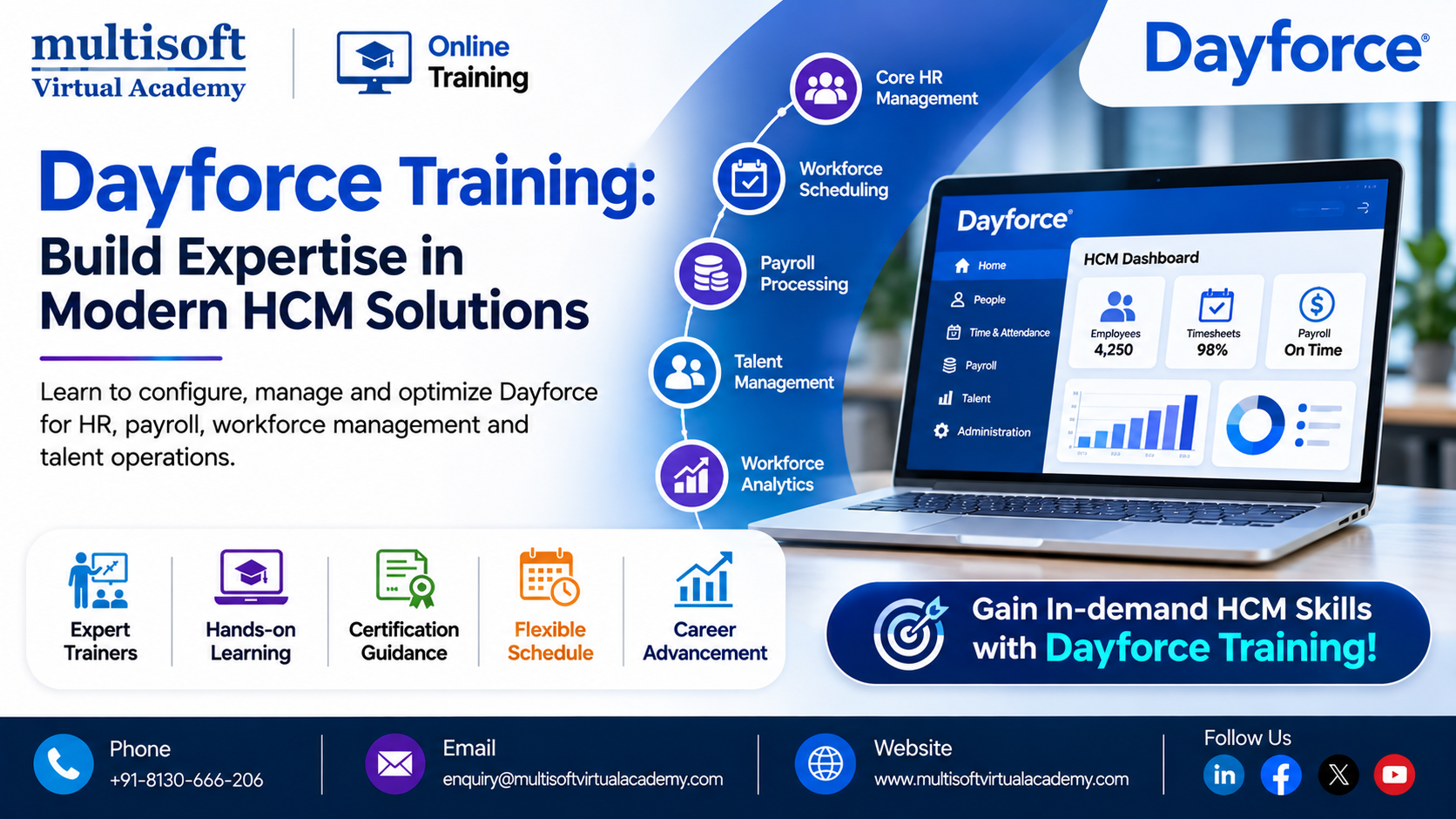
Managing employees, payroll, attendance, and workforce operations requires more than traditional HR processes. Organizations need technology that connects employee information with essential business activities while helping HR teams work more efficiently. Cloud-based Human Capital Management (HCM) platforms are becoming an important part of this transformation.
Dayforce offers an integrated environment for managing several workforce-related functions, including human resources, payroll, time and attendance, scheduling, benefits, and talent management. Understanding how these capabilities work can help professionals contribute to organizations that are modernizing their HR operations.
Dayforce Training provides an opportunity to develop knowledge of this platform and its business applications. It introduces learners to important HCM processes and explains how organizations can manage employee information, payroll activities, workforce schedules, and talent-related functions through connected workflows.
For HR executives, payroll administrators, business analysts, and technology professionals, learning Dayforce can be a valuable addition to their professional skill set.
Dayforce is a cloud-based human capital management platform that supports workforce-related business processes. It brings together multiple HR capabilities within an integrated system, helping organizations manage employee information and operational activities.
The platform supports different stages of the employee lifecycle, from recruitment and onboarding to payroll, performance management, learning, and workforce administration.
Its capabilities can help organizations address common HR challenges, such as maintaining accurate employee records, coordinating schedules, processing payroll information, and providing workforce-related reports.
A structured Dayforce learning program helps professionals understand how these functions are organized and how different modules support business requirements.
As companies expand their operations, managing workforce information becomes increasingly complex. HR departments must coordinate employee records, payroll, working hours, benefits, and compliance-related activities.
Professionals with knowledge of integrated HCM platforms can help organizations understand and manage these processes more effectively.
Employee information changes throughout the employment lifecycle. New hires join, employees change positions, reporting relationships are updated, and employment details require regular maintenance.
Dayforce training introduces learners to employee data management and related administrative workflows. This knowledge can help users understand how employee information is maintained within an organized HCM environment.
Payroll teams work with employee compensation, earnings, deductions, pay periods, and other financial information. A connected HCM environment can help coordinate relevant employee and payroll data.
Learning Dayforce payroll functionality helps professionals understand payroll-related activities and the importance of accurate information.
Businesses with shift-based operations need reliable scheduling and attendance processes. Workforce management capabilities help organizations coordinate employee availability, working hours, and staffing requirements.
Training provides an introduction to scheduling workflows and time management activities.
Workforce information can support operational planning and management decisions. Professionals who understand reporting features can retrieve relevant information and interpret workforce-related results more effectively.
A complete Dayforce HCM Training Course should explain the platform's major functional areas through business scenarios and practical demonstrations. The modules covered may differ depending on the training objectives and platform configuration.
Understanding the platform environment is an important first step for new users. Learners become familiar with navigation, employee records, user access, and common administrative activities.
Topics may include:
This foundation helps learners understand how different users interact with the platform.
Core HR focuses on maintaining employee information and managing essential human resource processes.
Training may cover employee profiles, job assignments, employment information, organizational structures, and employee-related changes.
Professionals can learn how HR teams maintain records and manage employee information throughout the employment lifecycle.
Payroll management is one of the important functional areas within an HCM environment. Businesses must process employee compensation accurately while considering applicable payroll policies and regulatory requirements.
Dayforce Payroll Training may introduce the following topics:
Practical exercises can help learners understand how payroll-related information is maintained and processed.
Payroll configuration and compliance requirements vary across countries and jurisdictions. Professionals should understand the applicable local rules when working with real payroll environments.
Time and attendance management helps organizations record and review employee working hours. It is particularly relevant to businesses with multiple shifts, hourly employees, and distributed teams.
A training program may cover:
Understanding these processes can help users recognize how working-time information connects with workforce management and payroll activities.
Workforce scheduling involves assigning employees to shifts according to operational needs and availability.
Dayforce workforce management training may introduce shift planning, schedule creation, schedule adjustments, employee availability, and staffing requirements.
Professionals can explore how scheduling processes support workforce coordination and help managers review staffing information.
Employee benefits contribute to the overall employee experience. Organizations need processes for maintaining benefit information, managing enrollment, and reviewing employee eligibility.
Training may introduce:
The exact functionality available depends on the organization's configuration and regional requirements.
Talent management helps organizations attract, develop, evaluate, and retain employees.
This functional area can be relevant to HR teams responsible for recruitment, performance reviews, employee development, and career planning.
Possible learning topics include recruitment workflows, performance management, goal tracking, talent development, succession planning, and compensation-related processes.
Employee learning and development help organizations maintain workforce capabilities and prepare employees for changing business requirements.
A Dayforce learning-focused program may cover learning catalogs, course assignments, employee learning plans, training progress, and learning-related reports.
These concepts are useful for learning administrators and HR professionals responsible for employee development initiatives.
Reporting supports the review of employee information and workforce operations. HR teams may use reports to understand staffing, payroll, attendance, and other operational activities.
Training may introduce standard reports, report navigation, data filters, access permissions, and reporting practices.
Learners should also understand the importance of data accuracy, confidentiality, and appropriate access when working with employee information.
Learning the platform's functional modules is important, but implementation knowledge provides a broader understanding of how organizations introduce HCM technology.
Dayforce Implementation Training can introduce professionals to the activities involved in preparing and deploying the platform.
Implementation teams begin by understanding the organization's HR policies, payroll processes, workforce structure, and operational requirements.
Professionals must identify business needs and document the processes that the system should support.
After requirements are collected, teams plan how the required processes will operate within the platform.
Configuration depends on the selected modules, organizational policies, system capabilities, and implementation scope.
Employee information must be reviewed and prepared before migration. Data quality is important because incorrect or incomplete information can affect payroll, reporting, and employee administration.
Organizations may connect Dayforce with financial applications, identity management systems, external payroll services, and other enterprise platforms.
Understanding integration requirements helps project teams plan how information will move between systems.
Testing helps confirm that important business processes work as expected. Typical scenarios may include employee onboarding, payroll processing, attendance tracking, schedule changes, and benefits enrollment.
User acceptance testing also allows business stakeholders to review whether the solution meets their operational requirements.
Following deployment, employees and administrators need guidance on using the system. Support teams monitor issues, assist users, and help maintain effective application operations.
Understanding these stages can help learners prepare for implementation-related responsibilities.
HCM technology continues to develop as organizations explore automation, data-driven workforce planning, and AI-assisted employee services.
Professionals learning Dayforce can also develop awareness of these wider technology trends.
AI is becoming relevant to several HR activities, including information discovery, employee assistance, and selected administrative workflows.
Professionals should understand how AI-supported features are governed and how employee data privacy, permissions, and human oversight affect their use.
Workforce analytics helps organizations examine employee information, staffing patterns, labor requirements, and operational performance.
Knowledge of reporting and data interpretation can help HR professionals contribute to workforce planning activities.
Automation can reduce repetitive administrative tasks and support consistent process execution. Examples include selected approval workflows, employee notifications, and routine information updates.
Professionals should understand which tasks can be automated and which require review or approval.
Organizations increasingly focus on identifying employee capabilities and matching skills with business needs.
Talent management and learning processes can support workforce development and help businesses plan for future skill requirements.
These are relevant HCM learning opportunities rather than a guarantee that every feature is available in every Dayforce configuration.
Dayforce Online Training is relevant to professionals who work with HR operations, payroll, workforce administration, and enterprise applications.
Previous experience in HR, payroll, business administration, or enterprise applications can be useful, although course prerequisites vary.
Developing Dayforce knowledge can complement existing experience in HR technology and enterprise application management.
Depending on professional qualifications and practical exposure, learners may explore positions such as:
Employers generally evaluate candidates based on their understanding of business processes, platform knowledge, relevant experience, and problem-solving abilities. Training is one part of professional development and does not guarantee employment or certification.
Choosing a suitable course can make a significant difference to the learning experience. Before enrolling, consider the following points.
Check the syllabus: Review whether the course includes the modules relevant to your career goals, such as Core HR, payroll, workforce management, benefits, and reporting.
Prioritize practical demonstrations: Look for a learning program that explains platform workflows through business scenarios rather than focusing only on theoretical concepts.
Evaluate trainer knowledge: An experienced instructor should be able to explain both platform functionality and the business processes behind it.
Confirm the learning environment: Ask whether learners receive access to a practice system and which version or configuration is covered.
Choose a suitable format: Consider live online classes, individual sessions, or corporate training according to your schedule and learning requirements.
Understand certification options: Verify whether the provider offers a course-completion certificate or preparation for a separate vendor certification. These credentials serve different purposes.
Dayforce Training helps professionals understand the platform's HCM capabilities, including employee administration, payroll, time and attendance, scheduling, benefits, talent management, and reporting.
Yes. Beginners can start with platform fundamentals and core HR concepts before progressing to specialized areas. Basic knowledge of human resources or business operations can be helpful.
Payroll-focused training may cover employee pay information, earnings, deductions, pay periods, payroll processing, validation, and reporting. The exact scope depends on the course.
Implementation-focused training may introduce requirement gathering, process mapping, configuration planning, data migration, integration, testing, deployment, and support.
Yes. Online learning can help HR professionals develop platform knowledge while continuing their regular work responsibilities.
Potential career paths include HCM Consultant, Payroll Specialist, HRIS Analyst, Workforce Management Consultant, System Administrator, and Application Support Specialist. Opportunities depend on qualifications and practical experience.
Modern organizations need connected HCM solutions to manage employee information, payroll, benefits, scheduling, and talent development effectively. Developing knowledge of Dayforce can help professionals understand how these functions operate within an integrated cloud environment and how implementation activities support digital HR transformation. A quality training program should combine platform fundamentals, role-based learning, practical demonstrations, and relevant business scenarios. Multisoft Virtual Academy provides Dayforce Training for HR professionals, payroll specialists, administrators, and aspiring consultants who want to strengthen their HCM knowledge and develop practical understanding of modern workforce management processes.
| Start Date | End Date | No. of Hrs | Time (IST) | Day | |
|---|---|---|---|---|---|
| No schedule available ! | |||||
Schedule does not suit you, Schedule Now! | Want to take one-on-one training, Enquiry Now! |
|||||




 Let's Get Started
