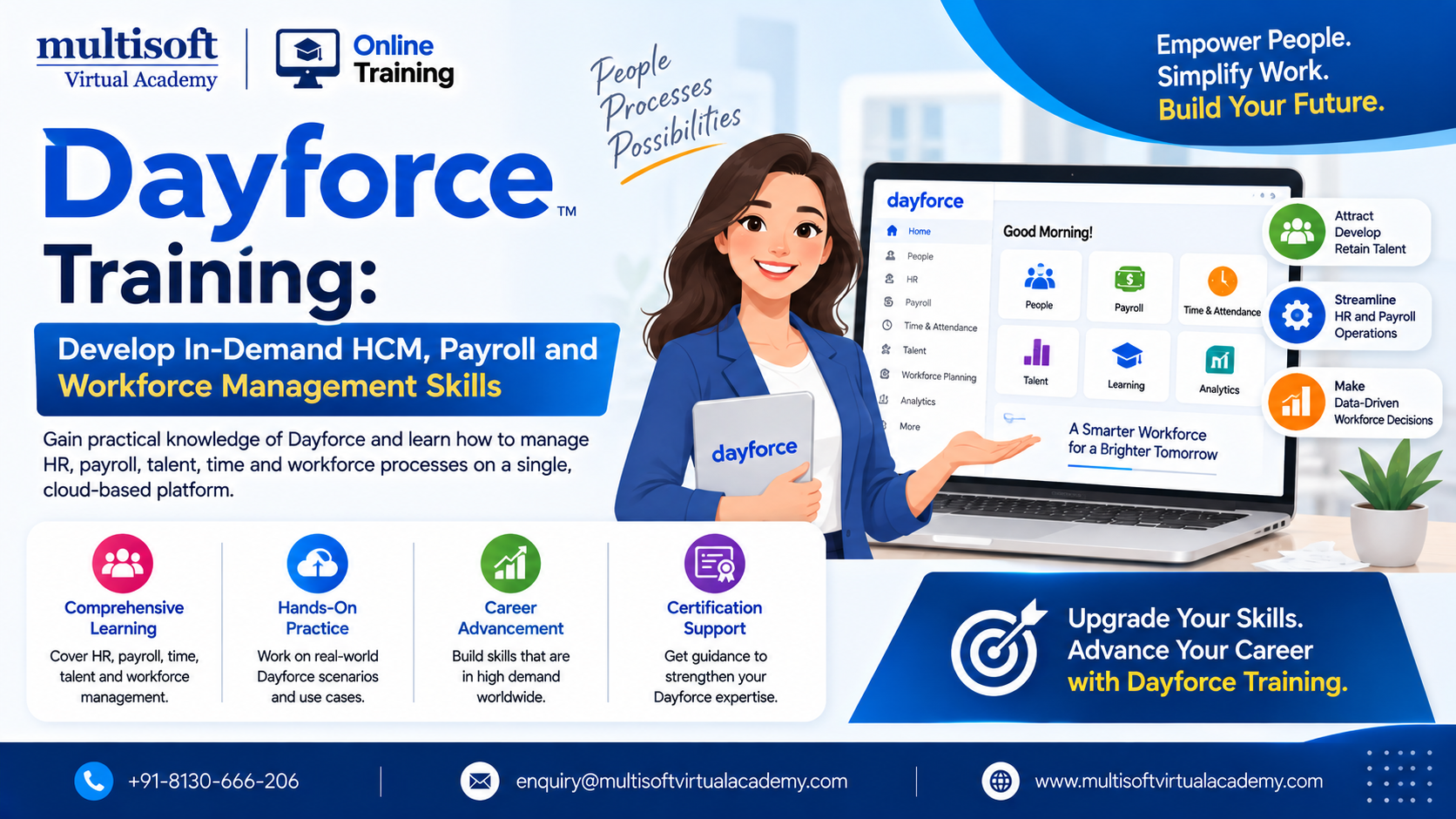
Organizations are increasingly adopting unified human capital management platforms to simplify HR operations, improve workforce visibility and support better employee experiences. As businesses manage complex payroll requirements, workforce scheduling, talent development and employee data across locations, professionals with specialized Dayforce Training are becoming increasingly valuable.
Dayforce is a comprehensive human capital management platform that brings together capabilities across areas such as human resources, payroll, workforce management, talent and learning. Effective training helps professionals understand how these functions work together while developing the practical knowledge required to administer and use the platform efficiently.
With organizations continuing to modernize HR technology, learning Dayforce HCM, payroll, workforce management and related capabilities can help HR professionals, payroll specialists, consultants, administrators and technology teams strengthen their professional expertise.
Dayforce Training is a structured learning program designed to help professionals understand and work with the Dayforce HCM platform. Depending on the learner's role, training may cover HR administration, payroll, workforce management, benefits, talent, learning, reporting, configuration and system administration.
Training can range from fundamental concepts for beginners to advanced administration and implementation topics for experienced professionals.
The official Dayforce training ecosystem includes instructor-led learning, self-directed learning and role-based learning opportunities. Dayforce also emphasizes continued learning after implementation so users can remain familiar with platform capabilities and updates.
For organizations, this makes structured training an important part of successful HCM adoption rather than simply an optional professional development activity.
Modern HR departments increasingly depend on technology to manage employee information, payroll, scheduling and workforce processes. However, implementing an HCM platform alone does not guarantee successful adoption.
Employees and administrators need to understand how the platform works and how its capabilities relate to their responsibilities.
A well-designed Dayforce HR Training program can help professionals:
Training can also reduce dependency on trial-and-error learning and help organizations establish more consistent processes.
Dayforce HCM Training focuses on the broader human capital management ecosystem. It can help learners understand how HR information, payroll, workforce management and employee development processes operate within an integrated environment.
For HR professionals, relevant learning areas may include employee records, organizational structures, HR workflows, security concepts, reporting and workforce processes.
Understanding the relationship between different HCM functions is especially important because changes in one business process can affect another.
For example, workforce scheduling can influence time data while time data can influence payroll processing. Similarly, organizational structures can affect reporting, access and employee administration.
A comprehensive learning approach therefore focuses not only on individual features but also on how processes connect.
Payroll is one of the most important components of any HCM environment because accuracy, compliance and timely processing directly affect employees and the organization.
Dayforce Payroll Training helps professionals develop knowledge of payroll concepts and processes within the Dayforce environment. Depending on the learning path, topics may include payroll setup, pay groups, earnings, deductions, payroll processing, payroll reporting and related administration.
Dayforce documentation also covers specialized payroll capabilities such as certified payroll configurations, mappings and exports.
Professionals working in payroll can therefore benefit from structured training that combines platform knowledge with practical understanding of payroll workflows.
For organizations operating across multiple locations or jurisdictions, payroll knowledge becomes even more important because requirements can vary by region.
Workforce management is another major area where specialized skills are increasingly valuable.
Dayforce Workforce Management Training can help professionals understand processes related to time and attendance, scheduling, workforce planning and related employee activities.
Workforce management teams need to balance operational requirements with employee availability, labor policies and business objectives. A properly configured HCM platform can help organizations manage these processes more efficiently.
Professionals who understand workforce management functionality can contribute to better scheduling practices, improved visibility and more efficient workforce administration.
Current Dayforce initiatives continue to highlight the connection between workforce management and payroll, particularly around real-time workforce visibility and compliance.
Organizations need skilled administrators to maintain and manage their HCM environments.
Dayforce Administrator Training is particularly useful for professionals responsible for configuration, security, employee administration, workflows, reporting and ongoing system maintenance.
An administrator-focused learning path may include:
Dayforce's implementation documentation identifies implementation consultants, implementation partners, resellers, client system administrators and technical staff among the audiences who work with implementation and configuration processes.
This demonstrates why administrator knowledge is valuable throughout the implementation and operational lifecycle.
HCM implementation projects require more than product familiarity. Consultants need to understand business requirements, configuration concepts, organizational structures, workflows, testing and deployment processes.
Dayforce Implementation Training can help aspiring and experienced consultants develop a stronger understanding of the implementation lifecycle.
A practical implementation learning path may cover:
The Dayforce implementation documentation describes implementation and configuration as a structured process involving concepts, rules, codes and other elements needed for the platform to function effectively.
This makes implementation-focused education particularly relevant for consultants and technical professionals seeking to work on HCM transformation projects.
Certification can be an important component of a professional development strategy because it provides a structured way to demonstrate knowledge and maintain learning progress.
Professionals researching Dayforce Certification should distinguish between general training, vendor-specific certification and role-based learning opportunities. Certification requirements and available pathways can change over time, so candidates should always verify current requirements through the appropriate official resources.
Dayforce's current learning documentation includes certification management capabilities and explains how certifications can be connected with courses and learning plans.
For professionals, combining training with practical experience can provide a stronger foundation than relying on certification preparation alone.
Learning management has become an increasingly important part of modern HCM.
Dayforce Learning provides capabilities for managing learning activities, skills and certifications. Current Dayforce documentation describes functionality for tracking learning activities and certification status within the platform.
The platform also supports learning activities across the employee lifecycle. Dayforce describes its learning capabilities as supporting workforce development, skills growth, personalized learning and certification management.
This creates opportunities for professionals interested in Dayforce Learning Training to develop expertise beyond traditional HR administration.
Dayforce Online Training can be useful for professionals from multiple backgrounds, including:
HR managers and executives can gain a better understanding of digital HR processes and HCM administration.
Payroll professionals can strengthen their knowledge of payroll processes and platform functionality.
Scheduling and workforce specialists can learn how technology supports time, attendance and workforce planning.
System administrators can develop configuration and operational knowledge.
Consultants can build knowledge relevant to implementation and client-facing projects.
Technology professionals supporting HR systems can improve their understanding of HCM architecture, administration and integration-related concepts.
HR technology specialists can develop expertise in one of the major enterprise HCM platforms used by organizations.
Online learning has become a practical option for working professionals who need flexibility.
A well-structured Dayforce Online Course can provide several advantages:
Dayforce itself recognizes multiple learning formats, including classroom learning, virtual learning and self-study.
For working professionals, online training can therefore provide a convenient way to improve skills without completely interrupting their existing schedules.
Choosing the right course is important because not every training program provides the same depth or practical value.
Before enrolling in a Dayforce Training Course, consider the following factors.
Look for training that covers relevant modules and workflows rather than focusing only on basic navigation.
Instructors with practical HCM knowledge can explain concepts using realistic business scenarios.
Hands-on demonstrations, exercises and case studies can help learners understand how theoretical concepts translate into real business processes.
HR administrators, payroll specialists and consultants have different responsibilities. Training should match the learner's professional objectives.
HCM platforms continuously evolve. Training content should therefore be reviewed and updated regularly.
Virtual instructor-led and self-paced options can make professional development more accessible.
Ongoing guidance can help learners resolve questions and reinforce concepts after completing the primary training.
The HCM technology market continues to evolve as organizations invest in automation, workforce analytics and integrated employee experiences.
Professionals with specialized platform knowledge can potentially pursue roles such as:
The exact requirements for each role vary by employer, geography and level of experience.
However, combining HCM knowledge with platform-specific skills can help professionals create a stronger technology-focused career profile.
Training is not only valuable for individuals. Organizations implementing or expanding Dayforce can also benefit from structured employee education.
Enterprise training can help different user groups understand the functionality relevant to their responsibilities.
For example:
Dayforce itself recommends training throughout implementation and beyond, with learning designed to help organizations achieve value from the platform and keep users engaged after go-live.
Completing training should not be considered the end of the learning journey.
Enterprise HCM environments change as organizations modify policies, processes and configurations. Platform capabilities can also evolve through new releases and enhancements.
Continuous learning helps professionals stay current with new functionality and maintain confidence in their day-to-day responsibilities.
Dayforce's current documentation demonstrates an active product development environment, with updated implementation and learning guides released for current platform versions.
For this reason, professionals should consider ongoing learning, refresher sessions and advanced training as part of their long-term development strategy.
The ideal learning path depends on your professional objective.
If you are new to HR technology, begin with fundamental Dayforce HCM Training.
If you work in payroll, prioritize Dayforce Payroll Training.
If your responsibilities involve scheduling and employee time management, consider Dayforce Workforce Management Training.
If you manage the platform, focus on Dayforce Administrator Training.
If you want to work on enterprise transformation projects, explore Dayforce Implementation Training.
If your objective is career advancement, combine structured training with hands-on practice, relevant HCM knowledge and certification preparation where applicable.
This role-based approach prevents unnecessary learning and allows professionals to concentrate on the skills most relevant to their career goals.
The future of HR technology is increasingly connected to automation, analytics, workforce intelligence, employee experience and artificial intelligence.
Dayforce has also continued to emphasize AI-related capabilities and responsible AI practices. In 2026, the company announced ISO 42001 certification and NIST AI RMF attestation related to its approach to AI governance and risk management.
As HCM platforms become more intelligent, professionals will need to understand not only traditional HR processes but also how technology can support workforce decisions.
This makes continuous development in areas such as HCM administration, workforce analytics, payroll technology, learning management and AI-enabled HR particularly relevant.
Dayforce Training can provide a valuable foundation for professionals who want to strengthen their expertise in modern HCM, payroll, workforce management and HR technology. Whether the objective is to improve current job performance, support a Dayforce implementation, transition into an HCM technology role or develop advanced administrative skills, structured learning combined with practical experience can create a stronger professional foundation. Multisoft Virtual Academy provides professional training solutions designed to help learners develop practical knowledge and career-focused expertise across modern enterprise technologies, making it a valuable service provider for professionals seeking structured Dayforce Training and related HCM learning opportunities.
| Start Date | End Date | No. of Hrs | Time (IST) | Day | |
|---|---|---|---|---|---|
| No schedule available ! | |||||
Schedule does not suit you, Schedule Now! | Want to take one-on-one training, Enquiry Now! |
|||||






 Join our Live Instructor-Led online classes delivered by industry experts
 Let's Get Started