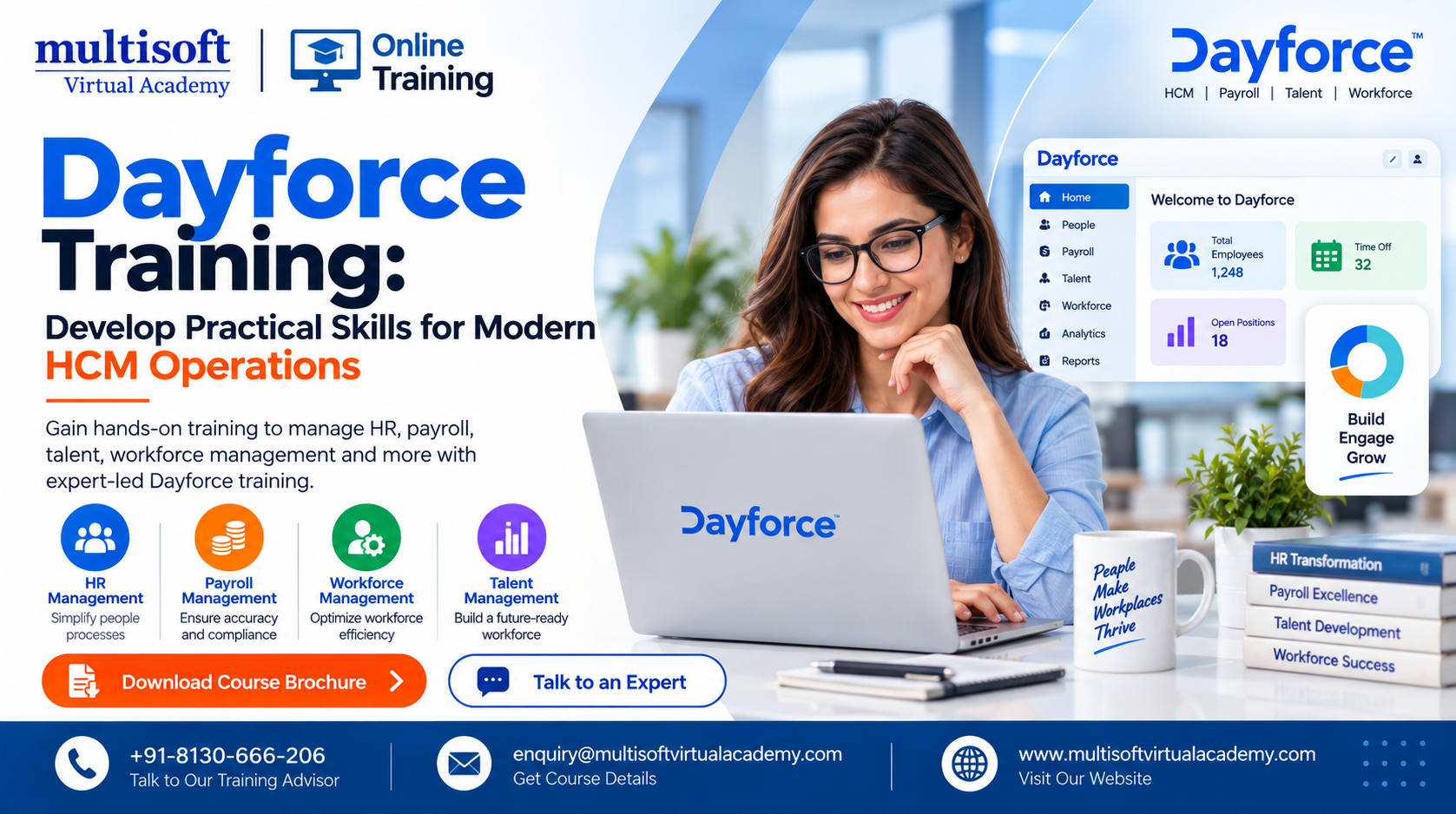
Human resources technology is evolving rapidly as organizations look for smarter ways to manage payroll, employee data, workforce scheduling, talent, compliance, and people analytics. As businesses move toward unified Human Capital Management (HCM) platforms, professionals with practical knowledge of modern HR technology are becoming increasingly valuable.
Dayforce Training can help HR professionals, payroll specialists, workforce management teams, administrators, consultants, and technology professionals develop the knowledge required to work with the Dayforce platform effectively. Dayforce brings HR, payroll, workforce management, talent, reporting, analytics, and AI capabilities together within a connected platform.
For professionals planning to enter the HCM technology field or strengthen their existing HR technology skills, learning Dayforce can provide a structured path toward understanding modern employee management processes and enterprise HR operations.
Dayforce Training is a cloud-based HCM platform designed to help organizations manage a broad range of people-related processes through a connected technology environment. Its capabilities include HR, payroll, workforce management, talent, reporting and analytics, benefits, and AI-supported functionality.
Instead of relying on multiple disconnected applications, organizations can use an integrated platform to manage employee information, time and attendance, payroll processes, workforce planning, talent activities, and workforce insights.
This integrated approach also creates a need for professionals who understand how different HCM functions work together. That is where structured Dayforce HCM Training becomes valuable.
Implementing an enterprise HCM platform is not simply a technical exercise. Successful adoption depends on whether HR teams, administrators, managers, payroll professionals, and employees understand how to use the system within their organizational processes.
Dayforce itself highlights training as an important component of successful implementation and long-term adoption. Its training options include instructor-led learning, self-directed learning, customized education, and multiple learning formats.
A comprehensive training program can help professionals:
The objective is not simply to learn where features are located. Effective training should help learners understand why a particular function is used, how it connects with other processes, and how it can support business requirements.
A strong Dayforce Training program should provide exposure to multiple areas of the platform rather than focusing on only one feature.
Core HR is an essential starting point for understanding the platform. Training can introduce employee records, organizational structures, employment information, HR processes, and related administrative functions.
Professionals working in HR operations can use this knowledge to understand how employee information is maintained and how HR processes can be managed within an integrated environment.
Payroll is one of the most important areas for organizations implementing an HCM platform.
Dayforce Payroll Training can help learners understand payroll-related concepts, employee pay information, payroll processes, time inputs, deductions, calculations, and reporting.
Because payroll is closely connected with time and workforce information, understanding these relationships is essential for professionals working with enterprise payroll systems.
Modern organizations need accurate workforce planning, scheduling, attendance management, and labor insights.
Dayforce Workforce Management Training can help professionals understand concepts related to employee schedules, time, attendance, labor management, workforce planning, and operational efficiency.
Dayforce positions workforce management as one of its core platform capabilities, helping organizations make more informed staffing and labor decisions.
Talent management is another important area for HR professionals.
Training may cover processes related to recruiting, employee development, performance, succession, skills, and workforce planning. These capabilities help organizations connect employee development with broader business objectives.
Professionals who understand both core HR and talent functionality can contribute more effectively to enterprise-wide HCM initiatives.
HR teams increasingly depend on workforce data to make informed decisions.
Dayforce reporting and analytics capabilities allow organizations to work with connected people data and generate workforce insights.
Training in this area can help professionals understand reporting concepts, workforce metrics, dashboards, data analysis, and the importance of accurate HR information.
This knowledge can be especially useful for HR analysts, HRIS professionals, managers, and consultants.
Dayforce is relevant to several professional groups.
HR specialists can learn how technology supports employee administration, workforce processes, talent activities, and organizational data management.
Payroll teams can strengthen their understanding of integrated payroll and time-related processes.
HRIS analysts and administrators can benefit from learning platform configuration, data management, integrations, reporting, and system administration concepts.
Administrators need deeper knowledge of system functionality, user access, configuration, workflows, reporting, and ongoing platform management.
Implementation professionals need to understand business requirements, configuration concepts, testing, data migration, integrations, and user enablement.
IT professionals supporting HR technology can benefit from understanding the relationship between HCM processes, enterprise systems, integrations, security, and data.
An HCM implementation typically involves multiple stages, including configuration, data migration, integration, testing, deployment, and user training. Dayforce's own implementation guidance identifies these areas as important components of implementation projects.
This makes Dayforce Implementation Training particularly valuable for professionals involved in enterprise HCM projects.
Implementation-focused learning should ideally address:
A practical understanding of the implementation lifecycle can help professionals identify dependencies and reduce avoidable configuration or process-related mistakes.
Organizations need skilled administrators after implementation as much as they need implementation specialists before go-live.
Dayforce Administration Training can help professionals understand how an HCM environment is maintained after deployment.
Administrative responsibilities may include managing users, supporting configurations, reviewing processes, maintaining organizational data, generating reports, supporting employees, and coordinating system changes.
Dayforce's implementation documentation specifically identifies implementation consultants, implementation partners, resellers, client system administrators, and technical staff among the audiences that may work with implementation and configuration information.
This demonstrates why administration and implementation knowledge can be useful for professionals building careers around the platform.
Certification can be useful for professionals who want to demonstrate structured knowledge of a technology platform. However, certification preparation should ideally be combined with practical learning.
Dayforce Certification Training can be approached by first understanding fundamental HCM concepts, followed by platform-specific functionality and hands-on practice.
Professionals should focus on developing:
The combination of knowledge and practical experience can be more valuable than memorizing examination-oriented information alone.
Dayforce also provides learning functionality involving courses, learning plans, skills, and certifications within its platform. Its current documentation explains that certifications can be configured with courses or learning plans and may include expiration and renewal requirements.
Not every training program provides the same learning experience. Before selecting a course, professionals should evaluate the curriculum carefully.
Dayforce continues to evolve, so training material should reflect current platform concepts and functionality.
Hands-on exercises, demonstrations, scenarios, and implementation examples can make complex HCM concepts easier to understand.
HR professionals, payroll specialists, administrators, consultants, and technical professionals have different learning requirements. A role-focused curriculum can make training more relevant.
Trainers with practical knowledge of HCM processes can explain not only the functionality but also the business context behind it.
Professionals may prefer instructor-led sessions, virtual classes, self-paced learning, or customized corporate programs. Dayforce itself recognizes classroom, virtual, self-study, instructor-led, and self-directed approaches.
Learning should not necessarily stop after implementation. Continuous education helps users stay familiar with changing functionality and organizational processes.
Developing Dayforce skills can offer several professional and organizational benefits.
Professionals gain insight into how HR, payroll, workforce management, talent, and analytics can operate within a unified environment.
Trained users are better positioned to use platform functionality appropriately instead of relying on manual processes.
Professionals with implementation knowledge can contribute more effectively to configuration, testing, migration, and deployment activities.
Employees are more likely to use a system confidently when they understand how it supports their daily responsibilities.
As organizations modernize HR technology, knowledge of enterprise HCM platforms can become a valuable addition to an HRIS, payroll, consulting, or technology professional's skill set.
The HCM technology landscape is moving toward greater automation, analytics, integration, and AI-assisted decision-making. Dayforce currently positions AI alongside HR, payroll, workforce management, talent, and analytics capabilities within its platform.
This means future HCM professionals may need more than traditional HR knowledge. They may need a combination of:
HR expertise + HCM technology + data literacy + process understanding + digital skills.
Professionals who develop this combination can be better prepared to participate in digital HR transformation projects.
For organizations, investing in employee training can also support smoother technology adoption. Training should therefore be viewed not merely as an introductory activity but as part of the broader HCM transformation strategy.
A practical learning journey can begin with the fundamentals.
Step 1: Understand HCM fundamentals
Learn the basic concepts behind HR, payroll, workforce management, talent, and employee data.
Step 2: Explore the Dayforce platform
Understand the platform's major modules and how they interact.
Step 3: Select a role-specific learning path
Choose content aligned with your career objective, such as HR, payroll, administration, implementation, or analytics.
Step 4: Practice real-world scenarios
Work through employee lifecycle, payroll, scheduling, reporting, configuration, and implementation scenarios.
Step 5: Develop advanced skills
Move toward administration, configuration, integrations, reporting, or implementation concepts.
Step 6: Continue learning
Keep your knowledge current as platform functionality, organizational requirements, and HCM practices evolve.
Dayforce Training offers professionals an opportunity to develop relevant skills for today's technology-driven HR environment. From Dayforce HCM Training and Dayforce Payroll Training to workforce management, administration, implementation, reporting, and certification preparation, a structured learning approach can help professionals understand both the technology and the business processes behind it.
For organizations, effective training can support better user adoption, smoother implementation, and stronger long-term utilization of the HCM platform. For individuals, it can strengthen their professional profile and prepare them for roles across HR technology, HRIS, payroll, administration, consulting, and implementation.
Professionals and organizations looking for structured learning and practical guidance can consider Multisoft Virtual Academy as a service provider for Dayforce-focused training. With a learning approach centered on practical knowledge, role-oriented concepts, and current HCM requirements, Multisoft Virtual Academy can help learners develop the confidence and skills needed to work more effectively with modern Dayforce environments.
| Start Date | End Date | No. of Hrs | Time (IST) | Day | |
|---|---|---|---|---|---|
| 26 Sep 2026 | 18 Oct 2026 | 24 | 06:00 PM - 09:00 PM | Sat, Sun | |
| 27 Sep 2026 | 19 Oct 2026 | 24 | 06:00 PM - 09:00 PM | Sat, Sun | |
| 03 Oct 2026 | 25 Oct 2026 | 24 | 06:00 PM - 09:00 PM | Sat, Sun | |
| 04 Oct 2026 | 26 Oct 2026 | 24 | 06:00 PM - 09:00 PM | Sat, Sun | |
Schedule does not suit you, Schedule Now! | Want to take one-on-one training, Enquiry Now! |
|||||






 Join our Live Instructor-Led online classes delivered by industry experts
 Let's Get Started