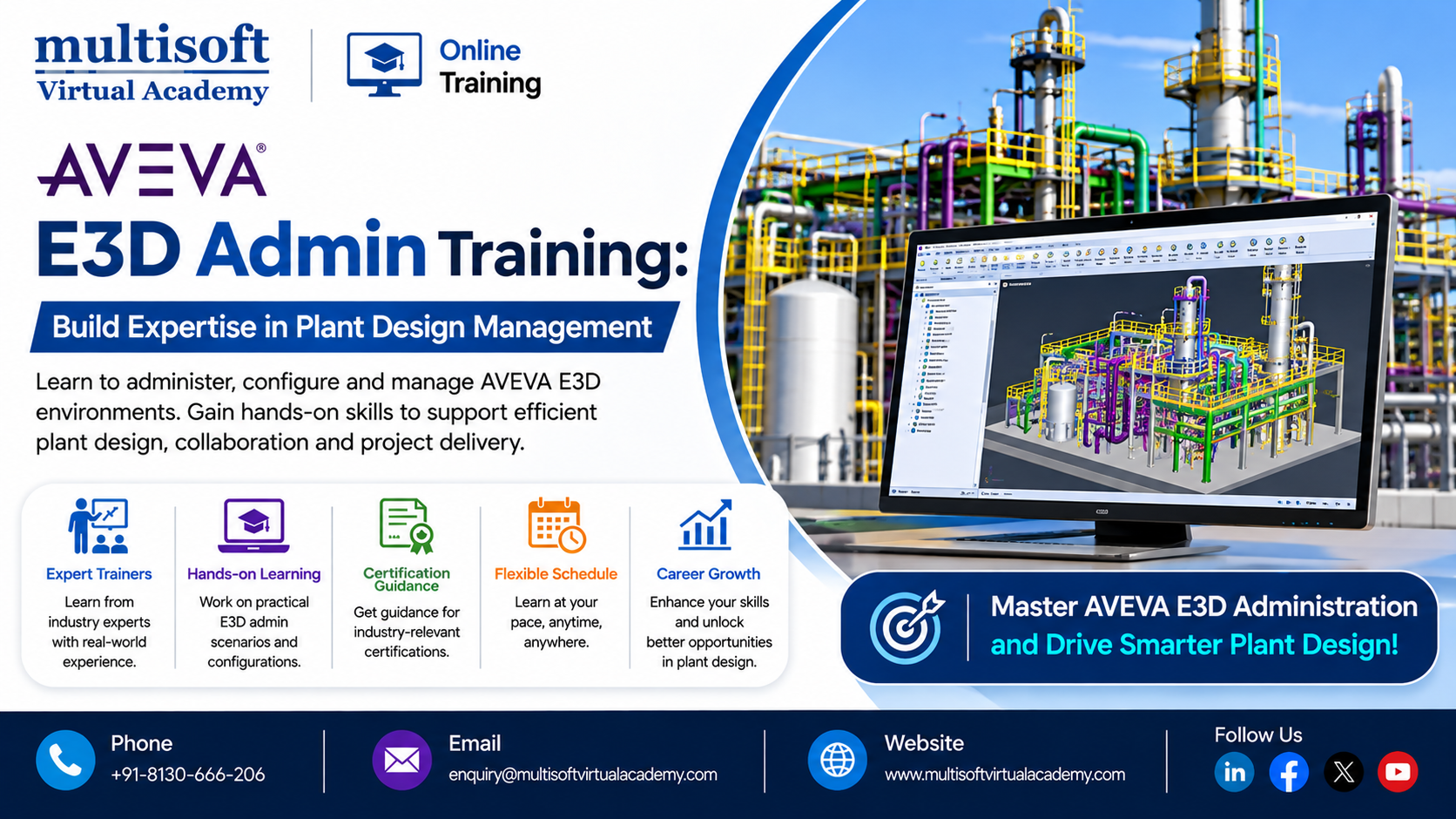
The successful execution of an industrial engineering project depends on accurate design information, organized databases, and effective coordination between engineering teams. As plant design projects become more complex, organizations require professionals who can manage the software environments used to create and maintain engineering data. AVEVA E3D is one such platform used in plant design, making administrative knowledge an important skill for professionals working in engineering and EPC organizations.
E3D Admin Training provides an understanding of how to manage AVEVA E3D project environments, configure databases, maintain engineering resources, and control user access. It focuses on the administrative activities that support designers, engineers, and project teams throughout the plant design lifecycle.
Whether you are an experienced piping engineer, CAD administrator, mechanical professional, or engineering software specialist, learning E3D administration can help you expand your technical capabilities and understand the infrastructure behind multidisciplinary plant design projects.
AVEVA E3D, or Everything3D, is an engineering software platform used to develop and manage intelligent 3D models for industrial facilities. It supports different engineering disciplines and helps teams coordinate design information within a shared project environment.
Administration is an essential part of maintaining this environment. It involves configuring project resources, organizing databases, managing users, maintaining specifications, and ensuring that engineering teams have access to the information required for their activities.
Unlike E3D design training, which primarily concentrates on modelling and design operations, AVEVA E3D Admin Training focuses on the management and configuration of the software environment.
An administrator must understand how different project elements are connected and how administrative changes can affect engineering operations. This knowledge is particularly important when several teams work simultaneously on a large plant design project.
Industrial projects involve thousands of engineering components, extensive technical records, and multiple departments. Without proper administration, managing these resources can become difficult.
E3D administrators help maintain an organized working environment by performing essential configuration and support activities.
A plant engineering project requires a structured arrangement of databases, project resources, and engineering information. Administrators help establish this structure so that different teams can work within a coordinated environment.
Project databases contain information related to equipment, piping, structures, and other engineering components. Administrators need to understand how these databases are created, configured, and maintained.
Not every project participant requires the same level of access. User and team administration helps organizations assign appropriate permissions according to individual responsibilities.
Incorrect configurations, database problems, and access-related issues can interrupt design activities. Administrative knowledge helps professionals investigate these issues and support engineering teams.
Catalogues, specifications, and project attributes must follow defined requirements. Administrators help maintain these resources so that engineering teams can work with consistent information.
A well-designed E3D Administration Course should cover the administrative modules and workflows used to manage an AVEVA E3D environment. The following topics provide a strong foundation for learners.
The first stage introduces learners to the E3D administrative environment and its essential functions.
Topics may include:
These fundamentals help participants understand how an E3D project is organized before moving into database and user administration.
Project configuration establishes the environment in which engineering activities are performed. Administrators must understand how project elements are defined and how the required resources are connected.
Training may cover project creation, configuration settings, project hierarchy, administrative attributes, and the management of project resources.
Learners also develop an understanding of how configuration decisions influence the availability of engineering information.
Database management is one of the most important areas of E3D administration. Large industrial projects depend on organized databases to maintain engineering information and support multidisciplinary collaboration.
A practical training program may introduce:
Understanding MDB administration is especially useful because engineering teams may need access to different combinations of databases depending on their project responsibilities.
Engineering projects involve designers, engineers, administrators, and reviewers. Each role may require access to specific project resources.
E3D user administration introduces learners to the processes involved in creating users, organizing teams, and assigning access permissions.
Important topics may include:
These activities help maintain a controlled project environment and reduce unnecessary access to restricted resources.
Paragon is an important area of the AVEVA engineering environment associated with catalogue administration. It supports the organization of component information and specifications used in plant design.
Training may introduce the creation and management of catalogue structures, including:
Professionals involved in piping design and catalogue management may find this module particularly useful.
Engineering specifications define the technical requirements associated with components and design activities. Specon provides tools for managing specification-related information within the relevant AVEVA environment.
Depending on the course syllabus, learners may study specification creation, copying, modification, deletion, and management of specification information.
Understanding Specon helps administrators recognize how engineering specifications are maintained and made available to design teams.
Project information often requires structured attributes and data definitions. Lexicon administration helps manage relevant data definitions within the project environment.
Training may cover attribute management, data structures, project-specific information, and the organization of engineering data.
This knowledge can be valuable when supporting projects that use customized engineering information requirements.
Drawing administration supports the preparation and management of engineering drawings and related deliverables.
Depending on the software version and course coverage, learners may explore drawing configuration, templates, styles, symbols, and administrative resources used by drawing teams.
This module helps administrators understand the resources that support engineering documentation workflows.
An E3D administrator should be able to investigate common administrative problems and understand the correct maintenance procedures.
Training may introduce database-related issues, access problems, configuration errors, and project resource management.
Learners should also understand the importance of backup procedures, change control, and testing administrative modifications before applying them to production environments.
AVEVA E3D administration knowledge can be relevant across several industries where plant design and engineering information management are important.
Oil and gas: Refineries, offshore platforms, gas processing facilities, and pipeline projects require coordinated design environments and organized engineering data.
Petrochemical plants: These projects involve complex piping systems, equipment layouts, and multidisciplinary design activities.
Power generation: Engineering teams working on power plants need structured project environments for managing design information and technical documentation.
Manufacturing: Industrial manufacturing facilities may use engineering applications to support plant development, upgrades, and expansion projects.
EPC organizations: Engineering, procurement, and construction companies coordinate multiple project teams. E3D administration helps support project resources and maintain consistent design environments.
The exact administrative responsibilities depend on the organization's project structure, software configuration, and internal engineering procedures.
E3D administration training can be useful for professionals who want to move beyond basic design operations and understand how engineering software environments are managed.
Previous exposure to engineering applications can make the learning process easier. However, candidates should check the prerequisites of the selected training program.
Specialized software knowledge can help professionals strengthen their technical profiles and prepare for responsibilities involving engineering project management and application administration.
After developing relevant experience, learners may explore roles such as:
The actual responsibilities and eligibility requirements vary by employer. Practical experience, engineering knowledge, database understanding, and troubleshooting ability remain important for these positions.
Learning administration can also help professionals understand the activities involved in setting up and maintaining an AVEVA E3D project environment.
E3D implementation may involve preparing project resources, configuring databases, organizing user access, establishing catalogue and specification requirements, and validating the environment before engineering work begins.
Professionals should develop an understanding of the following areas:
Requirement assessment: Understand the project's engineering disciplines, database needs, user groups, and administrative requirements.
Project configuration: Learn how project resources and settings are organized according to the project structure.
Database preparation: Understand how relevant databases are created, included, and configured for engineering activities.
User setup: Organize users and teams according to project responsibilities and access requirements.
Catalogue preparation: Understand how catalogue and specification resources support engineering design.
Testing and validation: Review the configured environment and confirm that relevant users can access the required resources.
Implementation activities are project-specific. Practical implementation experience is valuable for understanding the challenges that may arise in real engineering environments.
Choosing an appropriate training program can make a significant difference in how effectively you develop administrative skills.
Review whether the curriculum includes project administration, database management, user administration, Paragon, Specon, Lexicon, and other relevant topics.
Administrative concepts become easier to understand through guided exercises. Look for training that includes project setup, database operations, user creation, and catalogue-related demonstrations.
Choose a program led by an instructor who understands AVEVA E3D and can explain administrative workflows using practical engineering examples.
Ask which software version will be used and whether learners receive access to a suitable practice environment.
Check the training duration, learning materials, practical coverage, assessment requirements, and certificate details before enrolling.
Live instructor-led classes, one-to-one sessions, and online learning can provide different benefits. Select an option that supports your learning objectives and professional schedule.
E3D Admin Training explains how to configure and manage AVEVA E3D project environments. It generally covers project setup, database administration, user management, catalogue configuration, and specification maintenance.
Yes. E3D Design Training focuses on 3D modelling and engineering design activities, while E3D Admin Training concentrates on project configuration, databases, user permissions, and administrative resources.
Many comprehensive administration programs include Paragon and Specon because they are relevant to catalogue and specification management. Confirm the exact coverage with the training provider.
Beginners can start with introductory training, although familiarity with engineering projects and software environments can be helpful. Advanced administrative responsibilities generally require additional practice.
An E3D administrator helps manage project environments, databases, users, access permissions, catalogue resources, and administrative configurations. Responsibilities vary according to project requirements.
It can help professionals develop skills relevant to E3D administration and engineering software support roles. Career opportunities depend on practical experience, qualifications, and employer requirements.
AVEVA E3D administration is an important part of maintaining organized and reliable engineering project environments. From project configuration and database management to user administration, Paragon, Specon, and Lexicon, these capabilities help support the daily activities of multidisciplinary engineering teams. Developing practical knowledge of these administrative functions can strengthen a professional's understanding of plant design systems and prepare them for technical responsibilities in industrial projects. Multisoft Virtual Academy offers E3D Admin Training designed to help professionals understand AVEVA E3D administration, develop relevant software skills, and build knowledge of engineering project management workflows.
| Start Date | End Date | No. of Hrs | Time (IST) | Day | |
|---|---|---|---|---|---|
| No schedule available ! | |||||
Schedule does not suit you, Schedule Now! | Want to take one-on-one training, Enquiry Now! |
|||||




 Join our Live Instructor-Led online classes delivered by industry experts
 Let's Get Started
