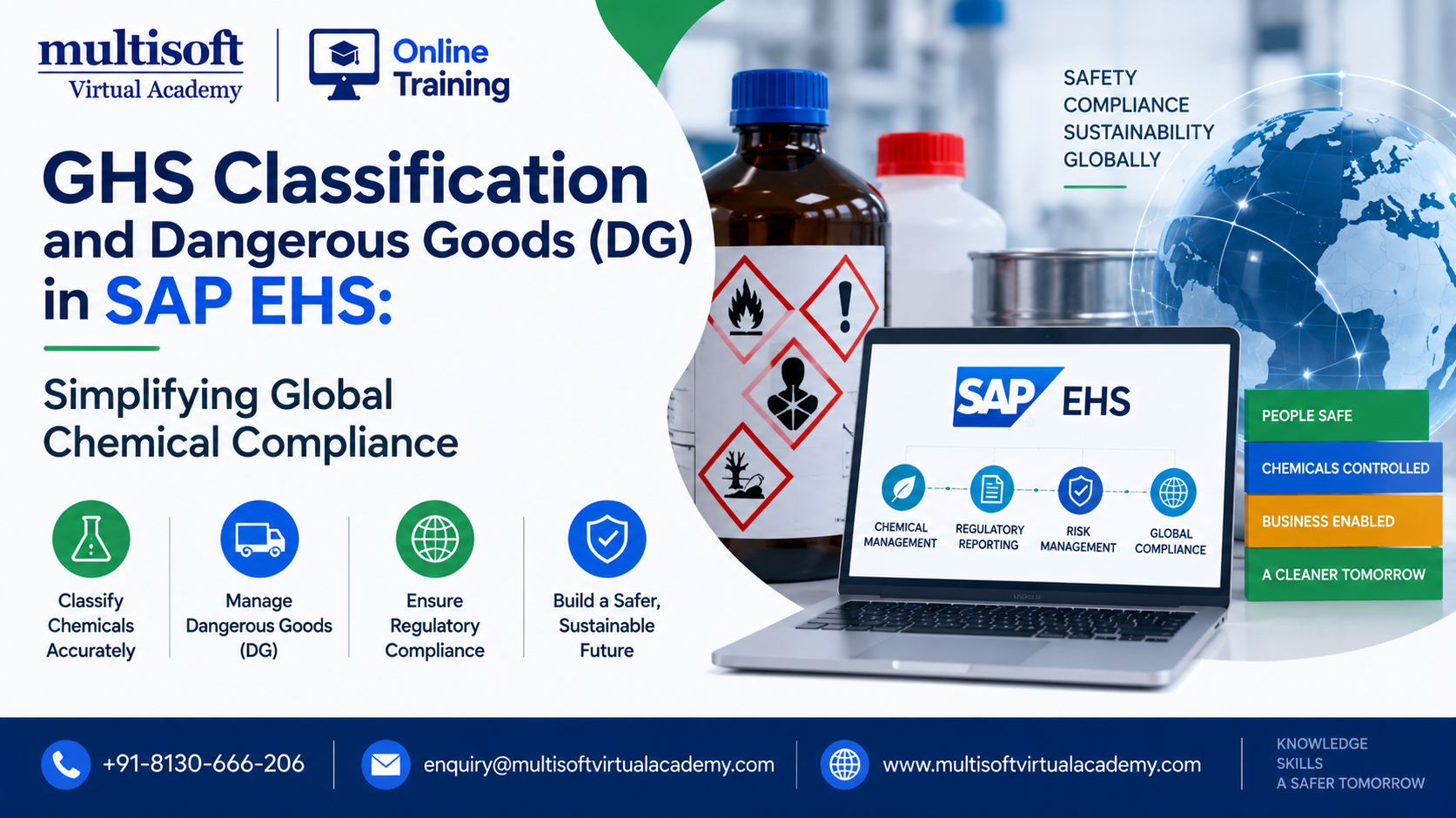
Managing hazardous chemicals is no longer limited to maintaining safety records or preparing regulatory documents. Organizations operating across countries must accurately identify chemical hazards, classify products, maintain dangerous goods information and ensure that regulatory requirements are reflected throughout the supply chain. This is where GHS Classification and Dangerous Goods (DG) in SAP EHS becomes highly valuable.
With chemical regulations continuously evolving, companies are increasingly adopting integrated approaches to SAP EHS, SAP Product Compliance, GHS compliance, Dangerous Goods Management, chemical substance management and Safety Data Sheet management. A well-designed SAP environment can connect regulatory information with product, sales, logistics and supply chain processes, helping organizations establish a more consistent compliance framework.
For professionals working in chemical manufacturing, pharmaceuticals, oil and gas, consumer products, automotive, logistics or regulatory affairs, understanding how GHS and dangerous goods processes work within SAP can provide valuable technical and functional expertise.
The Globally Harmonized System of Classification and Labelling of Chemicals, commonly known as GHS, provides a standardized framework for communicating chemical hazards.
GHS Classification and Dangerous Goods (DG) in SAP EHS evaluates the hazardous characteristics of substances and mixtures and helps determine the appropriate hazard communication requirements. Depending on the applicable jurisdiction, this information can influence labels, Safety Data Sheets and other regulatory documentation.
However, GHS implementation is not identical everywhere. Individual countries and regions may introduce their own legal requirements based on GHS principles. Consequently, multinational organizations must maintain accurate chemical information while considering the regulations applicable to each market.
This makes SAP EHS GHS classification an important capability for companies managing extensive chemical product portfolios.
Dangerous goods classification addresses a different but closely connected area of compliance.
A product may be hazardous because of its chemical properties, but transportation regulations determine how that product can be moved safely from one location to another. Depending on the material and applicable regulation, transportation requirements may involve a UN number, proper shipping name, hazard class, packing group, packaging requirements and transportation restrictions.
SAP Dangerous Goods Management provides capabilities for maintaining and using this information within business processes.
Therefore, organizations should not consider GHS classification and dangerous goods classification as interchangeable. Instead, they should be viewed as complementary components of a broader chemical compliance management strategy.
A major challenge for global companies is that chemical compliance information is often distributed across multiple systems, spreadsheets and departments.
Consider a manufacturer introducing a new chemical product.
The organization may need to:
If each activity is managed independently, inconsistencies can easily arise.
An integrated SAP EHS compliance solution can help connect these activities and provide a more structured flow of information from substance management through logistics.
SAP EHS environments can support several interconnected areas of chemical and product compliance.
Substance management provides a foundation for maintaining information about chemical substances and their relevant properties.
Specifications can be used to organize substance-related and regulatory information within the SAP environment.
Hazard information can be maintained and used for applicable regulatory processes.
Accurate regulatory information can support the creation and maintenance of safety documentation.
Transportation-related classification and regulatory information can be managed for applicable materials.
Broader product compliance requirements can be evaluated according to applicable markets and regulations.
Together, these capabilities create a more connected approach to SAP EHS chemical management.
One of the most important considerations in dangerous goods compliance is data quality.
A dangerous goods process is only as reliable as the information behind it. Incorrect classification data, missing transportation information or outdated regulatory information can create problems throughout the supply chain.
Depending on the applicable regulation, dangerous goods master data may include:
Maintaining this information systematically can reduce dependence on manually maintained records and help compliance teams establish stronger data governance.
The classification process generally begins with identifying the material and relevant regulatory information.
The organization then determines which dangerous goods regulations apply to the product and transportation scenario. Based on the available product and regulatory data, the material can be assessed and classified.
A simplified workflow may include:
Material Identification ? Substance Data ? Regulatory Evaluation ? Dangerous Goods Classification ? Compliance Assessment ? Logistics Check ? Documentation
The exact configuration and process depend on the SAP solution, industry requirements and regulatory environment.
This flexibility is particularly important for multinational organizations where transportation requirements can vary between countries and modes of transport.
GHS classification is closely connected with Safety Data Sheet management.
An SDS communicates important information about chemical hazards, handling precautions, storage, emergency measures, exposure controls and other safety considerations.
When the underlying classification changes, related regulatory documentation may also require review or revision.
For organizations selling products internationally, SDS management becomes more complicated because requirements can vary according to:
A centralized SAP-based approach can help organizations manage these dependencies more efficiently.
Transportation is one of the areas where incorrect chemical classification can have immediate operational consequences.
Before hazardous materials are shipped, organizations may need to determine whether transportation is permitted under the applicable rules.
Additional considerations may include:
For example, requirements for road transportation can differ from those applicable to air or sea transportation.
Consequently, SAP Dangerous Goods Management should be configured with the regulatory requirements relevant to the organization's markets and logistics processes.
The evolution of SAP solutions has increasingly connected product compliance with broader enterprise processes.
Modern organizations are not only concerned with identifying whether a product is hazardous. They also need to understand whether that product meets regulatory requirements throughout its lifecycle.
This includes activities such as:
This broader perspective makes SAP Product Compliance training increasingly relevant for consultants and professionals who want to work beyond traditional EHS processes.
A properly planned implementation can provide several operational and compliance benefits.
Chemical and regulatory information can be organized within a structured enterprise environment.
Centralized data management can reduce conflicting information between departments.
Compliance teams can gain improved visibility into product classifications and regulatory requirements.
Automated or standardized workflows can reduce repetitive manual activities.
Dangerous goods requirements can be connected with relevant logistics and sales processes.
Organizations can establish more traceable processes for managing regulatory information.
SAP can help organizations manage different regulatory requirements across markets and transportation scenarios.
Despite its advantages, implementing SAP EHS requires careful planning.
One common challenge is poor master data quality. If chemical identities, properties or regulatory information are incomplete, downstream processes can become unreliable.
Another challenge is regulatory complexity. Different jurisdictions may have different implementation requirements even when they follow the same broader GHS framework.
Integration is another important consideration. EHS processes often interact with material management, sales, logistics, product compliance and other enterprise functions.
Organizations may also face challenges related to:
A successful implementation therefore requires collaboration between EHS specialists, regulatory experts, SAP consultants, business users and IT teams.
Organizations can improve their implementation outcomes by following several practical principles.
Determine which teams are responsible for creating, validating and maintaining chemical and regulatory information.
Develop consistent procedures for classification, review, approval and regulatory updates.
Clean and validate existing chemical and material information before migration or implementation.
Identify the regulations that apply to each country, market and transportation method.
Avoid treating compliance as an isolated back-office activity. Connect it with sales, logistics and supply chain workflows wherever appropriate.
Regulatory requirements and product compositions can change. Establish procedures for reviewing affected classifications and documentation.
Employees should understand not only how to navigate SAP but also why particular compliance processes exist.
As businesses expand globally, regulatory compliance is becoming increasingly connected with digital transformation.
Professionals who understand both chemical regulations and SAP technology can play an important role in this transition.
SAP EHS consultants may work on:
This combination of technical and regulatory knowledge can be particularly useful for professionals seeking specialized careers in enterprise compliance technology.
SAP EHS training can be relevant to several professional groups.
Functional consultants can strengthen their knowledge of EHS and product compliance processes.
EHS specialists can learn how their regulatory responsibilities translate into SAP workflows.
Regulatory professionals can gain a better understanding of digital compliance management.
Supply chain teams can understand how dangerous goods requirements influence logistics operations.
Product stewardship specialists can develop skills for managing regulatory information across product lifecycles.
SAP professionals can expand their knowledge into specialized compliance functionality.
Professionals comparing SAP EHS training online should look for programs that combine conceptual knowledge with practical scenarios.
A comprehensive curriculum may include:
Practical exercises are particularly valuable because they help learners understand how theoretical regulatory requirements are represented and managed within SAP.
Chemical compliance is moving toward greater automation, centralized data management and connected enterprise processes.
Artificial intelligence, analytics, workflow automation and improved regulatory data management are likely to influence how organizations manage compliance activities.
At the same time, regulatory expectations are becoming more sophisticated. Businesses will need better visibility into product composition, hazards, market requirements and transportation restrictions.
The future of SAP EHS compliance management will therefore depend not only on technology but also on reliable data, effective governance and professionals who understand the relationship between regulatory requirements and enterprise systems.
GHS classification involves evaluating chemical hazards and maintaining relevant information according to applicable GHS-based regulatory requirements. This information can support hazard communication, labeling and safety documentation processes.
SAP Dangerous Goods Management supports processes for managing dangerous goods classifications and transportation-related information for materials subject to dangerous goods regulations.
No. GHS primarily focuses on chemical hazard communication, whereas dangerous goods classification focuses on transportation requirements. A product may need to comply with both.
Accurate dangerous goods master data supports reliable transportation assessments, compliance checks and documentation. Poor-quality information can create operational and regulatory risks.
SAP Product Compliance supports organizations in evaluating and managing product-related regulatory requirements across relevant business and compliance processes.
SAP consultants, EHS professionals, chemical regulatory specialists, product stewardship teams, supply chain professionals and SAP S/4HANA specialists can all benefit from learning SAP EHS capabilities.
The growing complexity of chemical regulations makes GHS Classification and Dangerous Goods (DG) in SAP EHS an important area for organizations seeking stronger regulatory control, better data governance and more connected compliance operations. From GHS hazard classification and Safety Data Sheet management to dangerous goods assessment, product compliance and logistics integration, SAP can support a structured approach to managing critical chemical information. Professionals who develop expertise in these areas can position themselves for opportunities across EHS, product compliance, regulatory affairs and SAP consulting. For organizations and professionals looking for structured, practical and career-focused learning in this domain, Multisoft Virtual Academy provides specialized training and learning support designed to develop relevant SAP EHS and compliance capabilities.
| Start Date | End Date | No. of Hrs | Time (IST) | Day | |
|---|---|---|---|---|---|
| No schedule available ! | |||||
Schedule does not suit you, Schedule Now! | Want to take one-on-one training, Enquiry Now! |
|||||






 Join our Live Instructor-Led online classes delivered by industry experts
 Let's Get Started