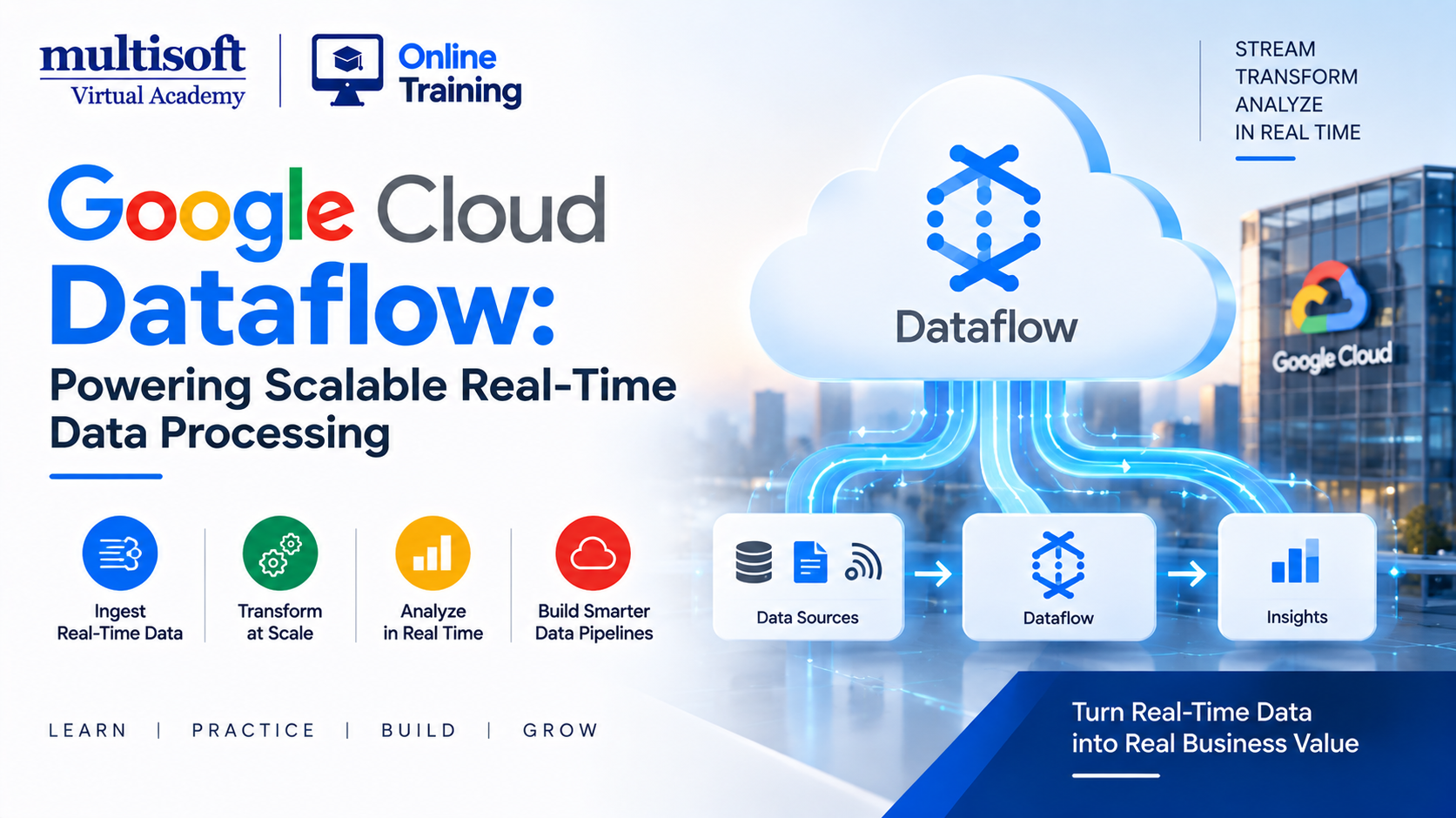
Modern businesses generate enormous amounts of data from applications, websites, IoT devices, customer interactions, financial systems and digital platforms. Turning this constantly growing information into useful business intelligence requires reliable data processing infrastructure. Google Cloud Dataflow has emerged as a powerful solution for organizations that need scalable, flexible and managed data processing for both real-time and batch workloads.
As businesses increasingly adopt cloud data engineering, real-time analytics, artificial intelligence and machine learning, technologies such as Google Cloud Dataflow, Apache Beam, BigQuery, Pub/Sub and Google Cloud Platform are becoming important components of modern data architectures.
Whether an organization needs real-time data analytics, ETL pipelines, streaming data processing or machine learning data preparation, Dataflow provides a unified approach to building and managing sophisticated data pipelines.
Google Cloud Dataflow is a fully managed Google Cloud service designed to process data at scale in both batch and streaming environments. It enables organizations to build pipelines that ingest data from different sources, transform and enrich it and deliver processed information to appropriate destinations.
Dataflow is built around the open-source Apache Beam programming model, allowing developers to define unified batch and streaming pipelines. The same programming approach can be used to process bounded datasets as well as continuously arriving data.
This capability makes Dataflow particularly valuable for organizations that want to modernize traditional ETL architectures while also supporting real-time analytics and event-driven applications.
Traditional data processing environments often require organizations to provision servers, configure infrastructure and manually manage computing resources. These responsibilities can become challenging as data volumes fluctuate.
Google Cloud Dataflow addresses this challenge through a managed processing environment. Google Cloud automatically provisions the resources required to execute Dataflow jobs while supporting parallel processing and autoscaling.
This allows data engineering teams to concentrate more on pipeline logic and business requirements rather than infrastructure administration.
Dataflow is particularly relevant to modern data engineering trends, including:
Google Cloud Dataflow offers several capabilities that make it suitable for enterprise-scale data processing.
One of Dataflow's major advantages is its ability to handle both batch and streaming workloads through a unified programming model. Organizations can process historical datasets as well as continuously generated information without maintaining completely separate processing frameworks.
This makes Dataflow useful for applications ranging from scheduled ETL jobs to real-time dashboards and event processing.
Apache Beam provides the programming model used to define Dataflow pipelines. Developers can use Apache Beam SDKs with languages such as Python, Java and Go to create customized processing workflows.
The separation between pipeline logic and execution infrastructure helps teams develop reusable data processing applications while taking advantage of Dataflow's managed execution environment.
Data volumes can change significantly throughout the day. A pipeline that handles normal traffic may suddenly receive a large volume of events.
Dataflow supports autoscaling by adding or removing worker resources based on workload requirements. This can help organizations handle changing workloads without manually provisioning infrastructure.
For businesses managing unpredictable workloads, this capability can simplify capacity planning and improve operational efficiency.
Real-time analytics has become increasingly important for industries such as finance, retail, manufacturing, telecommunications and digital services.
Dataflow can process streaming information with low latency, making it suitable for applications such as real-time monitoring, fraud detection, customer analytics, IoT processing and operational dashboards.
For example, organizations can use Google Cloud Pub/Sub to ingest events and Dataflow to transform and process those events before sending the results to services such as BigQuery or Cloud Storage. Google Cloud provides Dataflow workflows for reading Pub/Sub messages, applying transformations and writing processed information to storage.
Data accuracy is essential when processing financial transactions, inventory information, business metrics or other critical records.
Dataflow supports exactly-once processing for streaming pipelines by default. It also provides an at-least-once mode for workloads where duplicate records are acceptable and lower latency or cost is a priority.
The choice between exactly-once and at-least-once processing should depend on the application's business requirements and tolerance for duplicate records.
BigQuery and Dataflow are frequently used together in modern Google Cloud data architectures.
Dataflow can ingest and transform information before delivering it to BigQuery for analytical workloads. This architecture can support scalable ETL and ELT processes while helping organizations create centralized analytical environments.
For example, an enterprise may collect application events through Pub/Sub, process and enrich those events with Dataflow and store the resulting datasets in BigQuery. Business intelligence platforms can then use the processed information to create dashboards and reports.
This combination supports a modern cloud data warehouse architecture where data ingestion, transformation and analytics can be integrated within the Google Cloud ecosystem.
Real-time applications frequently require a reliable mechanism for receiving event data.
Google Cloud Pub/Sub can act as an event ingestion layer while Dataflow performs processing and transformation. This architecture can support continuous streams of information from applications, devices and business systems.
A typical workflow may look like this:
Data Source ? Pub/Sub ? Dataflow ? Transformation ? BigQuery / Cloud Storage ? Analytics
Dataflow can apply operations such as filtering, aggregation, enrichment and windowing before sending information to downstream systems.
This makes the combination particularly useful for real-time analytics and streaming data pipelines.
ETL remains an important component of enterprise data management. However, modern organizations increasingly need ETL pipelines that can operate across cloud applications, databases, data lakes and analytical platforms.
Dataflow can support extract, transform and load workflows by connecting data sources with processing logic and destination systems.
Common activities include:
Google Cloud also provides templates and low-code options for certain data movement scenarios. Its current documentation recommends templates or the visual Job Builder for simpler movement workflows while Apache Beam SDKs are appropriate for more advanced custom pipelines.
The growth of generative AI and machine learning has increased the importance of high-quality, continuously available data.
Machine learning systems depend on reliable data pipelines for training, feature preparation, inference and monitoring. Dataflow can help prepare and process information before it reaches machine learning systems.
Google Cloud currently provides Dataflow capabilities for machine learning pipelines, including turnkey transformations. Dataflow can also run streaming pipelines involving large language model inference through Apache Beam's RunInference API.
This creates opportunities for organizations exploring AI data pipelines, real-time machine learning and generative AI data processing.
The modern data landscape is moving beyond traditional warehouses toward flexible data lake and lakehouse architectures.
Dataflow can participate in data movement between cloud storage environments and lakehouse technologies. Current Google Cloud Dataflow use cases include ingestion into managed lakehouse tables using formats and technologies such as Apache Iceberg, as well as importing Parquet and Delta Lake data.
For enterprises adopting data lakehouse architecture, this flexibility can simplify the movement and transformation of large datasets across different storage and analytics environments.
Building a pipeline is only one part of successful data engineering. Organizations also need to consider latency, resource consumption, reliability and operational costs.
Dataflow provides technologies designed to improve pipeline execution. Streaming Engine, for example, moves streaming execution away from worker VMs into a dedicated service and can improve autoscaling responsiveness while reducing worker resource consumption. Dataflow Shuffle similarly moves shuffle operations for batch pipelines into a dedicated service.
Developers should also consider appropriate windowing strategies, efficient transformations, resource configuration, data serialization and pipeline architecture when optimizing performance.
The relevance of Dataflow is closely connected with several major trends in cloud computing and data engineering.
Organizations increasingly want insights immediately rather than waiting for scheduled reports. Streaming data processing enables companies to respond quickly to customer behavior, operational changes and business events.
Generative AI and machine learning require dependable data pipelines. Dataflow's integration with machine learning workflows positions it as an important technology for organizations developing AI-enabled applications.
Businesses are reducing infrastructure management wherever possible. Managed services such as Dataflow allow engineering teams to focus on data workflows while the cloud platform manages much of the underlying execution infrastructure.
Lakehouse architectures combine characteristics of data lakes and analytical systems. Dataflow's current integration options for technologies such as Apache Iceberg support evolving enterprise data architectures.
Not every workload requires exactly-once processing. Dataflow's support for at-least-once processing can provide an alternative when applications can tolerate duplicates and prioritize lower latency or cost.
Dataflow can be valuable for organizations and professionals working across several areas of modern technology.
Data engineers can use it to develop scalable pipelines and automate data transformation.
Cloud architects can incorporate Dataflow into enterprise cloud and hybrid data architectures.
Data analysts can benefit from cleaner and more timely datasets delivered to analytical platforms.
Machine learning engineers can use Dataflow to prepare and process information for ML workflows.
DevOps and cloud teams can benefit from a managed processing environment that reduces infrastructure administration.
Organizations in finance, healthcare, retail, manufacturing, telecommunications, logistics and technology can apply Dataflow to a wide variety of data processing requirements.
A successful Dataflow implementation requires more than simply creating a pipeline. Organizations should begin by clearly defining data sources, transformation requirements, destinations, latency expectations and service-level objectives.
It is also important to design pipelines for failure recovery and changing data volumes. Monitoring pipeline health, reviewing resource consumption and selecting appropriate processing modes can help maintain reliable operations.
For complex workloads, teams should establish reusable Apache Beam transformations and maintain consistent development, testing and deployment practices.
Google Cloud recommends planning Dataflow pipelines around workload requirements and service-level objectives. In some scenarios, separate pipelines can be used to isolate workloads with different latency or priority requirements.
As organizations continue investing in cloud modernization, data engineering skills are becoming increasingly valuable. Professionals who understand Google Cloud Dataflow, Apache Beam, BigQuery, Pub/Sub and cloud data pipelines can develop practical capabilities for designing modern data architectures.
Learning Dataflow also provides exposure to important concepts such as distributed processing, streaming analytics, ETL, pipeline optimization, event-driven architecture and cloud-based machine learning workflows.
For professionals seeking to strengthen their Google Cloud data engineering capabilities, practical experience with real-world pipeline scenarios can be particularly valuable.
Google Cloud Dataflow provides a flexible foundation for modern batch and streaming data processing, helping organizations transform large volumes of information into reliable and actionable datasets. Its integration with Apache Beam, BigQuery, Pub/Sub, machine learning workflows and emerging lakehouse architectures makes it relevant to today's evolving data engineering landscape. For organizations and professionals looking for structured learning, practical expertise and specialized guidance in Google Cloud Dataflow, cloud data engineering and modern data pipeline technologies, Multisoft Virtual Academy can serve as a reliable service provider focused on developing relevant technical capabilities for today's digital and data-driven business environment.
| Start Date | End Date | No. of Hrs | Time (IST) | Day | |
|---|---|---|---|---|---|
| No schedule available ! | |||||
Schedule does not suit you, Schedule Now! | Want to take one-on-one training, Enquiry Now! |
|||||






 Join our Live Instructor-Led online classes delivered by industry experts
 Let's Get Started