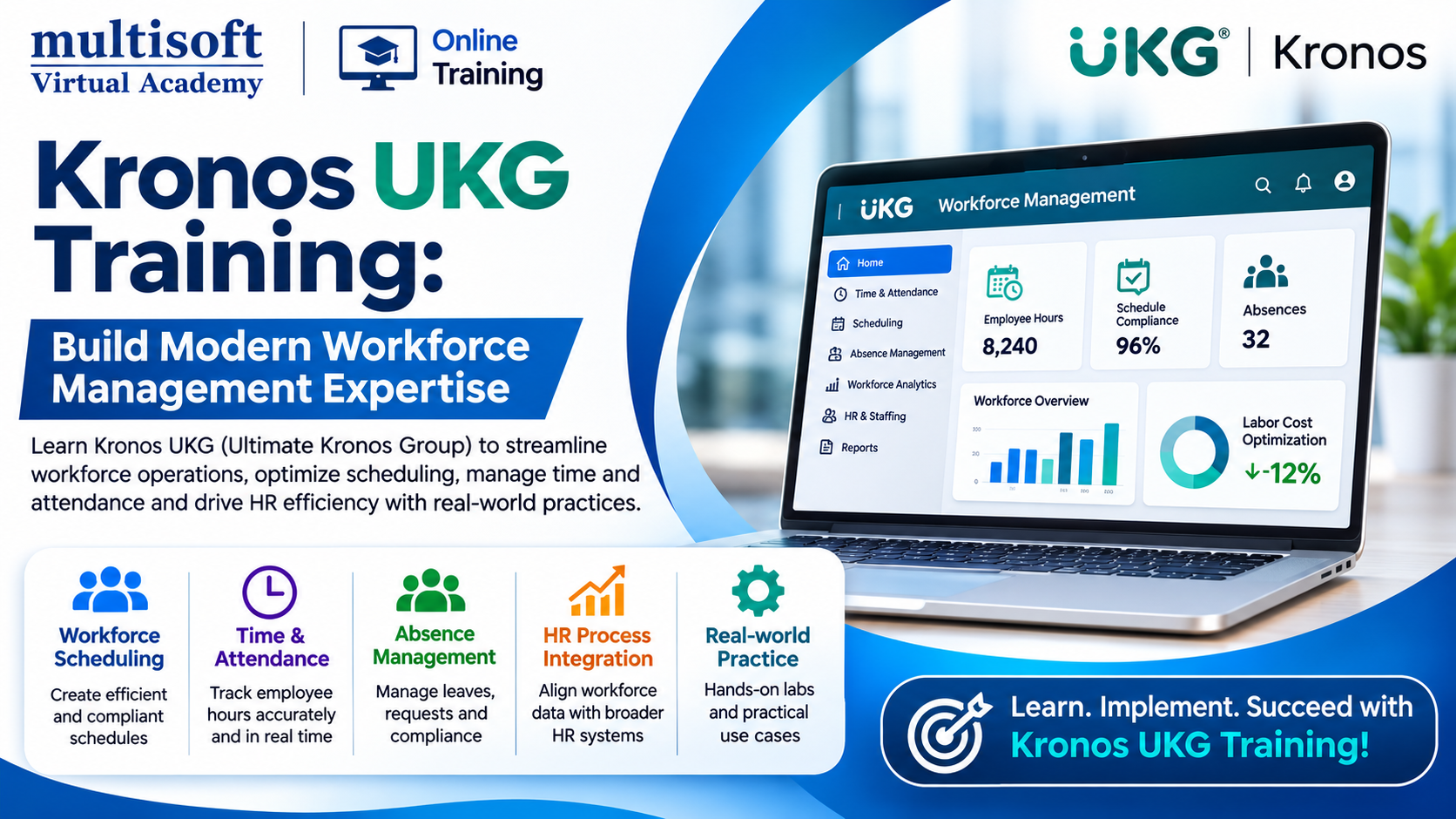
Workforce management has become an important part of business operations, particularly for organizations with large teams, multiple locations, and complex employee scheduling requirements. Managing attendance, working hours, shift rotations, leave balances, and labor information requires an organized approach. Digital workforce management platforms help businesses handle these responsibilities while improving visibility into employee activities.
Kronos UKG Training introduces professionals to the technology and business processes used to manage modern workforces. It provides an understanding of employee timekeeping, shift scheduling, attendance monitoring, workforce administration, reporting, and payroll-related activities. Learning these functions can help professionals understand how organizations coordinate their workforce through integrated software solutions.
Whether you are beginning a career in HR technology or expanding your experience as an experienced consultant, understanding Kronos and UKG workforce management applications can strengthen your professional knowledge.
Kronos is a recognized name in workforce management software. Following its merger with Ultimate Software, the organization became Ultimate Kronos Group, commonly known as UKG.
UKG develops workforce management and human capital management solutions that support organizations in managing employee information and workforce operations. Its applications help businesses coordinate schedules, track working hours, manage attendance, and review workforce-related data.
UKG Dimensions, now branded as UKG Pro Workforce Management, is associated with enterprise workforce management activities. It supports organizations that need to coordinate employees across different departments, locations, and working patterns.
For example, a manufacturing company may need to manage rotating shifts across production facilities. A healthcare organization may need to coordinate employee availability while maintaining appropriate staffing levels. A retail business may need to adjust schedules according to customer demand.
Workforce management technology provides structured tools for handling these operational requirements.
Organizations increasingly depend on workforce management applications to improve operational coordination and maintain reliable employee records. Professionals who understand these systems can contribute to HR operations, workforce administration, and enterprise application support.
Manual workforce administration can involve repetitive tasks such as attendance verification, schedule updates, timecard reviews, and employee information management.
Kronos UKG introduces digital workflows that help organizations organize these activities. Training allows participants to understand how different workforce processes are managed within the application.
Employee time records are important for attendance management and payroll-related calculations. Errors in timekeeping information can create additional work for HR and payroll teams.
Learning timecard management, punch review, attendance exceptions, and approval workflows helps professionals understand how organizations maintain accurate workforce records.
Businesses with shift-based operations need to balance employee availability and operational requirements. Workforce scheduling tools help managers organize employee assignments and review schedule coverage.
Training provides an introduction to shift planning, schedule patterns, employee availability, and schedule management.
Workforce reporting helps organizations examine attendance information, labor utilization, staffing patterns, and operational trends.
Professionals who understand reporting features can help managers access relevant information and make better-informed workforce decisions.
A structured Kronos UKG Training Course should explain the major application functions through practical examples and business-oriented exercises. The following areas are important for developing a strong foundation.
The first stage introduces learners to the UKG environment and the fundamental concepts of workforce management.
Topics may include:
This module helps learners understand the working environment and prepares them for more advanced topics.
Timekeeping is a core function in workforce management. It allows organizations to maintain employee working-hour information and review attendance activities.
Training may introduce:
These concepts are useful for employees, supervisors, timekeepers, and workforce administrators.
Workforce scheduling involves assigning employees to appropriate shifts while considering business requirements and employee availability.
A course may cover schedule creation, shift assignments, schedule templates, recurring patterns, employee availability, schedule changes, and staffing requirements.
Participants can learn how scheduling information is maintained and reviewed through workforce management applications.
Pay codes and related rules help organizations categorize employee time and support payroll-related processes.
Training may introduce:
Understanding these concepts is valuable for professionals involved in workforce configuration and timekeeping administration.
Actual configuration requirements depend on organizational policies, employment agreements, and applicable labor regulations.
Employees may be eligible for different types of leave depending on company policies and employment conditions.
Accrual management helps organizations maintain leave balances and related employee information.
Important learning areas may include accrual codes, accrual profiles, leave eligibility, balance calculations, absence requests, and related workflows.
Workforce reports provide useful information for HR departments, managers, and administrators.
Training may introduce standard reporting options, data filtering, employee attendance reports, schedule information, timecard summaries, and workforce data review.
Understanding reporting features helps learners identify how workforce information can support operational planning.
System administration involves managing application users, access permissions, organizational information, and relevant configuration settings.
Depending on the syllabus, participants may learn about user roles, employee records, organization structures, application settings, and administrative workflows.
These topics are particularly relevant to professionals responsible for maintaining workforce management environments.
Professionals researching Kronos software frequently encounter terms such as Kronos Workforce Central, Kronos Workforce Dimensions, UKG Dimensions, and UKG Pro Workforce Management.
These product names should not be treated as interchangeable in every technical context. UKG Dimensions was renamed UKG Pro Workforce Management, while other Kronos and UKG products have their own features and product histories.
UKG Pro Workforce Management supports workforce activities that may include:
The availability of specific functions depends on the product edition, configuration, and implementation.
Learners should confirm which application and version a training program covers before enrolling. This is particularly important for professionals working with older Kronos environments.
Workforce management technology can support several operational activities across an organization.
Employee attendance: Digital timekeeping helps organizations maintain structured employee attendance records and identify exceptions.
Shift coordination: Scheduling tools help managers organize employees according to business requirements and availability.
Workforce planning: Workforce information can support staffing decisions and help managers review operational requirements.
Leave administration: Accrual and absence-related processes help maintain employee leave information according to organizational policies.
Operational reporting: Workforce reports provide visibility into employee schedules, time records, and labor-related information.
Payroll coordination: Timekeeping data can be transferred to relevant payroll systems through supported integration processes.
These capabilities help organizations establish more organized workforce processes while reducing dependence on disconnected administrative activities.
Professionals interested in consulting or implementation roles should understand how workforce management applications are introduced into business environments.
A typical implementation project involves several stages.
The implementation team studies existing workforce processes and identifies business requirements. This includes reviewing employee scheduling practices, attendance policies, timekeeping procedures, and organizational structures.
After requirements are documented, the system is configured to support the organization's workforce processes. Configuration may involve employee groups, pay rules, scheduling settings, access roles, and other application parameters.
Employee records and relevant workforce information may need to be transferred from an existing application. Data quality checks help identify missing or inconsistent information.
Workforce applications may exchange information with HR, payroll, identity management, and other enterprise platforms. Integration planning helps maintain consistent information across systems.
Testing confirms whether the application supports the required business scenarios. Common scenarios include time entry, attendance corrections, employee scheduling, approvals, and payroll-related data transfers.
After validation, the application is deployed according to the project plan. Employees, supervisors, and administrators may receive role-based training to understand their responsibilities.
Knowledge of these stages can help learners understand the broader responsibilities involved in UKG implementation projects.
Workforce management solutions can be relevant to organizations that manage employees across different operational environments.
Healthcare: Hospitals and healthcare providers coordinate staff schedules, shift coverage, and employee attendance.
Retail and e-commerce: Retailers manage employee availability and staffing across stores, warehouses, and distribution facilities.
Manufacturing: Production organizations coordinate rotating shifts and monitor employee working hours across manufacturing units.
Hospitality: Hotels, restaurants, and travel businesses manage changing staffing requirements and employee schedules.
Transportation: Transportation and logistics companies coordinate employees across warehouses, transportation hubs, and operational facilities.
Banking and financial services: Large financial organizations may use workforce management applications to organize employee timekeeping and workforce administration.
This training can be relevant to professionals who want to develop knowledge of workforce applications and HR technology.
Basic knowledge of HR operations or payroll concepts can be useful, although introductory training can help beginners understand the fundamentals.
Developing Kronos and UKG knowledge can support career development in workforce management, HR technology, and enterprise application support.
Potential job roles include:
Professionals with practical application experience and knowledge of business requirements may also pursue responsibilities involving system configuration, integration testing, and implementation support.
Career progression depends on technical knowledge, professional experience, qualifications, and the requirements of individual employers.
A suitable training program should provide a balance of application knowledge and practical understanding.
Evaluate the syllabus: Review whether the course includes timekeeping, scheduling, attendance management, reporting, and system administration.
Check the product version: Confirm whether the program covers UKG Pro Workforce Management, UKG Dimensions, or another Kronos application.
Look for practical sessions: Training should include examples of timecard management, shift scheduling, employee records, and attendance workflows.
Review instructor expertise: Choose a trainer who can explain both software functionality and real business processes.
Understand learning options: Compare instructor-led online sessions, one-to-one training, and self-paced learning.
Confirm software access: Ask whether a practice environment is available and whether learners can perform guided exercises.
Check certification details: Understand whether the course offers a completion certificate or preparation for a separate official vendor certification.
It helps learners understand workforce management applications and processes, including employee scheduling, timekeeping, attendance tracking, reporting, and administration.
Kronos is the historical brand associated with workforce management software. UKG Pro Workforce Management is the current name for the product previously known as UKG Dimensions.
They are different workforce management products with their own capabilities and technical environments. Learners should identify the product used by their organization before choosing a course.
Yes. Beginners can start with workforce management fundamentals and application navigation before moving into timekeeping, scheduling, and configuration topics.
Some courses cover timekeeping, pay codes, overtime, and payroll-related workflows. Full payroll coverage depends on the UKG product and training curriculum.
Knowledge of workforce management, time and attendance, employee scheduling, application configuration, reporting, integration, and business analysis can be useful.
Yes. It can help HR professionals understand digital workforce processes and improve their familiarity with enterprise workforce management applications.
Workforce management technology has become an important part of modern business operations. Understanding Kronos UKG applications can help professionals develop knowledge of employee timekeeping, attendance management, scheduling, workforce administration, reporting, and implementation processes. Practical learning and familiarity with UKG Pro Workforce Management can provide a valuable foundation for working with enterprise HR technology. Multisoft Virtual Academy offers Kronos UKG Training for learners and working professionals who want to understand workforce management applications, explore practical business scenarios, and strengthen their technical knowledge for professional growth.
| Start Date | End Date | No. of Hrs | Time (IST) | Day | |
|---|---|---|---|---|---|
| No schedule available ! | |||||
Schedule does not suit you, Schedule Now! | Want to take one-on-one training, Enquiry Now! |
|||||





 Let's Get Started
