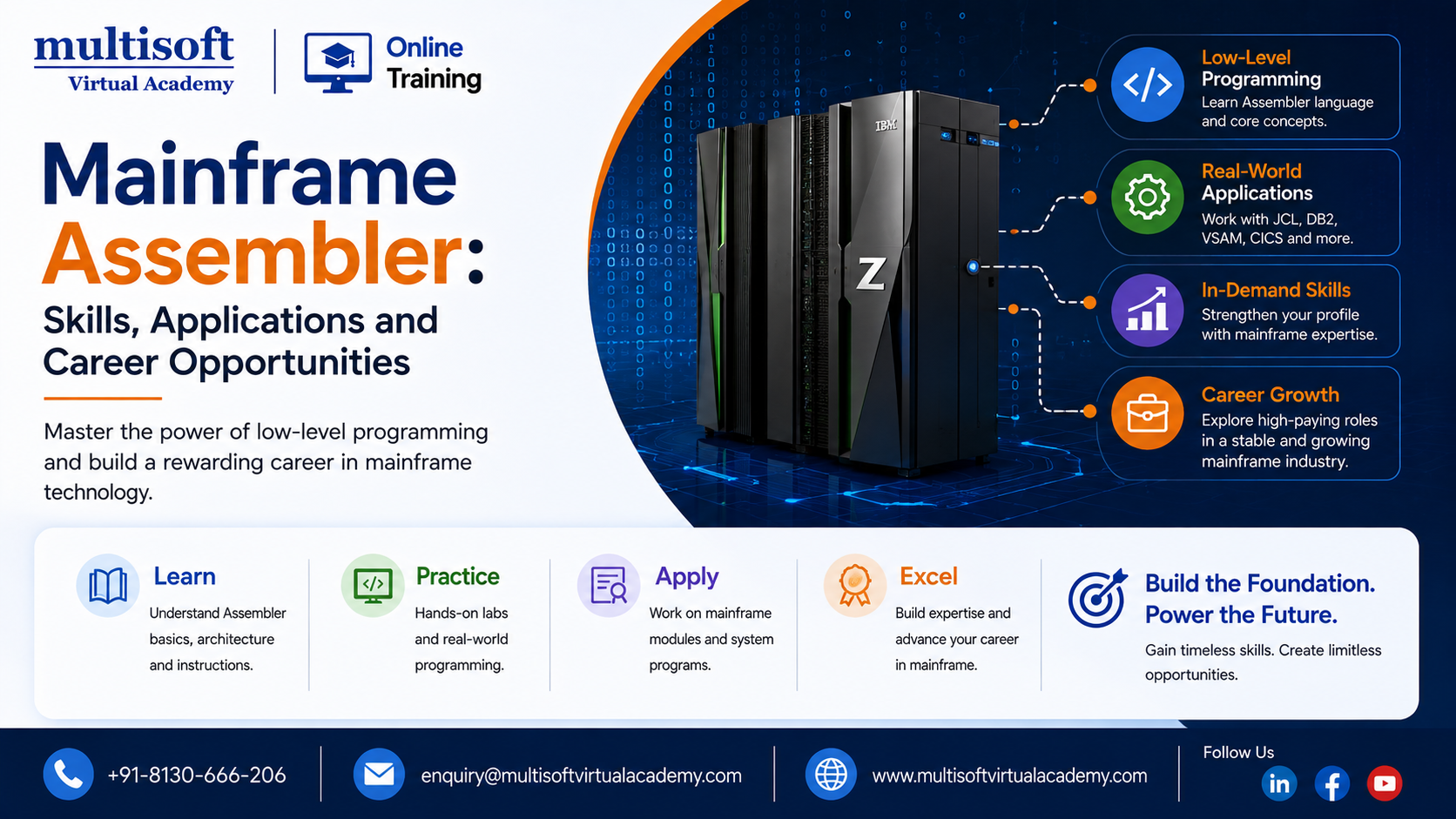
Mainframe technology continues to support some of the world's most critical banking, insurance, healthcare, government, retail and enterprise systems. While modern programming languages receive significant attention, Mainframe Assembler remains an important technology for organizations that depend on high performance, reliability and direct control over system resources.
As enterprises modernize their IT environments, demand is growing for professionals who understand both traditional mainframe technologies and modern transformation strategies. Knowledge of IBM Assembler, HLASM (High Level Assembler), z/OS Assembler, mainframe system programming and related technologies can provide a strong foundation for working with mission-critical computing environments.
Mainframe Assembler is a low-level programming language used primarily on IBM mainframe systems. It enables developers and system programmers to work closely with processor instructions, memory, registers and operating-system services.
Unlike higher-level programming languages that abstract many hardware-level operations, assembler provides detailed control over how instructions are executed. This makes it particularly valuable for applications where performance, memory efficiency and system-level functionality are essential.
IBM High Level Assembler, commonly called HLASM, is widely associated with assembler programming on IBM Z systems. Professionals use it for developing, maintaining, debugging and optimizing programs that operate within sophisticated mainframe environments.
The continued relevance of Mainframe Assembler is closely connected with the longevity of enterprise mainframe applications. Many organizations have decades of business logic running on IBM Z infrastructure, and some components depend directly on assembler routines.
Replacing such systems completely can be expensive, complex and risky. Instead, organizations frequently adopt modernization strategies that combine established mainframe technologies with APIs, cloud platforms, DevOps practices and modern application architectures.
This creates opportunities for professionals who can understand existing assembler programs and connect them with modern technologies.
Mainframe Assembler is particularly valuable where applications require:
IBM HLASM is one of the most important technologies for professionals pursuing a career in mainframe assembler programming. It provides assembler language support for IBM Z environments and is commonly used in system programming and application development.
Learning HLASM involves understanding fundamental concepts such as instructions, registers, storage areas, addressing, macros, control statements and program linkage.
A strong HLASM foundation also helps professionals understand how assembler programs interact with operating-system components and other mainframe applications.
For individuals entering mainframe development, HLASM can therefore become an important specialization within the broader IBM Z technology ecosystem.
One of the most common environments associated with Mainframe Assembler is IBM z/OS. z/OS is designed to support highly scalable, secure and reliable enterprise workloads.
Assembler programs running in a z/OS environment can interact with system services, storage management, data sets and other operating-system facilities. Professionals working in this area therefore need more than knowledge of assembler syntax.
They should also understand the broader mainframe environment, including:
Understanding these technologies allows developers to see how assembler programs operate as part of a larger enterprise application ecosystem.
Learning Mainframe Assembler requires a strong understanding of fundamental programming and computer architecture concepts.
Registers provide fast storage locations within the processor and play a major role in assembler programming. Developers must understand how registers are used for calculations, addressing and program control.
Memory management is equally important because assembler programmers often work much closer to storage than developers using higher-level languages.
Assembler programming involves working with processor instructions that perform operations such as loading data, storing values, comparing information, branching and performing arithmetic operations.
Understanding instruction behavior is essential for developing efficient programs.
Addressing is one of the core concepts in IBM assembler programming. Developers need to understand how addresses are calculated and how storage locations are accessed.
Strong knowledge of addressing techniques can improve both program reliability and debugging capability.
Macros help programmers reuse commonly required instruction sequences. They can simplify development and improve consistency across large mainframe environments.
Understanding macro processing is therefore an important part of professional HLASM development.
Assembler programs often interact with other programs and system components. Professionals should understand concepts such as calling conventions, parameter passing, linkage and return mechanisms.
These concepts become especially important when integrating assembler modules with COBOL, PL/I or other enterprise applications.
Mainframe environments rarely depend on a single programming language. COBOL and Assembler can coexist within the same enterprise ecosystem, with assembler routines sometimes providing specialized functionality for larger applications.
A COBOL developer who understands assembler can gain additional insight into how legacy applications work internally. Similarly, an assembler programmer with COBOL knowledge can more effectively troubleshoot applications that contain mixed-language components.
This combination can be valuable in organizations undertaking mainframe modernization, application maintenance and legacy-system transformation.
Mainframe modernization is one of the major trends influencing enterprise IT. Organizations are exploring APIs, microservices, hybrid cloud architectures, automation and DevOps while continuing to operate their core mainframe systems.
Modernization does not always mean replacing every existing application. In many cases, businesses need specialists who can analyze legacy code, identify dependencies and determine which components should be retained, refactored, integrated or replaced.
Mainframe Assembler knowledge can contribute to this process by helping professionals understand low-level modules that may not be easily interpreted by teams unfamiliar with assembler.
Professionals who combine Mainframe Assembler with cloud, DevOps, APIs and modernization skills can therefore position themselves for broader enterprise technology opportunities.
Mainframe Assembler skills can support several technical career paths. Depending on experience and additional expertise, professionals may work as:
Experienced professionals may also move into architecture, technical leadership and modernization consulting roles.
Assembler expertise becomes even more valuable when combined with related mainframe technologies.
Professionals can consider developing skills in COBOL programming, JCL, CICS, DB2, VSAM, z/OS, TSO/ISPF, JES2, IBM Z architecture and mainframe debugging.
Modern skills can further expand career opportunities. These may include:
The combination of traditional mainframe expertise and modern engineering practices can help professionals address the changing requirements of enterprise IT.
A structured Mainframe Assembler training program should ideally progress from fundamental concepts to practical development.
A comprehensive learning path can include assembler syntax, machine instructions, registers, addressing techniques, storage management, macros, program linkage, error handling and debugging.
Learners should also gain exposure to z/OS concepts and commonly associated tools such as TSO and ISPF.
Practical exercises are particularly important. Instead of studying syntax alone, learners should work through scenarios involving program creation, compilation, execution, debugging and interaction with other mainframe components.
A practical learning approach can help professionals understand not only how assembler instructions work but also why they are used in real enterprise applications.
Mainframe Assembler can be useful for several groups of IT professionals.
Existing mainframe developers who work with COBOL, JCL or z/OS may learn assembler to strengthen their understanding of legacy applications.
System programmers can benefit from assembler knowledge because it provides deeper insight into operating-system and processor-level operations.
Software engineers involved in mainframe modernization can also benefit because understanding legacy assembler code can make application assessment and transformation projects easier.
Students and professionals seeking specialized mainframe careers may also consider learning assembler as part of a broader IBM Z skill set.
Assembler can initially appear more complex than modern high-level programming languages. Developers must become comfortable with concepts such as registers, storage addresses, instruction formats and low-level program flow.
Another challenge is that assembler programming requires a strong understanding of the environment in which the program operates.
However, a structured approach can make the learning process easier. Start with computer architecture fundamentals, then progress through basic instructions, addressing, macros and program linkage before moving into advanced system-level programming.
Hands-on exercises and real-world troubleshooting scenarios can further strengthen understanding.
The future of Mainframe Assembler is closely connected with the continued evolution of IBM Z and enterprise modernization. Mainframes remain important for organizations that require secure, reliable and high-volume transaction processing.
At the same time, the role of the mainframe is changing. Modern mainframe environments increasingly interact with APIs, cloud platforms, automation tools and contemporary development practices.
This means the most valuable professionals may not be those who understand only legacy technologies. Instead, organizations are likely to value specialists who can bridge traditional mainframe systems with modern enterprise architectures.
For this reason, learning Mainframe Assembler alongside modernization, DevOps, cloud and integration technologies can create a more future-ready professional profile.
Building a career around Mainframe Assembler requires more than memorizing instructions. Professionals should develop a broad understanding of enterprise computing while building deep expertise in selected technologies.
A practical roadmap can include:
Continuous learning is particularly important because enterprise technology environments continue to evolve.
Mainframe technology is highly practical. Professionals often work with systems where reliability and accuracy are critical. A small programming or configuration issue can affect applications that process large transaction volumes.
Practical training therefore helps learners develop problem-solving skills alongside technical knowledge. Working with realistic examples can improve understanding of program execution, debugging, system interaction and application maintenance.
Hands-on experience can also make it easier to transition from theoretical learning into professional responsibilities.
Mainframe Assembler remains a specialized and valuable skill within the enterprise technology landscape. As organizations balance legacy-system continuity with modernization, professionals who understand HLASM, z/OS, IBM Z architecture and related mainframe technologies can play an important role in maintaining and transforming mission-critical applications. For learners and working professionals seeking structured guidance, practical learning and industry-focused expertise, Multisoft Virtual Academy provides professional training solutions designed to strengthen technical capabilities and support career development in evolving technology domains.
| Start Date | End Date | No. of Hrs | Time (IST) | Day | |
|---|---|---|---|---|---|
| No schedule available ! | |||||
Schedule does not suit you, Schedule Now! | Want to take one-on-one training, Enquiry Now! |
|||||






 Join our Live Instructor-Led online classes delivered by industry experts
 Let's Get Started