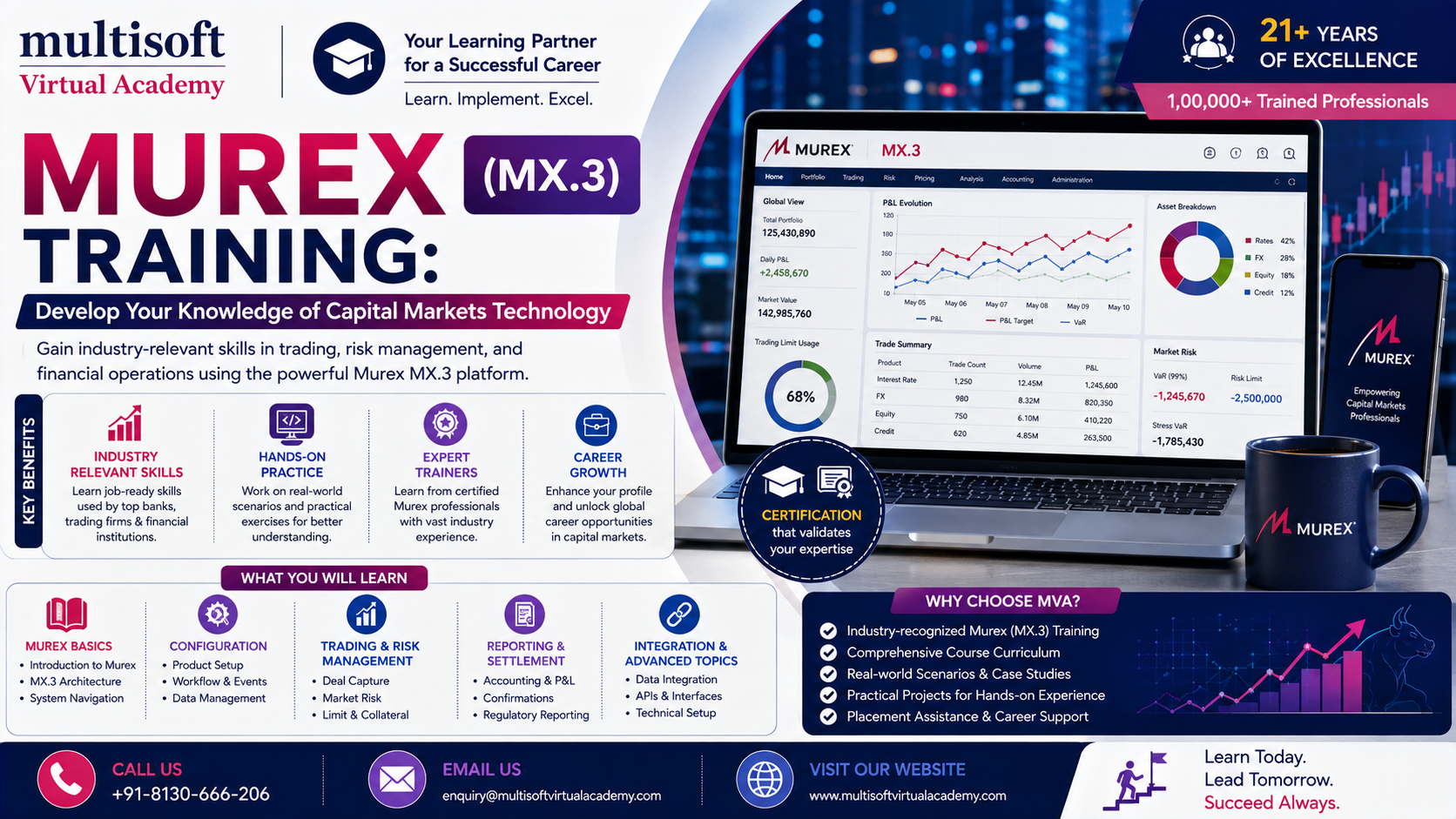
Murex has become an important technology platform within modern capital markets, supporting financial institutions across trading, risk management, treasury, operations and post-trade activities. As financial organizations continue to modernize their technology environments, professionals with knowledge of Murex MX.3 can build valuable expertise across both financial markets and enterprise technology.
Murex (MX.3) Training is designed for professionals who want to understand how an integrated capital markets platform supports the complete trade lifecycle. It can help learners develop knowledge of Murex architecture, trade capture, market data, static data, product configuration, risk management, workflows, reporting and integration.
The growing focus on digital transformation, real-time risk visibility, regulatory requirements and cloud-based financial technology is also creating greater interest in specialized capital markets platforms. Murex states that MX.3 integrates front office, risk, operations and finance while supporting trading, treasury and post-trade processes.
Financial markets are becoming increasingly technology-driven. Banks, investment firms, asset managers and other financial institutions need platforms capable of processing complex instruments while connecting trading, valuation, risk, collateral, accounting and operational processes.
MX.3 is positioned as a cross-asset capital markets platform that helps organizations connect traditionally separated functions. Its capabilities cover areas such as sales and trading, enterprise risk management, treasury management, operations and finance.
This makes Murex knowledge relevant to professionals working in:
For professionals looking to specialize in banking technology, Murex MX.3 Training can provide a structured pathway for understanding the relationship between financial products, technology workflows and enterprise-level capital markets operations.
Murex MX.3 is an integrated financial technology platform designed for capital markets. It provides capabilities across trading, risk management, treasury, collateral management, operations and finance.
The platform is designed to connect front-to-back processes rather than treating trading, risk and operations as completely separate environments. This integrated approach can help financial institutions establish consistent data flows, improve operational visibility and support regulatory and risk-management requirements.
From a learning perspective, understanding MX.3 requires more than knowing individual screens or functions. Professionals should understand how a transaction moves through the platform, how market data affects valuation, how risk calculations are generated and how downstream processes interact with the original trade.
That is why an effective Murex course should combine technology concepts with capital markets fundamentals.
A strong learning foundation begins with financial markets.
Learners benefit from understanding major asset classes and their associated business processes, including:
This financial knowledge makes it easier to understand why particular configurations, pricing models, workflows and risk calculations are required.
For example, a learner who understands the lifecycle of an FX transaction can more easily understand how trade capture, confirmation, valuation, settlement and risk management interact within an enterprise platform.
Therefore, Murex MX.3 Training is not simply about software operation. It combines financial technology knowledge with capital markets concepts.
A comprehensive Murex training online program can cover several interconnected areas.
Understanding architecture provides the foundation for working with the platform.
Training can introduce learners to the major components of MX.3, application environments, data flows, interfaces and the relationship between different functional areas.
Architecture knowledge is particularly valuable for technical consultants, developers and support professionals because it helps them understand how system components interact.
Static data is fundamental to financial applications.
Training can cover concepts related to counterparties, legal entities, portfolios, books, calendars, currencies, product definitions and other reference information.
Professionals working with Murex implementation or production support need to understand how accurate reference information influences transaction processing.
Market data plays an important role in valuation and risk calculations.
Learners can explore concepts such as:
Understanding these concepts helps professionals recognize how market conditions can influence valuation and risk results.
Trade capture is a core component of capital markets operations.
Training can introduce workflows associated with transaction entry, validation, pricing, confirmation and lifecycle management.
Learners can also develop an understanding of how front-office activity connects with risk and downstream operations.
Risk management is one of the most important areas of financial technology.
MX.3 supports enterprise risk capabilities covering market and credit risk among other areas. Its treasury capabilities also include liquidity and risk-management functionality.
Training may introduce concepts such as:
This knowledge can be especially useful for professionals pursuing roles in financial risk technology.
Treasury technology is another important area for Murex professionals.
Modern treasury teams need visibility into funding, liquidity, positions, risk and collateral. Murex describes MX.3 as supporting integrated treasury management with real-time data, liquidity management, risk controls and pre- and post-deal checks.
A Murex training course can therefore help professionals understand how treasury functions interact with trading and risk processes.
Relevant concepts include:
The ability to understand these interconnected processes can be valuable when working on banking transformation and Murex implementation projects.
Murex implementation projects require professionals who can understand both business requirements and technical configurations.
A consultant may need to participate in activities such as requirement analysis, configuration, testing, integration, troubleshooting, documentation and deployment support.
For this reason, Murex implementation training should ideally include practical scenarios rather than only theoretical explanations.
Learners can benefit from studying how a business requirement is translated into a system configuration and how the resulting workflow is tested.
Implementation-oriented learning can help professionals develop skills in:
These capabilities can be useful for aspiring Murex consultants, business analysts and application support professionals.
Murex is also relevant to technology professionals who work on financial applications.
Developers and technical consultants may interact with system configuration, interfaces, data processing, integrations, application environments and performance-related activities.
A technical learning path can therefore focus on understanding:
Professionals coming from Java, database, application support, enterprise software or financial technology backgrounds may find this combination particularly useful.
Business analysts play an important role in connecting financial-market requirements with technology teams.
A business analyst working on a Murex project needs to understand what the business wants to achieve and how the requirement affects trading, risk, operations or finance.
A well-designed Murex business analyst training path can focus on:
Combining domain knowledge with Murex platform awareness can help business analysts communicate more effectively with both financial users and technical teams.
Professionals researching Murex certification often want a structured way to demonstrate their knowledge and strengthen their career profile.
However, certification should not be viewed as the only objective. Practical understanding is equally important.
A strong learning strategy should combine:
This approach can help learners move beyond memorizing terminology and develop the ability to explain how a financial transaction moves through an integrated technology environment.
Murex is closely connected with real-world financial workflows. Consequently, practical learning can make a significant difference.
Instead of learning isolated features, learners should work through scenarios such as:
Trade Capture ? Validation ? Pricing ? Risk ? Confirmation ? Settlement ? Accounting
This helps create a complete understanding of the trade lifecycle.
Case-based learning can also introduce situations involving incorrect market data, configuration issues, workflow failures, pricing discrepancies or downstream processing problems.
Such scenarios can improve analytical thinking and prepare learners for responsibilities encountered in real project environments.
The Murex ecosystem is evolving alongside broader changes in financial technology.
Current developments include increased attention to cloud adoption, SaaS delivery, digital assets, analytics, regulatory technology and artificial intelligence. Murex has recently highlighted its SaaS offering and announced developments involving AI research and digital-asset infrastructure.
This makes adjacent knowledge increasingly valuable for Murex professionals.
Learners can complement their Murex MX.3 Training with knowledge of:
The combination of Murex expertise and modern technology skills can provide a stronger professional profile in the evolving capital markets technology landscape.
The training can be relevant to a broad range of professionals, including:
Professionals already working in banking or financial technology may benefit from using Murex learning to deepen their domain specialization.
Before selecting a Murex course online, learners should evaluate whether the program provides more than basic theoretical information.
Important considerations include:
A course should also match the learner's career objective. Someone targeting a functional consultant role may require a different learning path from a developer or application support professional.
Murex expertise can support career development across several areas of financial technology.
Depending on previous education, experience and specialization, professionals may explore roles such as:
Career progression ultimately depends on practical skills, domain expertise, project exposure and professional experience. Training provides a foundation, while continuous learning and real-world application help professionals build deeper expertise.
The financial services industry increasingly depends on integrated technology platforms that can support complex products, high transaction volumes, risk calculations, regulatory requirements and connected front-to-back operations.
For professionals, this creates an opportunity to develop a specialized skill set combining financial markets knowledge with enterprise technology expertise.
Murex (MX.3) Training can be a valuable part of that journey when it is approached systematically. Start with capital markets fundamentals, understand the MX.3 platform, learn trade lifecycle processes, explore risk and treasury workflows and gradually move into implementation, integration and advanced technical concepts.
Murex MX.3 continues to occupy an important position in capital markets technology, with capabilities spanning trading, treasury, risk, operations and finance. For professionals seeking specialized expertise in financial technology, structured learning can provide a practical foundation for career growth and project readiness. Multisoft Virtual Academy acts as a best service provider for professionals seeking Murex (MX.3) Training, offering career-focused learning designed to help learners develop relevant knowledge and practical understanding for today's evolving capital markets technology environment.
| Start Date | End Date | No. of Hrs | Time (IST) | Day | |
|---|---|---|---|---|---|
| 27 Sep 2026 | 19 Oct 2026 | 24 | 06:00 PM - 09:00 PM | Sat, Sun | |
| 03 Oct 2026 | 25 Oct 2026 | 24 | 06:00 PM - 09:00 PM | Sat, Sun | |
| 04 Oct 2026 | 26 Oct 2026 | 24 | 06:00 PM - 09:00 PM | Sat, Sun | |
| 10 Oct 2026 | 01 Nov 2026 | 24 | 06:00 PM - 09:00 PM | Sat, Sun | |
Schedule does not suit you, Schedule Now! | Want to take one-on-one training, Enquiry Now! |
|||||






 Join our Live Instructor-Led online classes delivered by industry experts
 Let's Get Started