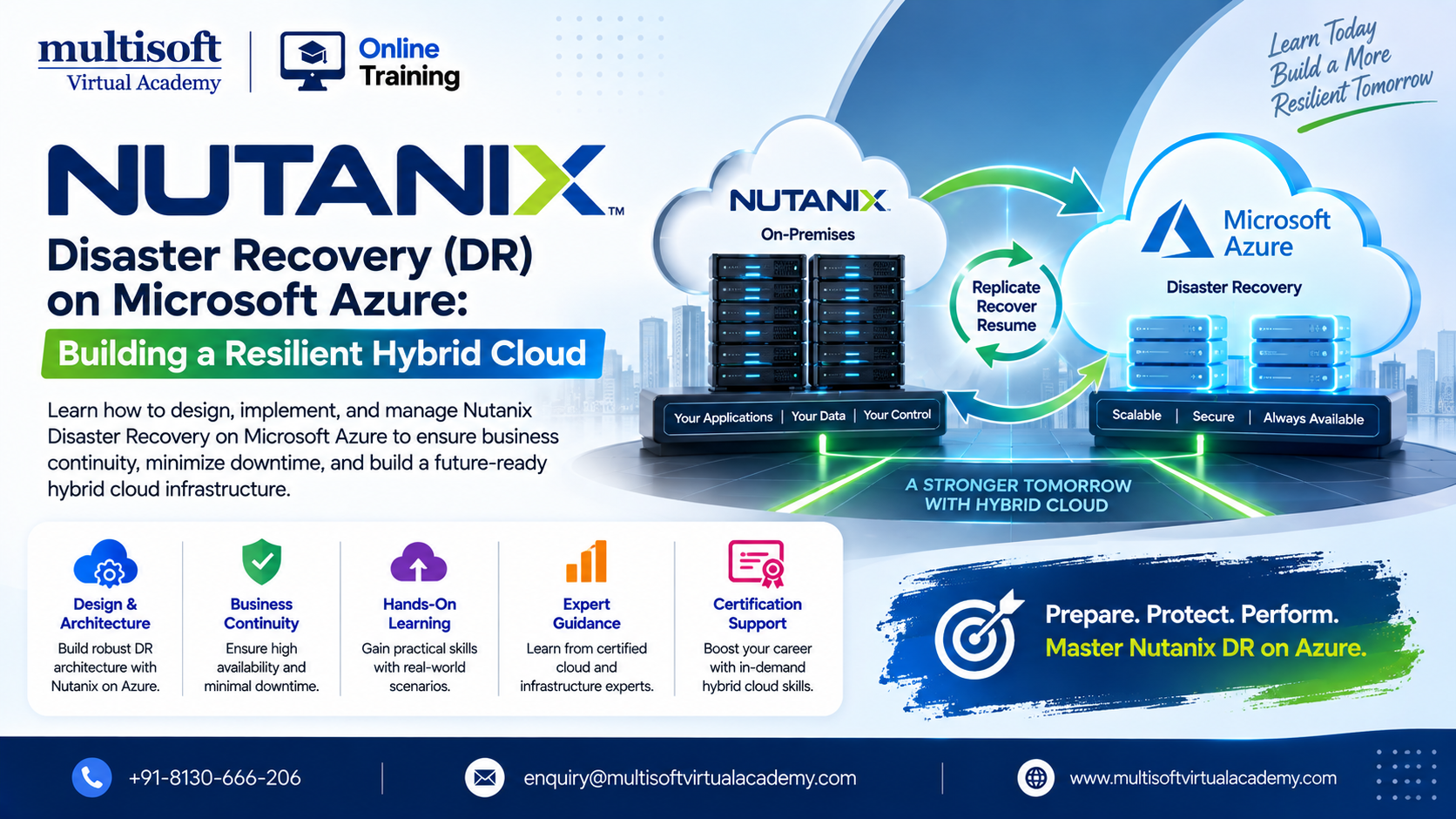
Businesses today depend on digital infrastructure for applications, data, customer services and daily operations. Even a short period of downtime can affect productivity, revenue, customer confidence and regulatory compliance. As organizations move toward hybrid and multicloud environments, Nutanix Disaster Recovery (DR) on Microsoft Azure is becoming an important strategy for improving business continuity and strengthening IT resilience.
Nutanix Cloud Clusters (NC2) on Microsoft Azure enables organizations to use Azure as a secondary environment for disaster recovery while maintaining a familiar Nutanix operational model. Microsoft documentation identifies disaster recovery as a supported NC2 on Azure use case, allowing organizations to provision Azure-based capacity and recover Nutanix workloads when required.
This approach can help organizations reduce dependence on a physical secondary data center while gaining access to Azure's global infrastructure and cloud scalability.
Nutanix Disaster Recovery on Microsoft Azure refers to a hybrid cloud disaster recovery approach in which Nutanix workloads can be protected and recovered using an NC2 environment hosted on Azure.
Instead of maintaining an expensive fully provisioned disaster recovery data center, organizations can use Azure-based Nutanix infrastructure as a recovery site. Nutanix describes NC2 on Azure as a solution for using Azure regions as a secondary site for business continuity and disaster recovery.
The architecture can combine:
This creates a hybrid cloud environment where organizations can maintain workloads on-premises while preparing Azure resources for recovery when a major outage or disaster occurs.
Traditional disaster recovery strategies often require organizations to maintain duplicate infrastructure at geographically separated facilities. This can involve substantial investments in servers, storage, networking, physical facilities, cooling, maintenance and operational staff.
Cloud disaster recovery changes this model by allowing organizations to use cloud infrastructure when additional capacity is required.
Azure-based disaster recovery can provide organizations with:
Nutanix states that its disaster recovery capabilities support flexible deployment models across on-premises infrastructure, public cloud and managed service environments.
For organizations already using Nutanix, integrating disaster recovery with Azure can therefore provide a practical path toward hybrid cloud resilience.
Business continuity is one of the primary reasons organizations implement disaster recovery.
A properly designed Nutanix DR strategy can help businesses continue critical operations after events such as:
The objective is not simply to create backups. A modern disaster recovery strategy must provide a reliable process for restoring applications and data within defined business requirements.
One of the most valuable aspects of Nutanix Cloud Clusters on Azure is the ability to use Azure infrastructure as a secondary site.
Microsoft's current NC2 on Azure documentation specifically identifies disaster recovery as a supported scenario where Azure can be used as a recovery environment for Nutanix workloads.
This can reduce the need to maintain a permanently active physical DR facility while giving organizations access to cloud infrastructure when recovery is required.
Traditional DR environments often require organizations to purchase enough hardware to support worst-case scenarios.
Cloud-based disaster recovery offers another model.
Organizations can design an environment around their recovery requirements and use Azure capacity when needed. Nutanix describes NC2 on Azure as providing elastic disaster recovery capabilities that can scale to the cloud when required.
This can be particularly useful for businesses with fluctuating workloads or organizations looking to modernize their infrastructure.
Many enterprises do not want to move every application immediately to a public cloud.
A hybrid cloud model provides another option.
Organizations can keep workloads on-premises while using Azure for:
This approach allows IT teams to gradually adopt cloud infrastructure rather than relying on a complete infrastructure transformation.
Two of the most important concepts in disaster recovery planning are Recovery Point Objective (RPO) and Recovery Time Objective (RTO).
RPO defines how much data loss an organization can tolerate following a disruption.
For example, an organization with a 15-minute RPO needs a recovery strategy capable of protecting data frequently enough to minimize potential data loss to approximately that timeframe.
RTO defines how quickly an application or workload must be restored after an outage.
For mission-critical applications, organizations may require a significantly shorter recovery window than less critical systems.
RPO and RTO requirements should influence the design of the entire disaster recovery architecture, including replication, networking, storage, recovery orchestration and application dependencies.
A typical Nutanix Disaster Recovery on Microsoft Azure architecture can involve a production Nutanix environment and an NC2 on Azure recovery environment.
At a high level, the process may include:
The exact architecture depends on workload requirements, Nutanix configuration, licensing, networking, security requirements and the organization's recovery strategy.
Nutanix Prism provides a centralized management experience for Nutanix infrastructure.
For disaster recovery operations, management and orchestration are particularly important because recovery involves more than simply restoring individual virtual machines.
Applications can have dependencies involving:
Recovery plans can help organizations coordinate the sequence in which workloads are recovered.
Nutanix's disaster recovery platform emphasizes centralized management, recovery orchestration and the ability to test failover without unnecessarily disrupting production environments.
Networking is one of the most critical components of a successful cloud DR architecture.
An organization must consider:
Microsoft documentation identifies Azure Virtual Network as a key component for connecting AHV hosts, Azure services and other resources. Azure VPN Gateway and ExpressRoute can also support connectivity between environments.
For organizations with strict latency, security or compliance requirements, network architecture should be planned before implementing replication and recovery workflows.
Traditional disaster recovery commonly requires a dedicated secondary infrastructure environment.
This approach can work well but may require significant capital and operational expenditure.
A Nutanix and Azure-based model can provide a more flexible alternative.
| Traditional DR | Nutanix DR on Azure |
| Dedicated physical DR infrastructure | Cloud-based recovery infrastructure |
| High upfront hardware investment | Flexible cloud capacity |
| Hardware lifecycle management | Cloud infrastructure model |
| Physical data center dependency | Azure geographic infrastructure |
| Capacity may remain underutilized | Capacity can scale based on requirements |
| Separate infrastructure management | Hybrid cloud management approach |
The right choice depends on business requirements, regulatory obligations, application architecture and recovery objectives.
A disaster recovery plan should never exist only as documentation.
Organizations need to test whether their recovery procedures actually work.
A DR testing strategy may include:
Testing can identify problems before an actual disaster occurs.
For example, an organization may discover during testing that a critical application depends on a service that was not included in the recovery plan. Identifying that dependency during a controlled test is significantly better than discovering it during a real outage.
Modern disaster recovery strategies must also consider cyber threats.
Ransomware can affect production systems, backups and recovery infrastructure. Consequently, organizations should consider recovery-point protection, access controls, network segmentation, immutable or protected copies where appropriate and secure administrative practices.
Nutanix highlights data protection and disaster recovery as part of a broader business resilience strategy that includes protection against data loss and compromise.
However, disaster recovery should not be treated as a replacement for a comprehensive cybersecurity program. Backup security, identity protection, endpoint security, network security and incident response should work together.
Organizations can consider Nutanix Disaster Recovery on Microsoft Azure for several scenarios.
Businesses can use Azure as a geographically separated recovery location without building an additional physical facility.
Organizations modernizing legacy infrastructure can incorporate cloud disaster recovery into their broader transformation strategy.
Companies can maintain existing Nutanix infrastructure while gradually introducing Azure capabilities.
Organizations experiencing seasonal demand can use cloud infrastructure to expand capacity when required.
Enterprises with strict uptime requirements can incorporate Azure into their business continuity architecture.
Businesses planning to reduce or consolidate physical data center infrastructure can evaluate NC2 on Azure as part of their cloud migration and modernization strategy.
A successful implementation requires more than deploying infrastructure.
Organizations should follow a structured approach.
Identify applications, dependencies, databases, users, network requirements and recovery priorities before creating protection policies.
Document RPO and RTO requirements for each application instead of applying the same recovery objective to every workload.
Plan VPN, ExpressRoute, routing, DNS, IP addressing, firewall rules and segmentation before performing production recovery tests.
Classify workloads based on business importance. Mission-critical applications should receive appropriate protection and recovery priority.
Automation can reduce manual intervention during stressful recovery situations. Recovery plans and centralized management can help standardize recovery workflows.
Testing should be performed periodically rather than only after deployment.
Documentation should explain who initiates recovery, how applications are validated, how users are redirected and how normal operations are restored.
Access permissions, administrative accounts, authentication, network controls and monitoring should be reviewed regularly.
The disaster recovery landscape is evolving as organizations adopt hybrid cloud, automation and AI-driven operations.
Several trends are influencing modern DR strategies:
Organizations are increasingly looking for recovery architectures that are not only reliable but also easier to manage, scale and test.
Implementing Nutanix Disaster Recovery on Microsoft Azure involves multiple technical disciplines. Infrastructure teams need to understand Nutanix architecture, AHV, Prism, replication, Azure networking, security, cloud infrastructure and business continuity requirements.
Poorly planned implementations can result in incomplete workload protection, unexpected application dependencies, networking problems or recovery delays.
Professional guidance can help organizations evaluate their existing environment, identify appropriate workloads, design recovery architecture, configure protection policies and validate recovery procedures.
The objective should be to create a DR strategy that aligns technology with actual business requirements rather than simply deploying another infrastructure platform.
It is a hybrid disaster recovery approach that uses Nutanix capabilities with Microsoft Azure infrastructure, including NC2 on Azure, to provide a cloud-based recovery environment for protected workloads.
Yes. Microsoft identifies disaster recovery as a supported NC2 on Azure use case, enabling organizations to use Azure infrastructure as a recovery environment for Nutanix workloads.
Nutanix Cloud Clusters on Azure allows organizations to run Nutanix infrastructure on Microsoft Azure bare-metal resources while maintaining a Nutanix operational experience. It supports use cases including disaster recovery, workload migration and on-demand capacity.
Microsoft's NC2 on Azure FAQ states that existing VPN or ExpressRoute gateways can be used for disaster recovery scenarios.
Testing validates whether workloads, applications, networking and recovery procedures can actually operate as expected during a disaster. It also helps identify missing dependencies before a real outage.
Nutanix Disaster Recovery (DR) on Microsoft Azure provides organizations with a flexible approach to hybrid cloud resilience, business continuity and workload recovery. By combining Nutanix's infrastructure and disaster recovery capabilities with Microsoft Azure's cloud infrastructure, organizations can develop recovery environments that support scalability, geographic redundancy and operational flexibility. As enterprises increasingly adopt hybrid cloud and cyber-resilient infrastructure strategies, choosing the right architecture, defining RPO and RTO requirements, securing workloads and regularly testing recovery procedures become essential. For organizations seeking professional guidance, structured learning and practical expertise around Nutanix Disaster Recovery (DR) on Microsoft Azure, Multisoft Virtual Academy serves as a service provider focused on helping professionals and organizations strengthen their knowledge of Nutanix, Azure, cloud infrastructure and disaster recovery technologies.
| Start Date | End Date | No. of Hrs | Time (IST) | Day | |
|---|---|---|---|---|---|
| No schedule available ! | |||||
Schedule does not suit you, Schedule Now! | Want to take one-on-one training, Enquiry Now! |
|||||






 Join our Live Instructor-Led online classes delivered by industry experts
 Let's Get Started