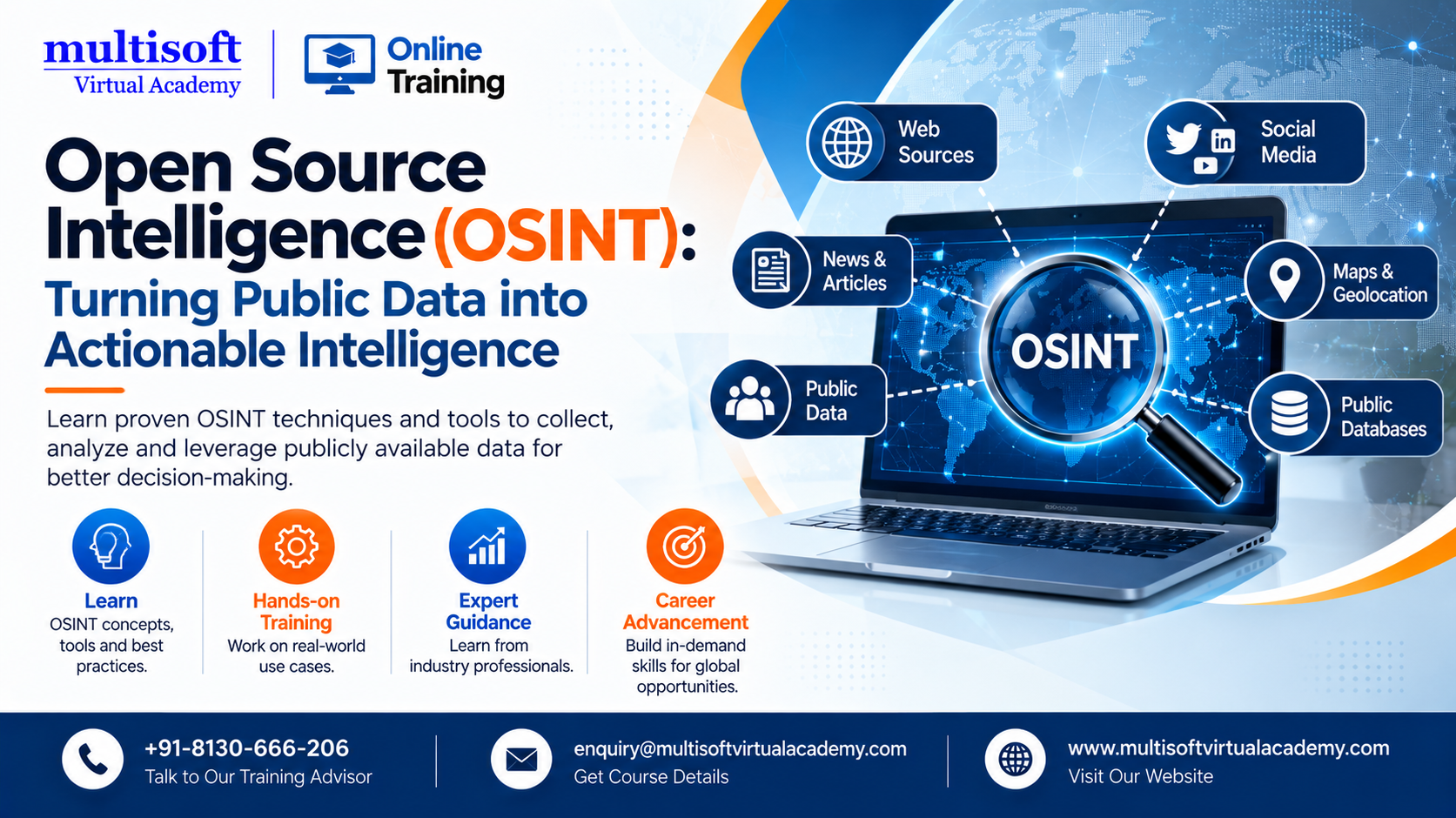
Open Source Intelligence (OSINT) is the structured process of collecting, verifying, analyzing, and interpreting information that is publicly or commercially available. Sources can include websites, social media platforms, public records, news publications, online databases, forums, company websites, digital archives, videos, images, and other openly accessible information.
The important distinction is that information is not automatically intelligence. Raw information becomes useful intelligence only when it is evaluated, connected with other evidence, placed into context, and analyzed against a specific requirement or decision. This makes OSINT valuable for cybersecurity, corporate investigations, threat intelligence, fraud detection, risk assessment, competitive research, and digital investigations.
As organizations become increasingly dependent on digital platforms, the amount of publicly available information continues to expand. At the same time, misinformation, duplicate information, manipulated media, privacy concerns, and rapidly changing online sources make verification more important than ever.
For professionals, learning OSINT techniques is therefore not simply about finding information online. It is about developing a repeatable and responsible methodology for discovering relevant information, establishing its reliability, identifying relationships, and producing defensible conclusions.
The internet has transformed how organizations obtain information. A business, individual, technology platform, or potential threat can leave numerous digital traces across different public sources.
Security teams may use Open Source Intelligence (OSINT) to identify indicators associated with emerging threats. Investigators may examine publicly available information to understand an organization or event. Businesses may use competitive intelligence to understand market developments, while analysts can monitor public sources for risks and emerging trends.
Modern OSINT can support several important objectives:
The growing volume of online information also means that manual searching alone can become inefficient. Modern OSINT tools and techniques help analysts organize, filter, correlate, and analyze information more effectively.
One of the strengths of OSINT investigation is the diversity of information sources available to an analyst. Different investigations require different source combinations.
Search engines remain an important starting point for discovering publicly available information. Analysts can use advanced search techniques to locate relevant documents, websites, publications, technical information, and publicly indexed resources.
However, search results should be treated as leads rather than unquestionable evidence. Information needs to be reviewed and validated before being used in an intelligence assessment.
Social platforms can provide valuable information about organizations, events, public activities, trends, and digital identities. Social Media Intelligence (SOCMINT) is closely related to OSINT and focuses on extracting meaningful intelligence from publicly available social media information.
Because social media content can be edited, deleted, duplicated, or manipulated, analysts should consider the source, publication time, context, and independent corroboration.
Government portals, regulatory records, corporate filings, public registers, research databases, and other legitimate sources can provide useful information for investigations and due diligence.
The availability and lawful use of these records vary by jurisdiction, so analysts must understand applicable regulations and organizational policies.
News websites, industry publications, research reports, and specialist publications can provide valuable historical and current context. Comparing multiple reputable sources can help analysts identify inconsistencies and reduce the risk of relying on inaccurate reporting.
Archived websites can help researchers understand how publicly available information changed over time. Historical context can be particularly useful when investigating organizations, websites, campaigns, or digital events.
Effective OSINT depends more on methodology than on simply knowing a large number of tools. A professional analyst generally begins with a clearly defined intelligence requirement.
Before collecting information, determine what question the investigation needs to answer.
A vague objective can result in excessive data collection and poor-quality analysis. A clearly defined question gives the investigation direction and helps determine which sources are relevant.
The next step is systematic information discovery. Analysts identify appropriate sources and search for information that may answer the investigation question.
Search operators, databases, public records, social platforms, archives, and specialist resources can all contribute to this stage.
Verification is one of the most important elements of an OSINT investigation.
A single online source should not automatically be treated as factual. Analysts should consider:
This verification process helps distinguish useful intelligence from unreliable online information.
Information from separate sources can become significantly more valuable when relationships are identified.
For example, analysts may connect publicly available information about organizations, domains, technologies, online accounts, publications, events, or infrastructure. Correlation helps transform disconnected observations into a broader picture.
The purpose of intelligence analysis is not merely to collect large quantities of information. Analysts need to determine what the information means in the context of the original requirement.
This can involve identifying patterns, relationships, anomalies, timelines, risks, and potential implications.
A professional investigation should maintain clear records of relevant sources, observations, verification steps, assumptions, and conclusions.
Good documentation improves transparency and allows findings to be reviewed or reproduced when necessary.
The OSINT ecosystem includes many different categories of tools. No single tool can answer every intelligence requirement, and recent research similarly emphasizes the diversity of available OSINT tools and the need to combine automated tools with manual analysis.
Common categories include:
Search and discovery tools: Used to locate publicly accessible information across websites and databases.
Social media research tools: Designed to help analyze publicly available information from social platforms.
Domain and infrastructure research tools: Useful for examining publicly available information associated with domains, websites, and internet infrastructure.
Metadata analysis tools: Can help examine metadata contained in legitimately obtained files where such metadata is available.
Image and media verification tools: Used to investigate publicly available images and media and assess their context or origin.
Data visualization tools: Help analysts represent relationships and connections between different pieces of information.
Threat intelligence platforms: Can help security teams organize indicators, intelligence feeds, and threat-related information.
The most effective approach is usually to select tools according to the investigation requirement rather than attempting to use every available OSINT platform.
One of the most important applications of Open Source Intelligence (OSINT) is cybersecurity.
Security professionals can use publicly available information to understand an organization's external digital footprint and identify information that may be relevant to security monitoring.
OSINT can contribute to:
For example, security teams may monitor legitimate public sources for information that could indicate emerging threats, compromised credentials, malicious infrastructure, or discussions surrounding a security incident.
OSINT can therefore complement other cybersecurity capabilities, but it should not be considered a replacement for vulnerability management, security controls, incident response processes, or professional security testing.
Cyber threat intelligence focuses on understanding threats, their potential impact, and the information needed to support better security decisions.
OSINT can serve as one important source of threat intelligence because publicly available information may reveal emerging campaigns, threat discussions, indicators, vulnerabilities, or changes in the threat landscape.
The real value comes from analysis. A security team does not necessarily benefit from receiving thousands of unfiltered alerts. It needs relevant, validated information that can help security professionals make informed decisions.
This is why effective OSINT programs combine data collection, verification, analysis, contextualization, and reporting.
Digital investigations increasingly involve information distributed across numerous online sources. Investigators may need to establish timelines, understand relationships, verify claims, or identify relevant publicly available evidence.
OSINT can support these activities by helping investigators organize information from legitimate public sources.
However, responsible investigations require discipline. Analysts should distinguish between verified facts, reasonable assessments, assumptions, and unresolved questions.
This distinction is essential because incorrect conclusions can lead to reputational, legal, financial, or operational consequences.
OSINT and digital forensics are related but fundamentally different disciplines.
OSINT generally focuses on information that is publicly or commercially available and can be lawfully accessed.
Digital forensics, by contrast, typically involves the systematic examination and preservation of digital evidence from devices, systems, storage media, or other sources within an authorized investigative context.
Both disciplines can contribute to investigations, but they involve different objectives, processes, evidence considerations, and professional requirements.
Understanding this distinction helps organizations choose the appropriate methodology for a particular investigation.
The fact that information is publicly accessible does not automatically mean that it can be used for any purpose.
OSINT investigations should always consider applicable laws, privacy requirements, terms of service, organizational policies, and ethical boundaries. A 2026 comparative study of OSINT tools and methods specifically highlights that public availability does not guarantee lawful use and emphasizes the importance of legal and ethical responsibility.
Professionals should therefore avoid unauthorized access, impersonation, harassment, unnecessary collection of personal information, or activities that violate applicable laws or platform rules.
Responsible OSINT focuses on legitimate objectives, proportional collection, reliable verification, appropriate handling of information, and respect for privacy.
A successful OSINT professional needs more than technical knowledge. Strong analytical thinking and research discipline are equally important.
Important skills include:
Professionals who develop these skills can apply OSINT knowledge across cybersecurity, investigations, intelligence analysis, fraud prevention, corporate security, and risk management.
Organizations looking to establish an OSINT capability should begin with clearly defined objectives rather than purchasing numerous tools immediately.
A practical approach can include:
Define the purpose: Establish what the organization needs to monitor or investigate.
Develop procedures: Create documented processes for collection, verification, analysis, and reporting.
Select appropriate tools: Choose tools based on actual intelligence requirements.
Train personnel: Ensure analysts understand research methods, technology, source evaluation, and ethical responsibilities.
Establish verification standards: Define how information should be corroborated before it becomes part of an intelligence report.
Protect collected information: Apply appropriate access controls and information-handling procedures.
Review the process regularly: Online sources and technologies change continuously, so OSINT methodologies should evolve accordingly.
The future of Open Source Intelligence (OSINT) will be influenced by the rapid expansion of digital information, artificial intelligence, automation, data visualization, cybersecurity threats, and increasingly complex online environments.
AI-assisted technologies may help analysts process large volumes of information more efficiently. However, automation does not remove the need for human judgment. Analysts still need to assess source reliability, understand context, identify uncertainty, and make responsible conclusions.
The combination of automation and human expertise is likely to become increasingly important. Technology can accelerate discovery and processing, while skilled analysts remain essential for interpretation and decision-making.
For professionals entering this field, developing both technical and analytical capabilities can provide a strong foundation for working in modern intelligence and cybersecurity environments.
Open Source Intelligence (OSINT) has evolved into an important capability for organizations that need to understand publicly available information and convert it into meaningful intelligence. From OSINT tools, social media intelligence, cyber threat intelligence, and digital investigations to risk assessment and competitive research, its applications continue to expand.
The strongest OSINT practices are not based on collecting the largest amount of information. They focus on asking the right questions, finding relevant sources, verifying evidence, understanding context, protecting privacy, and producing actionable analysis.
For professionals and organizations seeking structured learning and practical knowledge in this rapidly developing field, Multisoft Virtual Academy can serve as a specialized training provider for building skills in Open Source Intelligence, cybersecurity, digital investigation, threat intelligence, and related technologies. A well-designed learning approach can help professionals move beyond basic online searching and develop the analytical mindset required to turn open information into reliable, responsible, and useful intelligence.
| Start Date | End Date | No. of Hrs | Time (IST) | Day | |
|---|---|---|---|---|---|
| No schedule available ! | |||||
Schedule does not suit you, Schedule Now! | Want to take one-on-one training, Enquiry Now! |
|||||






 Join our Live Instructor-Led online classes delivered by industry experts
 Let's Get Started