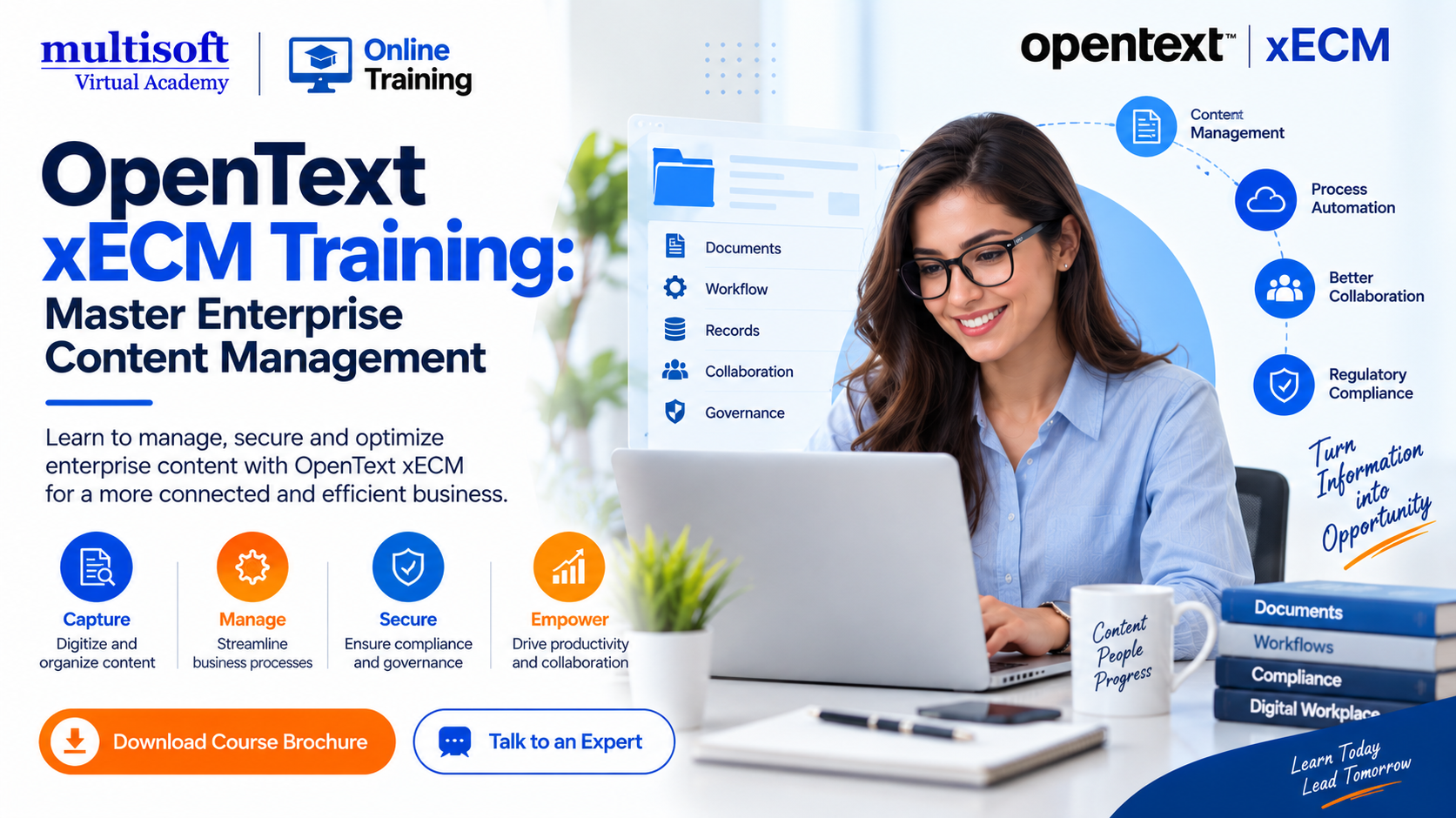
Organizations today manage enormous volumes of documents, business records, contracts, emails, engineering files, and other digital information. Managing this content efficiently is no longer only about storing documents. Businesses need to connect information with business processes, applications, employees, compliance requirements, and customer workflows. This is where OpenText xECM Training becomes highly valuable for professionals working with enterprise content management.
OpenText Extended ECM, commonly referred to as xECM, helps organizations connect enterprise content with the applications and processes employees already use. The platform is designed to bring relevant information into business context while supporting content management, governance, workflow, collaboration, and integration. OpenText describes Extended ECM as a content management platform that integrates with major enterprise applications such as SAP, Salesforce, Microsoft, and Guidewire.
For professionals who want to strengthen their enterprise content management skills, OpenText Extended ECM Training provides an opportunity to understand how content is created, organized, accessed, governed, secured, and connected with business processes.
OpenText xECM Training is an enterprise content management and content services approach that connects business information with the applications and processes where employees perform their daily work. Instead of forcing users to constantly switch between multiple systems, Extended ECM can make relevant documents and information available within business applications.
The concept goes beyond traditional document storage. It focuses on connecting content with business processes, creating a more unified information environment.
OpenText Extended ECM supports integrations with platforms such as SAP, Microsoft 365, Salesforce, Oracle applications, and other enterprise environments. It can also support custom integration scenarios through APIs and other interfaces.
This makes OpenText xECM Training particularly relevant for professionals involved in enterprise information management, application administration, business process improvement, document management, digital transformation, and system integration.
Digital businesses generate content across departments and applications. Finance teams handle invoices and financial documents, HR manages employee records, legal teams manage contracts, engineering teams work with technical documentation, and sales teams handle customer-related information.
Without an effective content management strategy, information can become scattered across repositories and applications.
OpenText xECM helps organizations create stronger connections between content and business processes. Training helps professionals understand how these capabilities can be configured and used effectively.
A structured OpenText xECM Training Course can help participants develop knowledge in areas such as:
These skills can be useful for both technical professionals and business users working with enterprise information systems.
OpenText Content Server Training is an important part of developing xECM expertise. Content Server provides capabilities for managing documents, folders, metadata, permissions, versions, workflows, and other enterprise information.
Professionals can learn how documents are added, searched, organized, shared, versioned, and managed throughout their lifecycle.
OpenText's current learning resources include foundational courses for managing documents in Extended ECM as well as administrator-focused training. Its learning paths are organized around different professional roles, helping learners build skills progressively.
Understanding Content Server is especially important for professionals who want to move into OpenText Content Server Administrator Training, application support, enterprise content administration, or information management roles.
Business Workspaces are another important topic for professionals learning Extended ECM.
A business workspace provides a centralized location for information related to a particular business object, project, customer, supplier, employee, or other organizational entity. Instead of searching through disconnected repositories, users can work with related content in a structured business context.
OpenText Business Workspace Training can help professionals understand how workspaces are created, configured, organized, secured, and used.
This capability is particularly useful in environments where employees need access to multiple documents and information sources while working on a common business process.
For example, a project workspace could contain contracts, specifications, correspondence, project documentation, approvals, and other relevant content. Connecting these documents to the business process can improve information accessibility and reduce unnecessary manual searching.
Workflow automation is another major area of enterprise content management.
Organizations frequently need documents to move through defined approval or review processes. An invoice may require financial approval, a contract may require legal review, and an engineering document may need several technical approvals before release.
OpenText xECM Workflow Training helps professionals understand how workflow processes can be designed and managed.
Participants can learn concepts related to:
OpenText has dedicated training around Extended ECM workflow design, where learners work with workflows and understand how to create, initiate, and manage different workflow scenarios.
Developing these skills can help organizations reduce manual activities, improve process consistency, and create more transparent document-based workflows.
Managing information is not only about accessibility. Organizations also need to control how long information is retained, who can access it, and how records are governed.
OpenText Records Management Training focuses on concepts that help organizations manage records according to established policies and governance requirements.
Records management can be particularly important in industries where organizations must maintain audit trails, retention policies, compliance documentation, and controlled information.
Extended ECM supports governance and compliance capabilities alongside enterprise content management. OpenText also provides dedicated learning resources for records management and administration.
Professionals working in information governance, compliance, document control, records administration, and enterprise content management can benefit from developing these skills.
One of the major reasons organizations invest in Extended ECM is its ability to connect content with business applications.
OpenText Extended ECM for SAP Training can be particularly valuable for SAP professionals, consultants, administrators, and enterprise application specialists.
SAP environments generate significant volumes of business documents and information. Connecting this content with SAP processes can help users access relevant documents without leaving their familiar business environment.
OpenText identifies Extended ECM for SAP Solutions as a content services integration for ERP processes, alongside integrations for Salesforce, Microsoft 365, Oracle applications, and other enterprise platforms.
Training can therefore help professionals understand the relationship between content repositories and SAP business processes, including document access, metadata, business workspaces, workflow, and content governance.
Microsoft 365 and SharePoint are widely used for collaboration and document management. Organizations often need to connect Microsoft environments with enterprise content management and governance frameworks.
OpenText Extended ECM for Microsoft 365 Training can help professionals understand how xECM works with Microsoft environments.
Current OpenText learning paths include dedicated training for Extended ECM for Microsoft Office 365 and SharePoint, including administrator-focused learning and certification preparation.
This knowledge can be valuable for Microsoft administrators, content managers, enterprise architects, business analysts, and professionals responsible for collaboration platforms.
Administrators play an important role in maintaining enterprise content environments.
OpenText xECM Administrator Training can help professionals understand system configuration, user management, permissions, server capabilities, databases, licenses, features, and operational administration.
OpenText's current training offerings include an Extended ECM Content Server System Administration course covering areas such as licenses, assets, server configuration, database configuration, and feature capabilities.
Administrative knowledge is especially useful for professionals responsible for supporting production environments and maintaining reliable access to enterprise content.
Developers can also benefit from learning Extended ECM because modern enterprise environments often require integration between content platforms and business applications.
Development-oriented xECM learning can cover areas such as:
OpenText documentation describes interfaces including REST APIs, web services, CMIS, and UI widgets for integration scenarios.
These capabilities make xECM relevant to developers working on enterprise digital transformation projects.
OpenText xECM Training can be useful for professionals from multiple technical and business backgrounds.
The training may be suitable for:
Both technical and functional professionals can benefit because Extended ECM connects technology with real-world business processes.
A comprehensive OpenText Extended ECM Training Program can help learners build practical knowledge across multiple areas.
Participants can develop an understanding of document management, metadata, permissions, version control, business workspaces, workflow, records management, information governance, integration, administration, and troubleshooting.
They can also learn how enterprise content platforms support broader digital transformation strategies.
The goal should not simply be to understand individual features. Effective training should help professionals understand how different xECM capabilities work together to solve enterprise information management challenges.
Professionals often search for OpenText xECM Certification, OpenText Content Server Certification, and related credentials when planning their career development.
Certification-oriented learning can help candidates validate their understanding and prepare for role-specific assessments. OpenText's current learning paths include certification examinations for roles such as business users, business administrators, and Extended ECM for Microsoft Office 365 administrators.
Career opportunities can vary depending on experience, technical background, and specialization. Professionals with xECM expertise may explore roles such as:
Combining xECM knowledge with SAP, Microsoft 365, Salesforce, cloud, workflow, or enterprise architecture skills can further strengthen a professional's profile.
Before selecting an OpenText xECM Training Course, professionals should consider their career objectives and current responsibilities.
Administrators may require deeper coverage of configuration, users, permissions, server settings, databases, and troubleshooting. Developers may need integration, APIs, customization, and application architecture. Business users may benefit more from document management, search, collaboration, workspaces, and process-oriented functionality.
A good training program should therefore provide:
OpenText itself structures learning paths according to professional roles, reinforcing the importance of role-based training.
Reading documentation can introduce professionals to concepts, but practical exercises are essential for developing confidence.
A strong OpenText xECM Online Training program should provide opportunities to work with realistic scenarios. Learners should understand not only what a feature does but also why it is used and how it fits into an enterprise environment.
For example, creating a Business Workspace is one skill. Understanding how that workspace supports a customer onboarding process, controls access, organizes documents, connects metadata, and supports workflow is a more valuable professional capability.
This practical approach helps learners connect technical knowledge with business outcomes.
As organizations continue moving toward cloud platforms, digital workflows, hybrid work environments, automation, and connected enterprise applications, content management is becoming increasingly integrated with everyday business operations.
The traditional approach of storing documents in isolated repositories is gradually giving way to connected content services.
OpenText's Extended ECM strategy reflects this shift by connecting content management capabilities with business applications and processes. Its current product positioning emphasizes integration, governance, cloud readiness, and enterprise information accessibility.
This creates opportunities for professionals who understand both enterprise applications and information management.
Multisoft Virtual Academy provides professional learning opportunities for individuals and organizations seeking to develop practical expertise in OpenText xECM Training, Extended ECM, Content Server, workflow, Business Workspaces, records management, enterprise content management, and integration technologies. For professionals planning to strengthen their OpenText skills, move toward administration or consulting roles, or understand how enterprise content connects with platforms such as SAP and Microsoft 365, structured training can provide a valuable foundation for long-term career growth and technical confidence.
| Start Date | End Date | No. of Hrs | Time (IST) | Day | |
|---|---|---|---|---|---|
| 26 Sep 2026 | 18 Oct 2026 | 24 | 06:00 PM - 09:00 PM | Sat, Sun | |
| 27 Sep 2026 | 19 Oct 2026 | 24 | 06:00 PM - 09:00 PM | Sat, Sun | |
| 03 Oct 2026 | 25 Oct 2026 | 24 | 06:00 PM - 09:00 PM | Sat, Sun | |
| 04 Oct 2026 | 26 Oct 2026 | 24 | 06:00 PM - 09:00 PM | Sat, Sun | |
Schedule does not suit you, Schedule Now! | Want to take one-on-one training, Enquiry Now! |
|||||






 Join our Live Instructor-Led online classes delivered by industry experts
 Let's Get Started