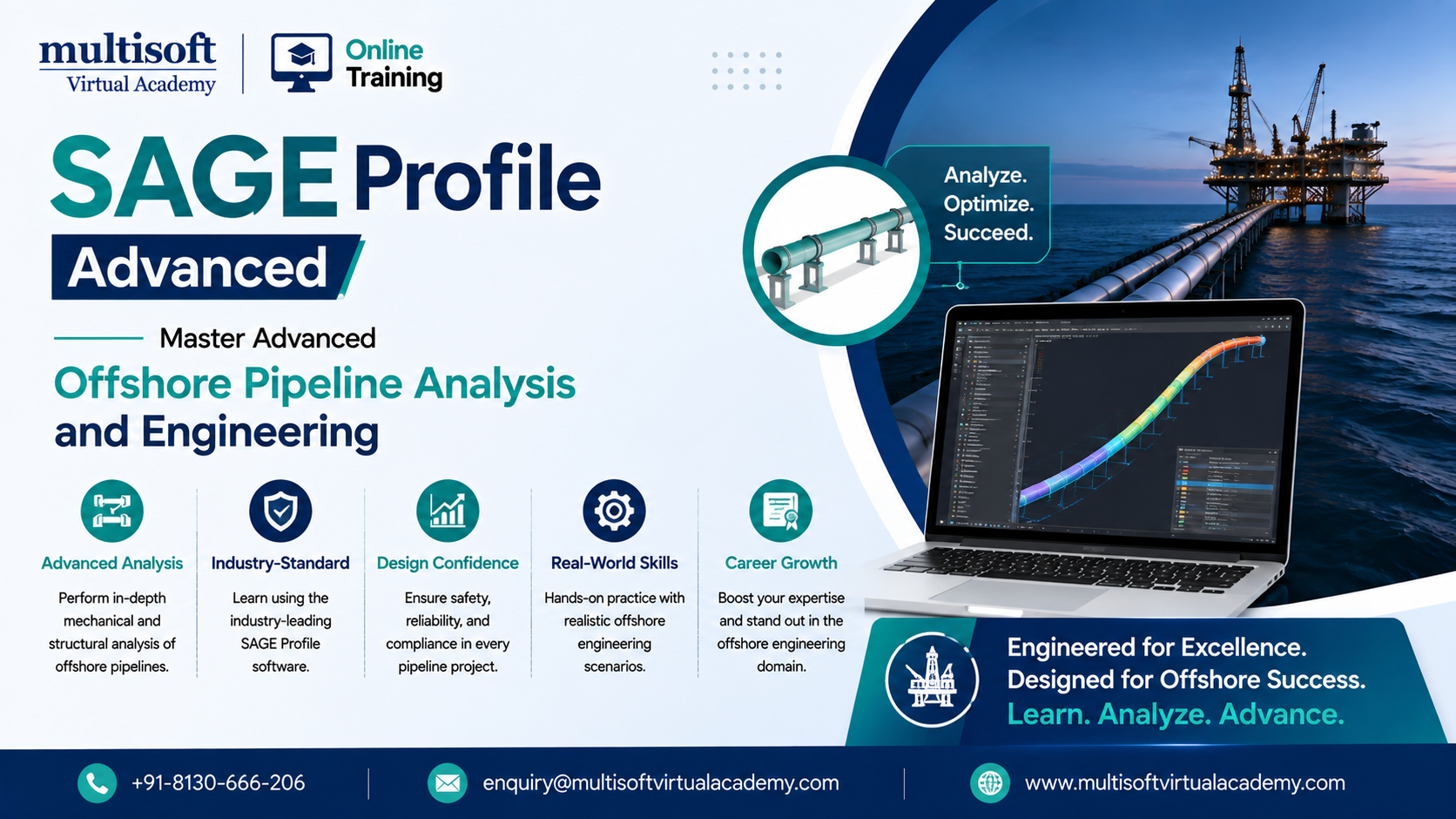
Offshore pipeline engineering demands precision, advanced simulation capabilities and a strong understanding of how pipelines interact with their surrounding environment. As offshore projects become more complex, engineers increasingly need specialized tools and advanced analytical skills to evaluate pipeline behaviour under challenging operating and environmental conditions. SAGE Profile Advanced provides a focused approach to advanced pipeline analysis, helping engineering professionals understand complex pipeline-soil interaction, buckling behaviour, free spans and other critical design considerations.
For professionals working in offshore engineering, subsea pipeline design, oil and gas projects and engineering consultancy, developing expertise in SAGE Profile Advanced Training can strengthen their ability to analyse real-world pipeline scenarios. The platform is specifically associated with advanced offshore pipeline analysis and includes capabilities for areas such as pipeline geotechnics, advanced soil models, pipe-soil interaction, upheaval and lateral buckling, pipeline walking, finite element analysis parameters and free-span analysis.
SAGE Profile is a specialized software suite used for offshore pipeline analysis. Its advanced capabilities allow engineers to investigate pipeline behaviour and evaluate engineering conditions that can affect the integrity, stability and performance of subsea pipelines.
SAGE Profile Advanced goes beyond basic modelling by addressing complex engineering problems involving soil interaction, thermal and operational effects, pipeline movement, buckling and free spans. The advanced course offered by the software's experts specifically covers pipeline geotechnics, XSPIM-based soil interaction, upheaval and lateral buckling, pipeline walking, advanced finite element parameters, boundary conditions and detailed free-span analysis.
This makes the subject particularly relevant for pipeline engineers, subsea engineers, offshore structural engineers, design consultants and professionals involved in engineering analysis.
Modern offshore pipeline projects operate under demanding environmental and operational conditions. Pipelines may experience temperature changes, pressure variations, seabed interaction, hydrodynamic forces and complex soil behaviour.
A conventional design approach may not be sufficient when engineers need to understand nonlinear pipeline responses or complicated soil-pipeline interaction. Advanced simulation helps professionals investigate these conditions before they become costly engineering or operational problems.
Learning SAGE Profile Advanced can therefore help professionals develop a deeper understanding of:
The combination of engineering knowledge and specialized software expertise can be particularly valuable for professionals involved in detailed pipeline design and analysis.
A structured SAGE Profile Advanced Training program can help learners move from fundamental concepts to advanced simulation techniques. Rather than focusing only on software commands, effective training should connect the software environment with actual engineering problems.
Learners can explore how a pipeline model is created, how soil parameters are defined, how boundary conditions influence results and how simulation outputs can be interpreted for engineering decisions.
The advanced learning path can include practical exposure to:
Pipeline geotechnics is an important component of subsea pipeline engineering because the seabed can significantly influence pipeline stability and movement.
Understanding soil classification, soil properties and load-transfer mechanisms helps engineers establish appropriate parameters for analysis. Advanced geotechnical modelling can then be used to investigate how pipeline and seabed conditions interact during different operational scenarios.
Pipe-soil interaction is another important area within advanced pipeline analysis. The interaction between the pipe and seabed can influence lateral movement, axial resistance and pipeline stability.
XSPIM-based modelling provides an advanced framework for representing soil-pipe interaction. Professionals studying SAGE Profile Advanced can develop an understanding of soil parameters, interaction models, assumptions, simulation setup and calibration.
This knowledge is useful when evaluating complex subsea pipeline behaviour where soil conditions cannot be represented adequately through simplified assumptions.
Pipeline walking is a critical consideration for certain offshore pipeline systems. Repeated operational cycles can cause a pipeline to move progressively along its route.
Changes in temperature and pressure can contribute to axial movement. Over multiple operating cycles, these movements may accumulate and create engineering challenges.
Advanced pipeline analysis helps engineers investigate the conditions that contribute to pipeline walking and evaluate its potential effects on pipeline behaviour.
For professionals working in subsea pipeline design, understanding pipeline walking analysis can improve their ability to assess long-term pipeline movement and develop appropriate engineering strategies.
Buckling is one of the most important subjects in advanced offshore pipeline engineering.
When a pipeline experiences thermal expansion while its movement is constrained, compressive forces can develop. Depending on seabed conditions and pipeline configuration, these forces can contribute to upheaval buckling.
Understanding the factors that influence upheaval buckling is essential for evaluating pipeline stability and designing appropriate mitigation strategies.
Lateral buckling involves sideways movement of the pipeline when compressive forces exceed the resistance provided by the surrounding environment.
Advanced analysis allows engineers to investigate the relationship between pipeline properties, soil resistance, operating conditions and pipeline configuration.
SAGE Profile's advanced training scope specifically includes modelling of both upheaval and lateral buckling, making these important subjects for professionals seeking advanced pipeline analysis skills.
Finite element analysis is widely used for evaluating complex engineering behaviour. In pipeline engineering, advanced finite element parameters can support detailed investigations of pipeline response under different loading and boundary conditions.
A strong finite element pipeline analysis workflow requires more than simply running a simulation. Engineers need to understand model assumptions, constraints, loads, soil behaviour, convergence and output interpretation.
SAGE Profile Advanced learning can help professionals understand advanced FE engine parameters and apply them appropriately to pipeline modelling scenarios.
This knowledge can support more informed engineering decisions and improve confidence when dealing with complex pipeline analysis problems.
Boundary conditions define how a pipeline model behaves within its simulated environment. Incorrect or unrealistic boundary assumptions can significantly influence simulation results.
Advanced pipeline modelling therefore requires engineers to understand how constraints, loads, supports and environmental interactions should be represented.
Through SAGE Profile Advanced Training, learners can study different boundary scenarios and examine how changes in boundary conditions affect pipeline behaviour.
This practical understanding is especially important when developing models based on real offshore project conditions rather than simplified academic examples.
Free spans occur when sections of a pipeline are unsupported by the seabed. These spans can be influenced by seabed irregularities, scour, environmental forces and other offshore conditions.
A detailed free span analysis can help engineers evaluate span dimensions, structural response, stress conditions and potential vibration-related concerns.
SAGE Profile's advanced course scope includes detailed free-span analysis, making it an important subject for professionals involved in offshore and subsea pipeline engineering.
Engineers can use advanced modelling concepts to investigate critical span conditions and better understand the structural response of unsupported pipeline sections.
SAGE Profile Advanced Training can be valuable for professionals whose responsibilities involve pipeline modelling, offshore engineering or engineering analysis.
The target audience can include:
Professionals who already understand pipeline design fundamentals can particularly benefit from advanced software-based learning because they can connect theoretical concepts with practical modelling workflows.
Choosing a practical and structured SAGE Profile Advanced Course can provide several professional benefits.
Hands-on exercises allow learners to understand how advanced pipeline models are developed and analysed.
Learners can explore difficult engineering conditions involving soil interaction, buckling, pipeline walking and free spans.
Advanced training should not stop at simulation execution. Understanding graphs, outputs and engineering results is equally important.
Specialized pipeline analysis skills can complement existing knowledge in offshore, subsea and oil and gas engineering.
Real-world scenarios can help learners understand how advanced analysis concepts are applied to practical pipeline engineering problems.
Professionals searching for SAGE Profile 3D Training may also be interested in developing broader pipeline modelling capabilities. SAGE Profile's advanced ecosystem is particularly relevant to offshore pipeline analysis, where three-dimensional modelling and detailed simulation can help engineers evaluate complex pipeline configurations.
The relationship between 3D modelling, geotechnical behaviour and structural analysis becomes increasingly important as projects involve challenging seabed conditions and complex pipeline routes.
A comprehensive learning approach should therefore connect software operation with engineering fundamentals rather than treating the application as an isolated technical tool.
Before selecting a SAGE Profile Advanced Course Online, professionals should consider several factors.
First, check whether the syllabus includes the advanced topics required for your role. A useful program should address areas such as pipeline geotechnics, pipe-soil interaction, buckling, pipeline walking, finite element parameters and free-span analysis.
Second, evaluate the practical component. Real-world exercises, project-based assignments and engineering case studies can make advanced concepts easier to understand.
Third, consider instructor expertise. Trainers with practical engineering experience can explain not only how to use a feature but also when and why it should be used.
Finally, check whether the course supports different learning requirements, including live online sessions, recorded resources, assessments and post-training assistance.
Specialized software expertise can complement professional qualifications and engineering experience. After developing advanced pipeline analysis capabilities, professionals may explore opportunities related to:
Career growth ultimately depends on an individual's engineering background, project experience, technical knowledge and ability to apply software skills effectively.
SAGE Profile Advanced is associated with advanced offshore pipeline analysis, including pipeline geotechnics, soil-pipe interaction, buckling, pipeline walking, finite element parameters and free-span analysis.
The advanced level is generally more useful for professionals who have basic pipeline engineering or software knowledge. However, beginners with a relevant engineering background can build toward advanced skills through structured learning.
Topics can include pipeline geotechnics, advanced soil models, XSPIM pipe-soil interaction, upheaval buckling, lateral buckling, pipeline walking, advanced FE parameters, boundary conditions and free-span analysis.
Pipe-soil interaction affects pipeline movement, resistance and stability. Understanding this interaction helps engineers create more realistic models and assess pipeline behaviour under different operating and environmental conditions.
Yes. Advanced pipeline analysis knowledge can complement careers in pipeline design, subsea engineering, offshore engineering, pipeline integrity, engineering consultancy and oil and gas projects.
As offshore pipeline projects continue to demand more accurate modelling and advanced engineering analysis, developing specialized expertise in SAGE Profile Advanced can be a valuable professional investment. From pipeline geotechnics and pipe-soil interaction to pipeline walking, buckling, finite element analysis and free-span assessment, these skills can help engineers approach complex pipeline challenges with greater technical confidence. For professionals and organizations seeking structured SAGE Profile Advanced Training, practical learning, expert guidance and project-focused development, Multisoft Virtual Academy provides a comprehensive learning environment designed to help learners strengthen their advanced pipeline analysis capabilities and apply their knowledge effectively in professional engineering scenarios.
| Start Date | End Date | No. of Hrs | Time (IST) | Day | |
|---|---|---|---|---|---|
| No schedule available ! | |||||
Schedule does not suit you, Schedule Now! | Want to take one-on-one training, Enquiry Now! |
|||||






 Join our Live Instructor-Led online classes delivered by industry experts
 Let's Get Started