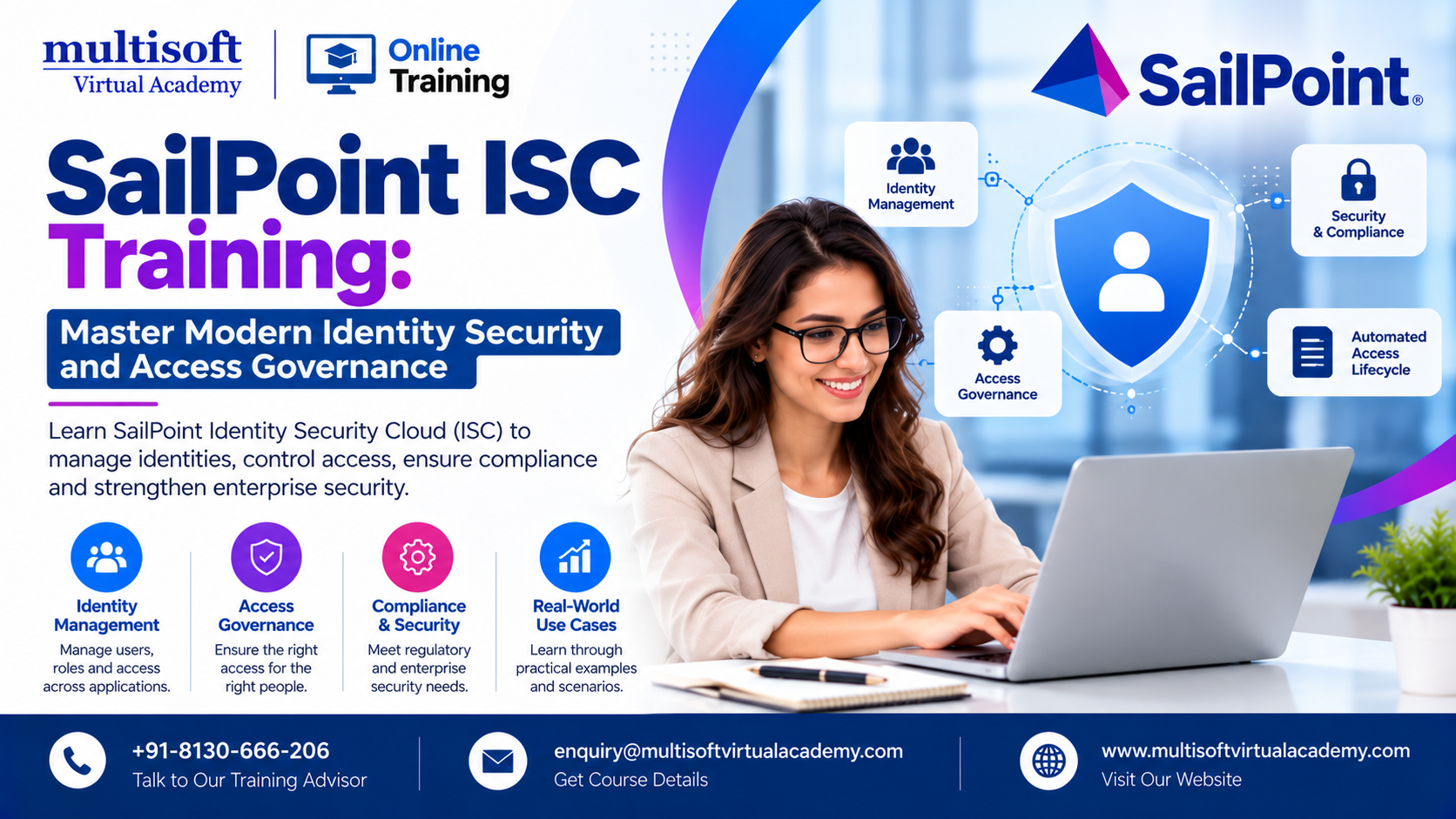
As organizations move rapidly toward cloud applications, hybrid infrastructure, remote workforces, and AI-powered business processes, controlling who can access what has become a critical cybersecurity priority. Traditional identity and access management approaches often struggle to provide the visibility, automation, and governance required in modern enterprise environments. This is where SailPoint Identity Security Cloud (ISC) has become increasingly important.
SailPoint ISC Training helps professionals understand modern identity governance, access management, identity lifecycle automation, application onboarding, provisioning, compliance, and risk-based access decisions. The platform brings identity security capabilities into a cloud-based environment while providing organizations with tools to govern human and non-human identities across complex technology ecosystems.
SailPoint describes Identity Security Cloud as its next-generation identity security solution, building on capabilities associated with IdentityNow. Its current platform also incorporates AI and machine learning capabilities for access recommendations, role modeling, anomaly detection, and identity risk analysis.
For professionals working in IAM, cybersecurity, identity governance, cloud security, or enterprise applications, learning ISC can provide a strong foundation for working with modern identity security environments.
SailPoint Identity Security Cloud is a cloud-based identity security and governance platform designed to help organizations discover, manage, govern, and secure access across applications and infrastructure.
The platform supports identity lifecycle processes, access governance, application connectivity, compliance activities, workflows, analytics, and other identity security functions. SailPoint's platform architecture also emphasizes connectivity, extensibility, a unified identity data model, AI services, workflow infrastructure, policy enforcement, and identity insights.
For learners searching for SailPoint IdentityNow Training, it is important to understand the current terminology. Identity Security Cloud represents SailPoint's next-generation cloud platform, so many skills previously associated with IdentityNow are now discussed in the context of ISC.
This makes SailPoint ISC Training particularly relevant for professionals who want to update their cloud identity governance knowledge.
Identity environments are becoming increasingly complicated. Employees may require access to multiple SaaS applications, cloud platforms, databases, business systems, and collaboration tools. At the same time, organizations must control access for contractors, partners, service accounts, bots, and increasingly AI agents.
Manual identity administration can create several challenges, including excessive permissions, delayed provisioning, orphaned accounts, access inconsistencies, compliance gaps, and difficulty identifying risky access.
SailPoint ISC addresses many of these requirements through centralized identity governance and automation.
A structured SailPoint ISC Training Course can help learners understand how these capabilities work together rather than treating identity management as a collection of disconnected administrative tasks.
A comprehensive SailPoint Identity Security Cloud Training program should combine fundamental identity concepts with practical platform knowledge.
Training generally begins with the fundamentals of Identity Governance and Administration (IGA). Learners explore identities, accounts, entitlements, roles, applications, access policies, governance processes, and identity lifecycle concepts.
Understanding these fundamentals is important because ISC implementations depend on accurately connecting business requirements with technical access controls.
Identity lifecycle management is one of the most important areas of enterprise identity governance.
Learners can explore how access changes throughout an employee's lifecycle, including:
Automating these processes can reduce manual administration and help organizations minimize unnecessary or outdated access. SailPoint highlights lifecycle management as a way to automate joiner, mover, and leaver processes while reducing manual work and access creep.
Modern enterprises use a large number of business applications. Bringing these applications into an identity governance platform requires appropriate connectivity, account correlation, attribute mapping, entitlement discovery, and provisioning configuration.
SailPoint ISC Implementation Training can introduce learners to application onboarding concepts and the considerations involved in connecting applications to ISC.
SailPoint's current AI capabilities can also assist application onboarding by discovering enterprise applications and recommending source configurations.
Provisioning enables appropriate access to be provided to users based on approved requirements. Deprovisioning removes access when it is no longer required.
Training in SailPoint ISC Provisioning can help professionals understand how automated access workflows contribute to security and operational efficiency.
Proper provisioning also helps organizations implement least-privilege principles and reduce the risk associated with excessive permissions.
Access certification is a critical component of identity governance.
Organizations need to periodically review whether users still require their assigned applications, roles, and entitlements. Certification campaigns provide a structured mechanism for managers, application owners, and other authorized reviewers to evaluate access.
A strong SailPoint ISC Certification Training curriculum should explain certification concepts, review processes, approval decisions, remediation, and compliance reporting.
SailPoint's AI capabilities can also provide recommendations during certification by highlighting unusual access patterns and helping reviewers focus on potentially risky or unnecessary permissions.
Role management is another important subject for professionals pursuing SailPoint ISC Training.
Roles can help organizations align access with job responsibilities. Instead of managing every entitlement individually, organizations can use role-based approaches to establish appropriate access patterns.
SailPoint's current Access Modeling capabilities use AI and machine learning to analyze access patterns, identify potential roles, and continuously refine access models.
Training should therefore cover concepts such as:
These skills are particularly useful for identity architects, IAM engineers, security administrators, and implementation professionals.
Automation is central to modern identity management.
Organizations can use workflows to automate repetitive processes such as access requests, approvals, lifecycle events, notifications, and remediation activities.
SailPoint Identity Security Cloud includes workflow infrastructure designed to automate identity processes and support dynamic workflows and approvals.
Professionals taking SailPoint ISC Administrator Training should understand how workflow automation can improve consistency while reducing manual identity administration.
One of the most important developments in modern identity security is the use of artificial intelligence and machine learning.
SailPoint currently incorporates AI capabilities into Identity Security Cloud for analyzing identity and access data, detecting anomalies, recommending access changes, supporting role optimization, and improving access decisions.
This creates opportunities for professionals interested in AI-driven Identity Security.
Examples include:
SailPoint has also expanded its focus beyond traditional human identities. Current platform developments address machine identities and AI agents, reflecting the growing importance of non-human identity governance.
The identity landscape is changing rapidly. Organizations now manage service accounts, bots, applications, machine identities, and AI agents in addition to employees.
These identities can access sensitive systems and data, but they may not follow traditional employee lifecycle processes.
Consequently, SailPoint Identity Security Cloud Training is becoming relevant to professionals who want to understand identity security across both human and non-human identities.
SailPoint's recent platform developments specifically address machine identities and AI-agent governance, demonstrating the industry's movement toward broader identity security rather than employee-only access management.
SailPoint ISC Training can be useful for professionals working in several technology and security roles.
Identity and Access Management professionals can strengthen their knowledge of cloud-based identity governance and modern access management.
Security professionals can learn how identity controls contribute to risk reduction, compliance, least privilege, and access visibility.
Administrators can develop practical knowledge of identity lifecycle management, application onboarding, access governance, certifications, and workflows.
Professionals involved in implementation and integration can benefit from understanding how ISC connects identity information, applications, workflows, and governance processes.
Architects can use ISC knowledge when designing enterprise identity governance strategies across cloud and hybrid environments.
Managers responsible for IAM programs can gain a better understanding of identity governance capabilities, implementation considerations, and operational requirements.
Traditional IAM training often focuses heavily on authentication, authorization, directory services, and access administration. While these remain important, modern identity security requires a broader governance perspective.
ISC training combines identity management with governance, lifecycle automation, access certification, analytics, workflows, application onboarding, and risk-based decision-making.
This broader approach helps professionals understand not just how access is granted, but also why access should be granted, who should approve it, how long it should remain active, and how potential risks should be identified.
A well-designed training program can help learners develop a combination of conceptual and practical skills.
Key areas include:
The combination of these skills can provide a stronger foundation for professionals pursuing roles in identity security and enterprise IAM.
Professionals preparing for SailPoint ISC Certification should avoid relying only on theoretical reading.
A practical learning strategy can include understanding identity governance fundamentals first, followed by platform navigation, lifecycle processes, application onboarding, access management, certification, roles, workflows, and troubleshooting.
Hands-on practice is especially valuable because enterprise identity governance involves interconnected components.
Learners should also follow current SailPoint documentation and training resources because the platform continues to evolve. SailPoint provides dedicated Identity University training paths, including identity security administrator training covering lifecycle management, compliance management, access modeling, and analytics.
Identity security continues to be an important area within enterprise cybersecurity. Professionals with relevant SailPoint knowledge may explore roles such as:
Career progression depends on practical experience, broader cybersecurity knowledge, technical capabilities, certifications, and the ability to work with enterprise identity environments.
For experienced professionals, combining SailPoint ISC Training with cloud platforms, cybersecurity, API integration, automation, and identity architecture can create a broader technical profile.
Identity governance is difficult to master through definitions alone. Professionals need to understand how identity data moves between systems, how applications are connected, how entitlements are managed, how access requests are evaluated, and how lifecycle events trigger changes.
Practical exercises can help learners understand the relationship between configuration and business requirements.
For example, a simple employee onboarding scenario can involve identity creation, source aggregation, account correlation, role assignment, access provisioning, approval workflows, and compliance considerations.
Working through such scenarios helps transform theoretical knowledge into implementation-oriented skills.
The future of identity security is moving toward continuous, intelligent, and risk-aware governance.
As enterprises adopt more SaaS applications, cloud infrastructure, automation, and AI agents, identity teams must govern a growing number of access relationships.
SailPoint's current platform direction reflects this shift toward adaptive identity security, AI-powered insights, machine identity governance, cloud entitlement governance, and protection for AI and non-human identities.
This means professionals who understand traditional IAM concepts while also developing cloud identity, automation, analytics, and AI-related skills can be better prepared for changing enterprise requirements.
SailPoint ISC Training offers a practical pathway for professionals who want to develop modern identity governance and cloud identity security skills. From identity lifecycle management and application onboarding to provisioning, access certification, role management, workflow automation, analytics, and AI-driven access intelligence, ISC provides a broad environment for understanding how organizations can manage identity and access more effectively. As enterprises increasingly adopt cloud applications, hybrid infrastructure, machine identities, and AI agents, identity security is becoming an even more important component of cybersecurity strategy. For learners seeking structured guidance, practical knowledge, and industry-oriented learning in this evolving domain, Multisoft Virtual Academy acts as a professional service provider for SailPoint ISC Training, helping learners develop relevant identity security and governance capabilities for modern enterprise environments.
| Start Date | End Date | No. of Hrs | Time (IST) | Day | |
|---|---|---|---|---|---|
| 03 Oct 2026 | 25 Oct 2026 | 24 | 06:00 PM - 09:00 PM | Sat, Sun | |
| 04 Oct 2026 | 26 Oct 2026 | 24 | 06:00 PM - 09:00 PM | Sat, Sun | |
| 10 Oct 2026 | 01 Nov 2026 | 24 | 06:00 PM - 09:00 PM | Sat, Sun | |
| 11 Oct 2026 | 02 Nov 2026 | 24 | 06:00 PM - 09:00 PM | Sat, Sun | |
Schedule does not suit you, Schedule Now! | Want to take one-on-one training, Enquiry Now! |
|||||






 Join our Live Instructor-Led online classes delivered by industry experts
 Let's Get Started