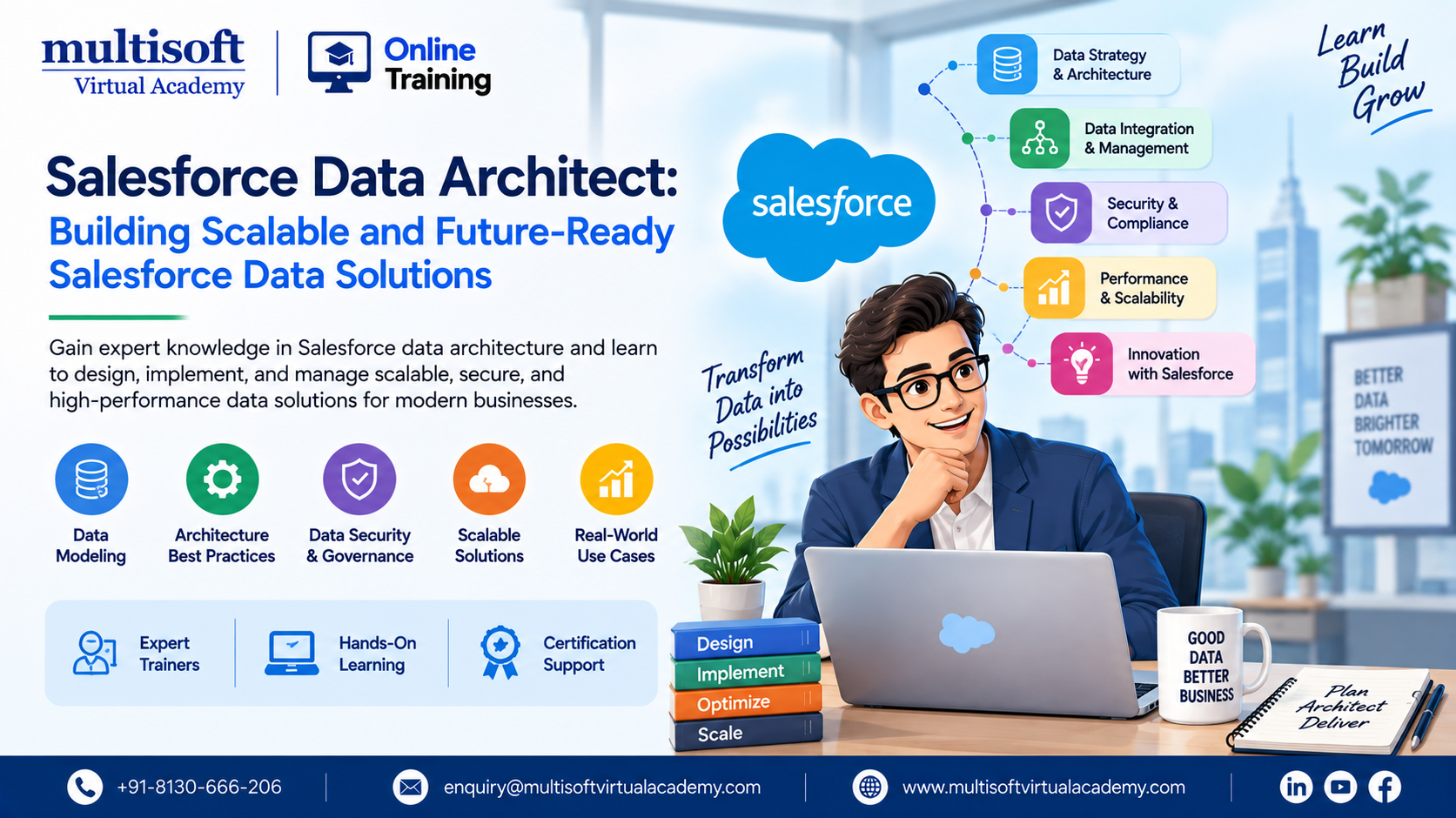
Modern businesses depend on data to understand customers, improve operations and make faster decisions. As organizations collect information from CRM platforms, websites, applications, marketing systems, data warehouses and other enterprise sources, managing that information effectively becomes increasingly important. This is where a Salesforce Data Architect plays a critical role.
A Salesforce Data Architect designs data structures and strategies that help organizations manage information efficiently across the Salesforce ecosystem. The role goes far beyond creating objects and fields. It involves data modeling, data governance, data quality, integration, security, migration, master data management and performance optimization.
Salesforce identifies Platform Data Architects as professionals who design scalable, high-performing solutions for enterprise data management. Their responsibilities include data modeling, master data management, data governance, data migration and large data volume considerations.
As Salesforce continues expanding its data and AI capabilities, organizations are also paying greater attention to Salesforce Data Cloud, now known as Data 360, along with real-time data activation, unified customer profiles and AI-ready data.
A Salesforce Data Architect is a specialist who plans how data should be structured, stored, accessed, integrated and governed within Salesforce and connected enterprise systems.
The architect studies business requirements and translates them into an effective Salesforce data architecture. This can include determining which Salesforce objects should be used, how relationships should be designed, how external systems should exchange information and how data quality should be maintained.
A strong Salesforce Data Architect considers both current requirements and future business growth. A solution that works for thousands of records may not perform effectively when an organization reaches millions of records. Therefore, scalability and performance are fundamental parts of Salesforce data architecture.
Salesforce's official certification guidance highlights areas such as database design, master data management, data governance, large data volumes, data migration and data quality as important areas for Platform Data Architects.
Poorly designed data architecture can create duplicate records, inconsistent customer information, slow queries, complex integrations and reporting problems. These issues can affect sales, marketing, customer service and management teams.
A well-planned Salesforce data architecture helps organizations:
The objective is not simply to store more data. The objective is to make business data reliable, accessible, secure and useful.
Data modeling is one of the most important responsibilities of a Salesforce Data Architect.
The architect determines how objects, fields and relationships should represent business processes. Depending on the requirements, the solution may involve standard objects, custom objects, master-detail relationships, lookup relationships and other Salesforce capabilities.
Effective Salesforce data modeling helps prevent unnecessary complexity while creating a structure that can support future business requirements.
Data governance establishes policies and practices for maintaining reliable and secure information.
A Salesforce Data Architect may work with business and IT teams to define rules for:
Strong governance becomes increasingly important as organizations connect Salesforce with multiple business systems.
Salesforce data migration is another major area of responsibility. Organizations frequently move information from legacy CRM platforms, databases or other enterprise applications into Salesforce.
A Salesforce Data Architect must evaluate source data, map fields, identify duplicates, determine transformation requirements and plan migration strategies.
The process can involve extraction, transformation, cleansing, validation and loading. Large migrations also require careful consideration of performance, data dependencies and deployment sequencing.
Salesforce's Data Architect exam guidance specifically includes data migration and large data volume considerations among the core areas of expertise.
Master Data Management, or MDM, focuses on maintaining consistent and trusted records across business systems.
For example, an organization may have customer information stored in Salesforce, an ERP platform, an e-commerce system and a marketing automation platform. Without a suitable strategy, the same customer may appear differently in each system.
A Salesforce Data Architect helps establish a reliable approach to customer, account, product and other critical business data.
High-quality data is essential for effective CRM operations.
Duplicate accounts, incomplete contact information, incorrect addresses and inconsistent naming conventions can reduce confidence in reports and business decisions.
A Salesforce Data Architect may establish validation rules, duplicate management processes, cleansing strategies and stewardship responsibilities to improve data quality.
Salesforce's architect learning resources also emphasize data quality, duplicate management and data management as important areas for data architecture expertise.
One of the most important developments in the Salesforce ecosystem is the evolution of Data Cloud into Data 360.
Salesforce describes Data 360 as a native data engine designed to connect, unify and activate enterprise data across Salesforce applications and agents. It can bring together data from different sources and help create a more complete view of the customer.
For Salesforce Data Architects, this creates new opportunities and responsibilities.
Instead of focusing only on CRM records, architects increasingly need to think about:
Salesforce has also highlighted the role of unified data in providing better context for AI-powered applications and Agentforce.
Artificial intelligence is changing how enterprises think about data architecture.
AI applications require reliable, relevant and well-governed information. If customer data is incomplete or inconsistent, AI-generated recommendations and automated actions can also become less reliable.
This means Salesforce Data Architects increasingly need to consider how enterprise data can support AI initiatives.
An effective architecture should help ensure that relevant information can be discovered, governed and delivered to the right applications and users.
The combination of Salesforce Data 360 and Agentforce is particularly important because Salesforce positions unified enterprise data as a foundation for providing context to AI-powered agents.
Enterprise organizations rarely use Salesforce in isolation. Salesforce may need to communicate with ERP systems, marketing platforms, payment systems, data warehouses, customer portals and other applications.
This makes Salesforce integration architecture an essential consideration.
A Salesforce Data Architect should understand:
The right integration strategy can reduce duplicate data movement and improve consistency across enterprise applications.
Large Data Volumes, often referred to as LDV, can introduce significant architectural challenges.
As record counts grow, organizations must carefully consider data storage, indexing, queries, sharing models, reporting requirements and migration strategies.
A Salesforce Data Architect needs to evaluate how data will behave as the organization grows rather than designing only for today's requirements.
Performance planning should therefore be part of the architecture process from the beginning.
Salesforce's official Platform Data Architect exam objectives include techniques for improving performance when migrating large data volumes and considerations for exporting Salesforce data.
For professionals interested in building a career in Salesforce architecture, the Salesforce Certified Platform Data Architect credential can demonstrate knowledge of enterprise data architecture.
Salesforce describes certified Platform Data Architects as professionals capable of designing scalable and high-performing Salesforce solutions for enterprise data management.
The certification path focuses on areas such as:
Salesforce also recommends combining practical experience, training and self-study when preparing for the certification.
Professionals should also keep their knowledge current because Salesforce regularly introduces platform updates and maintains certification requirements around product releases.
A successful Salesforce Data Architect needs a combination of technical knowledge, analytical thinking and communication skills.
Important technical areas include:
Technical expertise alone is not enough.
The architect must understand business requirements and explain technical decisions to stakeholders. Salesforce's official exam guidance specifically highlights the importance of communicating solutions and design trade-offs to business and IT stakeholders.
This means a good architect should be able to answer questions such as:
Although the roles can overlap, their primary focus may differ.
A Salesforce Data Architect concentrates heavily on data structures, data quality, governance, migration, integration and data management.
A Salesforce Solution Architect generally takes a broader view of the complete business solution, including applications, processes, integrations, security and technology decisions.
Both roles can work together to create scalable Salesforce implementations.
The Salesforce ecosystem is moving toward more connected, intelligent and data-driven architectures.
Some important areas to watch include:
Salesforce Data 360: Organizations are increasingly focused on unified data and activation across applications.
AI-ready data architecture: Reliable enterprise data is becoming increasingly important for AI applications and agents.
Real-time data: Businesses increasingly want information to move between systems faster so teams can respond to customer events quickly.
Data governance: As organizations connect more data sources, governance and security become increasingly important.
Zero-copy data strategies: Salesforce continues expanding approaches that allow organizations to work with external data while reducing unnecessary data duplication.
Cross-cloud architecture: Organizations increasingly need architects who can understand how Salesforce products and external enterprise systems work together.
These trends make data architecture a strategic business function rather than simply a technical implementation activity.
Every organization has different requirements. Therefore, there is no universal Salesforce data architecture model.
Before designing the architecture, organizations should evaluate:
A structured assessment helps architects select the right approach while avoiding unnecessary complexity.
Organizations increasingly rely on Salesforce for critical customer and business processes. As the amount and variety of enterprise data increase, architecture decisions can have a direct impact on productivity, customer experience and operational efficiency.
A skilled Salesforce Data Architect helps organizations move from disconnected information toward a structured and trusted data environment.
The value is not simply technical. Good architecture can support better decision-making, stronger data quality, improved scalability and more efficient business processes.
The role of a Salesforce Data Architect is becoming increasingly important as organizations move toward unified customer data, advanced analytics, connected applications and AI-powered business processes. From Salesforce data modeling and governance to data migration, master data management, integration and Data 360 strategies, architects need a broad combination of technical and business expertise.
For organizations and professionals looking to strengthen their Salesforce data architecture capabilities, Multisoft Virtual Academy provides specialized learning and professional training solutions designed to develop practical knowledge across Salesforce technologies, data architecture and emerging enterprise technology requirements. With the right training and hands-on approach, businesses and professionals can create more scalable, reliable and future-ready Salesforce data strategies.
| Start Date | End Date | No. of Hrs | Time (IST) | Day | |
|---|---|---|---|---|---|
| No schedule available ! | |||||
Schedule does not suit you, Schedule Now! | Want to take one-on-one training, Enquiry Now! |
|||||






 Join our Live Instructor-Led online classes delivered by industry experts
 Let's Get Started