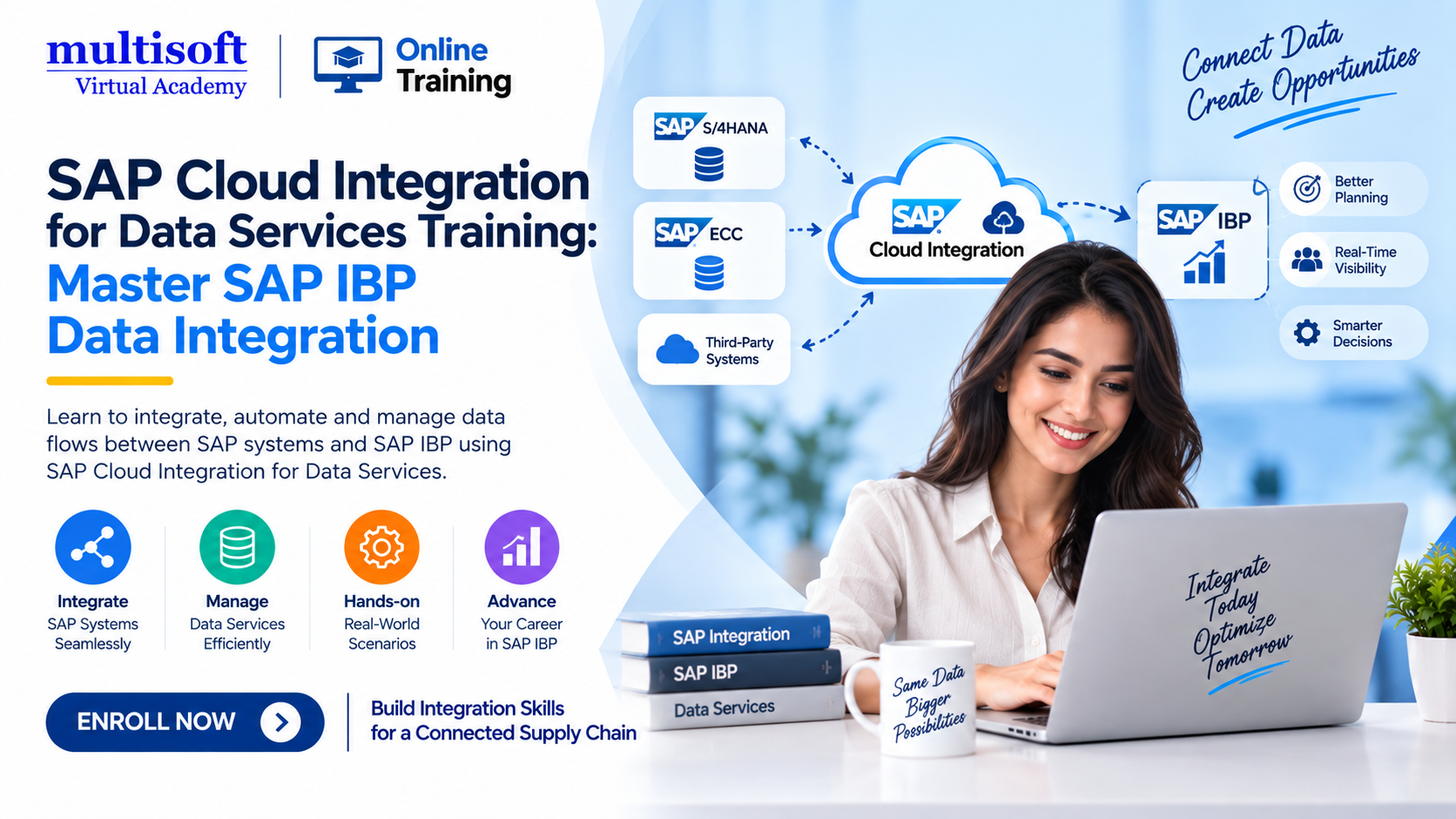
Modern enterprises depend on accurate, timely, and consistent data to support planning, analytics, supply chain operations, and business decisions. As organizations increasingly connect cloud applications with on-premise systems, the ability to integrate business data efficiently has become an essential SAP technology skill.
SAP Cloud Integration for Data Services (SAP CIDS) Training, also commonly associated with SAP CI-DS Training, helps professionals understand how data can be moved, transformed, scheduled, monitored, and integrated across enterprise landscapes. The technology has a particularly important role in SAP Integrated Business Planning (SAP IBP), where reliable master data and time-series data integration are fundamental to effective planning processes.
SAP describes Cloud Integration for data services as a cloud-based integration solution for batch and scheduled data integration between on-premise and cloud applications. Its primary positioning is around SAP IBP, including time-series and master-data integration.
For professionals looking to build practical expertise in SAP data integration, a structured SAP Cloud Integration for Data Services (SAP CIDS) Training program can provide an effective pathway from integration fundamentals to real-world implementation scenarios.
SAP Cloud Integration for Data Services is designed to facilitate data movement between different systems and applications. It can support integration scenarios involving SAP and non-SAP environments, particularly where data needs to be transferred into or out of SAP IBP.
Unlike a simple file-transfer mechanism, enterprise data integration often requires multiple activities. Data may need to be extracted from a source system, transformed into the required structure, validated, mapped to target fields, loaded into the destination, and monitored for errors.
This is where SAP CI-DS Training becomes valuable.
Learners can develop an understanding of how integration jobs are designed and executed, how source and target systems are connected, how transformations are applied, and how scheduled data loads can support recurring business processes.
SAP documentation also notes that CI-DS can connect with cloud applications using standard protocols such as SOAP, REST, and OData.
Data integration is no longer simply an IT back-office activity. It directly influences forecasting, supply chain planning, reporting, analytics, and operational decision-making.
Organizations using SAP IBP need dependable data flows between planning applications and their surrounding business systems. For example, master data such as products, locations, customers, suppliers, and resources may need to be synchronized. Time-series information may also need to move between operational systems and planning environments.
A well-designed integration process can help organizations:
For professionals, these requirements create opportunities to develop specialized skills in SAP data integration, SAP IBP integration, and cloud-based enterprise integration.
A comprehensive SAP Cloud Integration for Data Services Training program should go beyond theoretical concepts. Learners should understand how integration works in practical enterprise environments.
The training can begin with the architecture, terminology, components, and business purpose of SAP CI-DS.
Participants can learn:
This foundation helps learners understand how individual integration components work together.
One of the most important areas is SAP IBP Data Integration Training.
SAP IBP depends on reliable business information to support planning activities. Data integration can therefore become a critical part of an IBP implementation.
Training can cover concepts such as:
SAP Learning resources specifically reference CI-DS and Data Services for certain SAP IBP data-import scenarios.
A successful integration starts with understanding where data originates and where it needs to go.
During SAP CI-DS Training, professionals can learn how to analyze source structures and target requirements before designing integration jobs.
A source system might contain operational information, while the target application may require the same information in a different structure.
For example:
Source Data ? Extraction ? Transformation ? Mapping ? Validation ? Target Load
Understanding each stage helps integration professionals design more reliable data pipelines.
The ability to identify data types, field relationships, business rules, and transformation requirements is particularly important when working with complex enterprise environments.
Data rarely moves from one system to another without modification.
Different systems can use different:
Therefore, SAP Data Integration Training should provide practical exposure to transformation and mapping concepts.
Professionals can learn how to prepare data for target systems while maintaining consistency and business logic.
For example, a source system may use one product identifier while the target system requires another identifier. Integration logic must appropriately transform or map the value before the data reaches the target.
This makes mapping knowledge an important part of becoming an effective SAP integration professional.
Enterprise integration often involves recurring data transfers. Manually executing the same process every day or week can increase operational effort and introduce human error.
SAP CI-DS supports scheduled integration scenarios, making automation an important part of the learning journey.
A practical training program can explain:
Automated integration allows organizations to create repeatable processes rather than relying on manual intervention.
Understanding the architecture is essential for professionals working on real implementation projects.
SAP has described CI-DS as having two major architectural components: the Data Services Agent, which is installed on-premise and interfaces with source-side business data, and a cloud server component used for design-time ETL artifacts, data movement, and scheduling.
Training should therefore explain the relationship between these components and how data travels through the integration landscape.
Architecture knowledge becomes especially useful when professionals need to troubleshoot connectivity, authentication, data-transfer, or execution issues.
Creating an integration job is only one part of an integration professional's responsibility.
Production environments require continuous attention to failed jobs, incorrect mappings, unavailable systems, invalid data, authentication issues, and unexpected source changes.
SAP Cloud Integration Training can help learners understand how to approach these problems systematically.
A practical troubleshooting approach includes:
This structured approach can improve operational reliability and reduce unnecessary downtime.
Professionals searching for SAP Integration Suite Training may wonder how it relates to CI-DS.
SAP Integration Suite is a broader integration platform that connects applications, processes, events, and data across cloud and on-premise environments. It includes capabilities such as Cloud Integration, API Management, Event Mesh, and other integration services.
CI-DS has a more specific positioning. SAP states that it continues to be supported for SAP IBP use cases, with its current product direction focused on IBP-related time-series and master-data integration.
This distinction is important for professionals because choosing an integration technology should depend on the business scenario, architecture, application landscape, and integration requirements.
For non-IBP use cases, SAP recommends considering the broader SAP integration architecture and appropriate integration capabilities.
Professionals with experience in SAP integration can work across multiple roles and project environments.
Potential career paths include:
The actual role depends on an individual's background, project requirements, and broader SAP knowledge.
Candidates with experience in SAP IBP, SAP ERP, SAP S/4HANA, data integration, ETL, APIs, databases, or enterprise application integration may find CI-DS knowledge particularly relevant.
This training can be useful for professionals who want to develop or strengthen enterprise data integration capabilities.
It may be suitable for:
Basic knowledge of SAP systems, databases, data structures, or integration concepts can make the learning experience easier, although the exact prerequisites depend on the training format.
Integration concepts are much easier to understand when learners can work through realistic scenarios.
A practical SAP CI-DS Training Course should ideally include demonstrations and exercises covering:
Hands-on practice enables learners to understand not only what a feature does but also why and when it should be used.
SAP IBP remains an important environment for planning-related data integration. As businesses seek better forecasting, supply chain visibility, and data-driven planning, reliable integration between planning and operational systems becomes increasingly important.
At the same time, SAP's broader integration strategy continues to emphasize cloud integration, APIs, event-driven architectures, and connected business processes.
SAP Integration Suite is positioned as an enterprise integration platform that supports connections across cloud and on-premise applications, processes, events, and data.
For professionals, this means that learning CI-DS should not be viewed in isolation. Building broader knowledge of SAP IBP, SAP BTP, SAP Integration Suite, APIs, data integration, and cloud architecture can create a stronger long-term skill set.
A focused training program can help professionals develop several valuable capabilities.
Learners understand how business data travels between applications and how integration processes support operational workflows.
CI-DS skills can complement SAP IBP expertise by helping professionals understand how master data and time-series data reach planning environments.
Hands-on integration exercises can help professionals identify common connectivity, mapping, transformation, and data-quality problems.
Professionals can learn how scheduled data processes reduce dependence on repetitive manual activities.
Specialized integration skills can complement existing SAP, data, development, and consulting experience.
SAP Cloud Integration for data services is a cloud-based integration capability used for batch and scheduled data integration, with a strong focus on SAP IBP use cases such as master data and time-series integration.
Yes. SAP identifies SAP IBP as the primary use case for CI-DS and states that the solution continues to be supported for IBP scenarios.
No. They are related to SAP's broader integration ecosystem but have different positioning and capabilities. SAP Integration Suite is a broader integration platform, while CI-DS is specifically positioned around data integration, particularly for SAP IBP.
SAP consultants, IBP professionals, integration developers, data professionals, technical consultants, and IT professionals can consider learning CI-DS depending on their career objectives and project requirements.
Yes. CI-DS is designed for batch and scheduled data integration, making automation an important part of its use cases.
As enterprises continue moving toward connected cloud ecosystems and data-driven planning, integration expertise is becoming an increasingly valuable professional capability. SAP Cloud Integration for Data Services (SAP CIDS) Training can help professionals understand practical data movement, transformation, scheduling, monitoring, and SAP IBP integration concepts while building a foundation for broader SAP integration skills. For learners seeking structured, practical, and career-focused SAP CI-DS Training, Multisoft Virtual Academy provides specialized learning programs designed to help professionals strengthen their SAP technology knowledge and develop relevant skills for modern enterprise integration environments.
| Start Date | End Date | No. of Hrs | Time (IST) | Day | |
|---|---|---|---|---|---|
| No schedule available ! | |||||
Schedule does not suit you, Schedule Now! | Want to take one-on-one training, Enquiry Now! |
|||||






 Join our Live Instructor-Led online classes delivered by industry experts
 Let's Get Started