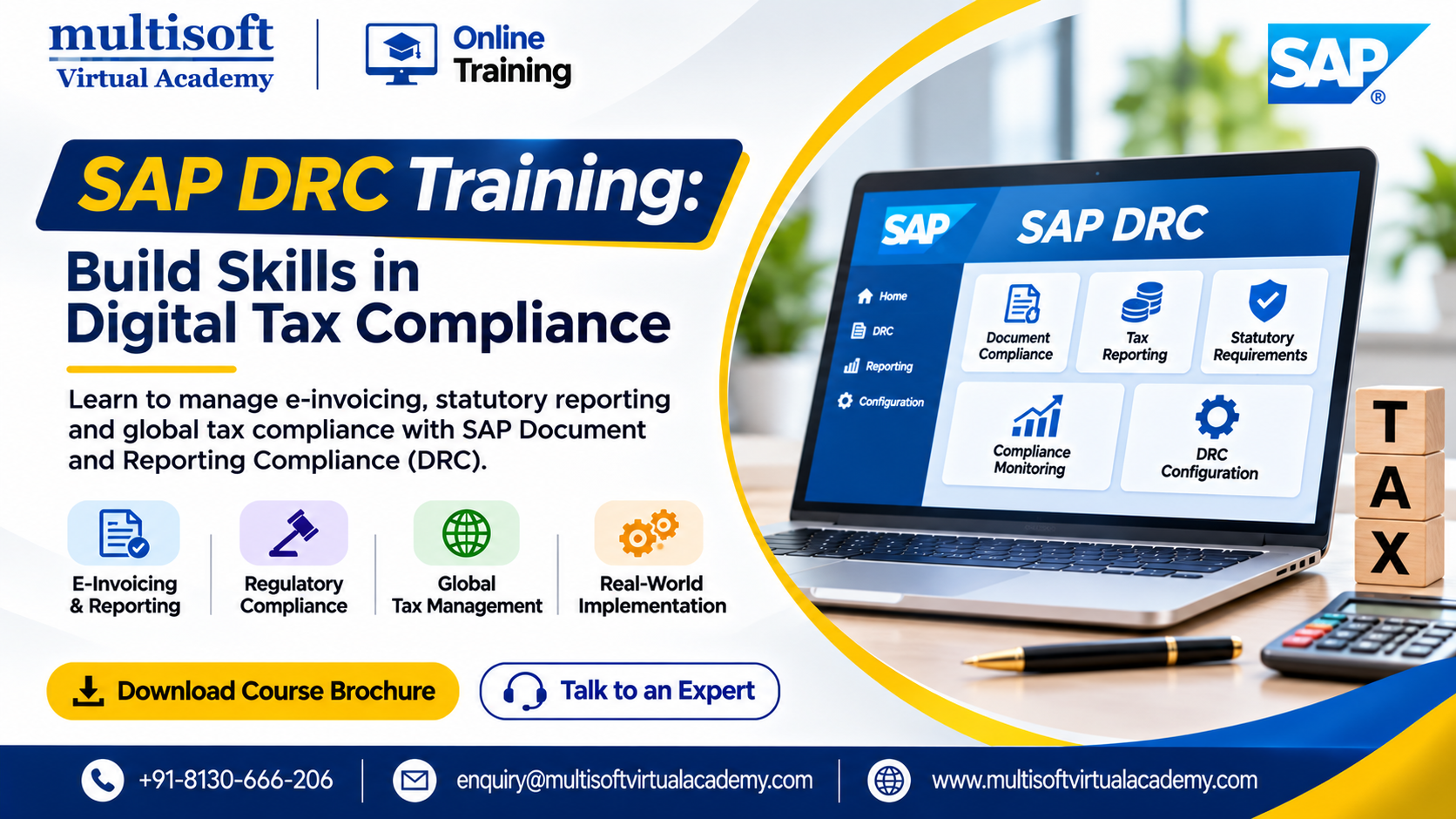
Digital transformation has changed how organizations manage financial transactions, tax documentation, and regulatory reporting. Governments across the world are increasingly adopting electronic invoicing systems, digital tax reporting, and automated document verification. Businesses must adapt to these requirements while maintaining accurate financial records and meeting regulatory deadlines.
SAP Document and Reporting Compliance (DRC) helps organizations manage supported electronic document and statutory reporting processes within their SAP environments. It provides capabilities for handling regulatory documents, communicating with external platforms, and monitoring compliance-related activities.
SAP DRC Training introduces professionals to the technology and business processes behind digital compliance management. It helps learners understand electronic invoicing, statutory reporting, document processing, system integration, and configuration concepts. For SAP consultants and finance professionals, this knowledge can be useful when supporting organizations through tax automation and regulatory transformation projects.
SAP Document and Reporting Compliance is a solution designed to support organizations in meeting electronic document exchange and statutory reporting requirements.
Businesses operating in different countries face different compliance obligations. Some jurisdictions require electronic invoices to be submitted to government platforms, while others require periodic tax reports or digital transaction records. Managing these requirements across multiple systems can become complicated without an organized approach.
SAP DRC supports relevant compliance processes by connecting business information with electronic document and reporting workflows.
Its capabilities may include:
The exact capabilities depend on the country, SAP release, deployment model, and configured business scenario.
Regulatory compliance is no longer limited to preparing tax returns and maintaining financial documents. Many authorities now require organizations to exchange transaction information electronically and follow specific technical standards.
SAP DRC helps businesses address supported requirements through structured digital processes.
Manual invoice preparation and submission can involve repetitive activities. Electronic document processing helps organizations manage relevant information through defined workflows.
This can support more consistent document creation, validation, submission, and status monitoring.
Multinational businesses must manage different tax regulations across their operating locations. Each country may have its own document formats, reporting deadlines, and submission procedures.
SAP DRC supports available country-specific scenarios, helping organizations manage relevant compliance processes within their SAP landscape.
Compliance reporting depends on accurate financial and transactional information. Incorrect tax details, incomplete customer records, or inconsistent invoice data can create processing problems.
Structured validation and monitoring processes help teams identify issues and investigate discrepancies.
Organizations need to know whether electronic documents and reports have been successfully processed. Monitoring capabilities help responsible teams review document statuses and identify items that require attention.
A professional SAP DRC Training Course should explain the solution's core concepts and demonstrate how they are used in business scenarios.
Learners begin by understanding the purpose of Document and Reporting Compliance and its role in SAP's digital compliance environment.
Topics may include:
This foundation helps participants understand why organizations use DRC and how it supports financial and regulatory processes.
Understanding system architecture is important for professionals involved in implementation, configuration, and support.
Training may introduce the relationship between SAP S/4HANA, SAP Business Technology Platform (BTP), DRC services, and external regulatory systems.
Important learning areas include:
Learners should understand that architecture and integration requirements can vary according to the organization's SAP environment.
Electronic invoicing is one of the major areas associated with SAP DRC. It involves preparing invoice information in a required digital format and exchanging it with the relevant recipient or authority.
A course may cover:
For example, an organization may create a customer invoice in SAP S/4HANA and need to submit the corresponding electronic document to an authorized government platform. DRC-related workflows help manage supported activities in this process.
Statutory reporting requires businesses to prepare and submit financial or tax-related information according to applicable regulations.
Training may introduce reporting activities such as VAT-related reporting, audit reports, Intrastat-related scenarios, and other supported country-specific requirements.
Learners can explore report preparation, execution, validation, monitoring, and correction procedures.
Understanding statutory reporting is particularly useful for finance professionals and consultants working with organizations that operate in regulated markets.
Configuration knowledge is important when implementing or maintaining DRC-related business scenarios.
Depending on the system environment, a training program may cover:
Practical exercises can help participants understand how configuration settings influence document processing and reporting workflows.
Electronic document processing may encounter issues such as missing information, incorrect formatting, validation failures, or communication errors.
Professionals must understand how to investigate these issues and follow the appropriate correction procedures.
Training may include document status analysis, error identification, correction activities, resubmission concepts, and monitoring procedures.
These skills can be useful for implementation teams as well as application support professionals.
Understanding the complete document lifecycle helps learners connect individual SAP DRC features with business requirements.
Consider a company that generates customer invoices through SAP S/4HANA and must follow an electronic invoicing requirement.
The business creates an invoice through its regular sales and financial processes. The relevant customer, tax, and transaction information is recorded in the SAP system.
The required invoice information is processed to prepare an electronic document according to the applicable country-specific format.
The document is checked against relevant validation requirements. Missing or inconsistent information may need to be corrected before submission.
The electronic document is sent through the configured communication process to the relevant government authority or external recipient.
The organization receives a response or processing status. Depending on the regulatory scenario, the document may be accepted, rejected, or require additional action.
Responsible teams review document statuses, investigate errors, and complete the required correction or reconciliation activities.
This process illustrates a general electronic document workflow. Actual steps depend on the relevant country regulations and SAP implementation.
Implementing SAP DRC requires coordination between technical teams, finance departments, tax specialists, and business stakeholders. Consultants must understand both the regulatory requirements and the organization's existing SAP landscape.
The first step is identifying the organization's compliance obligations. Consultants need to understand the countries involved, required electronic documents, reporting responsibilities, and business processes.
Different countries follow different electronic invoicing and reporting models. Consultants must identify applicable formats, validation rules, submission procedures, and supported SAP capabilities.
After analyzing business requirements, implementation teams determine how relevant DRC processes should operate. Configuration and solution design must consider the SAP release, deployment model, integration requirements, and country-specific functionality.
DRC-related processes may involve SAP S/4HANA, SAP BTP services, and external platforms. Consultants need to understand the information exchanged between these systems and the technical dependencies involved.
Testing confirms whether the electronic documents and reporting processes work according to business requirements. Scenarios may include successful submissions, rejected invoices, missing data, and communication failures.
After implementation, organizations need processes for monitoring compliance activities and resolving operational issues. Support teams may investigate document errors, review system messages, and coordinate corrections with relevant departments.
SAP DRC can be useful for organizations that need to manage electronic document exchange and statutory reporting requirements.
Manufacturing: Manufacturing businesses handle sales invoices, supplier documents, and financial transactions across multiple locations. Digital compliance workflows can support relevant reporting and document exchange activities.
Retail and e-commerce: Retailers generate large volumes of transactions and may need structured electronic invoicing and tax reporting processes.
Information technology: Software and technology companies operating across different markets may need to manage country-specific invoice and reporting requirements.
Telecommunications: Telecom organizations handle recurring billing and financial transactions that may be connected with electronic invoicing and reporting obligations.
Banking and financial services: Financial institutions operate under regulatory requirements and may use relevant SAP capabilities to support selected reporting processes.
Multinational enterprises: Organizations operating in multiple countries may benefit from a structured approach to managing different compliance scenarios within their SAP environments.
The specific DRC functionality used by an organization depends on local regulations and its SAP landscape.
SAP DRC training is relevant to professionals who work with financial systems, tax processes, regulatory reporting, or SAP implementation projects.
Basic SAP knowledge and familiarity with accounting or financial processes can be helpful. Beginners should start with the fundamentals before moving into advanced configuration and implementation topics.
Organizations implementing digital tax and compliance solutions require professionals who understand financial processes and enterprise applications.
SAP DRC knowledge can complement career opportunities such as:
Career opportunities depend on professional experience, implementation knowledge, technical skills, and employer requirements.
Training can help learners develop foundational knowledge, but practical exposure to SAP systems and real business scenarios is important for building professional capability.
Choosing the right course can make a difference in how effectively learners understand the solution.
Evaluate course coverage: Look for a syllabus covering DRC fundamentals, electronic invoicing, statutory reporting, architecture, configuration, and troubleshooting.
Prioritize practical learning: A course with guided examples and business scenarios can help learners understand how compliance workflows operate.
Check SAP version coverage: Confirm whether the program covers the relevant SAP S/4HANA release and deployment environment.
Review trainer expertise: Experienced trainers should be able to explain technical concepts alongside their business applications.
Understand integration topics: Check whether the course introduces relevant SAP BTP concepts and external platform communication.
Confirm certification information: Clarify whether the program offers a course-completion certificate or prepares learners for a separate SAP certification assessment.
SAP DRC stands for SAP Document and Reporting Compliance. It supports electronic document processing and statutory reporting requirements in supported SAP environments.
The training helps professionals understand electronic invoicing, document exchange, statutory reporting, configuration, integration, and compliance monitoring.
SAP provides DRC capabilities for supported SAP environments, including SAP S/4HANA. The available functions depend on the deployment model, software release, and country requirements.
SAP provides India-specific electronic invoicing capabilities within its compliance offerings. Organizations should confirm the applicable solution, integration requirements, and current regulatory scope before implementation.
SAP Finance knowledge can be helpful because many compliance processes involve invoices, tax information, and financial transactions. However, the required background depends on the course level and professional role.
It can help develop foundational knowledge for SAP compliance-related roles. Becoming an effective consultant also requires practical experience, business process understanding, and knowledge of the relevant regulatory environment.
Digital compliance is becoming an important part of enterprise financial management. SAP Document and Reporting Compliance helps organizations manage supported electronic invoicing, statutory reporting, document exchange, and regulatory workflows through their SAP environments. Developing knowledge of DRC architecture, SAP S/4HANA integration, configuration, country-specific requirements, and troubleshooting can help professionals prepare for digital tax transformation and implementation projects. A course with practical examples and relevant business scenarios can provide a strong starting point for developing these skills. Multisoft Virtual Academy offers SAP DRC Training for professionals who want to build their understanding of electronic invoicing, statutory reporting, and SAP compliance solutions through structured learning.
| Start Date | End Date | No. of Hrs | Time (IST) | Day | |
|---|---|---|---|---|---|
| No schedule available ! | |||||
Schedule does not suit you, Schedule Now! | Want to take one-on-one training, Enquiry Now! |
|||||




 Join our Live Instructor-Led online classes delivered by industry experts
 Let's Get Started
