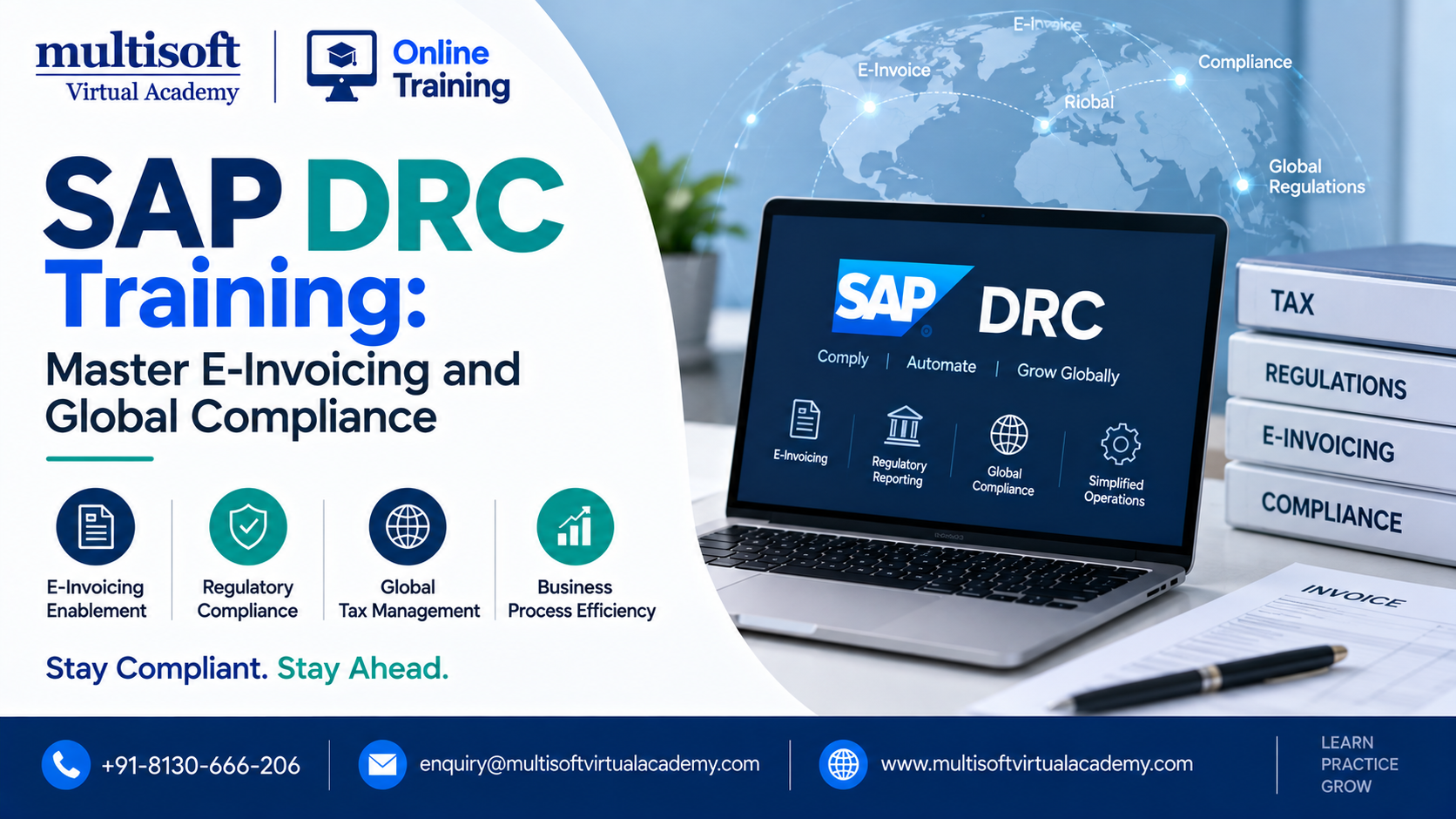
As businesses expand across countries and tax regulations become increasingly digital, managing electronic invoices, statutory reports and regulatory requirements manually is becoming difficult. Organizations need reliable systems that can automate compliance processes while reducing errors and improving visibility. This is where SAP DRC Training is becoming increasingly valuable for SAP professionals, finance teams, tax specialists and consultants.
SAP Document and Reporting Compliance, commonly known as SAP DRC, helps organizations create, process, exchange and monitor electronic documents and statutory reports. It supports businesses in meeting local legal obligations while creating a more standardized approach to global compliance. SAP positions DRC as a solution for real-time, periodic and ad hoc compliance mandates and for moving organizations toward more automated compliance processes.
For professionals looking to strengthen their SAP careers, learning SAP DRC Training can provide valuable knowledge of e-invoicing, e-reporting, tax compliance, electronic document processing and SAP S/4HANA integration.
SAP Document and Reporting Compliance is an SAP solution designed to help organizations manage electronic documents and statutory reporting requirements. Instead of treating compliance as a completely manual activity, organizations can use DRC to create, process, monitor and submit relevant information electronically.
The solution can support different compliance scenarios depending on the country, business process and regulatory requirement. SAP documentation highlights capabilities for electronic document processing and statutory reporting as well as integration with external communication partners and tax authorities.
This makes SAP DRC particularly relevant as governments worldwide continue introducing digital tax reporting and e-invoicing mandates.
The global movement toward digital taxation is increasing the demand for professionals who understand automated compliance processes. Businesses operating internationally must frequently adapt to different invoice formats, reporting requirements, tax authority interfaces and submission timelines.
SAP DRC Training helps professionals understand how these requirements can be managed within an SAP environment. Instead of focusing only on theoretical compliance concepts, effective training should connect business requirements with SAP configuration, electronic document processing, monitoring and integration.
Current SAP developments also demonstrate why this knowledge is relevant. SAP continues to expand DRC capabilities around global e-invoicing and statutory reporting requirements. In 2026, for example, SAP has highlighted changing electronic invoicing requirements across markets including Belgium, Brazil, Poland, the UAE and France.
A comprehensive SAP DRC Training program can cover several technical and functional areas. These topics help learners understand the complete compliance lifecycle.
Training generally begins with the fundamentals of SAP Document and Reporting Compliance. Learners understand:
Understanding these fundamentals creates a strong foundation for more advanced implementation topics.
SAP e-Invoicing is one of the most important areas associated with digital compliance. E-invoicing involves electronically creating and exchanging invoice information according to requirements established by tax authorities or business networks.
With SAP DRC, organizations can automate relevant invoice processes and communicate with external platforms depending on the country and supported scenario.
Professionals learning SAP DRC should understand invoice generation, validation, submission, response handling, error correction and monitoring.
Another important area is SAP e-Reporting. Organizations increasingly need to provide transaction and financial information electronically to government authorities.
Training can help professionals understand how statutory information is prepared, transformed and submitted while maintaining appropriate compliance controls.
SAP DRC supports statutory reporting scenarios and can help organizations manage reporting requirements through a more standardized framework.
Understanding SAP S/4HANA DRC integration is essential for professionals working on modern SAP landscapes.
SAP DRC can integrate with SAP S/4HANA, SAP S/4HANA Cloud and other SAP business systems depending on the required compliance scenario. SAP documentation describes integration between DRC and SAP S/4HANA, SAP S/4HANA Cloud Public Edition, SAP ERP and several other SAP products.
Training should therefore explain how business transactions move from the source SAP system through the compliance process and ultimately to external authorities or business partners.
The SAP Document and Reporting Compliance Cloud Edition is particularly important for organizations adopting cloud-based compliance capabilities.
The cloud edition provides services that can support electronic document exchange and statutory reporting. Depending on the business scenario, organizations may integrate DRC Cloud Edition with SAP business systems or use SAP Integration Suite where appropriate.
Professionals who understand both traditional SAP compliance processes and cloud-based DRC architecture can be better prepared for modern SAP transformation projects.
SAP's current documentation also includes cloud edition capabilities such as monitoring, communication settings, process management, extensibility, scheduling and digital-signature-related functionality.
India is an important market for SAP DRC because of its digitally enabled GST compliance ecosystem.
Organizations subject to Indian e-invoicing requirements need to manage invoice registration and obtain the appropriate Invoice Reference Number through the applicable government ecosystem. SAP documentation describes DRC-related capabilities for Indian e-invoicing and electronic waybill processes.
This makes SAP DRC Training for India, SAP GST e-Invoicing Training and SAP DRC e-Invoice Training relevant search areas for professionals working with Indian SAP implementations.
Training can cover concepts such as:
SAP has also documented migration considerations for customers moving from legacy electronic invoice integration toward DRC Cloud Edition.
One of the major trends influencing tax technology is the movement toward Continuous Transaction Controls (CTC).
Under traditional models, organizations may prepare tax reports periodically. CTC models can require transaction information to be reported, validated or cleared closer to the time of the transaction.
SAP describes DRC as helping organizations transition from periodic statutory reporting toward continuous transaction controls and evolving legal mandates.
For SAP consultants and tax technology professionals, understanding CTC concepts can therefore complement SAP DRC knowledge and create a broader understanding of digital tax compliance.
Peppol e-invoicing is another increasingly relevant topic for professionals working with international electronic document exchange.
Peppol provides a framework for exchanging electronic business documents through participating service providers and standardized processes. SAP documentation includes integration scenarios involving Peppol Exchange and DRC Cloud Edition.
A well-designed SAP DRC Training program can introduce learners to:
This knowledge can be particularly useful for professionals supporting multinational SAP environments.
Learning SAP DRC implementation requires more than understanding individual configuration screens. Professionals should understand the complete business and technical flow.
A typical implementation learning path can include:
Business Requirement ? Country/Region Requirement ? Compliance Scenario ? SAP Configuration ? Document Creation ? Validation ? Transformation ? Submission ? Authority Response ? Monitoring ? Error Resolution
This end-to-end perspective helps consultants identify problems more efficiently.
SAP documentation notes that different countries and compliance scenarios can require different integration approaches. Some scenarios may use SAP DRC Cloud Edition while others can involve SAP Integration Suite or country-specific services.
There are several reasons professionals may consider SAP DRC Training Online or instructor-led SAP DRC learning.
Learners gain practical knowledge of how tax compliance is integrated with business processes.
DRC knowledge complements SAP S/4HANA Finance and other enterprise processes where electronic documents and statutory reporting are important.
Professionals can understand configuration, integration, monitoring and troubleshooting concepts.
SAP DRC knowledge can be relevant to SAP consultants, finance professionals, tax technology specialists, functional consultants, solution architects and compliance professionals.
Because DRC supports country-specific compliance scenarios, learners can develop a broader understanding of international e-invoicing and statutory reporting requirements.
SAP DRC Training can be suitable for professionals from several backgrounds, including:
Previous experience with SAP S/4HANA, SAP Finance, taxation or enterprise integration can be helpful, although the appropriate prerequisites depend on the training level.
Organizations increasingly need professionals who can connect finance, taxation, technology and regulatory compliance. This combination makes SAP DRC knowledge useful for people who want to specialize in SAP compliance transformation.
A professional who understands only the finance process may not fully understand the technical integration requirements. Similarly, a technical professional may need stronger knowledge of tax and statutory reporting processes.
SAP DRC Training bridges these areas by introducing the relationship between business transactions, electronic documents, regulatory requirements, integrations and reporting.
Professionals can further strengthen their profiles by combining DRC expertise with SAP S/4HANA Finance Training, SAP Integration Suite, SAP BTP, tax technology, e-invoicing and country-specific compliance knowledge.
The quality of training matters considerably. A strong program should not focus entirely on theoretical presentations.
Effective learning should combine:
Practical exercises can help learners understand how compliance documents move through the system and how errors are identified and resolved.
Digital tax transformation is not slowing down. Governments are continuing to introduce or expand electronic invoicing and digital reporting frameworks. Businesses therefore need scalable compliance processes that can adapt to changing regulatory requirements.
SAP's current DRC roadmap and documentation reflect this broader transformation toward automated electronic documents, statutory reporting, monitoring and global compliance.
Recent SAP initiatives also show active attention to emerging country requirements. For example, SAP has highlighted DRC capabilities related to Singapore's InvoiceNow and GST InvoiceNow developments as well as upcoming e-invoicing requirements in the UAE and Oman.
Consequently, professionals who develop expertise in SAP DRC, e-invoicing, e-reporting and continuous transaction controls can position themselves for roles connected with the growing digital compliance ecosystem.
As electronic invoicing, statutory reporting and digital tax mandates continue to evolve, organizations need professionals who can manage compliance requirements with accuracy, efficiency and technical confidence. SAP DRC Training provides an opportunity to understand electronic documents, e-invoicing, e-reporting, SAP S/4HANA integration, statutory reporting, Peppol, GST compliance and emerging continuous transaction control models. For professionals and organizations seeking structured learning, practical guidance and industry-focused SAP compliance knowledge, Multisoft Virtual Academy can be a valuable service provider for developing SAP DRC capabilities and preparing learners to work with modern digital compliance environments.
| Start Date | End Date | No. of Hrs | Time (IST) | Day | |
|---|---|---|---|---|---|
| No schedule available ! | |||||
Schedule does not suit you, Schedule Now! | Want to take one-on-one training, Enquiry Now! |
|||||






 Join our Live Instructor-Led online classes delivered by industry experts
 Let's Get Started