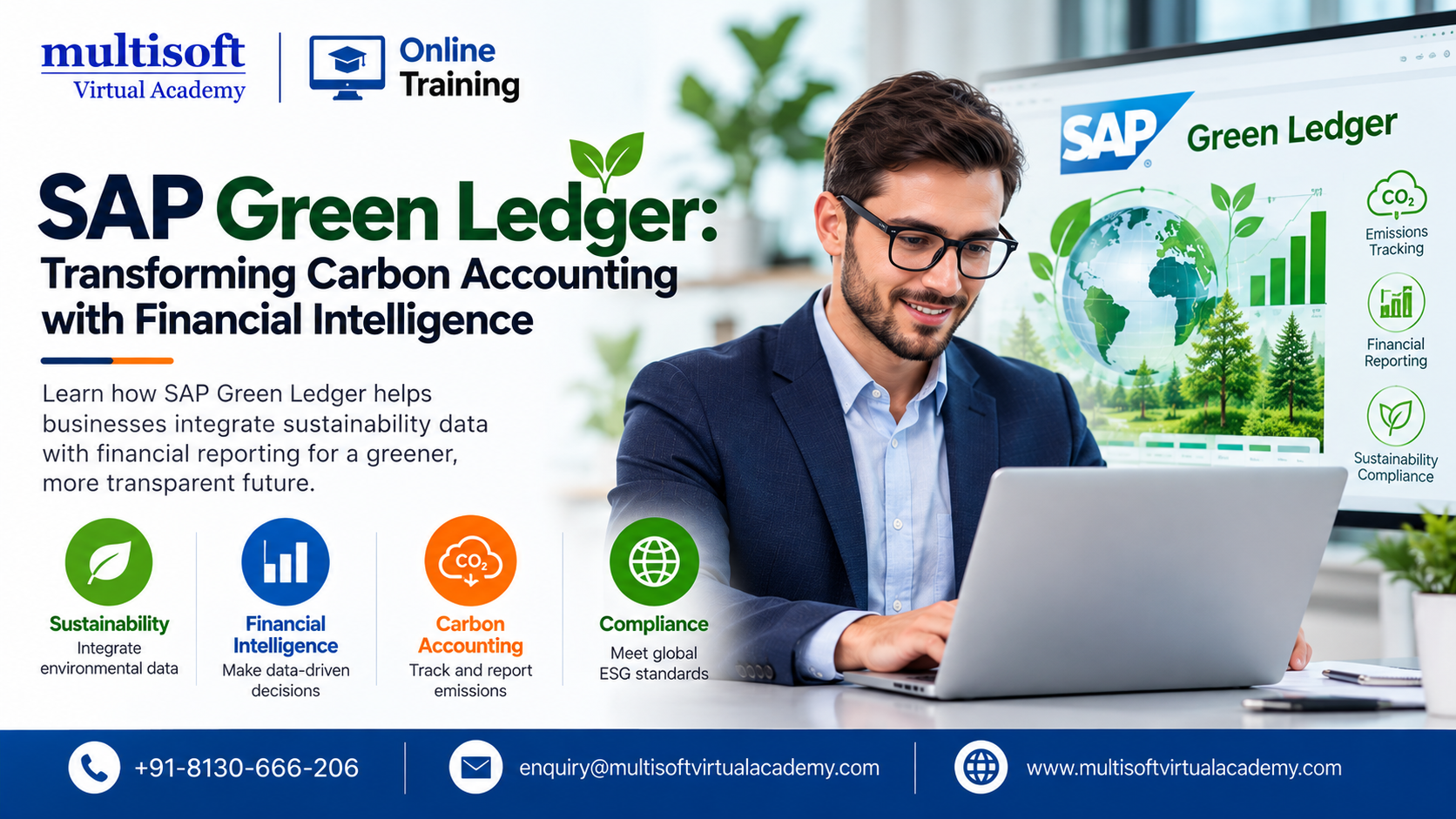
Sustainability is rapidly becoming a core business priority rather than a separate environmental initiative. Organizations across industries are under increasing pressure to measure greenhouse gas emissions, improve transparency, meet sustainability reporting requirements, and connect environmental performance with financial outcomes. As companies move toward more data-driven sustainability strategies, SAP Green Ledger is emerging as an important solution for integrating carbon accounting with financial accounting.
Traditional sustainability reporting often depends on aggregated environmental data collected from multiple systems. While this approach can provide an overall view of emissions, it may not offer the transaction-level visibility required to understand where carbon is generated, how it affects business performance, and which operational decisions can reduce emissions.
SAP Green Ledger addresses this challenge by connecting carbon information with financial data and business processes. According to SAP, the solution runs on SAP Business Technology Platform and integrates with SAP S/4HANA Cloud, enabling organizations to align carbon and financial accounting and analyze carbon impact using financial dimensions.
SAP Green Ledger is a carbon accounting solution designed to bring environmental and financial information closer together. It applies accounting principles and financial structures to carbon data, allowing organizations to analyze emissions alongside financial information.
Instead of viewing carbon emissions only as sustainability metrics, organizations can use carbon information in business planning, allocation, reporting, forecasting, and decision-making.
The solution can connect carbon quantities with dimensions such as:
This creates a more granular view of an organization's carbon impact and helps finance and sustainability teams work from more consistent information.
SAP describes Green Ledger as a way to track, measure, and report carbon impact at the transaction level while aligning carbon and financial data.
Businesses are moving beyond basic carbon measurement. They increasingly need to understand the financial implications of emissions and integrate sustainability into everyday business decisions.
For example, an organization may discover that a particular product generates significant Scope 2 or Scope 3 emissions. Knowing the emissions number is useful, but management also needs to understand its effect on product profitability, procurement costs, supply-chain decisions, and future investments.
This is where SAP carbon accounting becomes strategically important.
By connecting carbon and financial information, organizations can move from simply asking:
to more valuable questions such as:
This approach can support more informed sustainability planning while helping finance, operations, procurement, and sustainability teams work with connected information.
Carbon accounting involves measuring and managing greenhouse gas emissions generated by business activities. It provides the foundation for understanding an organization's environmental footprint and tracking progress toward climate goals.
The three major emission categories are generally:
Scope 1 covers direct greenhouse gas emissions from sources owned or controlled by an organization. Examples include emissions from company-operated facilities, industrial processes, and owned vehicles.
Scope 2 relates to indirect emissions associated with purchased energy, such as electricity, steam, heating, or cooling.
Scope 3 includes other indirect emissions throughout the value chain. These can involve purchased goods, transportation, business travel, use of sold products, and other upstream or downstream activities.
Managing Scope 3 emissions can be particularly challenging because organizations often depend on information from suppliers and external business partners.
A connected carbon accounting software environment can help organizations establish stronger data flows and improve visibility across their operations and value chains.
One of the key concepts behind SAP Green Ledger is the alignment of carbon information with financial accounting structures.
For example, a business transaction may already generate a financial accounting entry containing information such as the company code, cost center, profit center, material, or other financial dimensions.
Carbon information can be associated with relevant business activities and analyzed using corresponding financial dimensions.
SAP Learning explains that Green Ledger can record CO2 consumption in tons and post carbon information using financial dimensions, enabling organizations to evaluate carbon footprints alongside financial information.
This creates an additional carbon perspective alongside conventional financial accounting.
The result is greater visibility into questions such as:
A successful SAP Green Ledger implementation requires more than simply configuring a software application. Organizations need to consider their existing ERP environment, sustainability data, accounting structures, emission calculation processes, reporting requirements, and governance framework.
A practical implementation approach may include several stages.
The first step is understanding how financial and sustainability data is currently collected, processed, validated, and reported.
Organizations should identify existing systems, data sources, accounting dimensions, emission factors, reporting processes, and data ownership.
Businesses should determine what carbon information needs to be tracked and at what level of detail.
Requirements may differ depending on the industry, geography, organizational structure, sustainability strategy, and regulatory obligations.
A major consideration is mapping carbon information to relevant financial structures.
This can help organizations analyze emissions by business unit, cost center, profit center, plant, product, or other dimensions used in financial management.
SAP Green Ledger does not replace every sustainability application. Instead, it can work as part of a broader SAP sustainability ecosystem.
For example, SAP Sustainability Footprint Management is designed to calculate corporate and product carbon footprints, while Green Ledger focuses on aligning carbon information with financial accounting. SAP specifically distinguishes the two solutions, noting that Sustainability Footprint Management calculates footprints while Green Ledger supports financial and carbon accounting alignment.
Accurate carbon accounting depends heavily on reliable data.
Organizations should establish processes for data ownership, validation, emission factors, master data management, calculation methodologies, audit trails, and periodic reviews.
Before going live, businesses should validate whether carbon information can support the required financial, operational, sustainability, and management reporting scenarios.
Testing should cover relevant transactions, organizational structures, reporting periods, allocations, and exception scenarios.
The relationship between SAP Green Ledger and SAP S/4HANA is an important consideration for organizations planning integrated carbon accounting.
SAP states that Green Ledger is an application on SAP Business Technology Platform that integrates with financial accounting systems running on SAP S/4HANA Cloud.
This integration can help organizations leverage existing financial structures rather than maintaining an entirely separate carbon accounting framework.
When financial and carbon data are connected, sustainability information can become more relevant to finance and business management.
For CFOs and finance leaders, this can support a shift toward treating carbon as an important business performance factor rather than a separate sustainability metric.
Organizations exploring SAP sustainability solutions can consider several potential benefits of Green Ledger.
Transaction-level and financially aligned carbon information can provide greater visibility into the sources and distribution of emissions.
Combining environmental and financial information can help decision-makers evaluate sustainability initiatives alongside operational and financial considerations.
SAP highlights the use of financial accounting principles and controls for carbon accounting, helping organizations create more structured and auditable carbon information.
Carbon information can become part of planning activities, helping organizations consider emissions alongside traditional financial budgets and forecasts.
Finance teams, sustainability professionals, operations managers, and business leaders can work with a more connected view of organizational performance.
Organizations facing sustainability disclosure requirements need reliable and traceable environmental information. SAP positions Green Ledger as part of its broader carbon accounting portfolio supporting integrated sustainability and financial data.
Environmental, Social, and Governance (ESG) reporting is becoming increasingly data-driven. Organizations need credible information that can support internal sustainability management as well as external disclosures.
SAP Green Ledger for ESG reporting can contribute by connecting carbon information with financial structures and controls.
However, Green Ledger should be viewed as part of a broader sustainability architecture rather than a standalone solution for every ESG requirement.
Organizations may use complementary SAP solutions for sustainability reporting, carbon footprint calculation, data exchange, and analytics.
This broader ecosystem can help create a connected flow from carbon data collection and calculation to accounting, analysis, planning, and reporting.
The Corporate Sustainability Reporting Directive (CSRD) has increased the focus on transparent and auditable sustainability information for applicable organizations.
Companies operating in affected markets may need stronger processes for collecting, validating, managing, and reporting sustainability data.
SAP Green Ledger and CSRD can be considered together where organizations need to connect financial and environmental information. SAP identifies integrated carbon and financial data as relevant to addressing reporting requirements such as CSRD and ISSB.
Organizations should, however, assess their specific regulatory obligations and reporting requirements rather than assuming that a technology solution alone guarantees compliance.
The EU Carbon Border Adjustment Mechanism (CBAM) is another important consideration for organizations involved in affected international trade.
Carbon-related obligations can introduce financial implications for eligible imports and require reliable emissions information.
SAP's current Green Ledger learning material describes capabilities for recognizing certain CBAM-related emissions as liabilities and supporting the accounting and management of related certificates.
This demonstrates how carbon accounting can increasingly intersect with financial planning, risk management, compliance, and liquidity considerations.
Traditional carbon accounting frequently involves collecting emissions data, calculating a footprint, preparing sustainability reports, and reviewing performance against environmental targets.
While these activities remain important, modern organizations increasingly need carbon information to become actionable.
The difference can be viewed as follows:
| Traditional Carbon Accounting | SAP Green Ledger Approach |
| Focuses primarily on emissions measurement | Connects carbon with financial information |
| Often uses aggregated reporting | Enables more granular analysis |
| Sustainability-focused workflows | Finance and sustainability alignment |
| Periodic reporting | Supports planning and forecasting |
| Separate environmental information | Financial and carbon data together |
| Limited financial context | Carbon analyzed using financial dimensions |
This does not mean traditional carbon accounting is obsolete. Instead, SAP Green Ledger can extend carbon management by bringing financial discipline and business context into carbon accounting.
As organizations adopt integrated sustainability platforms, professionals may benefit from developing knowledge across both SAP and sustainability domains.
Relevant areas include:
Professionals who understand both finance and sustainability can potentially play an important role in implementing and managing integrated carbon accounting initiatives.
The future of sustainability management is moving toward greater integration between environmental, operational, and financial data.
Businesses increasingly want sustainability information to influence procurement, product development, supply-chain management, investment planning, operational efficiency, and financial strategy.
SAP's current carbon accounting portfolio reflects this direction, combining capabilities for footprint calculation, carbon data exchange, sustainability reporting, and financial-carbon integration.
As organizations progress toward net-zero objectives, carbon data is likely to become increasingly important for business planning.
The ability to understand emissions at a granular level and connect them with financial performance can help organizations identify priorities, evaluate trade-offs, and make sustainability initiatives more measurable.
SAP Green Ledger represents an important development in the evolution of carbon accounting because it connects environmental information with financial processes, helping organizations move from simply measuring emissions toward managing carbon as a business consideration. With growing interest in SAP carbon accounting, SAP Green Ledger implementation, SAP S/4HANA carbon accounting, ESG reporting, Scope 1 2 3 emissions, CSRD, CBAM, carbon footprint management, and sustainability accounting, professionals and organizations need practical knowledge of how these technologies and processes work together. Multisoft Virtual Academy acts as a best service provider for professionals and organizations seeking structured learning and practical understanding of SAP Green Ledger and related sustainability technologies, helping learners develop relevant skills for the evolving digital sustainability landscape.
| Start Date | End Date | No. of Hrs | Time (IST) | Day | |
|---|---|---|---|---|---|
| No schedule available ! | |||||
Schedule does not suit you, Schedule Now! | Want to take one-on-one training, Enquiry Now! |
|||||






 Join our Live Instructor-Led online classes delivered by industry experts
 Let's Get Started