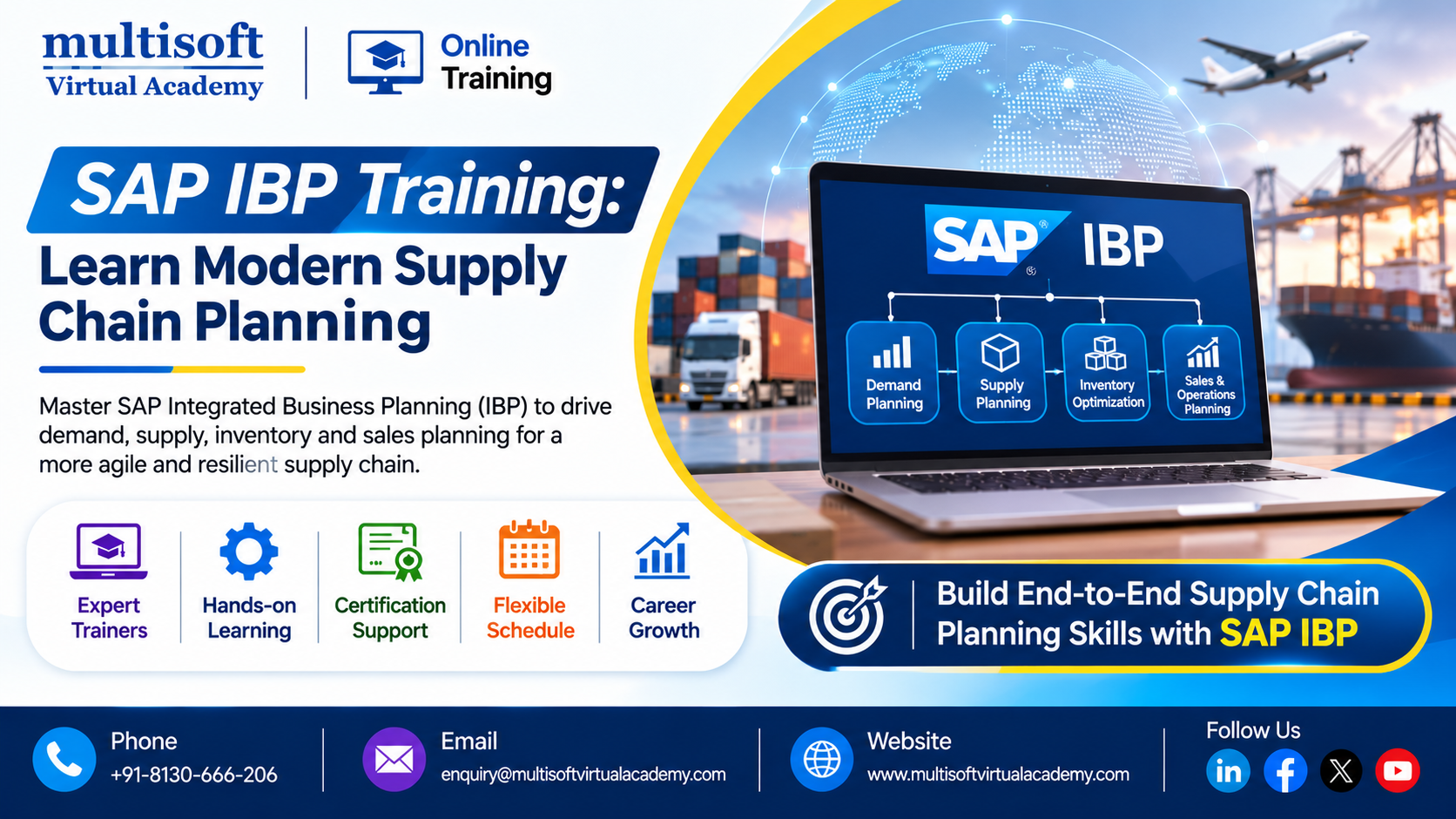
Managing a supply chain involves much more than purchasing materials and delivering finished products. Businesses must forecast customer demand, coordinate production, maintain suitable inventory levels, manage suppliers, and respond to unexpected changes. When these activities operate independently, organizations may experience planning gaps, excess stock, delayed deliveries, and increased operating costs.
SAP Integrated Business Planning (SAP IBP) provides an integrated environment for coordinating these activities. It helps organizations connect demand forecasting, supply planning, inventory optimization, and sales and operations planning through a common planning framework.
SAP IBP Training helps professionals understand how these capabilities work and how businesses use them to improve supply chain decisions. Through structured learning, participants can explore planning models, forecasting methods, supply algorithms, key figures, analytics, and system integration.
For SAP consultants and supply chain professionals, learning SAP IBP can provide a foundation for working with modern planning solutions and supporting digital supply chain transformation.
SAP Integrated Business Planning is a cloud-based solution designed to support strategic, tactical, and operational supply chain planning. It helps organizations bring together information from different departments and use it to develop coordinated business plans.
Instead of managing demand, production, inventory, and procurement as completely separate activities, companies can connect these processes and evaluate their combined impact.
For example, imagine a manufacturing company preparing for a seasonal increase in product demand. The sales department expects higher orders, but the production team must check available capacity and raw materials. Procurement needs to evaluate supplier availability, while inventory planners must determine suitable stock levels.
SAP IBP helps these teams work with connected planning information, evaluate different scenarios, and understand the consequences of their decisions.
Its capabilities include demand planning, supply planning, inventory optimization, sales and operations planning, and supply chain monitoring.
Supply chain planning is becoming increasingly data-driven. Organizations need professionals who can understand planning requirements, analyze business information, and use specialized applications to support operational decisions.
SAP IBP training helps develop knowledge in several important areas.
Demand forecasting helps businesses estimate future product requirements. Accurate forecasts support purchasing, production scheduling, inventory planning, and distribution activities.
Training introduces learners to historical demand analysis, statistical forecasting, forecast models, demand sensing, and forecast accuracy measurement.
Professionals can understand how planning teams evaluate demand patterns and adjust forecasts using relevant business information.
Supply planning determines how an organization can meet expected demand while considering production resources, supplier capabilities, inventory, and other constraints.
Learning SAP IBP helps participants understand how supply plans are generated, evaluated, and adjusted when business requirements change.
Inventory planning requires a balance between product availability and the cost of maintaining stock. Excess inventory can increase storage expenses, while insufficient inventory may affect customer satisfaction.
SAP IBP training introduces inventory optimization concepts that help learners understand inventory targets, service levels, demand variability, and supply lead times.
Supply chain decisions involve multiple departments. Sales, procurement, production, finance, and logistics teams need to work with consistent information.
SAP IBP supports coordinated planning and scenario analysis, helping professionals understand how business functions can contribute to a common planning process.
Training provides an introduction to planning areas, master data, key figures, planning operators, configuration concepts, and integration requirements. This knowledge can help professionals prepare for roles involving SAP IBP implementation, application support, and business process analysis.
A detailed SAP IBP Training Course should explain the major planning functions and their relationship with business operations. The following areas are particularly useful for learners.
Demand planning focuses on estimating future customer requirements using historical data, statistical methods, and market information.
The objective is to create a reliable demand plan that can be used by other supply chain functions.
Important topics include:
Learners can understand how demand forecasts are created, evaluated, and maintained within a planning environment.
Supply planning helps organizations determine how to fulfill expected demand using available resources and supply network capabilities.
It considers factors such as production capacity, sourcing rules, lead times, inventory, and material requirements.
Training may include:
These topics help participants understand how supply chain planners evaluate feasibility and respond to changing operational requirements.
Inventory optimization focuses on determining suitable inventory targets across different products and locations.
Organizations must consider demand variability, supplier lead times, production uncertainty, and desired service levels when developing inventory strategies.
Training may cover:
Understanding these concepts helps learners explore how businesses can improve inventory positioning without unnecessarily increasing stock levels.
Sales and Operations Planning, commonly called S&OP, connects commercial objectives with operational capabilities.
It allows business teams to review demand, supply, inventory, and financial considerations as part of a coordinated planning cycle.
Important learning areas may include:
This area is particularly relevant for professionals involved in business planning and cross-functional supply chain management.
Response and Supply Planning supports the development of feasible supply plans while considering relevant business constraints.
It helps planners evaluate supply alternatives and respond to changes in customer demand, material availability, and operational capacity.
Depending on the course syllabus, learners may study constrained planning, supply prioritization, optimization algorithms, order-based planning, deployment, and scenario simulations.
Supply chain visibility helps organizations monitor important operational information and identify situations requiring attention.
The Supply Chain Control Tower provides capabilities for monitoring, alerts, analytics, and exception management.
Training may introduce supply chain dashboards, alert configuration, case management, performance analysis, and visibility across planning activities.
SAP IBP Implementation involves translating business planning requirements into a working solution. It requires functional knowledge, an understanding of data structures, configuration expertise, and awareness of integration dependencies.
Professionals interested in implementation work should become familiar with the following concepts.
Master data represents important business entities used in planning. Examples include products, locations, customers, suppliers, resources, and sourcing relationships.
Learners should understand master data types, attributes, planning levels, and how these elements support planning activities.
Planning areas organize the data and structures used within SAP IBP. Key figures represent measurable planning information, such as demand quantities, inventory levels, supply values, and forecast results.
Understanding these concepts is important for working with planning models and analyzing business information.
Planning levels define the level of detail at which planning data is stored or calculated. Attributes provide additional information about planning objects.
These structures influence how planners view, calculate, and analyze data across different products, locations, and time periods.
Planning operators execute different planning processes. Algorithms support activities such as forecasting, supply planning, and inventory optimization.
Training should explain how these functions are selected and used to meet specific business requirements.
SAP IBP can exchange planning information with enterprise applications such as SAP S/4HANA and SAP ERP.
Integration supports the movement of relevant master data and transactional information between connected systems.
Learners should understand integration concepts, data transfer, application jobs, monitoring, and data validation.
Before a planning solution goes live, project teams must verify that its processes work correctly.
Testing may cover demand forecasts, supply calculations, inventory targets, planning scenarios, data integration, and exception handling.
Deployment also requires user preparation, process documentation, and appropriate support arrangements.
Consider a consumer goods manufacturer preparing for a major seasonal sales period.
The organization expects demand to increase, but its existing inventory may not be sufficient to fulfill all expected orders.
The planning process can involve several connected activities.
Demand evaluation: The demand planning team reviews historical sales, seasonal trends, and available market information to prepare a demand forecast.
Inventory assessment: Inventory planners evaluate existing stock and determine whether additional inventory is required at different locations.
Supply review: Supply planners examine production capacity, raw material availability, sourcing arrangements, and supplier lead times.
Scenario analysis: The organization compares different planning scenarios to understand the impact of increased demand, limited capacity, or delayed supplier deliveries.
Business alignment: Sales, procurement, production, and finance teams review the proposed plan and discuss necessary adjustments.
Plan execution: Once the plan is approved, relevant planning information can support subsequent procurement, production, and distribution activities through connected systems.
This example demonstrates why integrated planning is important. A decision made by one department can affect several other functions, so coordinated information helps organizations evaluate the wider business impact.
SAP IBP can support businesses that need coordinated planning across complex supply chains.
Automotive: Automotive companies manage large supplier networks, production requirements, component availability, and changing customer demand.
Manufacturing: Manufacturers use demand and supply planning to coordinate production, raw materials, capacity, and finished goods inventory.
Pharmaceuticals: Pharmaceutical organizations need reliable planning processes to manage product availability, inventory requirements, and distribution networks.
Retail: Retail businesses use forecasting and inventory planning to manage products across stores, warehouses, and distribution channels.
Consumer Goods: Consumer goods companies must respond to seasonal demand, promotions, changing purchasing patterns, and distribution requirements.
Food and Beverage: These organizations may use integrated planning to manage production schedules, stock availability, demand fluctuations, and product shelf-life considerations.
High-Tech and Electronics: Electronics companies manage complex sourcing networks, product lifecycles, component requirements, and supply disruptions.
The exact application of SAP IBP depends on the organization's business model, technical environment, and planning objectives.
SAP IBP training is suitable for professionals who want to develop their knowledge of enterprise supply chain planning.
Basic knowledge of supply chain processes, business operations, or SAP applications can make learning easier.
Developing SAP IBP knowledge can complement professional experience in supply chain planning, business analysis, and enterprise application consulting.
Potential career paths include:
Career opportunities depend on qualifications, relevant project experience, practical skills, and employer requirements. Training provides a learning foundation, while hands-on experience helps professionals apply their knowledge to actual business situations.
Choosing an appropriate course can make a significant difference to the learning experience.
Evaluate the course curriculum: Check whether the program covers demand planning, supply planning, inventory optimization, S&OP, and implementation concepts.
Prioritize practical learning: Look for exercises involving planning views, key figures, forecasting, planning operators, and scenario analysis.
Review trainer knowledge: An experienced trainer should be able to explain both the software functions and the business processes behind them.
Check system availability: Ask whether a practice environment is provided and which SAP IBP release is used during training.
Understand the delivery format: Compare instructor-led sessions, one-to-one learning, and self-paced training according to your requirements.
Clarify certification options: Check whether the course offers a completion certificate or provides preparation for a separate SAP certification examination.
SAP IBP Training helps professionals learn integrated supply chain planning processes, including demand forecasting, supply planning, inventory optimization, and sales and operations planning.
Yes. Beginners can start with supply chain fundamentals and gradually learn SAP IBP planning functions. Basic knowledge of business operations or SAP systems is helpful.
The major areas include demand planning, supply planning, inventory optimization, S&OP, response and supply planning, and supply chain monitoring.
SAP APO is an established SAP advanced planning solution, while SAP IBP is a cloud-based planning platform with capabilities for integrated demand, supply, inventory, and business planning. Organizations should evaluate their specific requirements when considering a transition.
A functional or advanced course may introduce master data, planning areas, key figures, integration, configuration concepts, testing, and deployment considerations. The actual coverage depends on the syllabus.
SAP IBP knowledge can strengthen a professional's supply chain planning skill set and complement experience in SAP consulting, demand planning, supply planning, and business analysis.
SAP Integrated Business Planning helps organizations coordinate supply chain activities, improve planning visibility, and make informed decisions using connected business information. Developing expertise in demand forecasting, supply planning, inventory optimization, S&OP, planning models, and implementation concepts can help professionals understand the requirements of modern supply chain operations. A well-designed training program should combine functional knowledge with practical exercises and relevant business scenarios. Multisoft Virtual Academy offers SAP IBP Training for professionals who want to strengthen their understanding of integrated business planning, develop practical SAP knowledge, and prepare for opportunities in supply chain planning and consulting.
| Start Date | End Date | No. of Hrs | Time (IST) | Day | |
|---|---|---|---|---|---|
| No schedule available ! | |||||
Schedule does not suit you, Schedule Now! | Want to take one-on-one training, Enquiry Now! |
|||||




 Join our Live Instructor-Led online classes delivered by industry experts
 Let's Get Started
