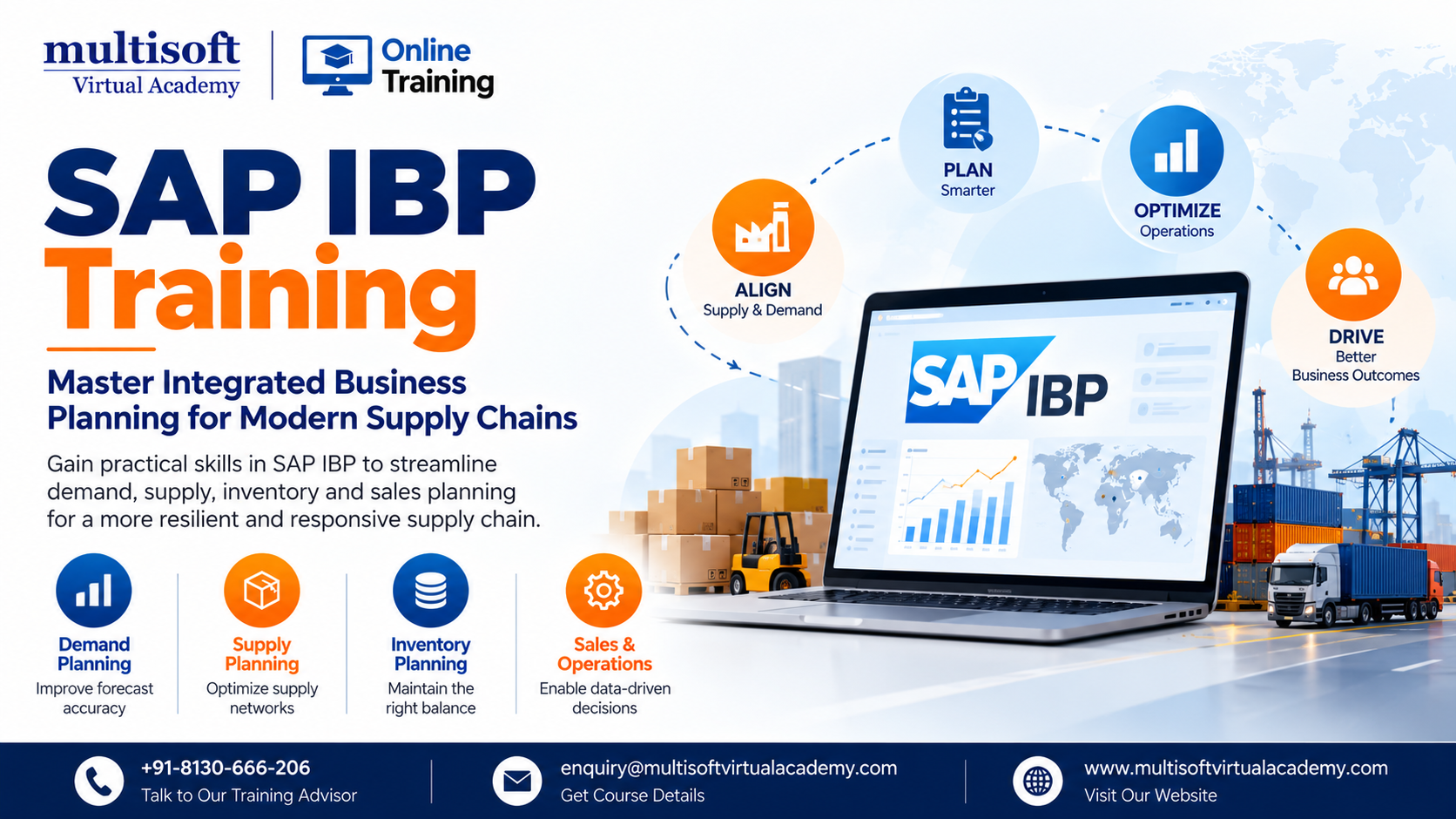
Modern supply chains are becoming increasingly complex. Changing customer demand, global sourcing, inventory pressure, production constraints, and the need for faster business decisions have made traditional planning methods less effective. Organizations need connected planning processes that allow supply chain teams to understand demand, evaluate supply capabilities, manage inventory, and respond quickly to changing business conditions.
This is where SAP Integrated Business Planning (SAP IBP) has become an important technology for modern supply chain management. SAP IBP brings together planning processes, analytics, forecasting, scenario management, supply planning, inventory optimization, and supply chain visibility within an integrated environment. SAP describes IBP as a solution that supports demand and supply balancing, responsive planning, demand-driven planning, inventory optimization, and end-to-end visibility.
For professionals who want to develop expertise in this area, SAP IBP Training can provide a structured path to understanding the platform and its business processes.
SAP Integrated Business Planning is a cloud-based supply chain planning solution designed to help organizations coordinate planning activities across different business functions. Instead of treating demand, supply, inventory, and sales and operations planning as isolated activities, SAP IBP supports a more connected planning approach.
The platform can help organizations analyze demand patterns, create supply plans, evaluate capacity, optimize inventory, monitor exceptions, and perform scenario-based planning.
SAP's current learning and training resources cover areas ranging from foundational planning processes to advanced implementation skills. Its implementation learning journey is designed to develop knowledge from fundamentals through practical implementation and certification-oriented preparation.
For professionals entering the SAP supply chain ecosystem, learning SAP IBP can therefore be valuable for both functional understanding and implementation-oriented career development.
Supply chain professionals are expected to make decisions based on accurate information rather than relying entirely on spreadsheets, disconnected systems, or historical assumptions. SAP IBP provides tools that support more structured planning and analysis.
A well-designed SAP IBP Training Course can help learners understand how different planning activities are connected. It can also introduce the terminology, functionality, planning processes, and configuration concepts required to work with SAP IBP.
Training is particularly useful for professionals who want to:
SAP's foundational IBP training is intended to provide knowledge of the solution, its components, and associated business processes before learners move into more specialized areas.
A comprehensive SAP IBP Course should not focus only on navigation. Learners should understand how the platform supports real-world supply chain planning.
The first step is understanding the overall SAP IBP environment. Learners can explore the architecture, business purpose, planning concepts, terminology, and major functional areas.
This foundation helps professionals understand how SAP IBP fits into broader supply chain processes.
Demand planning is one of the most important areas of supply chain management. Organizations need reliable forecasts to determine what products customers may require and when they may require them.
SAP IBP Demand Planning Training can introduce learners to forecasting concepts, demand analysis, statistical forecasting, planning data, key figures, and demand-related processes.
SAP's current IBP capabilities include forecasting and demand-oriented planning functionality, while its learning resources also cover supply chain forecasting and planning processes.
Professionals can use this knowledge to understand how demand signals influence downstream planning decisions.
Demand forecasts alone are not enough. Organizations also need to determine whether available production capacity, materials, resources, and supply sources can satisfy expected demand.
SAP IBP Supply Planning Training focuses on concepts such as supply planning, planning runs, capacity considerations, constrained and unconstrained planning, and supply-demand balancing.
SAP's training material includes topics such as unconstrained planning, capacity and scenario management, constrained planning with the Supply Optimizer, and order-based planning.
These concepts are particularly relevant for consultants and supply chain professionals involved in planning transformation projects.
Sales and Operations Planning, commonly known as S&OP, connects strategic business objectives with operational supply chain planning.
An organization may have strong sales expectations, but production, inventory, suppliers, and logistics must be aligned with those expectations.
SAP IBP S&OP Training can help professionals understand how demand and supply planning can be connected with business decision-making. It can also help learners understand scenario analysis and planning alignment.
The objective is not simply to produce another forecast. The objective is to support better business decisions through connected planning information.
Inventory represents both an opportunity and a cost. Excess inventory can increase carrying costs, while insufficient inventory can affect customer service and revenue.
SAP IBP Inventory Optimization Training introduces concepts related to inventory targets, service levels, supply variability, demand variability, and multi-stage inventory planning.
SAP identifies multi-stage inventory optimization and improved customer service levels among the capabilities supported by SAP IBP.
Understanding these concepts can be especially useful for supply chain planners, inventory managers, consultants, and business process owners.
Supply chains rarely operate exactly according to plan. Customer requirements change, suppliers face delays, production capacity can shift, and unexpected events can create shortages.
SAP IBP provides functionality for responsive supply planning and scenario-based decision-making.
SAP IBP Response and Supply Training can help learners understand how supply plans can be evaluated and adjusted when business conditions change.
Current SAP learning resources include response and supply concepts as part of the broader SAP IBP curriculum.
Planning teams need visibility into problems before they become major disruptions.
SAP IBP supports supply chain visibility, monitoring, alerts, analytics, and exception management.
Training can help professionals understand how planners can identify exceptions, analyze planning information, and prioritize situations that require attention.
This makes SAP IBP Training relevant not only to planners but also to business process owners, consultants, and supply chain managers.
Planning areas and key figures are important concepts for anyone learning SAP IBP.
A planning environment needs structured data that represents products, locations, customers, time periods, demand, supply, inventory, and other business dimensions. Key figures are used to represent measurable planning information.
Professionals undertaking SAP IBP Online Training should therefore spend sufficient time understanding:
SAP's current learning resources specifically include planning area and key figure management, data integration, disaggregation, analytics, and reporting.
These topics provide the technical and functional foundation required for deeper SAP IBP work.
No planning platform works in isolation. SAP IBP needs relevant business information to support meaningful planning decisions.
Therefore, SAP IBP Training should also introduce learners to integration concepts and data management.
Professionals should understand how master data and transactional information can be brought into the planning environment and how data quality affects forecasting and planning outcomes.
Training may cover areas such as:
Understanding integration is particularly important for SAP consultants because real-world implementations often involve multiple SAP and non-SAP systems.
One of the biggest advantages of modern planning is the ability to evaluate alternatives before taking action.
For example, an organization may want to understand what could happen if:
Scenario planning can help organizations evaluate potential outcomes without immediately changing the operational plan.
This makes scenario management an important topic for professionals pursuing SAP IBP Certification Training or implementation-oriented learning.
SAP's recent IBP enablement materials continue to highlight scenario management, response and supply, inventory optimization, analytics, integration, and AI-related updates.
Data becomes useful when professionals can interpret it correctly.
SAP IBP supports analytics, dashboards, charts, drill-down functionality, and other tools for analyzing planning information. SAP's learning resources specifically identify analytics and reporting as part of the core IBP skill set.
A strong training program should therefore combine theoretical concepts with practical analysis.
Learners should become comfortable asking questions such as:
This business-oriented approach makes SAP IBP knowledge more useful than simply memorizing system functions.
Supply chain technology continues to evolve. SAP's 2026 IBP updates include topics such as planner workspaces, Excel integration, response and supply, inventory optimization, integration, extensions, analytics, generative AI, and Joule.
This highlights an important point for professionals: SAP IBP learning should not stop at basic navigation.
Continuous learning is becoming increasingly important as organizations adopt new planning capabilities and integrate intelligent technologies into supply chain processes.
Professionals should follow current SAP learning resources, product documentation, release information, and implementation guidance to keep their skills relevant.
SAP IBP Training can be useful for a wide range of professionals, including:
SAP's foundational IBP course identifies application consultants, business process architects, business process owners, team leads, and power users among its intended audiences.
Online learning has become a practical option for professionals managing work and career development simultaneously.
A structured SAP IBP Online Training program can provide flexibility while allowing learners to study important concepts from different locations.
Potential benefits include:
Professionals can learn without relocating or attending a traditional classroom every day.
Hands-on exercises can help connect theoretical concepts with real planning scenarios.
SAP IBP skills can complement existing supply chain, SAP, ERP, or consulting experience.
Learners gain insight into how demand, supply, inventory, and business planning interact.
Structured learning can help candidates prepare for relevant SAP certification assessments. SAP itself provides learning journeys and certification-oriented resources for IBP professionals.
Not every training program provides the same depth of learning. Before choosing a SAP IBP Certification Course, professionals should evaluate several factors.
First, check whether the curriculum covers both foundational and advanced concepts. A course should ideally include demand planning, supply planning, inventory optimization, S&OP, analytics, integration, and scenario management.
Second, look for practical exercises. Supply chain planning is a business-oriented discipline, so theoretical explanations alone may not be sufficient.
Third, check whether the content reflects current SAP IBP releases. SAP regularly introduces changes and enhancements. For example, SAP currently provides training resources aligned with recent IBP releases including 2605 and 2608.
Finally, consider whether the training is suitable for your existing experience and career objective.
SAP IBP knowledge can support career paths across SAP consulting and supply chain management.
Depending on experience and specialization, professionals may explore roles such as:
The actual role and compensation depend on professional experience, implementation exposure, geographical market, technical skills, and the specific employer.
For experienced SAP professionals, combining IBP with broader SAP supply chain knowledge can provide a stronger foundation for participating in transformation and implementation projects.
A background in supply chain planning can make the learning process easier.
Professionals should ideally understand basic concepts such as:
However, foundational SAP IBP programs are also designed to introduce the platform and its business processes. SAP's IBP100 course lists familiarity with supply chain planning functions and terminology as an essential prerequisite while recommending no specific prior course.
Therefore, learners from different professional backgrounds can choose an appropriate starting point based on their existing knowledge.
The future of supply chain management depends on connected data, faster planning cycles, better visibility, and informed decision-making. SAP IBP Training can help professionals understand how modern organizations approach demand planning, supply planning, inventory optimization, S&OP, scenario management, analytics, and supply chain visibility within an integrated planning environment.
As SAP continues to enhance IBP with new planning capabilities, analytics, integration options, and intelligent technologies, professionals who continuously update their knowledge can remain better prepared for changing industry requirements. Current SAP resources demonstrate that the platform is evolving across areas such as response and supply, inventory optimization, planner workspaces, integration, analytics, and AI-related capabilities.
For learners and organizations seeking structured SAP IBP Training, Multisoft Virtual Academy can serve as a training provider focused on helping professionals develop practical knowledge of SAP Integrated Business Planning and its role in modern supply chain processes. A well-structured learning approach can help learners move from foundational concepts toward more advanced planning and implementation-oriented skills.
| Start Date | End Date | No. of Hrs | Time (IST) | Day | |
|---|---|---|---|---|---|
| 10 Oct 2026 | 08 Nov 2026 | 40 | 06:00 PM - 10:00 AM | Sat, Sun | |
| 11 Oct 2026 | 09 Nov 2026 | 40 | 06:00 PM - 10:00 AM | Sat, Sun | |
Schedule does not suit you, Schedule Now! | Want to take one-on-one training, Enquiry Now! |
|||||






 Join our Live Instructor-Led online classes delivered by industry experts
 Let's Get Started