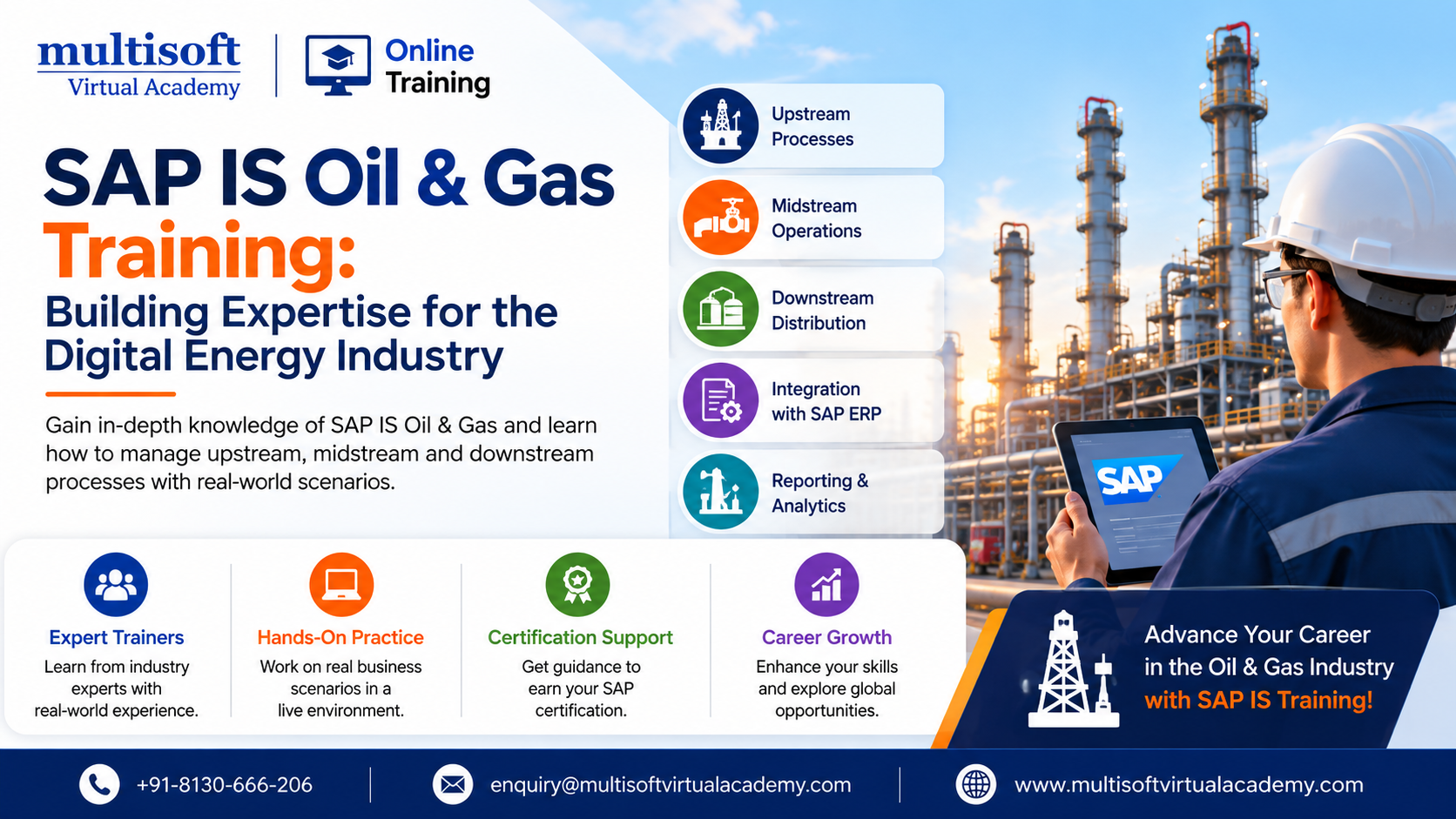
The oil and gas industry operates across complex processes involving exploration, production, transportation, refining, distribution, inventory, pricing, finance and regulatory requirements. As energy organizations continue to modernize their operations, professionals with specialized SAP skills are increasingly valuable for connecting business processes with digital enterprise systems.
SAP IS Oil & Gas Training helps professionals understand how SAP technologies can support industry-specific processes and how standard enterprise functions can be adapted to the requirements of oil and gas organizations. The training can be particularly useful for SAP consultants, functional professionals, business users, project teams and professionals planning to work on SAP Oil & Gas implementation projects.
SAP's current Oil, Gas and Energy learning resources cover industry-specific business processes, terminology and SAP solution capabilities across the energy value chain.
Oil and gas companies manage enormous quantities of operational, financial and supply chain data. A small inefficiency in inventory management, transportation planning or product accounting can have a significant commercial impact.
SAP provides a digital foundation for integrating business processes and improving visibility across the organization. Its Oil, Gas and Energy solutions address areas such as hydrocarbon processes, supply chain operations, asset management, finance and sustainability.
For professionals, this creates an opportunity to develop specialized knowledge beyond conventional SAP ERP skills.
An effective SAP IS Oil & Gas Course can help learners understand:
SAP IS Oil & Gas Training is specialized training focused on SAP functionality used to support oil and gas business processes.
Traditional SAP environments use different core modules to manage areas such as finance, materials, sales, procurement and logistics. Industry-specific capabilities extend these processes to address the particular requirements of oil, gas and energy organizations.
Modern SAP learning paths also connect Oil, Gas and Energy processes with SAP S/4HANA and intelligent enterprise capabilities. SAP describes its Oil, Gas and Energy learning journey as a way to understand end-to-end industry business processes and develop deeper solution knowledge.
Therefore, learning SAP IS-Oil is not simply about understanding software transactions. It involves understanding the relationship between technology and actual energy-sector operations.
A comprehensive SAP Oil & Gas Training program should connect technical SAP functionality with practical industry processes.
Learners first need to understand how the industry operates.
The training may introduce:
This foundation helps SAP professionals understand why specific processes require industry-oriented functionality.
Hydrocarbon management is one of the important areas of SAP Oil & Gas.
Organizations need to monitor quantities, movements, ownership and valuation of hydrocarbons throughout their operations. SAP's Oil & Gas capabilities include functionality supporting hydrocarbon-related processes and supply activities.
Training can help professionals understand concepts such as:
Understanding these processes can be particularly valuable for consultants working on industry-specific SAP projects.
Oil and gas products frequently move through pipelines, terminals, vessels, rail networks and road transportation.
SAP Oil & Gas processes can support supply and distribution activities that require accurate planning and visibility.
Training can introduce concepts such as:
Professionals can use this knowledge to understand how logistics activities interact with inventory, purchasing, sales and financial processes.
Inventory accuracy is critical for energy companies.
Oil, gas and petroleum products can move through multiple locations and storage facilities. Organizations therefore need effective processes for monitoring stock, goods movements and inventory reconciliation.
An SAP IS-Oil Training program may cover:
These concepts can help learners understand how SAP supports operational visibility.
Pricing in the energy sector can involve multiple business rules, taxes, discounts, freight components and product-specific conditions.
Professionals undertaking SAP Oil & Gas Certification Training can benefit from learning how pricing processes interact with sales, distribution, inventory and financial accounting.
Relevant topics may include:
A strong understanding of these areas can improve the ability of consultants to analyze business requirements and translate them into SAP processes.
The transition from traditional SAP ERP environments to SAP S/4HANA has changed how organizations approach digital transformation.
SAP's current Oil & Gas documentation includes SAP S/4HANA-based capabilities and industry-specific processes. SAP also documents implementation and activation requirements for Oil & Gas functionality in S/4HANA environments.
This makes SAP S/4HANA Oil & Gas Training an important related learning area for professionals who want to work on modern implementation and transformation projects.
Training can focus on:
Professionals moving from legacy SAP environments can particularly benefit from understanding how traditional processes map into the S/4HANA landscape.
Learning implementation concepts can make training more valuable for consultants and project professionals.
An SAP IS-Oil Implementation Training approach should explain how requirements are analyzed, mapped and configured within an SAP environment.
A typical implementation lifecycle includes:
SAP documentation identifies mandatory installation steps and optional activation of specific Oil & Gas-related business functions depending on the required functionality.
This demonstrates why implementation professionals need more than theoretical product knowledge. They must understand business requirements and determine which processes and capabilities are relevant to a particular organization.
The training can be useful for a broad range of professionals.
Consultants working with SAP MM, SD, FI, logistics or supply chain processes can expand their industry specialization by learning Oil & Gas processes.
Technical professionals can benefit from understanding the functional requirements behind integrations, reports, interfaces and extensions.
Business professionals working in petroleum, refining, logistics, supply chain or energy organizations can learn how SAP supports their existing workflows.
Project professionals can use industry-specific knowledge to communicate more effectively with SAP functional and technical teams.
Professionals preparing for S/4HANA transformation projects can develop specialized knowledge of Oil, Gas and Energy processes.
Professionals beginning an SAP career can consider industry specialization as a way to differentiate their skills from general ERP knowledge.
Certification can demonstrate structured knowledge and provide an additional credential for professionals seeking specialized SAP opportunities.
However, certification should ideally be supported by practical understanding.
The most useful SAP Oil & Gas Certification Course combines conceptual learning with business scenarios, practical exercises, implementation discussions and process-based examples.
Important benefits may include:
SAP itself provides certifications and learning paths for Oil, Gas and Energy professionals, with learning resources organized around different roles and levels of expertise.
Theory alone may not be sufficient for professionals working on enterprise SAP projects.
Practical training can use realistic scenarios such as:
A petroleum company needs to transfer products between storage locations. Learners can examine the business requirement, relevant SAP process and inventory impact.
A business needs to schedule product transportation between terminals. Learners can explore how transportation activities interact with inventory and logistics.
A company needs to calculate product prices with taxes and freight components. Learners can analyze the pricing process and downstream billing implications.
An organization is moving from an older SAP environment to S/4HANA. Learners can examine process changes, integration requirements and implementation considerations.
Scenario-based learning helps professionals connect SAP functionality with actual business decisions.
The energy industry is moving toward more connected, data-driven and intelligent operations.
Modern energy organizations increasingly require visibility across assets, supply chains, financial processes and operational data. SAP's Oil, Gas and Energy solutions are designed to help organizations integrate processes and improve visibility across the value chain.
This transformation also increases demand for professionals who understand both SAP and energy-sector processes.
Future-oriented training can therefore include subjects such as:
These areas complement core SAP IS Oil & Gas Training and can help professionals prepare for changing technology requirements.
Before selecting an SAP Oil & Gas course, learners should evaluate the curriculum carefully.
Look for a program that provides:
The ideal program should not simply explain SAP terminology. It should show how technology supports real oil and gas business processes.
Specialization can open different career paths depending on a professional's existing background.
Potential roles include:
Professionals with combined SAP and industry knowledge can be valuable because they can communicate between technical teams and business stakeholders.
Generic SAP knowledge provides a foundation, but industry specialization can help professionals understand the business context behind enterprise processes.
Oil and gas organizations have distinctive operational requirements. Production, measurement, product movement, transportation, inventory, pricing and financial processes must work together.
SAP's current Oil, Gas and Energy learning resources emphasize industry terminology, business processes and SAP solution capabilities across the value chain.
Consequently, professionals who combine SAP expertise with oil and gas domain knowledge can be better prepared to participate in transformation initiatives.
SAP IS Oil & Gas Training can be a valuable learning path for professionals seeking specialized expertise in one of the world's most complex industries. From hydrocarbon management and inventory to transportation, pricing, supply chain operations and SAP S/4HANA transformation, the right training can help learners understand how enterprise technology supports real energy-sector processes. As organizations continue investing in digital transformation, professionals with practical SAP and industry knowledge can position themselves for broader responsibilities and new career opportunities. Multisoft Virtual Academy provides specialized training solutions designed to help learners and corporate teams develop relevant SAP Oil & Gas knowledge through structured learning, practical business-oriented concepts and industry-focused guidance.
| Start Date | End Date | No. of Hrs | Time (IST) | Day | |
|---|---|---|---|---|---|
| No schedule available ! | |||||
Schedule does not suit you, Schedule Now! | Want to take one-on-one training, Enquiry Now! |
|||||






 Join our Live Instructor-Led online classes delivered by industry experts
 Let's Get Started