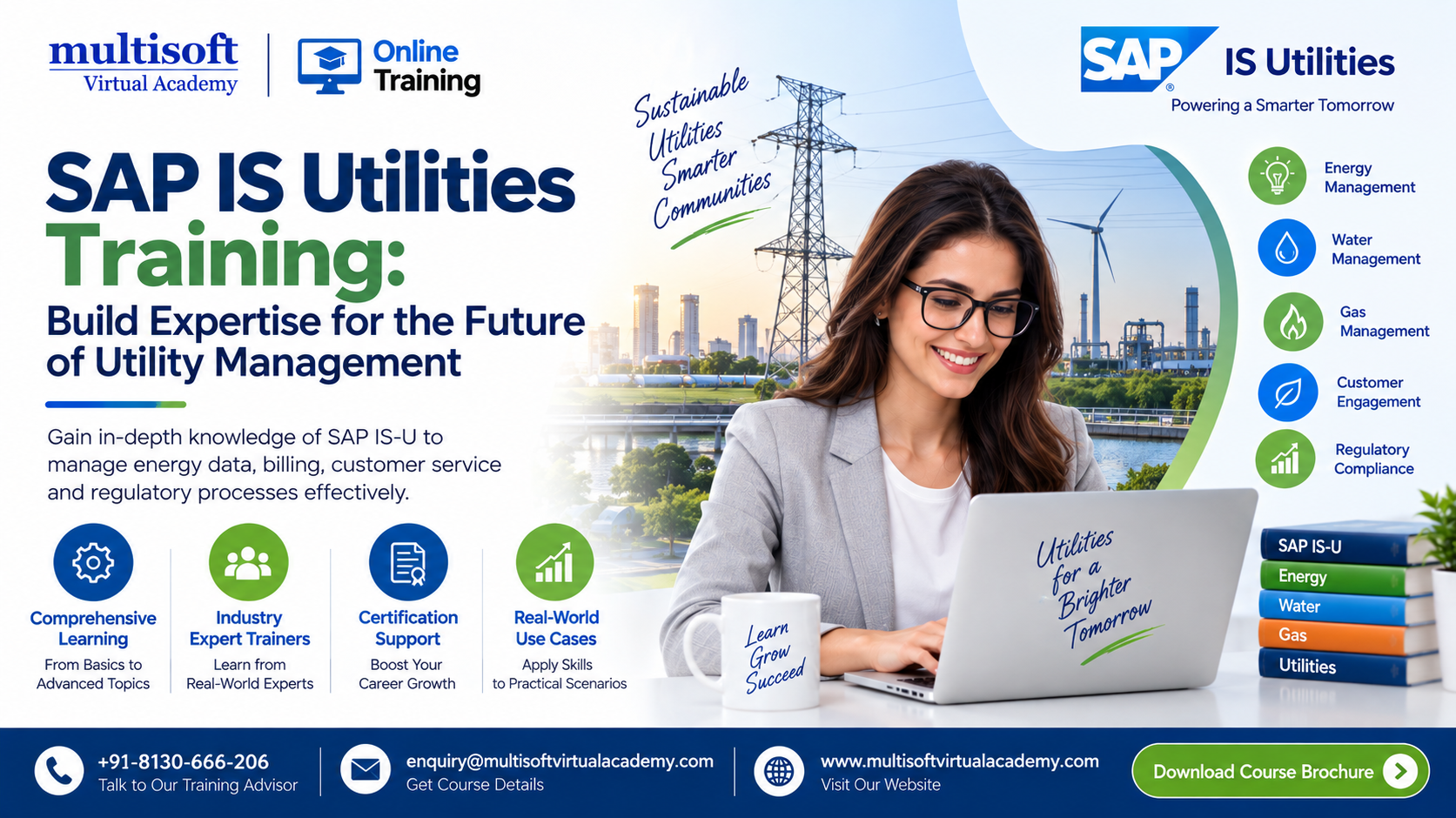
The utilities industry is undergoing a major digital transformation as energy, water, and other service providers adopt intelligent technologies to improve customer service, billing, asset management, and operational efficiency. At the center of this transformation is SAP for Utilities, commonly associated with SAP IS-U, which helps organizations manage complex utility business processes through an integrated enterprise platform.
SAP IS Utilities Training is therefore becoming an important learning path for professionals who want to develop specialized SAP skills and work on utility-focused digital transformation projects. With organizations increasingly moving toward SAP S/4HANA Utilities, cloud technologies, automation, analytics, and AI-driven processes, professionals with practical knowledge of SAP Utilities can explore opportunities across consulting, implementation, support, and business process management.
SAP IS-U, or SAP Industry Solution for Utilities, is designed to support the specific requirements of utility organizations. Unlike generic enterprise systems, SAP Utilities addresses processes that are central to utility businesses, including customer management, meter reading, device management, billing, invoicing, contract accounts, and meter-to-cash operations.
Modern SAP S/4HANA Utilities learning paths expand this foundation with capabilities such as SAP Fiori, analytics, customer engagement, asset management, cloud technologies, and AI-enabled process optimization. SAP's current training content includes key processes such as move-in and move-out, device installation, meter reading, billing, invoicing, contract accounts receivable and payable, and measurement concept management.
For professionals, learning these processes provides a strong foundation for understanding how technology supports the complete utility business lifecycle.
The demand for specialized enterprise technology skills continues to increase as utility companies modernize their IT landscapes. SAP Utilities professionals need more than basic SAP knowledge; they must understand how technology connects with industry-specific processes.
A well-designed SAP IS-U Training program can help learners understand both the functional and technical aspects of utility operations.
Key reasons to consider this training include:
SAP's current S/4HANA Utilities training also introduces areas such as SAP Fiori, AI integration, asset management, cloud solutions, and SAP Business Technology Platform capabilities.
The exact curriculum can vary depending on the learner's role and training level, but comprehensive SAP Utilities Training generally covers the major processes used by utility organizations.
Training typically begins with the fundamentals of SAP for Utilities. Learners explore the utilities industry, SAP Utilities architecture, basic terminology, organizational structures, and the relationship between technical and business master data.
Understanding these fundamentals makes it easier to work with advanced SAP Utilities processes.
Master data is a critical component of utility operations. Training can introduce technical and business master data and explain how these objects interact with utility processes.
Professionals can learn about areas such as:
SAP's current configuration training specifically covers technical and commercial master data along with basic utility functions.
The meter-to-cash process is one of the most important concepts in utility management. It connects customer services, meter reading, consumption measurement, billing, invoicing, and payment-related processes.
A strong understanding of SAP Utilities Meter-to-Cash helps professionals see how individual SAP processes work together to complete the customer revenue cycle.
Utility companies depend heavily on meters and other field devices. SAP Utilities supports processes associated with device installation, meter reading, measurement, and consumption data.
Training in this area can help professionals understand how meter-related information flows into subsequent billing and customer processes.
Billing is a core component of SAP Utilities. Professionals need to understand how consumption data, rate structures, billing schemas, and other business rules contribute to customer billing.
Current SAP learning content covers billing configuration, rate determination, manual billing, reversals, invoicing, budget billing, exceptions, backbilling, real-time pricing, prepayment, and meter-to-cash execution.
This makes SAP Utilities Billing Training particularly valuable for consultants and professionals working on utility transformation projects.
Another important area is financial processing related to customer contract accounts. Training introduces the connection between utility processes and financial transactions, helping learners understand how customer payments and receivables are handled.
This knowledge can be especially useful for professionals working with SAP FI-CA and utility billing processes.
Modern utility providers increasingly focus on improving customer experience. SAP S/4HANA Utilities includes customer engagement capabilities designed to support more customer-centric operations.
Training can help professionals understand how customer service processes interact with core utilities functions and how digital technologies can improve the overall customer journey.
One of the most important developments for SAP Utilities professionals is the transition toward SAP S/4HANA Utilities.
Organizations using traditional SAP Utilities environments need to understand the differences between older SAP ERP-based environments and modern S/4HANA solutions. SAP's transition-focused training addresses areas such as conversion scenarios, customer engagement, SAP Fiori, cloud solutions, asset management, AI, analytics, and SAP Business Technology Platform.
This makes SAP S/4HANA Utilities Training an important complementary skill for professionals who already have SAP IS-U experience.
Rather than treating SAP IS-U and S/4HANA Utilities as completely separate areas, professionals can build on their existing utilities knowledge while developing skills for modern SAP environments.
SAP IS Utilities Training can be useful for a broad range of professionals, including:
SAP's current Utilities courses identify roles such as application consultant, business process architect, enterprise architect, solution architect, system architect, industry specialist, and business process owner among the relevant audiences.
A practical learning program can help professionals develop a combination of SAP, business, and industry-specific skills.
Important capabilities include:
SAP Utilities Functional Knowledge: Understand the major business processes used by energy and utility organizations.
Process Integration: Learn how customer service, meter reading, billing, invoicing, and financial processes connect.
SAP S/4HANA Knowledge: Understand modern utilities processes and the transition from traditional SAP environments.
Problem-Solving Skills: Develop the ability to analyze business requirements and identify suitable SAP-based solutions.
Implementation Understanding: Learn how utility processes can be configured and adapted to organizational requirements.
Industry Knowledge: Gain deeper insight into the operational challenges faced by modern utility providers.
These skills can help professionals become more effective when participating in SAP Utilities implementation, migration, support, or transformation projects.
Specialized SAP skills can help professionals differentiate themselves in a competitive enterprise technology market. Instead of having only general SAP knowledge, learning SAP Utilities enables professionals to develop expertise in a specific industry domain.
Professionals can pursue roles related to:
However, career outcomes depend on individual experience, technical background, project exposure, and the depth of practical knowledge developed during training.
Choosing the right SAP IS-U Course requires more than checking the number of modules. Learners should evaluate whether the program reflects current industry requirements and provides meaningful coverage of real utility processes.
Consider the following factors:
Look for training that addresses modern SAP Utilities and S/4HANA Utilities developments rather than focusing exclusively on legacy concepts.
The course should explain how utility processes operate from beginning to end, particularly meter-to-cash, billing, customer engagement, master data, and device management.
Industry-experienced trainers can explain concepts using realistic business scenarios and project-oriented examples.
Depending on your career goal, consider a program that provides an appropriate balance of business-process understanding and system knowledge.
Online, instructor-led, and self-paced learning formats can provide different advantages. Choose the format that fits your professional schedule and learning objectives.
The future of SAP Utilities is not limited to traditional ERP processes. AI, analytics, cloud platforms, automation, and digital customer engagement are becoming increasingly relevant.
SAP's current Utilities learning content includes AI integration for process optimization, data analytics, machine learning scenarios, SAP Fiori, cloud technologies, and SAP Business Technology Platform.
This evolution means that future SAP Utilities professionals will benefit from combining traditional utilities process expertise with knowledge of emerging technologies.
For learners, this creates an opportunity to build a broader skill set that connects SAP Utilities with modern enterprise transformation.
For professionals interested in SAP consulting, utility technology, enterprise applications, or digital transformation, SAP IS Utilities Training can be a valuable investment in specialized knowledge.
Its value becomes particularly strong when learners combine structured training with practical exercises, business scenarios, implementation concepts, and continuous learning about SAP S/4HANA Utilities.
The objective should not simply be to memorize SAP transactions or terminology. Successful professionals understand the business problem behind each process and how SAP can support an efficient solution.
The utilities sector is becoming increasingly digital, customer-focused, data-driven, and connected. Utility organizations are looking for technologies that can improve operational efficiency while supporting better customer experiences.
As organizations modernize their SAP landscapes, knowledge of SAP S/4HANA Utilities, cloud solutions, analytics, AI, customer engagement, asset management, and integrated business processes is likely to remain valuable.
SAP itself continues to provide learning paths focused on upskilling utilities professionals for S/4HANA and RISE with SAP implementations.
For professionals beginning or advancing their SAP Utilities journey, this makes continuous learning an important part of long-term career development.
SAP IS Utilities Training offers professionals a structured way to understand the complex business processes that power modern utility organizations. From master data and device management to meter-to-cash, billing, invoicing, customer engagement, and SAP S/4HANA transformation, the knowledge gained can support a wide range of professional responsibilities.
As utilities organizations continue adopting cloud platforms, AI, analytics, automation, and modern SAP architectures, specialized skills are becoming increasingly important. Choosing comprehensive SAP IS-U Training that combines foundational concepts with current SAP S/4HANA Utilities practices can help professionals develop relevant, industry-focused capabilities.
Multisoft Virtual Academy acts as a trusted service provider for professionals and organizations seeking structured SAP IS Utilities Training, with a focus on practical learning, industry-relevant concepts, and career-oriented SAP skill development. Learners can explore the right program based on their existing experience, professional goals, and preferred learning format.
| Start Date | End Date | No. of Hrs | Time (IST) | Day | |
|---|---|---|---|---|---|
| 26 Sep 2026 | 18 Oct 2026 | 24 | 06:00 PM - 09:00 PM | Sat, Sun | |
| 27 Sep 2026 | 19 Oct 2026 | 24 | 06:00 PM - 09:00 PM | Sat, Sun | |
| 03 Oct 2026 | 25 Oct 2026 | 24 | 06:00 PM - 09:00 PM | Sat, Sun | |
| 04 Oct 2026 | 26 Oct 2026 | 24 | 06:00 PM - 09:00 PM | Sat, Sun | |
Schedule does not suit you, Schedule Now! | Want to take one-on-one training, Enquiry Now! |
|||||






 Join our Live Instructor-Led online classes delivered by industry experts
 Let's Get Started