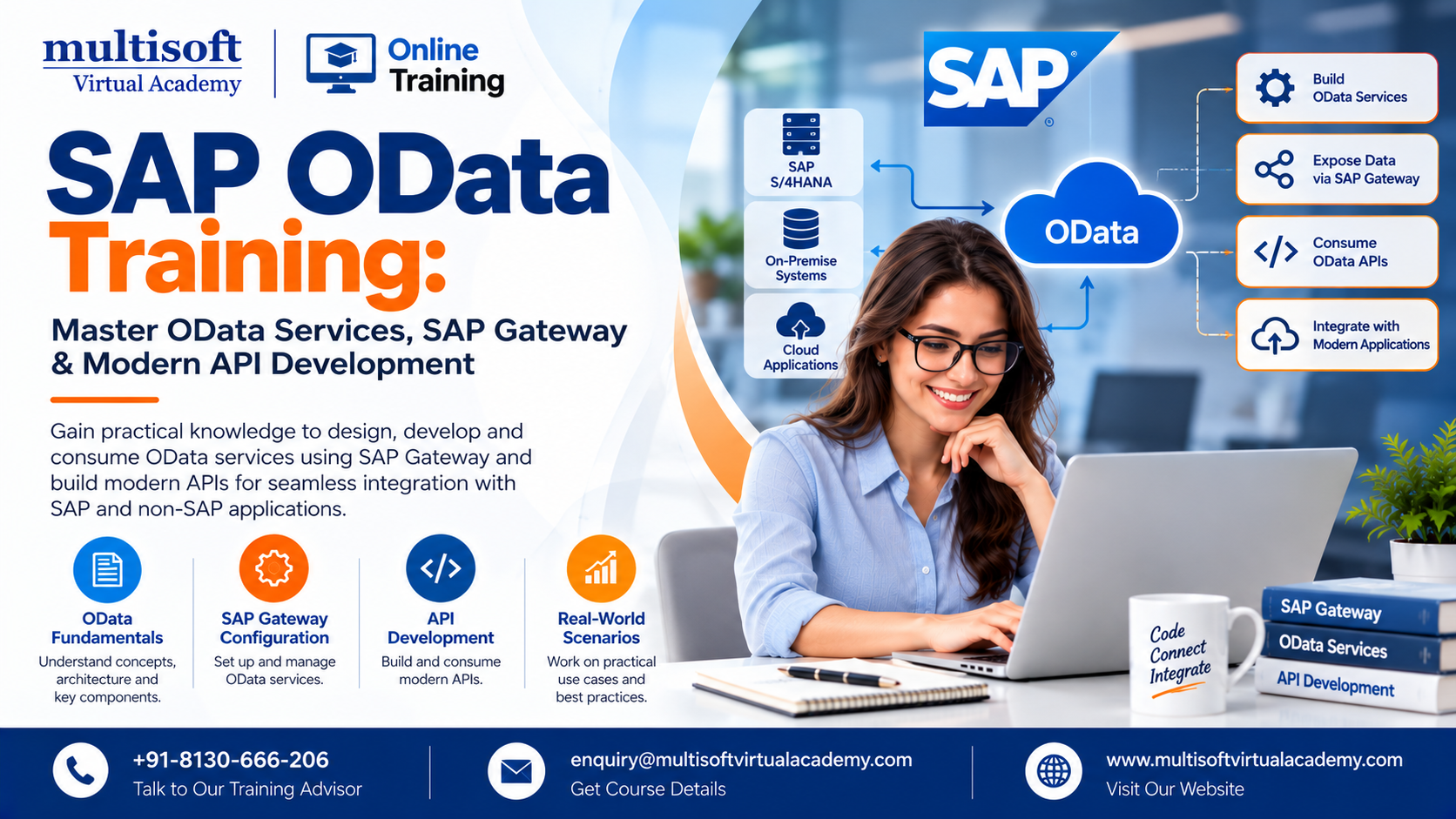
As SAP landscapes become increasingly connected, organizations need reliable ways to expose business data and processes to applications, web interfaces, mobile solutions, and external platforms. SAP OData Training has therefore become an important learning path for professionals working with SAP integration, application development, SAP Fiori, ABAP, and modern SAP architectures.
OData, or Open Data Protocol, provides a standardized approach for creating and consuming REST-based services. Within SAP environments, OData services enable applications to communicate with SAP business data through structured HTTP requests. SAP Gateway uses OData to make SAP functionality accessible to different technologies and applications, while SAP Fiori applications commonly depend on OData services to retrieve and update backend data.
For professionals planning to strengthen their SAP technical skills, learning OData is not simply about understanding APIs. It involves learning how to design services, model entities, implement business logic, handle requests, secure services, test APIs, troubleshoot errors, and work with newer SAP OData Training V4-based development approaches.
Modern enterprises rarely operate with isolated applications. SAP systems need to exchange information with websites, mobile applications, analytics platforms, cloud applications, third-party solutions, and other enterprise systems.
OData provides a standardized interface that can simplify this communication. SAP Gateway enables SAP Business Suite functionality to be exposed through REST-based OData services, allowing different applications and technologies to consume SAP data.
A structured SAP OData Training program can help learners understand this complete service-development lifecycle.
Professionals can learn how to:
These skills can be particularly useful for ABAP developers, SAP technical consultants, Fiori developers, integration specialists, and professionals working with SAP S/4HANA.
OData is an open web protocol designed for querying and updating data through standardized web technologies. It builds on HTTP and REST principles and provides predictable mechanisms for accessing resources.
In a typical OData environment, data is organized through concepts such as entities, entity types, entity sets, properties, relationships, functions, and actions.
For example, an application could request customer information through an OData endpoint and apply query options to retrieve only the required records. OData supports common HTTP methods such as GET, POST, PUT, and DELETE, depending on the service implementation and operation.
This standardized model makes OData useful when SAP data needs to be consumed by different applications without requiring every application to understand the internal implementation of the SAP backend.
Understanding the difference between SAP OData V2 and OData V4 is an important part of modern OData learning.
OData V2 has been widely used in SAP Gateway and SAP Fiori scenarios. Many existing SAP applications and integrations continue to use V2 services.
OData V4 introduces a more advanced service model designed to handle complex business scenarios, deeply structured business objects, modular services, and scalable applications. SAP documentation highlights OData V4 as an important framework for applications working with sophisticated business models and modern backend capabilities.
SAP Gateway Foundation currently provides dedicated capabilities for developing OData V4 services, including service provisioning, registration, service-group publishing, and related development tools.
Therefore, professionals should ideally understand both versions rather than limiting their knowledge to legacy OData implementations.
SAP Gateway plays a central role in exposing SAP backend functionality through standardized protocols such as OData.
A strong SAP Gateway foundation helps professionals understand how services are developed, registered, activated, published, consumed, and monitored.
In OData V4 scenarios, SAP Gateway Foundation supports service groups that can bring related services together under common administration and routing conditions. SAP documentation also describes how services within a service group can support cross-service references and requests such as GET, $expand, and $batch.
Learning SAP Gateway alongside OData can therefore provide a more practical understanding of how APIs operate within an SAP environment.
One of the most important applications of OData knowledge is SAP Fiori development.
SAP Fiori applications need to communicate with backend business data. OData services provide the interface through which Fiori applications can retrieve information, submit changes, and interact with backend functionality. SAP documentation identifies OData services as a mandatory component for running SAP Fiori applications in relevant SAP Gateway architectures.
A learner studying SAP OData Training can therefore benefit from understanding how:
This knowledge can help bridge the gap between backend ABAP development and frontend SAP Fiori development.
A quality SAP OData course should cover the fundamental concepts before moving into advanced development.
An entity represents an individual business object or record, while an entity type defines its structure. For example, a customer entity might contain an identifier, name, address, and other properties.
An entity set represents a collection of entities of the same type. Applications can query the entity set to retrieve multiple records.
Properties represent individual attributes within an entity. Naming and modeling these properties correctly is important for creating understandable APIs.
Business objects frequently have relationships. OData navigation properties allow applications to move between related entities.
SAP documentation describes navigation properties as a mechanism for representing relationships between entity types in OData V4.
Metadata describes the structure of an OData service. It can provide information about entity types, properties, relationships, and operations.
OData V4 services can expose metadata through the $metadata endpoint, helping consumers understand the available service model.
CRUD—Create, Read, Update, and Delete—is a fundamental concept in API development.
A typical OData implementation can support operations such as:
Create: Add a new business record.
Read: Retrieve existing data.
Update: Modify an existing record.
Delete: Remove a record when the business scenario and authorization permit it.
Learning CRUD operations through practical SAP examples can make OData easier to understand because learners can connect HTTP methods with actual SAP business processes.
A comprehensive training program should also explain request payloads, response structures, HTTP status codes, error handling, authorization, and testing.
One of the advantages of OData is its standardized query capabilities.
Common query options include:
These capabilities allow applications to request relevant information instead of unnecessarily transferring large volumes of data.
For enterprise applications, efficient query design is especially important because poorly designed requests can affect response time and backend workload.
SAP ABAP developers can benefit significantly from OData expertise.
OData provides a bridge between backend business logic and applications that need to consume SAP functionality. As organizations modernize their SAP S/4HANA environments, developers increasingly need to understand service-based architectures instead of relying only on traditional backend programming.
SAP Gateway is also integrated into modern ABAP-based development scenarios. SAP documentation notes that business services and RAP business objects based on ABAP CDS use SAP Gateway internally as part of the RAP runtime framework.
This makes OData knowledge relevant to developers moving toward:
The ABAP RESTful Application Programming Model (RAP) is an important area for professionals interested in modern ABAP development.
RAP supports the creation of transactional applications and services using modern ABAP development concepts. SAP Gateway is part of the runtime architecture used with RAP business objects and OData services.
As OData V4 becomes increasingly important in modern SAP development, professionals should understand service definitions, service bindings, business objects, behavior definitions, and how these components contribute to an exposed service.
SAP documentation recommends a programmatic development approach using ABAP Development Tools for OData V4 development rather than relying on the traditional Service Builder approach.
Another important area is the SAP Cloud Application Programming Model (CAP).
CAP is widely associated with cloud application development on SAP BTP, and OData is an important service protocol within CAP-based applications.
Recent CAP releases continue to enhance OData-related capabilities. For example, the 2026 CAP Java release introduced built-in OData processing and continued improvements around OData V4 capabilities.
This makes the combination of SAP OData, SAP BTP, SAP CAP, and OData V4 particularly relevant for professionals preparing for cloud-oriented SAP development.
SAP ABAP Developers:
OData can help ABAP developers expose backend functionality to modern applications and services.
SAP Fiori Developers:
Understanding OData makes it easier to consume and troubleshoot backend services used by Fiori applications.
SAP Technical Consultants:
OData skills can support integration, service configuration, troubleshooting, and architecture discussions.
SAP S/4HANA Professionals:
As organizations modernize SAP environments, API-based development becomes increasingly relevant.
Integration Developers:
OData provides a standardized interface for connecting SAP systems with other applications.
BTP and Cloud Developers:
Professionals working with SAP BTP, CAP, and modern application architectures can benefit from OData V4 knowledge.
OData is not a standalone technology limited to one SAP product. It connects several areas of SAP development and integration.
Professionals with SAP OData skills can work toward roles involving:
The most valuable approach is to combine OData with complementary skills such as ABAP, CDS views, SAP Fiori, SAP S/4HANA, RAP, CAP, and SAP BTP.
When selecting an SAP OData Training Course, professionals should look beyond a list of theoretical topics.
A useful program should provide a balance of concepts and practical implementation.
Consider whether the course includes:
Hands-on exercises are especially valuable because OData development involves understanding how different technical components work together.
Creating an OData endpoint is only one part of successful API development. The service should also be understandable, maintainable, secure, and efficient.
SAP recommends designing OData services from the consumer's perspective. Its guidance includes using understandable naming rather than exposing technical names from underlying data sources and following consistent naming practices for entity types and properties.
Important practices include:
These practices can improve both developer experience and application performance.
The future of SAP development is increasingly connected with APIs, cloud applications, modern ABAP, SAP BTP, RAP, CAP, and intelligent business applications.
OData V4 is particularly relevant because it provides capabilities suited to complex and deeply structured business models. SAP Gateway documentation highlights its ability to support sophisticated application scenarios and scalable service architectures.
At the same time, developments in CAP and modern SAP application frameworks demonstrate continued investment in cloud-native service development and OData capabilities.
For professionals, this means that learning OData should not be viewed as learning an isolated API technology. It can be treated as part of a broader SAP development skill set covering backend development, frontend applications, integration, cloud services, and modern enterprise architecture.
SAP OData Training can provide professionals with practical knowledge for developing, consuming, testing, and managing services across modern SAP environments. From SAP Gateway and SAP Fiori to SAP S/4HANA, RAP, CAP, and SAP BTP, OData connects many important areas of today's SAP technology landscape. For learners looking to develop these capabilities through structured instruction, practical exercises, and industry-oriented learning, Multisoft Virtual Academy acts as a trusted service provider offering professional training designed to help participants strengthen their SAP OData skills and apply them confidently in real-world development and integration scenarios. Download Course Brochure to explore the learning path and Talk to an Expert for guidance on the right SAP OData training option.
| Start Date | End Date | No. of Hrs | Time (IST) | Day | |
|---|---|---|---|---|---|
| No schedule available ! | |||||
Schedule does not suit you, Schedule Now! | Want to take one-on-one training, Enquiry Now! |
|||||






 Join our Live Instructor-Led online classes delivered by industry experts
 Let's Get Started