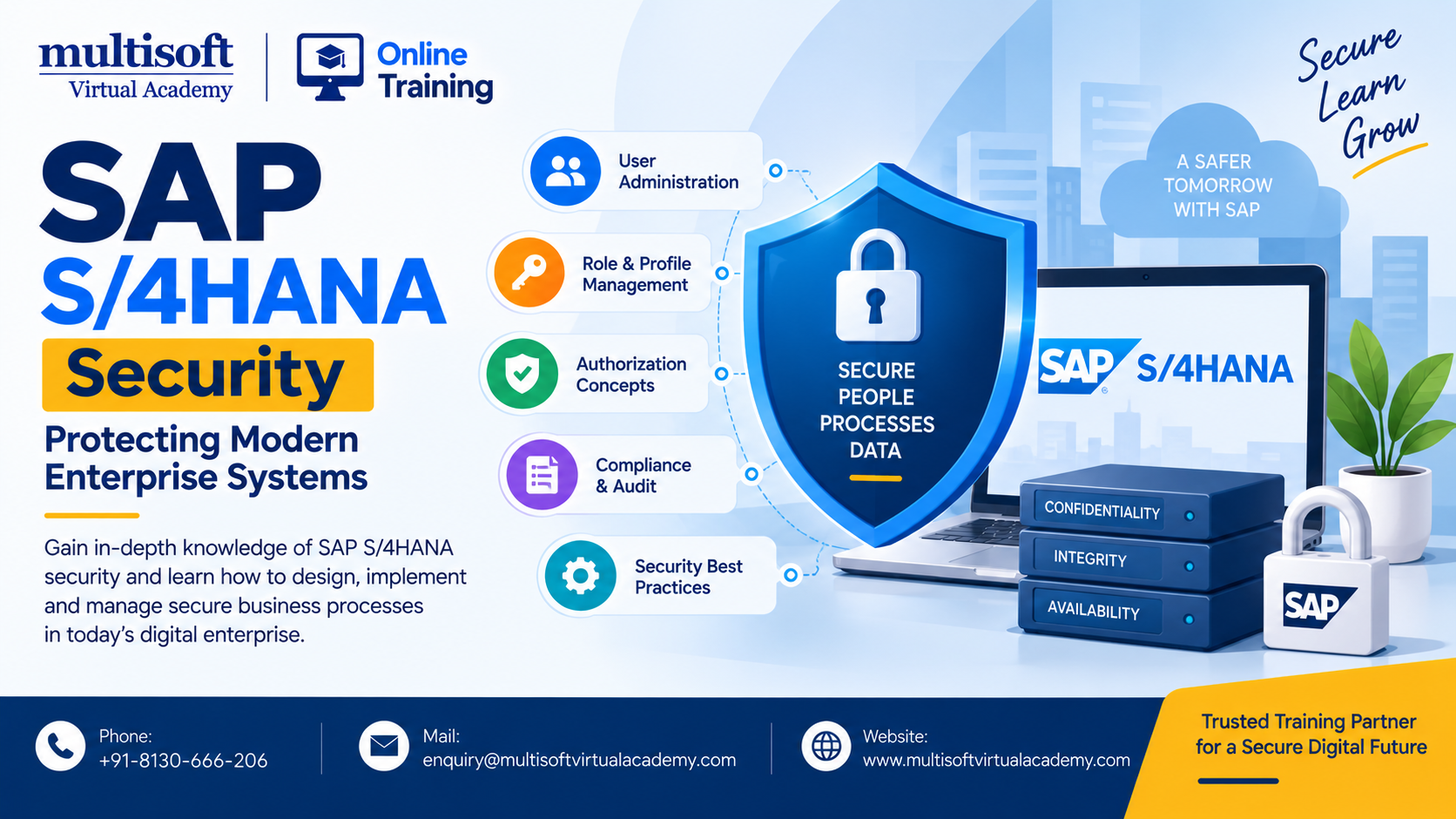
As businesses move critical operations to intelligent ERP environments, SAP S/4HANA Security has become a strategic priority rather than a technical afterthought. Modern SAP landscapes process sensitive financial, customer, employee, supply chain, and operational information. Protecting this information requires a structured security framework covering identities, authorizations, applications, databases, integrations, monitoring, and compliance.
SAP S/4HANA introduces a modern architecture with simplified data models, real-time analytics, Fiori applications, cloud capabilities, and extensive integration options. These capabilities improve business agility but also create new security considerations. Organizations therefore need effective SAP S/4HANA Security well-designed controls to reduce unauthorized access, data exposure, fraud, and operational risks.
SAP S/4HANA often becomes the central platform for business-critical processes. A compromised account or incorrectly configured authorization can potentially expose sensitive information or allow unauthorized transactions.
An effective security strategy helps organizations:
Security should therefore be incorporated throughout the SAP implementation lifecycle, from architecture and configuration to testing, deployment, monitoring, and continuous improvement.
The security architecture of SAP S/4HANA consists of multiple interconnected layers. Each layer requires appropriate controls to establish a strong security posture.
The major areas include:
Identity management determines who can access the SAP environment and how that access is controlled. Organizations should establish reliable authentication, user provisioning, deprovisioning, and identity lifecycle processes.
Integration with enterprise identity providers can also support centralized authentication and single sign-on. Multi-factor authentication can provide an additional layer of protection for privileged and sensitive accounts.
SAP authorization concepts determine what users are allowed to see and perform. Organizations should create roles according to business responsibilities rather than assigning excessive permissions.
Role design commonly considers:
Proper authorization management helps enforce the principle of least privilege.
Role design is one of the most important elements of SAP S/4HANA Security. Poorly designed roles can create excessive access privileges and increase the possibility of unauthorized activity.
A role should provide users with only the access required to perform their responsibilities. Access should be reviewed regularly because employee responsibilities, organizational structures, and business processes change over time.
Organizations should also distinguish between standard business users, technical users, administrators, developers, and privileged accounts. Each category requires different access controls.
SAP Fiori provides a modern user experience for SAP applications. However, securing Fiori requires more than protecting the user interface.
Security considerations can include:
Because Fiori applications can expose business functionality through intuitive interfaces, organizations should ensure that frontend access is aligned with backend authorization controls.
SAP HANA provides powerful in-memory data processing capabilities. Protecting the database is therefore an essential part of an SAP security strategy.
Database security can involve:
Organizations should carefully control technical and database administrator privileges. Highly privileged accounts should be monitored and periodically reviewed.
As enterprises increasingly adopt cloud-based SAP environments, security responsibilities extend across applications, identities, integrations, infrastructure, and configuration.
SAP S/4HANA Cloud security requires organizations to understand which security responsibilities are handled by the cloud provider and which remain with the customer.
Important areas include identity federation, user provisioning, access management, configuration security, API security, monitoring, data protection, and compliance.
A cloud migration should therefore include security planning from the beginning rather than treating security as a post-migration activity.
Segregation of Duties, commonly referred to as SoD, is a key internal control for organizations using SAP.
The objective is to prevent a single individual from having excessive control over a complete business process. For example, an employee who can create a vendor and independently process payments may present a higher fraud risk.
SoD analysis can identify conflicting combinations of access and help organizations establish mitigating controls.
Regular access reviews and risk analysis can help ensure that authorization structures remain aligned with business requirements.
Modern SAP environments frequently connect with enterprise identity systems and other applications. This makes SAP Identity and Access Management an important part of the broader security ecosystem.
IAM processes should cover the complete identity lifecycle:
Automating these processes where appropriate can reduce manual errors and improve access governance.
Preventive controls alone are not enough. Organizations also need mechanisms for detecting unusual or unauthorized activity.
SAP security monitoring can help security teams identify events such as:
Audit logs and security monitoring data can also support investigations and compliance assessments.
A strong SAP security program should follow a risk-based approach. Some important best practices include:
Users should receive only the permissions necessary for their jobs. Avoid broad authorization assignments when more precise access can be provided.
Administrative and emergency access should receive additional controls. Privileged accounts should be monitored and reviewed regularly.
Access requirements change as employees move between departments, projects, and responsibilities. Periodic reviews can help identify obsolete or excessive permissions.
Modern SAP environments communicate with external applications through APIs and integrations. These connections should be authenticated, authorized, encrypted, and monitored.
Security updates and supported software versions are important components of vulnerability management. Organizations should establish a structured patch and maintenance process.
Custom SAP applications, extensions, and integrations should undergo security testing before production deployment.
Continuous monitoring can improve an organization's ability to identify and respond to suspicious activity.
Organizations implementing or migrating to S/4HANA can encounter several security challenges.
One common challenge is legacy authorization design. Roles developed for older SAP environments may not always align perfectly with new business processes and Fiori applications.
Another challenge is excessive authorization. When users receive broad access for convenience, security risks can increase.
Integration complexity is another concern. SAP systems may connect with CRM platforms, cloud applications, identity providers, data platforms, third-party applications, and APIs. Every connection introduces additional security considerations.
Organizations may also struggle with continuous access governance. A role that was appropriate when assigned may become unnecessary months later.
Security should be integrated into every stage of an SAP S/4HANA implementation.
Start by evaluating existing systems, risks, user populations, integrations, and regulatory requirements.
Define the target security architecture, including authentication, authorization, identity management, network controls, monitoring, and data protection.
Create business roles based on actual job responsibilities and required access.
Test roles against business scenarios and identify excessive or missing permissions.
Analyze potential conflicts and establish appropriate mitigating controls.
Conduct security testing before production deployment.
Validate production roles, privileged access, monitoring, interfaces, and emergency access procedures.
Security should continue after implementation through monitoring, access reviews, vulnerability management, and periodic assessments.
Businesses operating in regulated industries must often demonstrate that sensitive information and business processes are adequately protected.
A properly structured SAP security framework can support compliance objectives involving access management, audit trails, data protection, change management, and internal controls.
Organizations should map security controls to their applicable regulatory and industry requirements instead of adopting a generic checklist.
The growing complexity of SAP environments has increased demand for professionals with specialized SAP S/4HANA Security training and practical knowledge.
Professionals working in SAP security can benefit from understanding:
Hands-on learning is particularly valuable because SAP security involves both technical configuration and business process understanding.
The future of SAP security will increasingly involve automation, cloud technologies, advanced analytics, identity-centric security, and intelligent threat detection.
Organizations are moving toward more integrated security models where identity, application access, data protection, monitoring, and governance work together.
Artificial intelligence may also contribute to security operations by helping identify unusual behavior and prioritize potential risks. However, organizations still need strong governance, clearly defined responsibilities, and human oversight.
As SAP environments become more interconnected, security will increasingly become a continuous business process rather than a one-time implementation activity.
SAP S/4HANA Security is essential for organizations that depend on SAP to manage critical business operations and sensitive enterprise data. From role-based authorization and SAP Fiori security to HANA database protection, identity management, SoD controls, cloud security, monitoring, and compliance, every layer contributes to a resilient SAP environment. Organizations looking to strengthen their capabilities can work with Multisoft Virtual Academy for structured learning and professional development focused on modern SAP security concepts, practical implementation approaches, and industry-relevant skills.
| Start Date | End Date | No. of Hrs | Time (IST) | Day | |
|---|---|---|---|---|---|
| No schedule available ! | |||||
Schedule does not suit you, Schedule Now! | Want to take one-on-one training, Enquiry Now! |
|||||






 Join our Live Instructor-Led online classes delivered by industry experts
 Let's Get Started