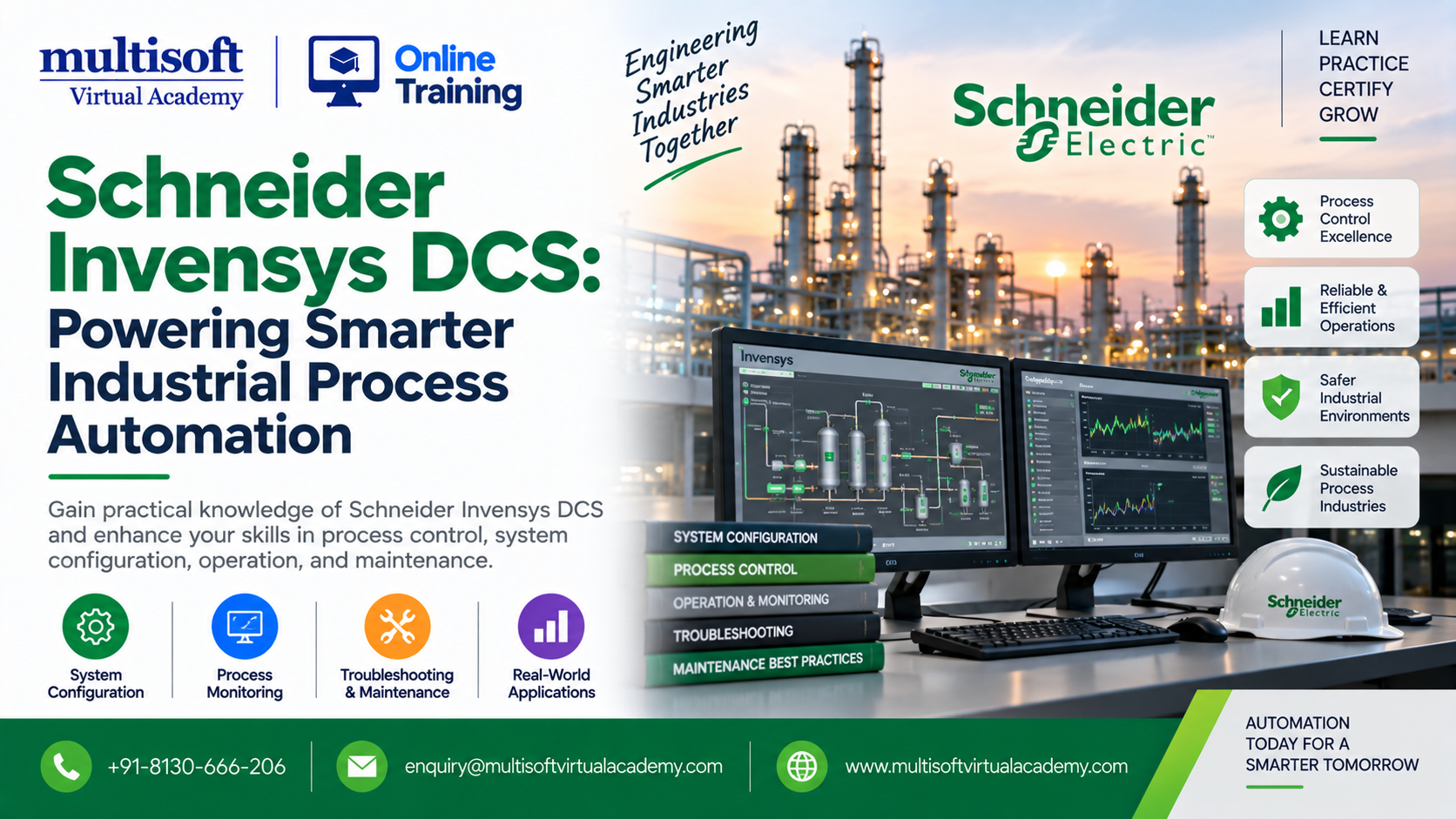
Industrial plants are becoming increasingly dependent on reliable automation, real-time monitoring and intelligent process control. In this environment, Schneider Invensys DCS technology continues to be an important area of interest for engineers, automation professionals and organizations operating complex process plants.
Schneider Invensys DCS is closely associated with the Foxboro family of distributed control systems and process automation technologies. Following Schneider Electric's acquisition of Invensys, the combined portfolio brought together established process automation capabilities and a broader industrial technology ecosystem. Schneider Electric has described the Foxboro portfolio as particularly suited to demanding continuous-process applications such as refining, petrochemicals, LNG and power generation.
For professionals working with process control, understanding the architecture, engineering concepts, operator interfaces, control strategies, integration methods and troubleshooting practices associated with Invensys and Foxboro systems can provide valuable practical knowledge.
A Distributed Control System, or DCS, is an industrial automation platform designed to control and monitor complex processes through distributed controllers, input/output systems, engineering stations, operator interfaces and industrial communication networks.
Schneider Invensys DCS generally refers to DCS technologies originating from Invensys and now associated with Schneider Electric's process automation portfolio. Foxboro I/A Series and Foxboro Evo are important names within this technology lineage.
Unlike conventional control approaches that may rely heavily on centralized processing, DCS architectures distribute control functions across the plant. This approach can improve operational availability, process visibility and scalability.
A typical DCS environment can include:
These capabilities make DCS technology particularly valuable for industries where continuous and reliable process control is essential.
Modern industrial facilities need more than basic machine control. Operators must understand process conditions, respond to alarms, maintain stable production and identify abnormal situations quickly.
A well-engineered DCS can support these requirements by bringing process information and control functions into a coordinated environment.
Schneider Invensys and Foxboro technologies have historically been associated with automation-intensive industries, including oil and gas, petrochemicals, refining, LNG and power generation. Schneider Electric has also positioned its process automation portfolio around applications requiring sophisticated control and integration capabilities.
For organizations, the major advantages of DCS technology can include:
When professionals search for Invensys DCS, they will frequently encounter the Foxboro name.
Foxboro has a long history in process automation and DCS technology. Foxboro I/A Series is one of the established systems associated with Invensys, while Foxboro Evo represents a later development in the technology family.
The Foxboro Evo platform evolved from Foxboro I/A Series and Triconex technologies. Industry documentation describes the system as supporting process automation through a fault-tolerant architecture and integration with safety systems.
This technology evolution is important for engineers because many industrial facilities continue to operate legacy automation infrastructure while simultaneously evaluating modernization strategies.
Understanding individual components is essential for anyone pursuing DCS engineering or Invensys DCS training.
Controllers execute control strategies and process logic. They receive information from field devices through I/O systems and generate outputs according to configured control algorithms.
Input/output modules connect field instrumentation with the control system. They may handle analog signals, digital signals and specialized communication interfaces depending on the system architecture.
The engineering environment allows qualified personnel to configure control strategies, system databases, graphics, alarms and other engineering functions.
Operators use HMI-based interfaces to monitor process conditions, acknowledge alarms, observe trends and interact with control functions.
The DCS network provides communication between controllers, workstations, servers and other plant systems. Network design, redundancy and reliability are critical considerations in industrial environments.
Effective alarm management helps operators identify abnormal conditions and prioritize actions. Poorly designed alarm systems can overwhelm operators, making alarm configuration and rationalization an important aspect of DCS engineering.
Process control is one of the most important areas of DCS operation.
Engineers may configure control blocks and PID loops to maintain variables such as:
PID control uses proportional, integral and derivative actions to regulate process variables around desired setpoints.
A strong understanding of PID fundamentals is therefore valuable for professionals working with Foxboro DCS and other industrial control systems.
However, successful DCS engineering involves more than configuring individual loops. Engineers must understand process requirements, control narratives, sequencing, interlocks, alarms and interactions between different control functions.
Modern process automation depends heavily on clear visualization.
DCS HMI environments provide operators with information about plant conditions through graphics, trends, alarms and process displays. This helps operators understand what is happening across the facility and respond appropriately.
Schneider Invensys DCS-related training commonly covers HMI development, graphics, alarm displays, historical data and trend analysis.
Although DCS and SCADA are different technologies, they can operate together in industrial environments. Understanding their differences and integration possibilities can help automation professionals work more effectively across complex plant architectures.
Process plants often require separate systems for basic process control and safety functions.
For example, Schneider Electric's historical Invensys portfolio included Foxboro process automation technology alongside Triconex safety systems. Schneider Electric has discussed the complementary nature of these technologies for demanding industrial applications.
Integration between process control and safety systems requires careful engineering because safety functions must follow applicable design, validation and operational requirements.
Professionals involved in DCS projects should therefore understand concepts such as:
One of the most important topics surrounding legacy DCS environments is modernization.
Industrial plants cannot always replace an entire control system at once. Production continuity, cost, engineering complexity and operational risk must all be considered.
As a result, organizations may evaluate different migration approaches, including phased migration, system modernization or replacement of legacy infrastructure.
Recent industry discussions around Foxboro DCS migration highlight approaches ranging from phased migration to like-for-like replacement and broader modernization initiatives.
A DCS migration project can involve:
The objective is not simply to install new technology. A successful migration should preserve essential control functionality while improving maintainability, reliability and future scalability.
Industrial automation technologies continue to evolve, but organizations still need professionals who understand the fundamentals of process control.
Schneider Invensys DCS Training can help engineers develop knowledge in areas such as system architecture, controllers, I/O, control strategies, HMI configuration, alarm management, integration and troubleshooting. Existing training curricula in this area commonly address these subjects and are aimed at automation, plant maintenance, operations and engineering professionals.
Training can be particularly useful for:
Hands-on understanding is especially valuable because DCS environments involve interconnected hardware, software, process logic and operational procedures.
Troubleshooting is an essential part of industrial automation.
A DCS engineer may need to investigate communication failures, controller issues, I/O problems, incorrect process values, alarm abnormalities, HMI problems or control-loop instability.
A systematic troubleshooting process should include:
Strong troubleshooting skills can reduce downtime and help organizations maintain stable plant operations.
The future of industrial automation is increasingly connected with digitalization, industrial cybersecurity, advanced analytics, remote operations and intelligent process optimization.
For DCS professionals, this means that traditional control knowledge should increasingly be combined with broader digital skills.
Important areas to explore include:
Professionals who understand both traditional process control and modern digital technologies can be better positioned to contribute to industrial modernization projects.
Before selecting a Schneider Invensys DCS course, professionals should evaluate whether the program covers both theoretical concepts and practical engineering requirements.
A useful curriculum should include DCS fundamentals, Foxboro architecture, control strategy development, HMI concepts, alarm management, communication, troubleshooting and industrial applications.
It is also important to consider whether the training is suitable for the learner's existing experience level. Beginners may require stronger coverage of process control fundamentals, while experienced engineers may prefer advanced configuration, migration, integration and troubleshooting topics.
The best learning approach should connect technical concepts with realistic industrial scenarios rather than focusing only on theoretical definitions.
Schneider Invensys DCS refers to distributed control technologies associated with Invensys and its integration into Schneider Electric's process automation portfolio. Foxboro I/A Series and Foxboro Evo are important technologies within this lineage.
Yes. Foxboro is strongly associated with Invensys process automation technology. Schneider Electric's acquisition of Invensys brought the businesses together and expanded Schneider Electric's process automation portfolio.
DCS technology is widely relevant to continuous and process-oriented industries such as oil and gas, refining, petrochemicals, LNG, chemicals, pharmaceuticals, manufacturing and power generation.
Professionals should develop knowledge of process control, DCS architecture, controllers, I/O, HMI, alarm management, industrial communication, PID control, troubleshooting, commissioning and system integration.
Yes. Many industrial facilities need modernization strategies that allow them to improve aging automation infrastructure while maintaining operational continuity. Migration planning is therefore an important skill for modern DCS professionals.
The importance of Schneider Invensys DCS extends beyond individual controllers or software tools. It represents a broader approach to reliable process automation, plant-wide monitoring, control strategy implementation and industrial operational excellence. As organizations modernize legacy systems and adopt more connected automation environments, professionals with strong DCS engineering and troubleshooting capabilities can play an important role in successful transformation.
For professionals and organizations looking to strengthen their knowledge of Schneider Invensys DCS, Foxboro DCS, DCS automation, process control, DCS engineering and industrial automation, Multisoft Virtual Academy provides specialized learning and professional training support designed around practical industrial requirements. Its Schneider Invensys DCS training can help learners understand system architecture, control strategies, HMI, alarms, integration and troubleshooting while developing skills relevant to modern process automation environments.
| Start Date | End Date | No. of Hrs | Time (IST) | Day | |
|---|---|---|---|---|---|
| No schedule available ! | |||||
Schedule does not suit you, Schedule Now! | Want to take one-on-one training, Enquiry Now! |
|||||






 Join our Live Instructor-Led online classes delivered by industry experts
 Let's Get Started