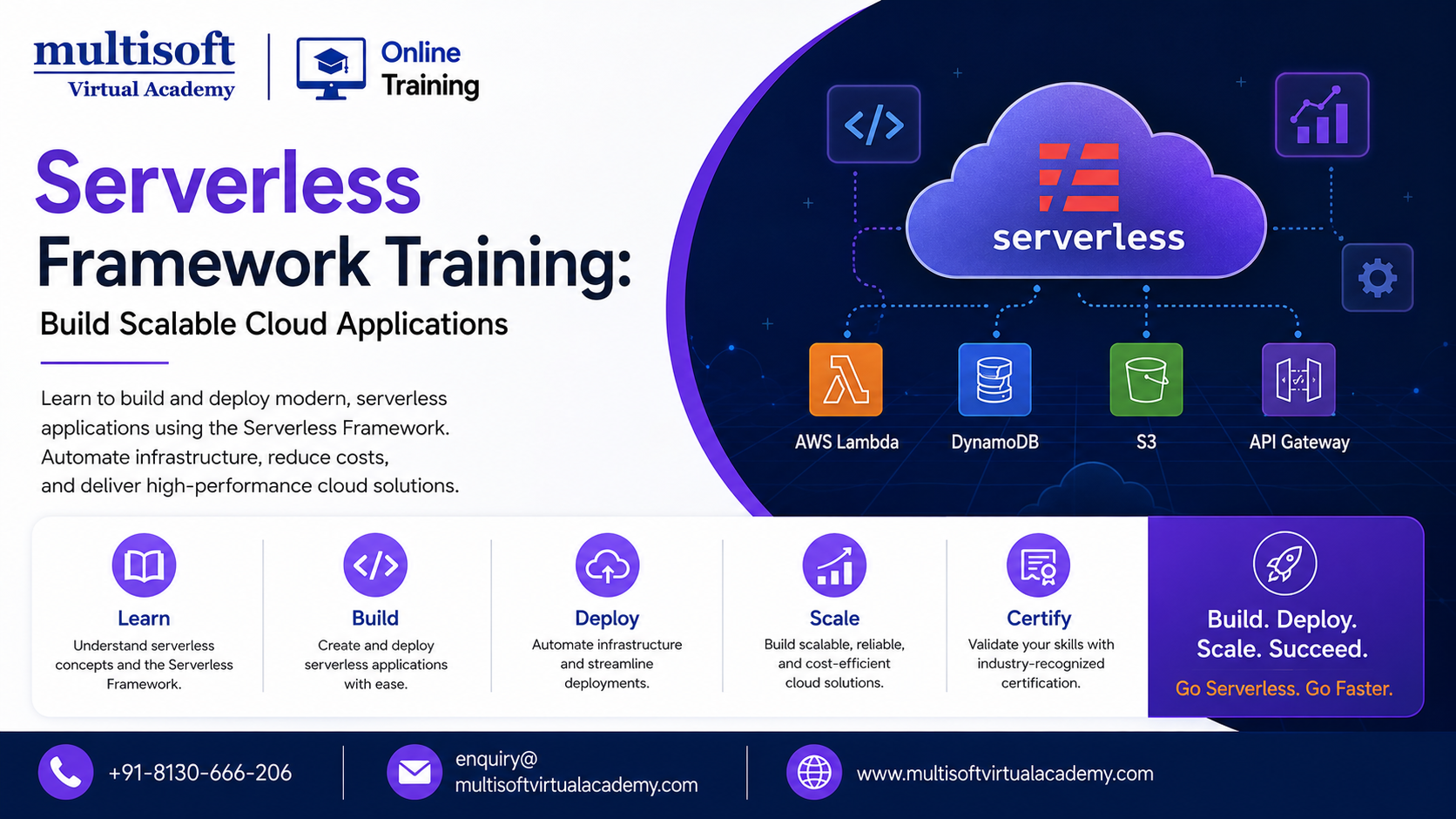
Serverless computing is transforming the way modern applications are designed, developed, deployed and managed. Instead of spending significant time provisioning and maintaining servers, development teams can focus on writing application logic while cloud platforms handle much of the underlying infrastructure. This approach supports faster development, automatic scaling and efficient resource utilization.
Serverless Framework Training is becoming increasingly relevant for developers, cloud engineers, DevOps professionals and architects who want practical expertise in building event-driven applications. The Serverless Framework provides a structured way to define, deploy and manage application code together with the cloud infrastructure required to run it. Its AWS integrations are particularly useful for building applications around services such as AWS Lambda, Amazon API Gateway, Amazon DynamoDB, Amazon S3 and event-driven messaging services.
Serverless computing is a cloud-native development approach in which the cloud provider manages the underlying servers, operating systems and much of the infrastructure administration. Developers deploy functions or application components without having to manage traditional server infrastructure directly.
The term "serverless" does not mean that servers do not exist. Rather, it means that infrastructure management is largely abstracted away from the development team. Applications can automatically respond to events, scale according to demand and use managed cloud services for databases, storage, APIs, messaging and monitoring.
This model has become an important part of cloud computing, cloud-native development, microservices architecture and DevOps practices.
Modern organizations are increasingly looking for ways to release applications faster while controlling infrastructure complexity. Serverless architecture can support these goals when it is applied to suitable workloads.
A structured Serverless Framework Training program helps professionals understand both the technology and the architectural decisions behind serverless applications.
Key areas of learning can include:
The Serverless Framework documentation describes the framework as a tool for developing and deploying AWS Lambda functions together with the infrastructure resources they require. It also supports multiple programming languages and event-driven application patterns.
AWS Lambda is one of the most important technologies associated with serverless application development. Lambda enables developers to run application code in response to events without managing traditional servers.
For example, a Lambda function can respond to:
The Serverless Framework helps developers define functions and connect them with events and supporting AWS resources through a centralized project configuration.
This makes Serverless Framework with AWS Lambda an important learning combination for professionals seeking practical cloud development skills.
A strong understanding of serverless architecture goes beyond knowing how to deploy a Lambda function. Professionals need to understand how different cloud services work together to create reliable applications.
A typical serverless application might contain an API Gateway endpoint that receives a request, an AWS Lambda function that processes the request, DynamoDB for data storage and S3 for object storage. Additional services can be introduced for messaging, authentication, monitoring and workflow orchestration.
This architecture can reduce infrastructure management responsibilities while allowing applications to be assembled from specialized managed services.
However, serverless is not automatically the best architecture for every application. Factors such as workload characteristics, execution duration, latency requirements, security, vendor dependencies and operational requirements should be evaluated before selecting a serverless approach.
Event-driven architecture is a major concept in serverless computing. Instead of continuously running application processes, functions can execute when specific events occur.
For example, an online application could trigger a function when:
This approach can help teams create loosely coupled application components. The Serverless Framework supports event definitions that connect functions with AWS services such as API Gateway, S3, SNS and scheduled events.
Learning event-driven architecture is therefore an important part of becoming proficient in serverless development.
One of the most valuable concepts covered in Serverless Framework training is Infrastructure as Code (IaC).
Traditional infrastructure management can involve manually configuring multiple cloud resources. With Infrastructure as Code, infrastructure requirements can be represented through configuration files and deployed consistently.
The Serverless Framework uses service configuration to define functions, events, plugins and cloud resources. These configurations can then be deployed to the selected environment.
This approach can improve:
For DevOps teams, combining Serverless Framework, Infrastructure as Code and CI/CD can create a more automated application delivery process.
Deployment is a core part of practical serverless development. The framework provides commands that help developers create services, configure cloud resources and deploy application components.
A Serverless Framework service commonly uses a configuration file such as serverless.yml to describe the application and its infrastructure. The deployment process can translate this configuration into the cloud resources required by the application.
Modern Serverless Framework workflows also support development, deployment and environment management capabilities. Current documentation for Serverless Framework Version 4 includes functionality for development workflows and AWS authentication options.
Serverless API development is another important application area. Developers can combine API Gateway with Lambda functions to create scalable HTTP APIs without managing conventional web servers.
For example, an application may provide endpoints for:
A Serverless Framework project can define API events associated with Lambda functions and deploy the required infrastructure. The official tutorial demonstrates creating an HTTP API with Serverless Framework and AWS.
This practical combination makes serverless technologies useful for developing modern web applications, mobile backends and microservices.
Microservices architecture divides an application into smaller services that can be developed and deployed independently. Serverless functions naturally support this model because individual functions can perform focused business operations.
A serverless microservices environment might include separate functions for customer registration, order processing, inventory updates and notification delivery.
However, simply converting every application component into an individual function can create unnecessary complexity. Effective serverless architecture design requires careful consideration of service boundaries, dependencies, observability, security and operational management.
Professionals should therefore learn when to use functions independently and when to group related capabilities into a broader service.
Security remains a critical consideration in serverless application development.
Although cloud providers manage significant portions of the infrastructure, application teams remain responsible for areas such as identity management, permissions, application logic, data protection and secure configuration.
Important areas include:
A good Serverless Framework Training program should therefore include security principles rather than focusing only on deployment commands.
Serverless applications require effective observability because traditional server-based troubleshooting methods do not always apply.
Developers should understand how to monitor:
Cloud monitoring and logging services can provide visibility into application behavior. Effective observability helps development teams identify failures, investigate performance issues and improve application reliability.
Serverless applications can deliver excellent scalability, but performance still requires careful engineering.
Developers may need to consider:
AWS Lambda training combined with Serverless Framework experience can help professionals understand these factors and build more efficient applications.
Performance optimization should always be based on actual application requirements and measured behavior rather than assumptions.
The combination of Serverless Framework and DevOps is particularly valuable for organizations seeking automated software delivery.
A serverless DevOps workflow can include:
Source Control ? Automated Testing ? Build ? Infrastructure Validation ? Deployment ? Monitoring ? Feedback
This approach can reduce manual deployment activities and improve consistency across development, testing and production environments.
Serverless applications can also integrate with CI/CD pipelines to automate deployments when changes are approved and merged into the appropriate development branch.
For DevOps professionals, learning serverless therefore extends beyond application development and into automated cloud infrastructure management.
Serverless Framework Training can be useful for professionals who already work with software development, cloud platforms or DevOps technologies.
It can benefit:
Professionals with experience in Node.js, Python, Java, TypeScript, AWS or cloud development may find it especially useful because the Serverless Framework supports multiple programming languages and development approaches.
Serverless development is applicable to many modern workloads.
Common examples include:
Build scalable backend APIs using API Gateway and Lambda.
Create authentication, data processing and notification services for mobile applications.
Process uploaded files, application events and data streams using event-driven functions.
Run recurring processes without keeping a dedicated server continuously active.
Automate business processes by connecting functions with messaging and workflow services.
Build event-driven capabilities for applications that need rapid processing and communication.
Support customer workflows, order processing, notifications and backend APIs through independently scalable services.
A comprehensive Serverless Framework course should combine conceptual learning with practical implementation.
Participants should ideally gain experience in creating a project, defining functions, configuring events, connecting cloud resources and deploying the application.
Important practical skills include:
The official Serverless Framework resources provide tutorials and examples for creating projects and deploying applications to AWS.
Cloud engineering is increasingly moving toward managed services, automation and cloud-native application patterns. Professionals who understand serverless technologies can contribute to projects where organizations want to minimize infrastructure administration and accelerate application delivery.
Serverless expertise can complement existing skills in:
AWS | DevOps | Cloud Computing | Microservices | APIs | Infrastructure as Code | CI/CD | Python | Node.js | TypeScript | Cloud Architecture
Rather than treating serverless as an isolated technology, professionals can view it as one component of a broader cloud-native engineering skill set.
When selecting a training program, learners should look beyond the course title. A quality program should provide structured concepts, practical demonstrations, real-world scenarios and opportunities to work with cloud services.
Important factors include:
The Serverless ecosystem continues to evolve, making it important for training content to remain aligned with current framework capabilities and cloud development practices. Current Serverless Framework documentation includes Version 4 capabilities and updated AWS development workflows.
Serverless computing is likely to remain an important component of cloud-native development as organizations continue adopting managed infrastructure, event-driven systems and automated deployment models.
Its relevance extends across application development, APIs, data processing, automation, microservices and digital transformation initiatives.
At the same time, professionals should understand the architectural trade-offs associated with serverless technology. Successful implementation depends on selecting appropriate workloads, designing efficient functions, managing dependencies and establishing strong security and observability practices.
The goal is not simply to eliminate servers. The goal is to build applications that use cloud infrastructure efficiently while allowing development teams to focus on delivering business value.
Multisoft Virtual Academy provides professional Serverless Framework Training designed to help learners build practical knowledge of serverless computing, AWS Lambda, serverless architecture, API development, event-driven architecture, Infrastructure as Code, DevOps and cloud-native application development. For professionals seeking to strengthen their cloud skills, structured training can provide the practical foundation needed to understand, develop and deploy modern serverless applications with greater confidence.
| Start Date | End Date | No. of Hrs | Time (IST) | Day | |
|---|---|---|---|---|---|
| 10 Oct 2026 | 01 Nov 2026 | 24 | 06:00 PM - 09:00 PM | Sat, Sun | |
| 11 Oct 2026 | 02 Nov 2026 | 24 | 06:00 PM - 09:00 PM | Sat, Sun | |
Schedule does not suit you, Schedule Now! | Want to take one-on-one training, Enquiry Now! |
|||||






 Join our Live Instructor-Led online classes delivered by industry experts
 Let's Get Started