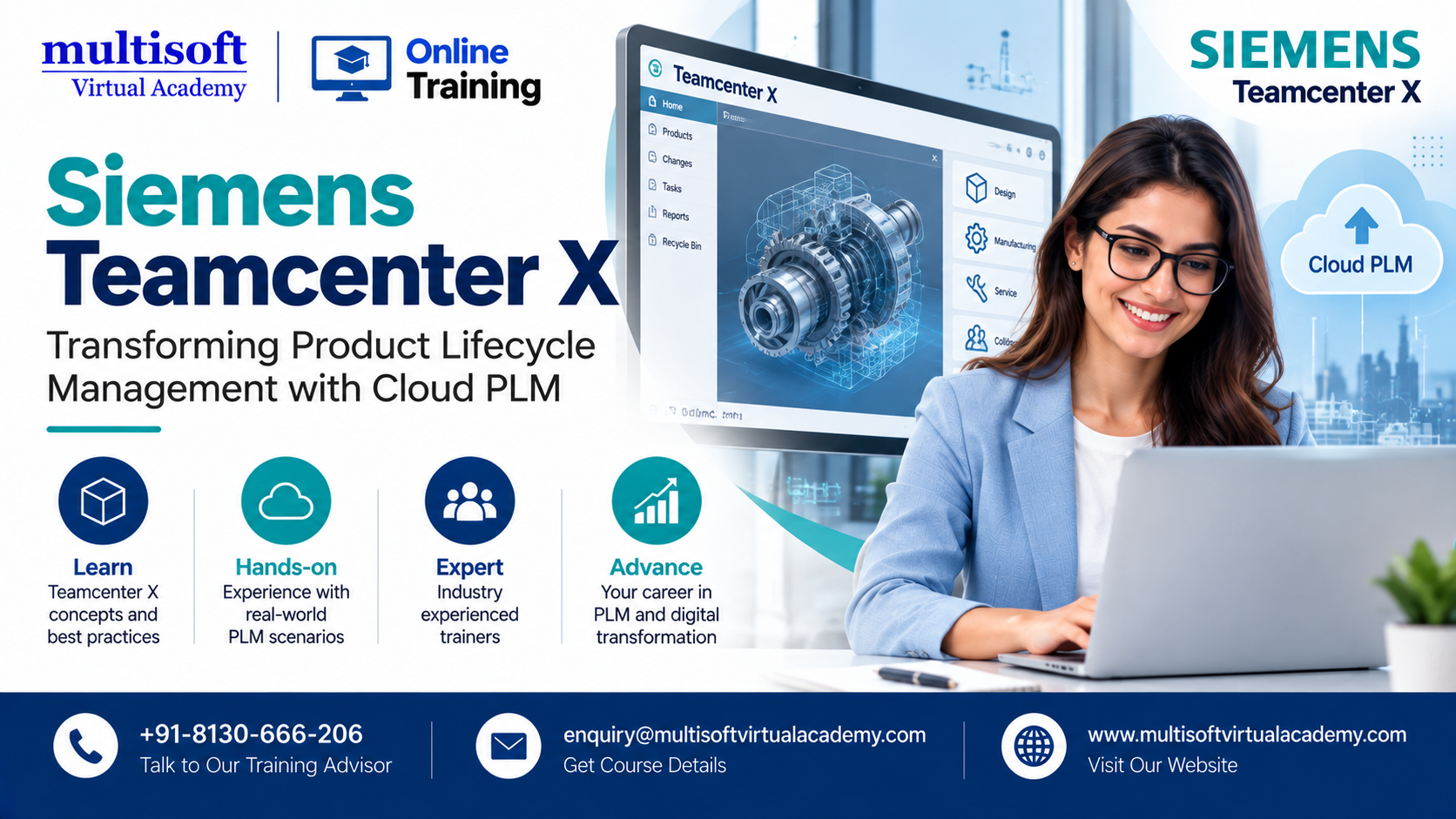
Product Lifecycle Management (PLM) is becoming increasingly important as manufacturers manage more complex products, distributed engineering teams, tighter development timelines, and growing volumes of product data. Traditional PLM environments can involve significant infrastructure, administration, upgrades, and integration requirements. Siemens Teamcenter X addresses many of these challenges through a cloud-based Software-as-a-Service (SaaS) approach to PLM.
Teamcenter X brings the capabilities of Teamcenter to the cloud while allowing organizations to manage product information, engineering processes, documents, bills of materials (BOMs), requirements, changes, and collaboration through a connected environment. Siemens describes Teamcenter X as a SaaS delivery of its Teamcenter PLM portfolio, operated and maintained by Siemens.
With cloud PLM, digital thread, digital twin, AI-enabled capabilities, and cross-domain collaboration becoming major priorities, Teamcenter X training, Teamcenter X certification, Teamcenter PLM training, Siemens PLM training, and cloud PLM skills are increasingly relevant for professionals working across engineering and manufacturing.
Siemens Teamcenter X is a cloud-based SaaS delivery of Teamcenter Product Lifecycle Management software. Instead of requiring organizations to operate the PLM infrastructure themselves, Siemens manages operations, maintenance, and updates as part of the SaaS model.
The platform is designed to help organizations connect product data and processes throughout the product lifecycle. Depending on the selected tier, capabilities can include mechanical CAD data management, document management, change management, project scheduling, requirements, electrical and electronic data management, classification, enterprise BOM, manufacturing planning, quality and compliance, product cost management, service lifecycle management, and model-based systems engineering.
This makes Teamcenter X particularly relevant to organizations looking for a modern cloud PLM solution that can grow with their business.
Manufacturing organizations are increasingly distributed. Engineering, manufacturing, suppliers, product managers, quality teams, and service departments may operate from different locations while working on the same product.
Traditional approaches based on disconnected applications, file sharing, and locally managed infrastructure can make it difficult to maintain a consistent view of product information.
Recent PLM trends point toward cloud adoption, connected data, AI, digital threads, and cross-domain collaboration. Siemens' recent discussion of PLM trends highlights cloud scalability and connected product data as important elements of modern PLM strategies.
A cloud PLM platform can help organizations:
These capabilities explain why cloud PLM software is becoming a significant technology area for modern manufacturing.
Teamcenter X provides different capability levels through its tiered SaaS offering. Siemens currently lists Essentials, Standard, Advanced, and Premium tiers, allowing organizations to start with required functionality and expand as their needs increase.
Product data is one of the foundations of PLM. Teamcenter X helps organizations manage product-related information, including CAD data, documents, revisions, and related structures.
A centralized approach can make it easier for teams to locate the latest approved information and reduce dependence on disconnected repositories.
BOM management is critical for engineering and manufacturing organizations.
Teamcenter X can support BOM-related processes across product domains, helping teams establish a more connected view of product structures. Higher-tier capabilities include enterprise BOM functionality and manufacturing planning.
Engineering changes can affect designs, components, documentation, manufacturing processes, suppliers, and schedules.
Teamcenter X provides change-management capabilities that help organizations control revisions and manage product changes through structured processes. Advanced capabilities also support effectivity control.
Modern product development requires requirements to remain connected with designs, documentation, and downstream activities.
Teamcenter X Standard and higher tiers include capabilities for creating and linking requirements, helping teams improve traceability throughout product development.
Modern products often combine mechanical, electrical, electronic, and software components.
Teamcenter X Advanced is designed to support cross-domain design collaboration and can help organizations manage mechanical, electrical, and electronic product information within a connected PLM environment.
The digital thread connects information and processes throughout the product lifecycle, while the digital twin provides a digital representation of a physical product or system.
Teamcenter X supports the broader Teamcenter portfolio for connecting product development with manufacturing, service, and suppliers.
This is particularly relevant for organizations pursuing digital transformation in manufacturing.
Siemens Teamcenter X vs. Traditional Teamcenter
One common question is: What is the difference between Teamcenter and Teamcenter X?
The fundamental Teamcenter capabilities remain closely related. The major distinction is the delivery and operational model.
Teamcenter X is Teamcenter delivered as a cloud service operated by Siemens. Organizations can therefore access PLM capabilities without managing the same level of infrastructure operations associated with a self-managed deployment.
This distinction makes Teamcenter X cloud PLM attractive to organizations seeking faster implementation and lower operational complexity.
Instead of concentrating heavily on infrastructure administration, internal teams can focus more on product processes, data quality, engineering collaboration, and business outcomes.
As organizations modernize their PLM environments, professionals who understand cloud-based PLM can develop valuable technical and functional skills.
Teamcenter X training can help learners understand how product information and lifecycle processes are managed in a cloud environment.
Professionals can build knowledge around areas such as:
Teamcenter skills can be relevant across several industries, including:
Professionals may explore career paths such as Teamcenter Administrator, Teamcenter Developer, PLM Consultant, PLM Analyst, Product Data Manager, Teamcenter Implementation Specialist, and PLM Solution Architect, depending on their existing experience and specialization.
AI is becoming an important part of modern PLM strategies.
Manufacturers have large amounts of engineering and product information, but extracting useful insights from that information can be difficult when data is fragmented.
Current Teamcenter X developments increasingly connect PLM with AI capabilities. Siemens highlights AI as part of the broader evolution of PLM, including applications such as finding information, understanding relationships, supporting engineering decisions, and improving productivity.
For professionals, this creates an important intersection between AI in manufacturing, PLM, engineering data, digital transformation, and cloud technology.
Understanding how AI can work with structured product information may become increasingly valuable as manufacturers adopt intelligent engineering workflows.
Teamcenter X can be relevant for professionals who already work with product development, engineering, manufacturing, or enterprise technology.
Suitable learners may include:
Professionals moving from traditional PLM environments toward cloud platforms may also benefit from developing knowledge of Teamcenter X implementation and administration concepts.
A comprehensive Siemens Teamcenter X training course should ideally combine theoretical knowledge with practical, scenario-based learning.
Important topics can include:
Understanding product lifecycle management, product data, processes, users, roles, and lifecycle stages.
Understanding cloud SaaS delivery, platform concepts, applications, security considerations, and operational responsibilities.
Working with product information, documents, CAD data, revisions, and structures.
Understanding product structures, BOM concepts, revisions, effectivity, and related processes.
Learning how engineering changes are initiated, reviewed, approved, implemented, and tracked.
Understanding requirements traceability and relationships between requirements and product information.
Learning how teams collaborate and how lifecycle processes can be structured.
Understanding how PLM interacts with CAD, ERP, manufacturing, engineering, and other enterprise applications.
Understanding how connected product information supports the product lifecycle.
Applying Teamcenter X concepts to realistic engineering and manufacturing scenarios.
Hands-on learning is especially important because PLM involves both technology and business processes.
Digital transformation in manufacturing is not simply about moving applications to the cloud. It involves connecting people, processes, data, and technologies.
A modern PLM environment can become an important foundation for that transformation.
Teamcenter X provides a cloud-based environment in which organizations can connect product development information with broader lifecycle processes. Siemens positions the platform around planning, developing, and delivering products while connecting product development with manufacturing, service, and suppliers.
For companies pursuing connected engineering, this can help establish a more consistent product information environment.
The future of manufacturing is increasingly connected.
Products are becoming more complex, engineering teams are becoming more distributed, and organizations are adopting cloud platforms, AI, digital twins, automation, and advanced analytics.
This means PLM professionals need more than traditional product-data skills. They increasingly need to understand how PLM interacts with cloud infrastructure, digital engineering, enterprise systems, and emerging technologies.
Teamcenter X provides an important learning pathway for professionals who want to understand modern cloud-based Product Lifecycle Management.
Its SaaS model can also help organizations start with specific PLM requirements and expand functionality as their business grows. Siemens currently offers multiple Teamcenter X tiers with progressively broader capabilities.
Multisoft Virtual Academy provides professional learning solutions for individuals and organizations seeking to strengthen their knowledge of Siemens Teamcenter X, Teamcenter PLM, cloud PLM, product lifecycle management, digital thread, BOM management, and modern manufacturing technologies. With practical, career-focused learning, the right training can help professionals understand how cloud-based PLM supports engineering collaboration, product data management, change processes, and digital transformation. For learners and organizations looking to develop relevant Teamcenter X skills, structured training can be a valuable step toward building stronger PLM expertise and preparing for the evolving demands of modern product development.
| Start Date | End Date | No. of Hrs | Time (IST) | Day | |
|---|---|---|---|---|---|
| No schedule available ! | |||||
Schedule does not suit you, Schedule Now! | Want to take one-on-one training, Enquiry Now! |
|||||






 Join our Live Instructor-Led online classes delivered by industry experts
 Let's Get Started