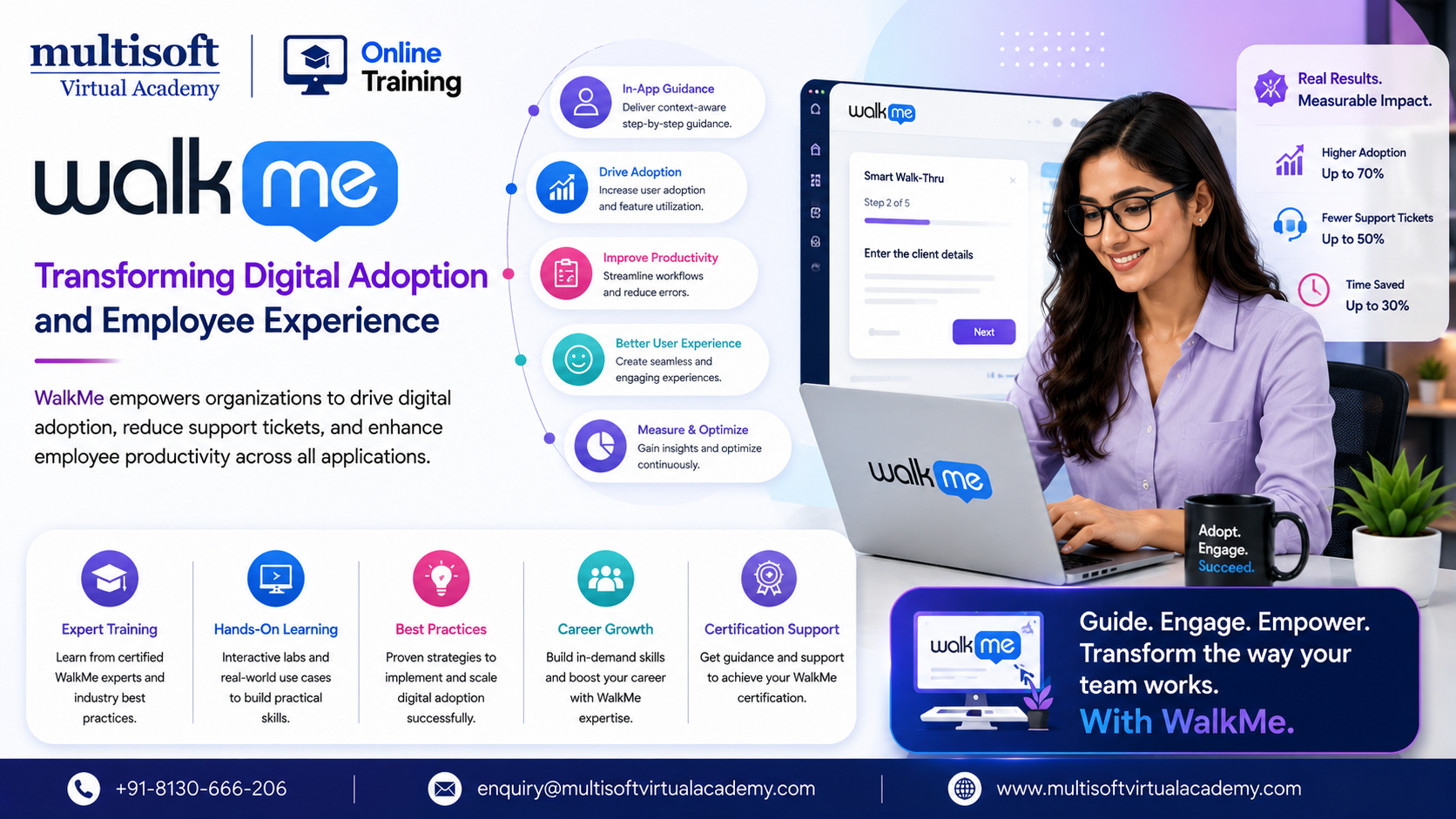
Digital transformation is no longer simply about implementing new software. Organizations invest heavily in enterprise applications, cloud platforms, automation and artificial intelligence, yet the expected business value often depends on one critical factor: whether employees can effectively use these technologies. This is where WalkMe has become an important digital adoption platform for organizations seeking to improve user engagement, software adoption and workplace productivity.
Modern businesses are increasingly searching for practical ways to simplify complex applications, reduce employee frustration and accelerate digital transformation. Digital adoption platforms such as WalkMe help organizations guide users directly within their applications, making technology easier to understand and use.
WalkMe is a digital adoption platform designed to help organizations improve the way employees and customers interact with digital applications. It provides contextual guidance, interactive assistance, automation and insights that can help users complete tasks more efficiently.
Instead of relying entirely on lengthy manuals, classroom training or support tickets, organizations can provide guidance within the software environment itself. Users can receive relevant instructions while performing a task, helping them learn applications through practical experience.
WalkMe Training can support digital adoption across enterprise applications, business processes and employee workflows. Its capabilities are particularly valuable for organizations managing complex technology ecosystems where users interact with multiple platforms every day.
Implementing new technology does not automatically produce business results. Employees need to understand how to use the technology correctly and consistently. Poor adoption can result in unused software features, inefficient processes, increased support costs and reduced return on technology investments.
Digital adoption focuses on closing this gap.
Organizations can use digital adoption strategies to:
With businesses continuing to adopt AI-powered applications, cloud software and enterprise platforms, the importance of effective digital adoption is expected to increase further.
The digital adoption platform market has evolved as organizations recognize that software training needs to move beyond traditional approaches. Employees increasingly expect technology to be intuitive, accessible and easy to learn.
WalkMe addresses this requirement by placing digital guidance within the user's workflow. Rather than asking users to leave an application and search for instructions, organizations can deliver contextual assistance at the point where it is needed.
This approach can make learning more immediate and practical. It also helps organizations create a more consistent digital experience across different user groups.
WalkMe offers several capabilities that can contribute to successful digital adoption initiatives.
In-app guidance can help users understand processes while they work inside an application. Step-by-step assistance can make unfamiliar workflows easier to navigate and can reduce dependency on external documentation.
Employee onboarding can become challenging when new hires must learn multiple enterprise applications simultaneously. WalkMe can provide contextual guidance that helps employees become familiar with important workflows and software features.
Complex business processes often involve multiple steps. Digital guidance can help users understand what to do next and complete workflows with greater confidence.
Automation can reduce repetitive manual activities and help users complete routine tasks more efficiently. This can contribute to productivity improvements while allowing employees to spend more time on higher-value responsibilities.
Understanding how employees interact with applications is essential for improving digital experiences. Digital adoption analytics can help organizations identify areas where users encounter difficulties, fail to complete processes or underutilize available features.
These insights can support continuous improvement and help technology teams make more informed decisions.
Employee productivity is closely connected to how easily people can access and use the tools provided by their organization. When employees struggle with complicated software, even simple tasks can consume unnecessary time.
WalkMe can help simplify digital workflows by providing assistance directly within applications. Employees can receive guidance without constantly switching between systems, searching knowledge bases or contacting support teams.
This can be especially useful in environments where employees work with CRM, ERP, HR, finance, collaboration and other enterprise applications.
Traditional software training often takes place before employees begin using an application. However, users may forget information when they encounter the same process weeks or months later.
Digital adoption introduces a more continuous approach to learning.
Instead of depending exclusively on one-time training sessions, organizations can provide guidance at the moment employees need it. This creates opportunities for learning within real workflows and can reinforce knowledge through repeated use.
For organizations with distributed teams, remote employees or frequent software updates, this approach can provide additional flexibility.
Large enterprises frequently operate complex technology environments containing numerous applications and platforms. Employees may need to switch between different systems throughout their workday.
Application adoption can become difficult when interfaces, processes and terminology differ from one system to another.
A digital adoption platform can help create a more consistent experience by guiding users through important processes. This can be particularly valuable during enterprise software implementation, system migration and application upgrades.
Organizations can use digital adoption strategies to support users before, during and after technology rollouts.
Technology implementation is also a change-management challenge. Employees may resist new applications when they do not understand why a change is necessary or when the new workflow appears complicated.
Successful change management requires communication, training and ongoing support.
WalkMe can complement these initiatives by providing practical assistance inside the new application. Instead of simply telling employees how a new system works, organizations can guide them through relevant processes as they use the platform.
This can help bridge the gap between theoretical training and practical application.
Organizations invest substantial resources in enterprise software. However, purchasing a sophisticated platform does not guarantee that employees will use all of its capabilities.
Low adoption can reduce the return on investment from technology.
Digital adoption can help organizations identify underused features and encourage users to follow recommended workflows. Better adoption can contribute to improved software utilization and help organizations extract greater value from existing technology investments.
The objective is not simply to make employees use software. It is to help them use the right features in the right way to support measurable business outcomes.
Digital adoption is not limited to internal employees. Organizations can also focus on improving digital experiences for customers and other external users.
Complex portals, applications and digital services can create friction when users do not understand how to complete important actions.
Contextual assistance can help users navigate digital experiences more confidently. By simplifying interactions, organizations can potentially improve engagement, reduce abandonment and support customer satisfaction.
Artificial intelligence is changing how employees interact with enterprise technology. AI assistants, intelligent automation and generative AI tools are becoming part of everyday business operations.
However, introducing AI creates a new adoption challenge. Employees must understand not only how to access AI tools but also how to incorporate them into existing workflows responsibly and effectively.
Digital adoption platforms can play an important role in supporting this transition. Organizations can use contextual guidance to introduce new capabilities, explain workflows and encourage appropriate usage.
The combination of AI and digital adoption therefore represents an important direction for modern workplace transformation.
Organizations considering a digital adoption initiative should understand the challenges that may affect implementation.
Employees may prefer familiar processes and hesitate to adopt new systems. Clear communication and practical guidance can help reduce this resistance.
Organizations using many applications may struggle to provide consistent training and support. A centralized digital adoption strategy can help address this complexity.
Without reliable usage data, organizations may find it difficult to identify adoption problems. Analytics can help technology leaders understand user behavior and prioritize improvements.
Enterprise applications frequently change. Training materials can quickly become outdated. In-app guidance can provide a more adaptable way to support users as workflows evolve.
A successful digital adoption initiative requires more than simply deploying technology. Organizations should begin by identifying specific business problems and user challenges.
Important best practices include:
The future of workplace technology will increasingly depend on how effectively people and technology work together. Organizations are adopting more applications, automation and AI capabilities while employees are expected to adapt quickly.
This creates demand for intelligent digital adoption solutions that can provide personalized assistance, actionable insights and seamless user experiences.
Digital adoption is likely to become an integral part of enterprise transformation rather than an optional training initiative. Companies that prioritize user experience alongside technology implementation can be better positioned to achieve sustainable digital transformation.
As businesses continue to modernize their technology environments, solutions such as WalkMe can help connect technology investments with actual employee behavior and business outcomes.
Every organization has different applications, processes, workforce requirements and transformation objectives. Therefore, the right digital adoption strategy should begin with an assessment of current technology usage and user challenges.
Organizations should consider factors such as application complexity, workforce size, training requirements, adoption gaps, existing support processes and measurable business objectives.
A well-planned strategy can help businesses move from technology implementation to technology utilization, ensuring that employees are equipped to gain meaningful value from the tools available to them.
WalkMe represents an important approach to solving one of the biggest challenges in digital transformation: helping people successfully adopt and use technology. From employee onboarding and software training to workflow assistance, analytics, automation and AI adoption, digital adoption can help organizations create more productive and engaging digital workplaces. Multisoft Virtual Academy supports organizations and professionals seeking practical, industry-focused learning and service solutions around emerging enterprise technologies, helping them strengthen digital capabilities, improve technology adoption and stay prepared for an increasingly technology-driven business environment.
| Start Date | End Date | No. of Hrs | Time (IST) | Day | |
|---|---|---|---|---|---|
| No schedule available ! | |||||
Schedule does not suit you, Schedule Now! | Want to take one-on-one training, Enquiry Now! |
|||||






 Join our Live Instructor-Led online classes delivered by industry experts
 Let's Get Started