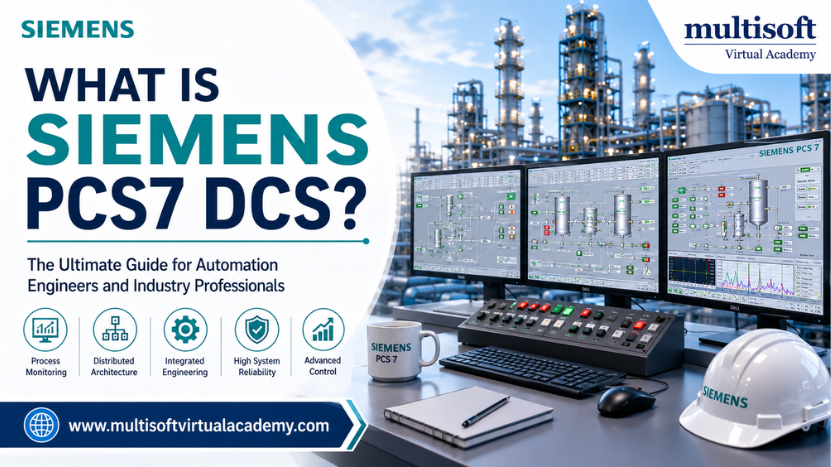
Siemens PCS7 (Process Control System 7) is a comprehensive Distributed Control System (DCS) developed by Siemens for automating, monitoring, and controlling complex industrial processes. Designed to meet the needs of modern process industries, PCS7 integrates process control, visualization, engineering, safety, diagnostics, and asset management into a single, scalable automation platform. It enables organizations to efficiently manage continuous and batch processes while ensuring high system availability, operational reliability, and consistent product quality.
Built on the proven SIMATIC automation platform, Siemens PCS7 combines advanced engineering tools, operator interfaces, communication networks, and automation controllers to provide centralized process management. The system supports seamless integration with field devices, PLCs, SCADA systems, Manufacturing Execution Systems (MES), Enterprise Resource Planning (ERP) solutions, and Industrial Internet of Things (IIoT) technologies. Its modular architecture allows businesses to expand automation capabilities as operational requirements grow, making it suitable for both small production facilities and large industrial plants.
Siemens PCS7 is widely deployed across industries such as oil and gas, chemical processing, pharmaceuticals, power generation, food and beverage, water treatment, cement, mining, and manufacturing. With features such as real-time monitoring, advanced process control, alarm management, redundancy, cybersecurity, and predictive maintenance, the platform helps organizations improve productivity, reduce downtime, optimize energy consumption, and maintain regulatory compliance. As industries continue embracing digital transformation and smart manufacturing, Siemens PCS7 remains one of the most trusted and widely adopted DCS solutions for achieving efficient, safe, and intelligent industrial automation.
Siemens PCS7 (Process Control System 7) is an advanced Distributed Control System (DCS) developed by Siemens to automate, monitor, and optimize complex industrial processes through a centralized and integrated automation platform. Built on the SIMATIC automation architecture, PCS7 combines engineering tools, automation controllers, Human Machine Interface (HMI), process visualization, industrial communication, alarm management, diagnostics, safety systems, and asset management into a single solution. It supports both continuous and batch process automation while enabling seamless integration with field devices, PLCs, SCADA systems, Manufacturing Execution Systems (MES), Enterprise Resource Planning (ERP) solutions, and Industrial Internet of Things (IIoT) technologies. Designed for high availability, scalability, and operational reliability, Siemens PCS7 is widely used across industries such as oil and gas, chemicals, pharmaceuticals, power generation, food and beverage, water treatment, mining, and cement. The platform helps organizations improve productivity, enhance process safety, reduce operational costs, ensure regulatory compliance, and accelerate digital transformation through intelligent process control and real-time operational visibility.
Industrial automation has evolved significantly over the past few decades, transforming manufacturing and process industries from manual operations to highly intelligent, interconnected production environments. Early industrial systems relied heavily on mechanical controls and human intervention, which often resulted in lower efficiency and increased operational risks. The introduction of Programmable Logic Controllers (PLCs) marked the first major step toward automation, followed by the development of Distributed Control Systems (DCS) that enabled centralized monitoring and control of complex industrial processes. Today, modern automation integrates Industrial Internet of Things (IIoT), cloud computing, artificial intelligence (AI), advanced analytics, and digital twins to optimize production, improve safety, reduce downtime, and support real-time decision-making. Siemens PCS7 represents this new generation of intelligent process automation by combining advanced control technologies with digital engineering, asset management, and industrial connectivity.
Siemens PCS7 plays a critical role in automating and managing complex industrial processes across industries such as oil and gas, chemical processing, pharmaceuticals, power generation, food and beverage, water treatment, cement, mining, and metals. It provides a centralized platform for controlling continuous and batch production processes while ensuring high availability, operational safety, and consistent product quality. PCS7 integrates process control, operator visualization, alarm management, diagnostics, asset management, and industrial communication into a unified system, enabling organizations to monitor plant performance in real time and respond quickly to operational changes. By improving process efficiency, reducing manual intervention, minimizing downtime, and supporting regulatory compliance, Siemens PCS7 helps organizations achieve higher productivity and operational excellence.
Learning Siemens PCS7 DCS provides professionals with valuable skills in one of the world's leading industrial automation platforms. As industries continue investing in smart manufacturing, Industry 4.0, and digital transformation, the demand for skilled DCS engineers, automation specialists, instrumentation engineers, and process control professionals continues to grow. Siemens PCS7 expertise enables professionals to design, configure, implement, operate, and maintain advanced distributed control systems used in large-scale industrial plants. Practical knowledge of PCS7 also improves career opportunities in engineering, commissioning, maintenance, process optimization, and industrial automation consulting. With strong adoption across global industries, mastering Siemens PCS7 offers long-term career growth, competitive salaries, and opportunities to work on complex automation projects worldwide.
This comprehensive guide provides an in-depth understanding of Siemens PCS7 DCS Training and its role in modern industrial automation. It explores the system architecture, core components, engineering environment, automation strategies, HMI configuration, communication protocols, process control, programming concepts, implementation methodology, system integration, cybersecurity, diagnostics, maintenance, and industry applications. The guide also explains best practices, common implementation challenges, business benefits, future trends, certification guidance, and career opportunities related to Siemens PCS7. Whether you are a beginner, automation engineer, instrumentation professional, control systems engineer, or experienced industrial automation specialist, this guide offers valuable insights to help you understand, implement, and master Siemens PCS7 DCS effectively.
Siemens PCS7 DCS Training is a comprehensive professional program designed to equip engineers and automation professionals with the knowledge and practical skills required to design, configure, operate, maintain, and troubleshoot Siemens Process Control System 7 (PCS7). The training combines theoretical concepts with hands-on experience, enabling learners to understand distributed control system architecture, process automation strategies, engineering tools, communication protocols, HMI development, system integration, and industrial best practices. Through practical exercises and real-world scenarios, participants gain the confidence to work on automation projects across industries such as oil and gas, chemicals, pharmaceuticals, power generation, food and beverage, water treatment, and manufacturing.
The primary objective of Siemens PCS7 DCS Training is to develop industry-ready professionals capable of implementing and managing modern distributed control systems. The course provides a thorough understanding of PCS7 architecture, engineering configuration, process control strategies, automation system programming, HMI development, communication networks, diagnostics, cybersecurity, and system maintenance. Learners also gain practical knowledge of commissioning, troubleshooting, and optimizing industrial automation systems while understanding international automation standards and best engineering practices.
Although Siemens PCS7 DCS Training is suitable for beginners, having a basic understanding of industrial automation, electrical engineering, instrumentation, process control, PLC concepts, or computer fundamentals is beneficial. Professionals with experience in process industries, manufacturing, instrumentation, maintenance, or industrial operations can quickly understand the advanced concepts covered in the course. Familiarity with industrial communication protocols and automation terminology further enhances the learning experience but is not mandatory.
The training equips participants with practical and technical skills required for industrial process automation using Siemens PCS7.
Key skills include:
Practical laboratory sessions form an essential part of Siemens PCS7 DCS Training. Learners work in simulated industrial environments where they configure hardware, develop control logic, create HMI screens, establish communication networks, configure alarms, perform diagnostics, and troubleshoot automation systems. These hands-on exercises help participants understand real industrial workflows while improving their technical confidence and problem-solving abilities. Practical exposure ensures that learners can apply theoretical concepts directly to real automation projects.
The course includes real-time industrial projects that simulate actual automation challenges encountered in process industries. Participants work on projects involving process control system configuration, plant automation, HMI development, batch process implementation, alarm management, communication setup, redundancy configuration, and system commissioning. These projects provide valuable experience in designing, implementing, testing, and optimizing Siemens PCS7 solutions while preparing learners for real industrial environments.
Industry case studies expose learners to practical automation scenarios from sectors such as oil and gas, power generation, pharmaceuticals, chemicals, food processing, water treatment, mining, and manufacturing. Participants analyze real-world automation challenges, evaluate engineering solutions, understand system architectures, and learn industry best practices for improving productivity, safety, reliability, and operational efficiency. These case studies bridge the gap between classroom learning and industrial implementation while enhancing analytical and decision-making skills.
The training program also prepares learners for professional Siemens PCS7 DCS certification by covering the core concepts, practical skills, and engineering knowledge required for certification success. Participants receive structured guidance on system architecture, process control, engineering tools, communication protocols, diagnostics, troubleshooting, and industrial automation best practices. Regular practical assignments, mock exercises, project work, and instructor-led revision sessions reinforce learning and strengthen technical confidence. By combining theoretical understanding with extensive hands-on experience, the course enables learners to successfully clear certification assessments and build rewarding careers in industrial automation, process control, and distributed control system engineering.
Siemens PCS7 DCS delivers substantial business value by providing a reliable, scalable, and intelligent automation platform that improves overall plant performance. By integrating process control, visualization, diagnostics, safety, and asset management into a single environment, PCS7 enables organizations to increase productivity while reducing operational costs and system downtime. Real-time monitoring and advanced process control help operators make informed decisions, optimize production, and maintain consistent product quality. Its modular architecture also simplifies system expansion, reduces engineering effort, and supports long-term digital transformation initiatives across process industries.
Implementing Siemens PCS7 DCS can involve several technical and operational challenges, particularly in large industrial environments. Integrating PCS7 with legacy automation systems, third-party devices, and existing communication networks often requires careful planning and specialized expertise. Hardware compatibility, network configuration, system migration, and data synchronization can increase project complexity. Organizations may also encounter issues related to cybersecurity, redundancy configuration, performance optimization, operator training, and maintaining system availability during upgrades. Inadequate documentation, insufficient testing, and changing project requirements can further impact implementation timelines. A structured implementation methodology, experienced engineering teams, comprehensive testing, and continuous operator training are essential for minimizing risks and ensuring successful PCS7 deployment.
Successful Siemens PCS7 implementation begins with clearly defining automation objectives and conducting a detailed assessment of process requirements. Organizations should adopt standardized engineering practices, use modular programming techniques, and design scalable system architectures that support future expansion. Proper hardware selection, network planning, redundancy configuration, and cybersecurity implementation are critical for ensuring system reliability and availability. Thorough Factory Acceptance Testing (FAT), Site Acceptance Testing (SAT), and commissioning should be performed before plant startup to validate system performance. Regular system backups, preventive maintenance, continuous performance monitoring, comprehensive documentation, and ongoing operator training further enhance long-term operational efficiency. Following industry standards and Siemens engineering guidelines helps organizations maximize the performance, safety, and reliability of their PCS7 automation systems.
| Feature | Siemens PCS7 DCS | Traditional DCS |
| Architecture | Integrated, modular, and scalable | Fixed and less flexible |
| Engineering Platform | Unified engineering environment | Separate engineering tools |
| Process Visualization | Advanced WinCC HMI | Basic HMI capabilities |
| Integration | Easy integration with ERP, MES, PLC, SCADA, IIoT | Limited integration capabilities |
| Scalability | Highly scalable for small to large plants | Expansion can be complex |
| Communication | Supports PROFINET, PROFIBUS, OPC UA, Industrial Ethernet | Limited protocol support |
| Diagnostics | Advanced online diagnostics and asset management | Basic diagnostics |
| Cybersecurity | Built-in modern security features | Limited cybersecurity capabilities |
| Redundancy | Comprehensive controller, server, and network redundancy | Basic redundancy support |
| Maintenance | Simplified maintenance and troubleshooting | Higher maintenance effort |
| Digital Transformation | Supports Industry 4.0 and IIoT | Limited digital capabilities |
| Cost Efficiency | Lower long-term operational costs | Higher lifecycle costs |
| Performance | High-speed, real-time process control | Moderate performance |
| Future Readiness | Cloud, AI, and digital integration ready | Limited support for modern technologies |
The future of Siemens PCS7 is closely aligned with Industry 4.0, smart manufacturing, and intelligent process automation. Siemens continues to enhance PCS7 by integrating Industrial Internet of Things (IIoT), artificial intelligence, machine learning, cloud computing, digital twins, and predictive analytics into its automation ecosystem. Future developments will focus on autonomous process optimization, advanced cybersecurity, edge computing, remote plant monitoring, and AI-assisted decision-making to improve operational efficiency and plant reliability. Greater integration with Siemens Xcelerator, cloud-based engineering tools, and enterprise digital platforms will further enable organizations to build connected, intelligent, and sustainable manufacturing environments. As industries continue adopting digital transformation strategies, Siemens PCS7 will remain a leading platform for modern process automation and industrial innovation.
Siemens PCS7 DCS has become one of the most trusted Distributed Control Systems for automating and managing complex industrial processes across industries such as oil and gas, power generation, chemicals, pharmaceuticals, food and beverage, and manufacturing. Its advanced architecture, integrated engineering environment, real-time monitoring, high availability, and seamless system integration enable organizations to improve productivity, enhance operational safety, reduce downtime, and support digital transformation initiatives. As Industry 4.0 and intelligent process automation continue to evolve, professionals with Siemens PCS7 expertise are in high demand worldwide.
To help learners develop these industry-relevant skills, Multisoft Virtual Academy offers comprehensive Siemens PCS7 DCS Online Training led by experienced industry professionals. The course features live instructor-led sessions, hands-on practical labs, real-world industrial projects, and certification-oriented learning to ensure participants gain practical expertise. Whether you are an automation engineer, instrumentation professional, or aspiring industrial automation specialist, Multisoft Virtual Academy equips you with the technical knowledge and practical experience needed to build a successful career in Siemens PCS7 DCS and modern process automation.
| Start Date | End Date | No. of Hrs | Time (IST) | Day | |
|---|---|---|---|---|---|
| 26 Sep 2026 | 18 Oct 2026 | 24 | 06:00 PM - 09:00 PM | Sat, Sun | |
| 27 Sep 2026 | 19 Oct 2026 | 24 | 06:00 PM - 09:00 PM | Sat, Sun | |
| 03 Oct 2026 | 25 Oct 2026 | 24 | 06:00 PM - 09:00 PM | Sat, Sun | |
| 04 Oct 2026 | 26 Oct 2026 | 24 | 06:00 PM - 09:00 PM | Sat, Sun | |
Schedule does not suit you, Schedule Now! | Want to take one-on-one training, Enquiry Now! |
|||||






 Join our Live Instructor-Led online classes delivered by industry experts
 Let's Get Started